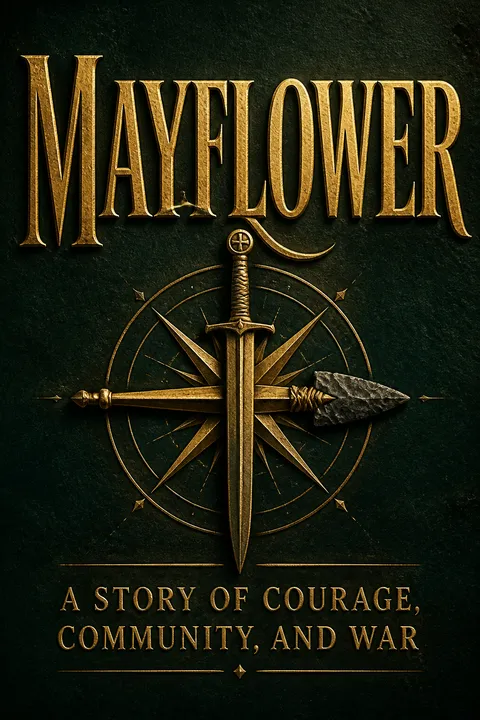


Key Takeaways
Read the Mayflower story as a fifty-six-year bargain, not a national origin myth
A familiar beginning misleads. The Mayflower carried 102 settlers toward a new life in 1620. Fifty-six years later, the Seaflower left New England carrying 180 Native people condemned to slavery. Its papers were approved by Josiah Winslow, son of Mayflower passengers. Between those voyages came more than half a century of uneasy cooperation, followed by King Philip's War, which killed thousands and transformed the region.
The story is about change. The Pilgrims' arrival was not a simple beginning for the United States. Their survival depended on Native help, and their descendants' prosperity increasingly depended on acquiring Native land. Philbrick presents neither peace nor war as inevitable. Choices by leaders, shifting interests, and changing generations shaped the outcome.
What's striking is how two ships turn a familiar national origin story into a history of obligations and consequences. Origin myths often select a clean starting point, then treat what follows as destiny. This book instead makes the ending part of the beginning: the settlers' pursuit of religious independence sits beside the later enslavement of Native people. That reframing is valuable, but the evidence is uneven. Most surviving written accounts come from English observers, while Native perspectives often reach the reader through colonial records or oral traditions recorded later. The narrative's complexity is therefore an achievement, not proof that every voice is equally recoverable.
Survive by adapting locally, not by trusting faith or grit alone
Improvisation kept them alive. The Pilgrims arrived late in the year, short of provisions, and uncertain where they could legally settle. Their first explorations on Cape Cod included taking buried Native corn and removing objects from homes and graves. These acts hardly established trust, but the settlers were desperate and had little knowledge of local food or farming.
Institutions mattered too. When some passengers threatened to reject the group's authority, the settlers signed the Mayflower Compact, an agreement to govern themselves through civil laws and chosen officers. Later, Squanto showed them how to grow corn with fish fertilizer, beans, and squash. Their faith and endurance mattered, but so did a practical political agreement and the willingness to learn unfamiliar methods.
The settlement's survival resembles a problem in organizational design: shared purpose can motivate people, but it cannot replace coordination, usable knowledge, or material resources. The Compact offered a way to keep a mixed group from splintering before it reached shore. Native agricultural knowledge addressed a different problem, one no amount of courage could solve. The account also complicates the idea of adaptation as an uncomplicated virtue. The settlers learned from people whose property they had already taken, and necessity, rather than respect alone, drove some of that learning. Cooperation began inside a relationship marked by unequal power and early harm.
Treat alliances as practical bargains, not permanent bonds
Massasoit needed partners. A disease epidemic from 1616 to 1619 devastated Native communities across southern New England. The Pokanokets, Massasoit's people, lost much of their population and faced pressure from the more powerful Narragansetts. An alliance with the newly arrived English offered Massasoit a way to strengthen his position. The English, in turn, needed food, local knowledge, and protection.
The harvest gathering reflected that bargain. In 1621, Massasoit arrived at Plymouth with about a hundred people and five deer. The event later remembered as the First Thanksgiving was a shared harvest celebration, not a staged tableau of equal partners. Its warmth was real, but it rested on mutual need. The alliance helped both leaders, while other Native communities remained wary or hostile.
The alliance is a useful corrective to stories that cast Native assistance as either pure generosity or simple submission. Massasoit acted strategically in a region where disease had altered the balance among Native nations. In political science, alliances are often understood as responses to specific threats, not as guarantees of lasting affection. That lens clarifies why cooperation could be sincere and self-interested at once. It also keeps Native leaders visible as political actors. The limitation is that the surviving English accounts describe the agreement in their own terms, so the precise balance of promises and expectations remains harder to reconstruct than the English side of the exchange.
Punitive displays can turn local fear into regionwide war
The Wessagussett raid changed the atmosphere. In 1623, Plymouth captain Miles Standish attacked Native leaders at the struggling English settlement of Wessagussett. The Pilgrims believed they faced a plot, but the attack killed several men, including the warriors Wituwamat and Pecksuot. Standish returned to Plymouth with Wituwamat's head, which was displayed above the fort.
The consequences spread beyond the targets. Native communities fled their homes, trade collapsed, and many people missed the planting season. Some died from illness and hunger while displaced. The raid strengthened Massasoit's position against rival Native leaders, but it also made English force more frightening and less predictable. Pastor John Robinson condemned the attack, warning that violence begun in fear could be difficult to stop.
This is a classic security dilemma: one side describes its violence as prevention, while the other experiences it as evidence that peaceful coexistence is unsafe. The raid may have answered a genuine fear, but its public brutality altered the incentives facing people who had not participated in any plot. In conflict studies, punishment can deter some adversaries while recruiting others through grievance and fear. The book also resists an easy verdict by showing that the English settlement at Wessagussett had behaved irresponsibly and was in real danger. The crucial question is not whether leaders faced risk, but whether their response reduced danger or widened it.
See cultural exchange clearly, without mistaking contact for equality
Daily life crossed cultural boundaries. Native people adopted English metal tools, blankets, and firearms, while English settlers relied on corn and learned Native farming practices. Wampum, shell beads used by Native communities, became an important medium of exchange for English traders as well. In Plymouth Colony, English and Native neighbors traded, worked, and sometimes shared language; there was no simple line separating settlement from wilderness.
But exchange did not mean equal power. The English increasingly treated land as a commodity transferred by deed, while Native relationships to land also involved community, use, and political authority. Colonial officials controlled who could purchase Native land, limiting sellers' access to competing buyers. The two peoples influenced one another, but their legal and economic power was not balanced.
The account anticipates a central insight of material culture studies: objects do not travel unchanged. A musket, a shell bead, or a farming tool can acquire new meanings as people incorporate it into different economic and social systems. This makes cultural exchange more than a story of one group copying another. Yet the same circulation of goods can conceal a widening disparity in control. The English benefited from Native crops and trade while imposing property rules that strengthened colonial claims. Contact, then, is not a synonym for equality. A careful account must track who can set the terms of exchange and who bears the cost when those terms change.
Track who controls land when old alliances outlive their original bargains
The generations faced different pressures. Massasoit's alliance had helped the Pilgrims survive, but their children inherited a growing English population, shrinking supplies of fur, and competition for land. Only about 20 percent of New England land was well suited to farming, and English families were expanding rapidly. Livestock also damaged Native cornfields, making land disputes part of everyday life.
A personal rupture exposed the new reality. In 1662, Plymouth officials sent Josiah Winslow to bring Massasoit's son Alexander to court over land sales. Winslow confronted him at a hunting camp with armed men and a pistol. Alexander became ill during the journey and died days later. His brother Philip became sachem, inheriting both the old alliance and a mounting belief that English authority was encroaching on Native autonomy.
This transition shows how demographic growth and property institutions can turn yesterday's partnership into today's contest. Land pressure was not abstract: livestock ate crops, new families wanted farms, and colonial courts regulated who could sell territory. In political ecology, environmental resources and social rules are analyzed together because neither alone explains conflict. The book's emphasis on Winslow and Alexander makes the shift vivid, though it also risks making a structural collision seem like the product of a few personalities. The deeper pattern is that one side's expanding settlement depended on a transfer of land that the other side could not indefinitely accept.
Interrupt escalation before fear makes a chosen war feel inevitable
The trigger was a disputed prosecution. In 1675, Native interpreter John Sassamon warned Plymouth governor Josiah Winslow that Philip was preparing for war. Soon after, Sassamon was found dead beneath the ice. Plymouth tried three Native men for his murder, relying on a witness whose credibility was questioned. One accused man's son changed his account after a failed hanging. The executions intensified Philip's fear that the English would decide Native justice and leadership for themselves.
The conflict was not fated. King Philip's War lasted fourteen months. Roughly 5,000 people died in a New England population of about 70,000, and more than three quarters of the deaths were Native. Hundreds more Native people were enslaved. Leaders on both sides faced real threats, but delay, suspicion, land pressure, and coercive decisions converted a possible crisis into devastating war.
The book's strongest causal claim is not that one trial alone created the war, but that a contested legal process became a decisive signal in an already brittle relationship. Institutions can de-escalate conflict when both parties regard them as legitimate; when one side sees the court as an instrument of control, formal procedure may deepen rather than settle the dispute. The trial's flaws matter, but so do years of land loss and political pressure. A useful caution is that saying the war was avoidable should not imply it was easy to avoid. Leaders were acting amid uncertainty, yet their choices still shaped which risks became reality.
Learn from local expertise without confusing military success with justice
Benjamin Church learned a different way to fight. A carpenter living among the Sakonnets, Church recruited Native allies and adopted their advice: spread out, move quietly, track opponents, and avoid retracing a route through a swamp. His small company captured hundreds of Native people, often persuading prisoners to join rather than sending them into slavery. Near the end of the war, he arranged for a captive named Conscience to live with an English acquaintance instead of returning him to Plymouth custody.
The record remains morally mixed. Church helped capture Philip and later secured the surrender of Annawon, but he also operated within a colonial system that rewarded the capture and sale of prisoners. The war left Native communities devastated, and Church's acts of mercy could not undo that destruction.
Church's military effectiveness came partly from treating Native knowledge as expertise rather than folklore. That is a powerful lesson in cross-cultural learning: people closest to a landscape often understand its constraints better than outsiders with formal authority. But tactical respect is not the same as political equality. Church's willingness to spare or recruit some captives coexisted with participation in a system that profited from prisoners. His example is best read as a genuine alternative to indiscriminate vengeance, not as proof that a fair relationship had been achieved. The small rescue of Conscience matters precisely because it occurred within a much larger machinery of coercion.
Analysis
Mayflower is most powerful when it refuses the clean split between a heroic founding and a later betrayal. Philbrick's narrative joins the Mayflower and the Seaflower, turning a story usually compressed into a single landing into a long history of interdependence, competition, and rupture. The Pilgrims are neither uncomplicated democrats nor merely predatory colonizers. Their civil compact helped a divided group govern itself, but their survival also depended on Native agriculture, diplomacy, and local knowledge. Massasoit's alliance was an exercise of Native strategy, not a footnote to English achievement.
The book's central argument is that peace was made through accommodation and weakened when each generation reinterpreted the relationship. That claim is persuasive because the narrative supplies concrete mechanisms: the epidemic that altered Native power, the land market and colonial courts, population growth, livestock damage, and the Sassamon trial. These pressures explain why the 1675 conflict was possible without making it inevitable. The distinction is important. Structural pressures create a range of dangerous choices, but decisions by Winslow, Philip, and other leaders determine which path is taken.
The narrative's biographical focus also has limits. Bradford, Massasoit, Philip, and Church make a vast regional history legible, yet their prominence can concentrate attention on a few leaders while obscuring the collective decisions of villages, families, and less visible Native communities. The source problem is substantial: English records dominate, while many Native accounts were preserved orally or filtered through colonial observers. Philbrick acknowledges this imbalance, and his use of Native political agency helps counter it, though it cannot erase it.
The book also reveals a tension in American political memory. The Mayflower Compact can be treated as an early experiment in self-government, but self-government for settlers coexisted with the taking of Native land and, eventually, Native enslavement. The lasting lesson is not that compromise always succeeds. It is that a community's security depends on recognizing others as political actors, and that a founding ideal becomes dangerous when its advocates forget who helped sustain it and who pays for its expansion.
Review Summary
People Also Read



Glossary
Mayflower Compact
Agreement for civil self-governmentA short agreement signed by adult male passengers aboard the Mayflower in November 1620. It bound the settlers to form a civil government, make laws for the colony's common good, and obey those laws. It did not establish universal democracy, but it gave a divided group a shared basis for governing itself far from England.
King Philip's War
New England's 1675-1676 warA fourteen-month conflict between English colonies and Native nations in New England, named for the Pokanoket leader Philip, also known as Metacom. Land loss, political coercion, and a disputed murder trial helped trigger the fighting. About 5,000 people died, most of them Native, and many Native captives were enslaved or displaced.
Separatists
Puritans outside the established churchA radical branch of English Puritanism that rejected the Church of England as a true church and formed independent congregations. Members believed worship should follow the Bible without church traditions they considered human distortions. Because their meetings and beliefs were illegal in England, the Scrooby congregation fled first to Holland and later sent some members to America.
Pokanokets
Massasoit's Native peopleThe Native people led by Massasoit and later by his sons Alexander and Philip. Their homeland centered on the region around Narragansett Bay and Mount Hope. Disease, political rivalry, English settlement, and land loss reshaped their community during the seventeenth century. The book notes that the name Wampanoag, often used today for their descendants, was not necessarily their original self-designation.
sachem
Native political leaderA leader of a Native community or territory in southern New England. A sachem's authority depended on relationships with followers and neighboring leaders, not simply on formal title. Sachems negotiated alliances, distributed access to land, and could gain or lose influence as population, warfare, trade, and colonial pressure changed the political landscape.
Praying Indians
Native Christian communitiesNative people who adopted Christianity and often lived in communities associated with English missionary John Eliot. They could serve as interpreters, teachers, guides, and military allies. During King Philip's War, English distrust led to the confinement of many Praying Indians, despite their loyalty to the colonies. Their position demonstrates that religious conversion did not erase Native identity or political vulnerability.
wampum
Shell beads used in exchangeBeads made from white periwinkle shells or the purple portions of quahog shells, often strung into belts. Native communities used wampum in trade and diplomacy; English colonists also adopted it as a medium of exchange. Purple beads were generally valued more highly than white ones, and the quality of the beads affected whether they were accepted in transactions.
powwows
Native spiritual specialistsReligious specialists among Native communities in southern New England. The book describes powwows as people who engaged with spiritual forces to heal illness, curse enemies, or seek knowledge of the future. Their practices were physical and communal, and English observers often interpreted them through Christian assumptions that cast Native spiritual life as demonic.
pniese
Respected Native warriorA Native warrior of unusual standing, strength, and stamina who could serve a sachem and help collect tribute. The book describes a belief that a pniese could not be killed in battle. Hobbamock, who allied with Plymouth and became close to Miles Standish, is presented as one such warrior.
About the Author
Other books by Nathaniel Philbrick



Download PDF
Download EPUB
.epub digital book format is ideal for reading ebooks on phones, tablets, and e-readers.








