

Key Takeaways
The Hudson duel exposed how political honor could make disagreement fatal.
A quarrel became political theater. On July 11, 1804, Vice President Aaron Burr and Alexander Hamilton met for a pistol duel after years of rivalry. The immediate dispute began with Burr demanding an explanation for reports that Hamilton had disparaged him. Hamilton believed he could not honestly withdraw his criticisms, and feared that refusing the challenge would destroy his standing as a public figure.
The shots remain uncertain. Ellis argues that Hamilton probably fired first, deliberately missing Burr, while Burr fired the shot that mortally wounded Hamilton. Conflicting eyewitness accounts make that reconstruction plausible, not certain. Hamilton died the next day; Burr escaped injury but suffered political ruin. Their encounter stands out because the generation usually kept its fierce conflicts in political argument rather than violence.
The duel shows that political order depends not only on laws but on informal norms and people willing to enforce them. Here, a code of honor meant to regulate violence instead made refusing violence seem dishonorable. The uncertainty over who fired first also matters: witnesses had reputations to protect, so the historical record itself became part of the conflict. Ellis's reconstruction is persuasive as an interpretation, but its limits are a useful reminder that a compelling explanation is not the same as conclusive evidence.
Treat the American founding as a fragile experiment, not an inevitable birth.
The outcome was unknowable. The thirteen colonies had little history of acting as one nation, and the British military was formidable enough that a more decisive early campaign might have crushed the independence movement. The new republic also attempted something without a durable precedent: representative government across a vast territory. Its founders could see the continent's promise, but they could not know that their institutions would survive long enough to realize it.
Decisions shaped the odds. The United States emerged through improvised responses to military and political crises, not through a smooth march toward a destined outcome. The Constitution, the first government under it, and the precedents created in the 1790s all depended on choices whose consequences were uncertain at the time. Looking backward makes success seem natural; Ellis asks readers to recover how precarious it felt to those making it.
This is a historical corrective to outcome bias, the tendency to judge a decision as sensible because its result turned out well. Path dependence adds another useful lens: once early choices establish institutions, they make some future routes easier and others harder. That helps explain why the founders' improvisations had consequences beyond their intentions. The caution is that contingency should not become a story of great men alone. Military fortunes and political decisions mattered, but so did the people whose labor and lives were shaped by the republic's expansion.
The United States was founded on an argument its Constitution never settled.
Two founding moments collided. In 1776, independence was justified through resistance to concentrated power. In 1787 and 1788, the Constitution created a national government strong enough to tax, regulate, and enforce laws. Ellis presents these as distinct founding moments: one established independence, the other tried to make a functioning nation from separate states. The Constitution did not erase the tension between liberty and national authority. It gave that tension a framework in which to continue.
The disagreement had real stakes. Hamilton saw national power and coordinated economic policy as necessary to build a viable country. Jefferson and Madison feared that centralized authority could reproduce the distant coercion the Revolution had rejected. Both drew on revolutionary principles. Their conflict was not simply about constitutional technicalities; it concerned what freedom meant, who held sovereignty, and how much power a republic needed to endure.
The Constitution's durability partly comes from its capacity to hold opposing principles together without pretending they are identical. In institutional design, ambiguity can create room for coalition and adaptation, but it can also defer disputes whose costs fall unevenly. That distinction is crucial here. The founders' unresolved argument fostered political flexibility, yet some compromises protected powerful interests rather than merely enabling fair debate. The framework deserves credit for containing conflict, not a blank check for every settlement made under its cover.
A dinner bargain bought the republic time by trading debt relief for a capital.
A legislative deadlock threatened trust. In 1790, Alexander Hamilton's plan to have the federal government assume state debts faced opposition from James Madison, especially because many southern states had already paid much of what they owed. At the same time, Congress was deadlocked over where to locate the permanent capital. Thomas Jefferson hosted a meeting with Hamilton and Madison that became associated with a bargain linking support for assumption to a Potomac capital.
The deal was more than one dinner. Earlier negotiations had already aligned Pennsylvania and Virginia around a temporary Philadelphia location and the Potomac as the permanent site. The final arrangement also involved revised calculations of Virginia's debt. The agreement helped pass Hamilton's fiscal plan and secured the capital's location, but did not resolve the conflict over federal power. It bought a fragile government time to continue its argument.
The episode resembles a coalition bargain in which each side accepts a policy it dislikes to secure something more important. Such trades can lower the temperature of a crisis, but they also obscure who pays and who benefits. The Potomac capital offered symbolic reassurance to those wary of centralized power, while assumption strengthened national financial capacity. Ellis's account makes the bargain's practical ingenuity visible without mistaking political survival for consensus. Its durability depended on managing distrust, not eliminating the reasons for it.
In 1790, Congress shut the federal door on emancipation to protect union.
A petition forced the issue into view. Quaker groups asked Congress to end the slave trade, while the Pennsylvania Abolition Society, backed by Benjamin Franklin, urged action against slavery itself. Southern representatives argued that the Constitution and the political bargains behind it barred federal interference. In the first census, the enslaved population approached 700,000, with more than 90 percent living in the South. The numbers made the problem both stark and politically difficult to address.
Madison helped close the debate. He considered slavery an evil but feared that a direct federal campaign against it could break the union. The House ultimately declared that Congress lacked authority to interfere with emancipation or the treatment of enslaved people within states. This went beyond postponing action until the slave trade could be restricted in 1808. It established a barrier to federal emancipation that endured, while the enslaved population continued to grow.
The episode captures a central moral cost of state-building: leaders treated union as a precondition for reform, then used its fragility to justify excluding reform from national politics. That logic can be understandable as crisis management and still be profoundly unjust. The silence was not neutral; it preserved a system whose burdens were borne by people excluded from the political bargain. Ellis shows that alternatives were debated, but the evidence cannot establish whether an early emancipation plan could have succeeded or prevented later conflict.
Washington made presidential power republican by proving it could be surrendered.
A voluntary exit established authority. George Washington had become the central symbol of the new nation, and many people doubted that the republic could function without him. His decision to leave after two terms helped establish that the presidency was an office, not a personal possession. His earlier resignation as commander in chief had made a similar point: leadership could include refusing power, not merely exercising it.
His farewell combined unity with restraint. Washington warned against sectional and party divisions at home and urged distance from Europe's wars. The address was collaborative: James Madison had drafted an earlier version, Alexander Hamilton shaped much of the final prose, and Washington revised it closely. Its argument reflected his experience that the nation needed both a strong federal government and time to develop before risking major foreign conflict.
Washington's departure functions as a costly signal: surrendering power made his claim to serve republican government more credible than another declaration could have. The precedent strengthened the office by demonstrating that it could survive its most celebrated occupant. At the same time, the farewell's call for unity could be used to criticize legitimate opposition, especially in a political culture still unsure how parties should work. Its wisdom depends on distinguishing destructive factionalism from the disagreement a republic needs.
Let parties contain disagreement instead of treating opposition as treason.
Parties formed before their rules did. Federalists and Republicans emerged from genuine disputes about government, finance, and foreign policy, but many leaders still treated party loyalty as a mark of corruption. Adams hoped to bring Jefferson into his administration and preserve their old partnership. Jefferson declined, choosing to lead the opposition. Their personal history made the break painful, but it also showed that private affection could not erase political commitments.
The fight became dangerous. During Adams's presidency, tensions over France escalated into the XYZ Affair, an effort by French agents to extract a bribe from American diplomats. The Alien and Sedition Acts then targeted immigrants and political criticism. Republicans called the measures a betrayal of liberty; Federalists saw their opponents as threats to the government. The parties eventually gave the founding argument an ongoing political form, but the conflict was never harmless.
A legitimate opposition is a safety mechanism: it lets citizens contest policy without having to treat every election as a test of loyalty to the nation. The founders lacked settled norms for that role, so partisan conflict often became a dispute over who counted as a true revolutionary. Adams's attempt at bipartisan government reflected trust in personal relationships, while Jefferson's refusal reflected the rising importance of organized opposition. Neither personal virtue nor party structure alone guarantees restraint; institutions need norms that protect dissent.
Adams and Jefferson repaired their friendship by arguing over the Revolution's meaning.
Their reconciliation began with old hurt. Adams and Jefferson had worked together for independence, then became rivals as Federalists and Republicans fought over the new government. Jefferson's political tactics during the 1800 election convinced Adams that a trusted friend had helped damage his reputation. They did not speak for years. In 1812, Adams finally wrote to Jefferson, beginning a correspondence that lasted until their deaths in 1826.
The letters preserved disagreement. They debated political elites, the French Revolution, and slavery, among other subjects. Jefferson often described the Revolution as a liberation whose principles could spread; Adams emphasized uncertainty, compromise, and the need for institutions. Their friendship recovered without producing a single shared account of the past. Both men died on July 4, 1826, the fiftieth anniversary of independence, a coincidence that gave their final act an almost scripted shape.
The correspondence demonstrates a form of reconciliation that does not require agreement. Trust returned through sustained exchange, including frank discussion of political injury and different interpretations of history. That makes the letters valuable not just as a portrait of two famous men, but as evidence that disagreement can be part of a relationship rather than proof that it has failed. Their exchange also has limits: the founders' own voices dominate the record, while people most affected by slavery had little power to shape this retrospective debate.
Read the founders' marble reputations as performances, not transparent portraits.
The founders knew they had an audience. They preserved letters, described their decisions, and cultivated images of what public service should look like. Washington's dignity, Jefferson's polished prose, and Adams's irreverent candor each shaped how later readers understood the era. Ellis uses episodes and personal relationships to make these leaders human, while also showing how they sometimes acted with an eye toward posterity.
History repeats their disagreements. Early accounts of the Revolution already divided over whether its central promise was individual liberty or national unity. Later historians often reproduced those same opposing interpretations. Adams resisted tidy heroic stories because his experience had been improvised and uncertain; Jefferson's more coherent vision proved easier to turn into a national narrative. The book asks readers to treat both the events and the stories told about them as contested.
Historical reputation is part of political power: leaders who leave more letters, portraits, and explanations can influence how later generations interpret their choices. Ellis's focus on elite relationships reveals how decisions were made, but the richness of those archives can make the founders appear more representative than they were. Their self-fashioning should neither disqualify their accounts nor be mistaken for neutral testimony. Reading them critically means asking what each person wanted posterity to see, and whose experience remains outside the frame.
Analysis
Ellis's central achievement is to restore uncertainty to an era whose outcome is often mistaken for destiny. The republic did not begin with settled agreement about the meaning of liberty, national authority, or popular sovereignty. Its early institutions were experiments built by leaders who feared that the union might dissolve, and whose political choices could make that fear more or less likely. The book's episodic design suits this argument: the dinner bargain, the slavery debate, the Farewell Address, and the Adams-Jefferson correspondence show turning points through relationships rather than through a simple march of laws and dates.
That emphasis on personal connection is analytically powerful. Before parties and institutions acquired durable authority, trust among a small group could make bargains possible. Yet the same dependence on personal loyalty could deepen faction, as the Adams-Jefferson rupture demonstrates. The emergence of parties offered a way to organize conflict, but leaders initially lacked a shared idea of legitimate opposition. Their accusations of treason made disagreement harder to contain precisely when the republic needed it most. The gravest contradiction is slavery. The founders' language of liberty coexisted with an enormous enslaved population, and the choice to exclude emancipation from federal politics protected the union at the expense of the enslaved. Ellis treats the decision as historically constrained without claiming that its moral consequences disappear. The counterfactual remains unknowable: an emancipation plan might have failed or shattered the union, but silence also helped entrench the institution and narrowed future choices.
The book's portraits of Washington, Hamilton, Madison, Jefferson, Adams, Franklin, and Burr resist both hagiography and simple condemnation. Their talents mattered, but so did ambition, insecurity, regional interest, and self-presentation. One limitation of this focus is that political leadership remains overwhelmingly white and male, even as the consequences of their decisions extended far beyond that circle. The resulting history is most convincing when success is measured not as a flawless founding, but as a precarious achievement whose unresolved conflicts became part of the republic itself.
Review Summary
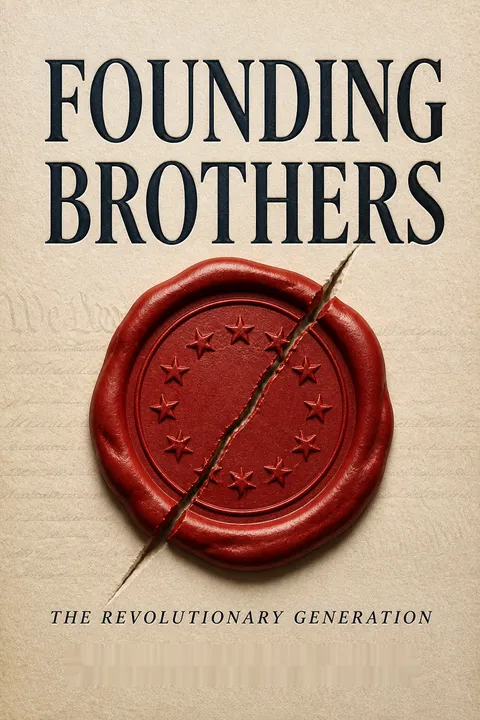
Founding Brothers: The Revolutionary Generation received largely positive reviews for its insightful analysis of key episodes in early American history. Readers praised Ellis's writing style, depth of research, and ability to humanize the Founding Fathers. Many found the book engaging and educational, appreciating the focus on relationships and conflicts among the revolutionary leaders. Some criticized the verbose language and perceived bias against certain figures. Overall, reviewers considered it a valuable contribution to understanding the complexities of America's founding era, though opinions varied on its accessibility to general readers.
People Also Read

Glossary
the second founding moment
Constitutional nation-buildingEllis's description of the Constitution's creation and ratification in 1787 and 1788. The first founding moment, in 1776, declared independence; the second created a national government with enough authority to hold the states together. The phrase highlights both the Constitution's practical achievement and its tension with revolutionary distrust of centralized power.
Compromise of 1790
A fiscal and capital bargainThe political accommodation associated with a meeting hosted by Thomas Jefferson, where support for Hamilton's federal assumption of state debts was linked to locating the permanent capital on the Potomac. Ellis emphasizes that earlier negotiations and recalculations of Virginia's debt were also crucial. The bargain helped pass key measures but did not reconcile competing visions of federal power.
code duello
Rules governing duelsThe conventions that regulated formal dueling between gentlemen, including procedures for challenges, seconds, weapons, and the exchange of shots. Although dueling was illegal in many places, participants used the code to present it as a matter of honor and to avoid straightforward legal accountability. The Burr-Hamilton encounter shows how these rules could escalate rather than resolve conflict.
the Virginia straddle
Virginia's divided slavery positionEllis's label for Virginia's simultaneous criticism of slavery and defense of state control over it. Virginia's leaders could invoke revolutionary principles against the slave trade while opposing federal authority to emancipate enslaved people already held in the state. The position allowed Virginia to sound antislavery while protecting its economic and political interests.
enlightened obfuscation
Madison's strategic ambiguityEllis's phrase for James Madison's indirect way of discussing slavery. Madison condemned slavery as a moral and political evil, yet argued that the moment was wrong for federal action and used carefully qualified language to avoid a direct confrontation. His political skill helped move the issue out of Congress, but also helped foreclose federal emancipation.
strategy of enlightened procrastination
Delay until strength improvesEllis's description of Washington's preference to avoid a major war while the young United States built population, resources, and military capacity. Drawing on his experience preserving the Continental Army, Washington treated time as a strategic advantage. Neutrality toward European conflicts was meant to protect the republic during its vulnerable early development.
XYZ Affair
A French diplomatic crisisThe name given to the 1797 to 1798 dispute in which French agents, identified in published dispatches by the letters X, Y, and Z, demanded a bribe and other payments before negotiating with American diplomats. The disclosures stirred public anger and pressure for war. President John Adams resisted that pressure and sent another delegation to seek peace.
FAQ
What is Founding Brothers: The Revolutionary Generation by Joseph J. Ellis about?
- Explores Revolutionary Leaders: The book examines the lives, relationships, and political dynamics of key figures in the American Revolution and early republic, such as Washington, Adams, Jefferson, Hamilton, Madison, Burr, and Franklin.
- Focus on Interactions and Conflicts: It highlights how their personal and political interactions—collaborations, rivalries, and compromises—shaped the new nation.
- Themes of Nation-Building: Ellis delves into the tension between revolutionary ideals and the practical challenges of forming a stable government.
- Narrative Style: The book uses historical correspondence and vivid storytelling to humanize the founders and bring the era to life.
Why should I read Founding Brothers: The Revolutionary Generation by Joseph J. Ellis?
- Humanizes the Founders: The book reveals the personal side of the founding fathers, showing their friendships, rivalries, and emotional struggles.
- Insightful Historical Analysis: Ellis combines rigorous scholarship with engaging narrative, making complex events accessible and compelling.
- Understanding American Political Origins: It provides crucial context for the ideological debates and compromises that shaped the U.S. Constitution and political culture.
- Fresh Perspective: The book offers new insights into familiar historical figures and events, challenging traditional heroic narratives.
What are the key takeaways from Founding Brothers: The Revolutionary Generation by Joseph J. Ellis?
- Fragility of the Early Republic: The success of the American Revolution and the new government was not inevitable but depended on chance, compromise, and the actions of a few leaders.
- Personal Relationships Shaped Politics: Friendships, rivalries, and personal trust among the founders had profound political consequences.
- Unresolved Issue of Slavery: The revolutionary generation consciously avoided confronting slavery, deferring the crisis and embedding it into the nation’s future conflicts.
- Birth of Political Parties: The emergence of Federalists and Republicans reflected deep ideological divisions that shaped the early years of the republic.
How does Joseph J. Ellis portray the personalities of the Founding Brothers in Founding Brothers: The Revolutionary Generation?
- Complex and Humanized Figures: Ellis presents the founders as passionate, fallible, and often contradictory individuals rather than mythic heroes.
- Diversity of Temperaments: The book highlights the dynamic created by their differing personalities and ideologies, which helped sustain the republic through mutual checks and balances.
- Historical Self-Awareness: Many founders were conscious of their place in history, often writing letters with future generations in mind.
- Interplay of Rivalries and Friendships: Personal bonds both fueled conflict and enabled reconciliation, shaping the nation’s political landscape.
What is the significance of the Burr-Hamilton duel in Founding Brothers: The Revolutionary Generation by Joseph J. Ellis?
- Symbol of Political Conflict: The duel is the only instance where political differences among the founders ended in violence and death.
- Personal and Political Rivalry: Burr and Hamilton’s animosity combined personal insults with deep political disagreements, culminating in the fatal encounter.
- Reflection of Early Republic Values: The event underscores the importance of honor and reputation in the early republic, where personal character was seen as vital to political leadership.
How does Founding Brothers: The Revolutionary Generation by Joseph J. Ellis explain the Compromise of 1790?
- Political Bargain: The compromise resolved a congressional deadlock by agreeing to federal assumption of state debts and the location of the national capital on the Potomac River.
- Brokered by Jefferson: Thomas Jefferson hosted a private dinner where Hamilton and Madison negotiated the deal, exemplifying the importance of personal diplomacy.
- Exposed Sectional Tensions: The agreement revealed deep divisions between northern commercial and southern agrarian interests, foreshadowing future conflicts over federal power.
How does Founding Brothers: The Revolutionary Generation by Joseph J. Ellis address the issue of slavery among the founders?
- Slavery as a Taboo Subject: The revolutionary generation largely avoided confronting slavery in national politics to preserve the fragile union.
- 1790 Congressional Debate: Quaker petitions to end the slave trade sparked heated debate, exposing sectional divisions and constitutional limits on federal power.
- Deferred Crisis: Leaders like Madison advocated moving the issue off the national agenda, recognizing its potential to fracture the union and leaving it unresolved for future generations.
What is the significance of George Washington’s Farewell Address in Founding Brothers: The Revolutionary Generation by Joseph J. Ellis?
- Retirement as a Republican Act: Washington’s voluntary departure set a precedent for peaceful transfer of power and commitment to republican principles.
- Themes of Unity and Neutrality: The address warned against excessive partisanship and foreign entanglements, urging Americans to maintain national unity.
- Collaborative Authorship: The address was shaped by input from Madison and Hamilton, reflecting the collective effort of the founding generation.
- Strategic Silence on Slavery: Washington avoided the topic of slavery, highlighting the era’s political sensitivities.
How does Founding Brothers: The Revolutionary Generation by Joseph J. Ellis explain the emergence of political parties in the early republic?
- Ideological Divisions: The split between Federalists and Republicans was rooted in differing visions of government power, foreign alliances, and the meaning of the Revolution.
- Personal Rivalries: Conflicts, especially between Hamilton and Jefferson, fueled the formation of organized political opposition.
- Impact on Governance: The rise of parties led to partisan press attacks, polarization, and debates over loyalty, shaping the young nation’s political culture.
What role does the Adams-Jefferson relationship play in Founding Brothers: The Revolutionary Generation by Joseph J. Ellis?
- Symbol of Collaboration and Conflict: Their partnership embodied both the unity of the Revolution and the deep ideological divides that followed.
- Political and Personal Dynamics: Adams was fiery and confrontational, Jefferson more reserved and idealistic; their relationship evolved from friendship to rivalry and eventual reconciliation.
- Impact on Early Politics: Their rivalry influenced the formation of political parties and presidential elections, shaping the nation’s early political landscape.
How does Joseph J. Ellis depict the Adams presidency in Founding Brothers: The Revolutionary Generation?
- Inherited Challenges: Adams faced a nation divided by partisan conflict and an undeclared naval war with France, making his presidency especially difficult.
- Bipartisan Efforts and Isolation: He attempted to bridge divides by including Republicans in his administration, but was thwarted by party opposition and personal rivalries.
- Controversial Decisions: His signing of the Alien and Sedition Acts damaged his reputation, while his pursuit of peace with France left him politically isolated and led to his defeat in 1800.
What is the significance of the Adams-Jefferson correspondence in Founding Brothers: The Revolutionary Generation by Joseph J. Ellis?
- Reconciliation and Reflection: Their late-life letters represent a profound reconciliation, allowing them to revisit and debate the meaning of the Revolution and their legacies.
- Intellectual Dialogue: The correspondence covers themes like aristocracy, equality, the French Revolution, and slavery, revealing enduring differences and mutual respect.
- Historical Testament: Ellis presents the letters as a capstone to the revolutionary generation’s story, symbolizing the personal and ideological complexities that shaped the nation’s founding.
About the Author
Other books by Joseph J. Ellis
Download PDF
Download EPUB
.epub digital book format is ideal for reading ebooks on phones, tablets, and e-readers.








