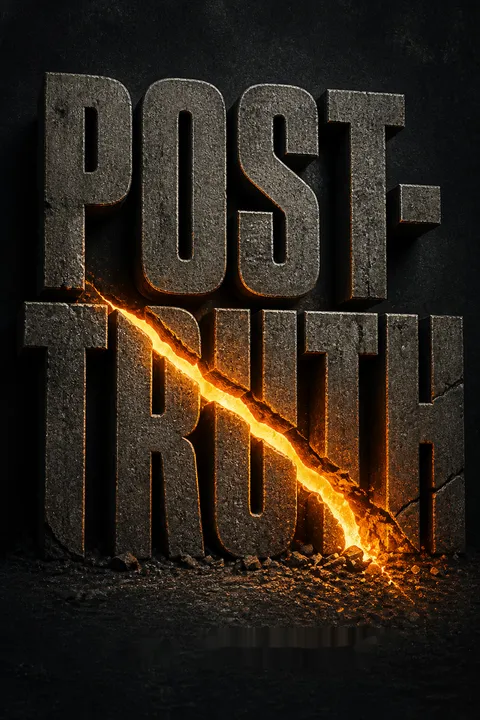


Key Takeaways
Post-truth begins when political loyalty outranks evidence about reality.
More than a false claim. Post-truth describes a climate where feelings and prior beliefs shape public judgments more than objective evidence. It is not simply being wrong. A falsehood can be an honest mistake; willful ignorance means repeating a claim without checking it; lying means knowingly trying to deceive. The book also distinguishes indifference to truth, or bullshit, from deliberate deception. These behaviors differ, but each can weaken public trust in evidence.
Beliefs set the rules. During a debate about crime statistics, Newt Gingrich conceded that FBI data showed crime falling, then argued that voters' feelings mattered more politically. The deeper problem, McIntyre argues, is selective standards: rejecting unwelcome evidence while accepting friendly claims without scrutiny. The result is not merely a mistaken opinion, but a public argument in which political aims dictate which facts count.
What's striking is the distinction between a wrong answer and a corrupted standard for judging answers. That distinction helps explain why fact-checking alone can feel inadequate: a correction assumes both sides accept evidence as the referee. Political psychology and the philosophy of science both rely on shared procedures for settling disputes, even when participants disagree about outcomes. The account also benefits from treating post-truth as a spectrum of conduct, not a diagnosis of every person who repeats a false claim. That care matters because misinformation, carelessness, and intentional manipulation demand different responses.
When scientific doubt spreads, investigate who benefits from keeping it alive.
Doubt can be manufactured. In 1953, tobacco executives responded to research linking cigarette tar with cancer in mice by creating a committee to sponsor further research and emphasize that no conclusive proof existed. Its newspaper advertisement reached 43 million people. The aim was not to resolve the science, but to keep the public uncertain long enough to protect sales. In 1998, tobacco companies agreed to a settlement reported at $200 billion, after decades of denying what internal documents showed they already knew.
A reusable playbook. The same approach appeared in disputes over climate change: fund friendly experts, present political disagreement as scientific disagreement, and demand equal media attention. The book cites a review in which only 0.17 percent of nearly 14,000 climate papers dissented from the consensus, despite widespread public confusion about whether scientists agreed.
This history shows how an information problem can begin as an incentive problem. When a company profits from delay, uncertainty itself becomes a valuable product, and public relations can imitate scientific debate without meeting science's evidentiary standards. Similar patterns appear in other regulated industries, where selective studies and strategic ambiguity can slow policy action. Still, financial support does not automatically invalidate a claim. The useful test is whether evidence is independently checkable, reproducible, and proportionate to the confidence being expressed, not simply whether a funder has an interest.
Test beliefs by trying to disprove them, especially when identity is involved.
The mind protects itself. Cognitive dissonance is the discomfort of holding conflicting beliefs or behaving in ways that clash with one's self-image. In Leon Festinger's experiment, people paid only a dollar to describe a dull task as enjoyable later rated it more positively than people paid twenty dollars. The small payment gave them less external reason to do the task, so changing their opinion helped make their behavior feel sensible.
Agreement can overpower sight. Solomon Asch found that 37 percent of participants went along with a group's plainly incorrect judgment about line lengths. Peter Wason gave students the sequence 2, 4, 6 and asked them to discover its rule. Only six of 29 found the rule without first making a wrong guess. Many tested examples that confirmed their hunch rather than ones that might refute it. This is confirmation bias: favoring evidence that supports what one already believes.
These experiments explain why intelligence alone does not immunize people against motivated reasoning. A belief can serve social belonging or self-respect, so counterevidence threatens more than a single conclusion. The practical value of the Wason task is its simple discipline: ask what observation would prove the current theory wrong. That habit is also central to good scientific inquiry and adversarial legal reasoning. The studies do not show that people always conform or resist correction; they reveal predictable pressures that become stronger when a belief is public, personal, or group-defining.
Journalistic fairness means weighing evidence, not dividing airtime equally.
Balance can mislead. In climate coverage, news outlets often gave a small group of skeptics exposure comparable to the much larger scientific consensus. The book cites a 2013 survey finding that 97 percent of peer-reviewed papers taking a position on climate change attributed warming primarily to human activity. Presenting the issue as an evenly split scientific debate made political opposition look like equivalent scientific evidence.
The cost reaches the public. The same pattern appeared in coverage of a discredited claim linking vaccines to autism. Years of debate gave weak research undue credibility. After the research was exposed as fraudulent, the book notes a measles outbreak involving 84 people across 14 states. The lesson is not to suppress genuine disputes. It is to distinguish uncertainty about policy choices from evidence about whether a factual claim is well supported.
This is a sharp correction to the idea that neutrality requires equal treatment of every assertion. In journalism, as in medicine, a claim's prominence should track the quality of its evidence, not the intensity of its advocates. At the same time, consensus is not a substitute for inquiry: minority views can reveal overlooked assumptions, and policy questions may remain open even when underlying facts are settled. Credible reporting makes those distinctions visible, explaining both the strength of evidence and the real uncertainties that remain.
Check the source before sharing the story your political side welcomes.
Feeds blur credibility. The book reports that 62 percent of US adults got news from social media, and 71 percent of those used Facebook. In a feed, a carefully reported article can sit beside a fabricated headline with little visual distinction. Personalization and social networks also let readers avoid sources that challenge their views, creating information silos that reinforce existing beliefs.
Fake news has intent. The term refers here to deliberately false material designed to look like news, not every inaccurate report. Some election-era publishers first chased advertising clicks, then concentrated on stories likely to manipulate political views. A recent college graduate invented a story about fraudulent votes found in an Ohio warehouse; it was shared with millions. Before sharing, check the publication, author, date, evidence, and independent coverage. A familiar-looking website is not proof of reliability.
The important shift is from asking whether a story feels plausible to asking how it was produced and verified. That resembles source criticism in history: evidence gains strength through provenance, corroboration, and context. Yet individual vigilance cannot carry the entire burden. Platforms shape visibility, publishers face financial pressure, and users rarely have time to investigate every post. Media literacy works best when supported by transparent platform policies and sustainable funding for reporting, rather than used to imply that audiences alone caused the information disorder.
Question authority without pretending every account is equally true.
Critique can be misused. Postmodernism encompasses varied approaches that question whether knowledge is wholly objective and examine how language and power shape claims. McIntyre argues that some versions of this skepticism were repurposed to attack scientific authority. In 1996, physicist Alan Sokal submitted a deliberately nonsensical article about physics to a cultural studies journal, which published it. The episode exposed how ideological language could substitute for checking technical claims.
The pathway is contested. The book describes Intelligent Design advocate Phillip Johnson explicitly borrowing postmodern arguments to challenge evolution's status as objective science. It does not follow that all postmodern thought caused post-truth or that criticism of institutions is illegitimate. The key distinction is between asking how knowledge is shaped by power and concluding that evidence cannot distinguish a better-supported account from a worse one.
The strongest version of this argument is not that scholarship created political disinformation, but that concepts travel beyond their original setting and can be stripped of safeguards. Critiques of scientific institutions can uncover bias, exclusion, or conflicts of interest. Science remains distinctive not because scientists are free of social influence, but because claims are tested against evidence that resists political preference. The historical link to denial campaigns is suggestive, though it is not a complete causal explanation. Political organization, money, media incentives, and motivated audiences also shape how skepticism is deployed.
Challenge false claims for the undecided audience, not the committed liar.
Silence leaves space. In the 2004 presidential campaign, John Kerry's team waited two weeks before responding to attacks on his military record by the Swift Boat Veterans for Truth. By then, the claims had reached a large audience and one veteran's recantation made little difference. McIntyre's point is that a correction need not persuade the person making a false claim to help listeners who have not yet made up their minds.
Make correction checkable. Experiments discussed in the book suggest that repeated exposure to disconfirming evidence can eventually move even motivated reasoners, though not on a predictable timetable. One study also found that graphical information sometimes corrected misperceptions more effectively than narrative alone. A practical source-checking routine asks who published a claim, whether independent sources confirm it, who wrote it, and whether the evidence supports the headline.
This approach treats correction as public record-keeping, not a contest to defeat an opponent in real time. Inoculation research offers a useful parallel: people can become more resistant to manipulation when they learn how misleading arguments are constructed and practice identifying them. Repetition can help, but tone and trust matter; humiliating someone may harden the very identity defense that correction is meant to loosen. The intended audience should therefore include quiet observers, who may need clear evidence and a credible source more than a dramatic takedown.
Test physical claims against consequences, not confidence or political comfort.
Reality has no party. South African President Thabo Mbeki rejected evidence-based AIDS treatment in favor of claims that the drugs were part of a Western plot. The book cites an estimate that this policy contributed to more than 300,000 deaths. On a different scale, the Challenger disaster showed the cost of treating confidence and schedules as stronger than engineering warnings. Investigators found concerns that cold could compromise the shuttle's O-rings, yet the launch proceeded on an unusually cold day.
Use evidence before damage. These cases differ in cause and circumstance, but each shows why empirical questions cannot be settled by preference. The book's practical conclusion is to support rigorous reporting, scrutinize one's own favored claims, and change beliefs when evidence warrants it. In fields such as medicine, engineering, and climate science, the material consequences of ignoring evidence can arrive long after the political argument has ended.
The Challenger example connects public truth-telling to safety engineering, where dissenting warnings need channels that can interrupt a decision before failure. This makes epistemic humility more than a personal virtue: institutions need procedures that give inconvenient evidence authority. The AIDS example likewise underscores that public claims can have human costs, though responsibility for a complex death toll should be described carefully rather than reduced to a single cause. Evidence does not guarantee perfect decisions, but ignoring it removes one of the best safeguards against preventable harm.
Analysis
McIntyre presents post-truth not as a sudden invention of social media or one politician, but as the convergence of older vulnerabilities and newer systems. Human beings defend identity, seek social approval, and notice confirming evidence more readily than disconfirming evidence. Commercial actors learned to exploit these tendencies by manufacturing doubt about science. Media organizations sometimes amplified that doubt in the name of balance, while digital platforms made it cheap to circulate content without editorial checks. The result is a weakened common process for deciding what deserves belief.
The book's strongest contribution is its connective history. The tobacco campaign provides a model for how uncertainty can be strategically cultivated; climate denial shows its transfer to a broader political fight; social media accelerates the circulation of both propaganda and profit-seeking fabrications. The distinction between false equivalence and responsible neutrality is especially useful. Equal airtime is not the same as equal evidentiary standing.
The account also benefits from acknowledging that cognitive bias is human, not exclusively partisan. Its warning about postmodern arguments is more debatable. The route from academic skepticism to political denial is plausible in the examples McIntyre supplies, particularly the Intelligent Design movement, but the intellectual lineage alone cannot explain the rise of post-truth. Political incentives, institutional distrust, media economics, and organized campaigns do much of the explanatory work. Likewise, experimental findings about correction and bias describe tendencies, not immutable laws.
The practical conclusion is demanding but not despairing: preserve shared standards for evidence, fund journalism capable of checking claims, correct falsehoods publicly, and apply skepticism to favored beliefs as rigorously as to opponents' claims. Truth is not secured by confidence, perfect neutrality, or one authoritative source. It depends on procedures that let claims be tested, challenged, and revised. That is the fragile civic infrastructure the book asks readers to defend.
Review Summary
Post-Truth by Lee McIntyre receives mixed reviews. Many praise it as an informative, accessible introduction to the concept of post-truth, particularly in relation to American politics and Trump's presidency. Readers appreciate McIntyre's exploration of cognitive biases, media influence, and postmodernism's role. However, some criticize the book for being US-centric, lacking rigorous academic standards, and offering insufficient solutions. Despite these critiques, most reviewers find the book thought-provoking and relevant to understanding contemporary challenges to truth and facts in society.
People Also Read


Glossary
Post-truth
Politics subordinating factsA condition in which emotion and personal belief influence public opinion more than objective evidence. In McIntyre's account, it is not merely a period after truth or a synonym for lying. It describes the political use of selective standards, where facts are accepted or rejected according to whether they support a preferred position.
Science denialism
Strategic rejection of scienceA set of tactics used to undermine well-supported scientific conclusions, often by attacking researchers' motives, exaggerating uncertainty, or presenting fringe disagreement as a balanced controversy. It differs from legitimate scientific scrutiny, which tests claims through evidence, peer review, and replication rather than dismissing findings because they conflict with an ideology or financial interest.
Cognitive dissonance
Discomfort between beliefsPsychological tension produced when beliefs, behavior, or attitudes conflict. People often reduce this discomfort by changing a belief, but the adjustment does not always restore accuracy. Festinger's studies, including an experiment involving a dull task and unequal payments, suggest that people may revise their opinions to make their actions feel consistent with their self-image.
Confirmation bias
Favoring confirming evidenceThe tendency to seek, notice, or interpret information in ways that support existing beliefs while neglecting evidence that could disprove them. In Wason's number-sequence experiment, many participants tested examples that fit their initial guess instead of examples that might expose its limits. The bias can make an untested hunch feel like a proven conclusion.
Motivated reasoning
Reasoning shaped by desired beliefsA process in which what a person wants to be true affects how evidence is evaluated. It is not identical to confirmation bias: motivated reasoning describes the broader psychological orientation, while confirmation bias is one way that orientation can operate. Political identity, emotional investment, and self-interest can all influence which explanations seem credible.
Backfire effect
Correction strengthens a misconceptionA reported response in which corrective information appears to make some people hold a mistaken belief more strongly. McIntyre discusses experiments involving political misconceptions, while also noting evidence that repeated corrective information can eventually change some minds. The effect is therefore a possible obstacle to correction, not a universal rule that facts always intensify false beliefs.
Dunning-Kruger effect
Limited skill hides limitationsA cognitive bias in which people with weak ability in a domain may lack the skill needed to recognize their own shortcomings. In the study discussed by McIntyre, students who performed poorly on a logic test greatly overestimated their standing relative to others. The concept warns that confidence is not a reliable measure of competence.
False equivalence
Treating unequal claims as equalThe presentation of two positions as comparably credible when the evidence strongly supports one over the other. In journalism, equal airtime for a scientific consensus and a poorly supported counterclaim can make a manufactured controversy appear genuine. Fair coverage requires representing legitimate disagreement without implying that all claims have equal evidentiary weight.
Information silo
Self-reinforcing news environmentAn information environment shaped by selecting sources and social connections that reinforce existing views while filtering out disagreement. Social media can make such environments easy to maintain through personal choices and feed curation. Silos amplify confirmation bias and reduce exposure to corrective evidence, although users and platforms both contribute to how they form.
Fake news
Deliberately fabricated news-like contentMaterial intentionally made false while imitating the appearance of legitimate news, often to earn advertising revenue or influence political beliefs. It is not simply a mistaken report, satire clearly presented as comedy, or an accurate story someone dislikes. In the book's account, election-era fabrications ranged from clickbait to politically consequential disinformation.
Postmodernism
Critique of objective knowledge claimsA broad and varied intellectual movement that questions assumptions about objective truth, interpretation, language, and power. McIntyre argues that some postmodern ideas were repurposed to weaken scientific authority, while recognizing that critiques of institutional power can be legitimate. The term covers multiple traditions, and should not be treated as a single doctrine or a complete cause of post-truth.
FAQ
What's "Post-Truth" by Lee McIntyre about?
- Exploration of Post-Truth: The book delves into the concept of "post-truth," where objective facts are less influential in shaping public opinion than appeals to emotion and personal belief.
- Historical Context: McIntyre traces the roots of post-truth back to various historical, cultural, and political developments, including the rise of social media and the decline of traditional media.
- Impact on Society: It examines how post-truth affects political discourse, scientific understanding, and public trust in institutions.
- Call to Action: The book encourages readers to recognize and combat the spread of misinformation and the erosion of truth in public life.
Why should I read "Post-Truth" by Lee McIntyre?
- Understanding Modern Challenges: The book provides insights into the current challenges of misinformation and the manipulation of truth in politics and media.
- Critical Thinking Skills: It offers tools and strategies to critically assess information and resist cognitive biases.
- Historical Perspective: McIntyre provides a historical perspective on how post-truth has evolved, helping readers understand its deep-rooted causes.
- Empowerment: By understanding the mechanisms of post-truth, readers can become more informed and active participants in democratic processes.
What are the key takeaways of "Post-Truth" by Lee McIntyre?
- Definition of Post-Truth: Post-truth is characterized by the subordination of facts to emotions and personal beliefs, often for political gain.
- Role of Cognitive Bias: Cognitive biases, such as confirmation bias and the backfire effect, play a significant role in the persistence of post-truth.
- Media's Influence: The decline of traditional media and the rise of social media have facilitated the spread of misinformation.
- Fighting Post-Truth: Combating post-truth requires critical thinking, media literacy, and a commitment to evidence-based reasoning.
How does Lee McIntyre define "post-truth"?
- Emotional Over Facts: McIntyre defines post-truth as a situation where objective facts are less influential than appeals to emotion and personal belief.
- Political Strategy: It is often used as a strategy for political dominance, where truth is manipulated to fit ideological narratives.
- Historical Precedents: The book discusses historical precedents of post-truth, such as propaganda and misinformation campaigns.
- Normative Concern: Post-truth is presented as a normative concern, highlighting the importance of truth in maintaining democratic societies.
What role does cognitive bias play in "Post-Truth" by Lee McIntyre?
- Confirmation Bias: Cognitive biases like confirmation bias lead individuals to favor information that confirms their preexisting beliefs.
- Backfire Effect: The backfire effect occurs when people hold onto their beliefs more strongly when presented with contradictory evidence.
- Motivated Reasoning: People often engage in motivated reasoning, where they process information in a way that aligns with their desires and emotions.
- Implications for Truth: These biases contribute to the persistence of misinformation and the challenge of correcting false beliefs.
How does "Post-Truth" by Lee McIntyre address the decline of traditional media?
- Loss of Trust: The book discusses how the decline of traditional media has led to a loss of trust in established news sources.
- Rise of Partisan Media: It highlights the rise of partisan media outlets that prioritize opinion over fact-based reporting.
- Impact of Social Media: Social media platforms have blurred the lines between news and opinion, contributing to the spread of misinformation.
- Need for Media Literacy: McIntyre emphasizes the importance of media literacy in discerning credible sources from unreliable ones.
What is the relationship between postmodernism and post-truth in McIntyre's book?
- Philosophical Roots: McIntyre explores how postmodernist ideas, which question objective truth, have influenced the post-truth era.
- Critique of Science: Postmodernism's critique of science and objectivity has been co-opted by some to undermine factual discourse.
- Right-Wing Appropriation: The book discusses how right-wing movements have used postmodernist skepticism to challenge scientific consensus.
- Consequences for Truth: This philosophical shift has contributed to the erosion of trust in facts and expertise.
How does "Post-Truth" by Lee McIntyre suggest we combat misinformation?
- Critical Thinking: The book advocates for developing critical thinking skills to evaluate information and resist cognitive biases.
- Support for Journalism: It encourages supporting investigative journalism and fact-based reporting to counter misinformation.
- Media Literacy Education: McIntyre suggests promoting media literacy education to help individuals discern credible sources.
- Active Engagement: Readers are urged to actively challenge falsehoods and engage in informed discussions to uphold truth.
What are the best quotes from "Post-Truth" by Lee McIntyre and what do they mean?
- "The very concept of objective truth is fading out of the world. Lies will pass into history." This quote underscores the book's central theme of the diminishing role of truth in public discourse.
- "In times of universal deceit, telling the truth will be a revolutionary act." It highlights the courage required to uphold truth in an era dominated by misinformation.
- "Post-truth amounts to a form of ideological supremacy." This quote emphasizes how post-truth is used as a tool for political dominance, where truth is manipulated to fit narratives.
- "We are not post-truth any more than we are pre-truth, unless we allow ourselves to be." It serves as a call to action, urging readers to resist the erosion of truth and actively engage in defending it.
How does "Post-Truth" by Lee McIntyre relate to current events?
- Political Climate: The book's exploration of post-truth is highly relevant to the current political climate, where misinformation is prevalent.
- Media Landscape: It addresses the challenges posed by the modern media landscape, including the rise of social media and partisan news.
- Public Discourse: McIntyre's insights into cognitive bias and motivated reasoning are applicable to understanding public discourse and polarization.
- Call to Action: The book's call to action for critical thinking and media literacy is timely in addressing the spread of misinformation.
What historical examples does "Post-Truth" by Lee McIntyre use to illustrate its points?
- Tobacco Industry: The book discusses the tobacco industry's campaign to create doubt about the link between smoking and cancer.
- Climate Change Denial: It examines the tactics used by climate change deniers to undermine scientific consensus.
- Swift Boat Veterans for Truth: McIntyre uses the Swift Boat campaign against John Kerry as an example of early post-truth tactics in politics.
- Yellow Journalism: Historical instances of yellow journalism are used to illustrate the long-standing presence of misinformation in media.
What is the significance of the title "Post-Truth"?
- Era of Misinformation: The title signifies an era where misinformation and emotional appeals overshadow objective facts.
- Challenge to Truth: It highlights the challenge to truth and the need to defend it in public discourse.
- Cultural Shift: The title reflects a cultural shift towards valuing personal beliefs over empirical evidence.
- Call for Awareness: It serves as a call for awareness and action to address the erosion of truth in society.
About the Author
Other books by Lee McIntyre

Download PDF
Download EPUB
.epub digital book format is ideal for reading ebooks on phones, tablets, and e-readers.








