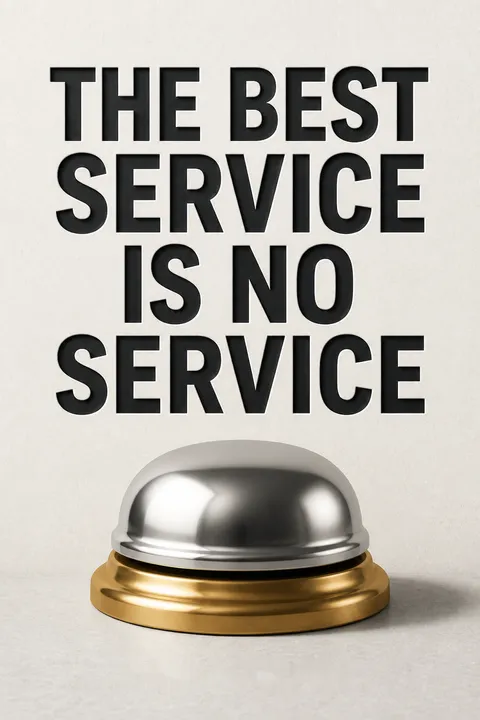


Key Takeaways
Design products so customers can use them without calling for help.
Start with the customer’s purpose. People buy a product or service to accomplish something, not to build a relationship with a support department. The book’s central test is simple: does using the offering work clearly and reliably, or must customers spend time correcting confusion, defects, and delays? The goal is not to eliminate every human interaction. It is to prevent avoidable ones while making necessary help excellent.
Prevention beats recovery. Fixing a mistake can restore trust, but relying on recovery means customers still pay in time and frustration, and some will never complain before leaving. The authors argue that better design can improve satisfaction and reduce costs together. Their ideal is service that feels invisible because the customer can get on with the task that mattered in the first place.
This reframes service as a property of the whole product, not a department’s performance. It aligns with systems thinking: repeated failures usually reflect the design of a process, not a succession of uniquely careless customers or agents. The prevention logic is especially persuasive where errors are predictable and costly to repair. Still, a low call volume is not automatically proof of a good experience. Customers may stop trying, lack access to support, or switch without reporting why. Prevention should be judged alongside outcomes, not inferred from silence.
Measure contacts per order, then trace each avoidable call to its cause.
Count the rate, not just the queue. CPX, or contacts per business unit such as orders, transactions, or customers, shows whether a company is becoming easier to use as it grows. The authors describe Amazon reducing its contacts per order by about 90 percent over time. British Telecom cut daily customer contacts from 2.4 million to 1 million between 2001 and 2004, while satisfaction improved.
Follow the cause upstream. Useful contact categories explain why a customer needed help, not merely what the agent did. Then teams can decide whether to remove the cause, automate a useful request, simplify a frustrating process, or learn from positive feedback. The book’s Value-Irritant Matrix helps compare whether a contact benefits the customer and the company. Repeated unresolved issues, which the authors call snowballs, deserve special attention.
A rate such as contacts per order is more informative than raw volume because it adjusts for business growth. It also shifts attention from staffing arithmetic to process quality. This resembles defect-rate measurement in manufacturing, where recurring failures trigger investigation rather than faster production. The caution is that not every contact is waste: advice, complex decisions, and welcome sales conversations may create value. A useful metric therefore needs disaggregated reasons and a clear distinction between customer-initiated help and interactions the customer actually wants.
Build self-service customers choose, understand, and can leave for human help.
Choice is part of usability. Self-service works when customers can complete their goal conveniently, not when a company simply blocks access to staff. The book identifies three common failures: limiting channel options, designing confusing interfaces, and disconnecting automated and staffed channels. A customer who enters account information in a phone menu should not have to repeat it to the agent who answers.
Test the whole task. New York State’s motor vehicle agency promoted online transactions with the promise of avoiding an office visit. In 2002, its site drew more than six million visitors, and 97 percent of users reportedly found the information they needed. The authors credit usable design, customer testing, and active promotion. Staff also need to understand the tools, support customers who get stuck, and help them learn to use successful options.
The book’s strongest point is that digital availability is not the same as usable self-service. Human-factors design treats the user’s task, attention, and memory as constraints, not inconveniences. Channel continuity matters for the same reason: customers experience one organization even when its departments use separate systems. Self-service can also exclude people with disabilities, limited connectivity, or unfamiliarity with the interface. A good design offers autonomy without turning automation into a gate that customers must pass before receiving help.
Tell customers what is happening before uncertainty becomes another service call.
Use known events as triggers. Companies often know when an order is delayed, a flight is cancelled, or a claim is taking longer than expected. Waiting for customers to discover the problem creates avoidable anxiety and inbound calls. Amazon’s order and shipping updates reduced questions about whether purchases had gone through and when they would arrive. Alaska Airlines notified passengers about disruptions and, when possible, arranged alternative flights.
Make alerts useful and answerable. Proactive contact means more than sending a notification. Give customers relevant progress, realistic expectations, and a clear route to respond or request help. The authors recommend prioritizing alerts by urgency and impact, choosing a channel customers have agreed to use, and planning for replies. A timely message can prevent confusion, but an inaccurate or unwanted one can create a new problem.
Proactive updates reduce uncertainty, a major source of perceived risk in services where customers cannot inspect the process themselves. They also help organizations manage demand before it peaks. The practice resembles preventive maintenance: detect a likely failure early, communicate its significance, and intervene before disruption spreads. It requires disciplined data, however. Poorly calibrated alerts can become noise, while sensitive account information raises privacy concerns. Customer permission, channel preferences, and accurate estimates are not decorative details; they determine whether outreach feels like care or surveillance.
Keep contact doors open; silence can hide defects, not satisfaction.
Make reaching the company easy. The authors argue that many customers who experience a problem never report it. They may work around the issue, tell others, or leave. Hiding phone numbers or forcing customers into a single channel suppresses evidence without fixing the underlying cause. USAA, by contrast, made its contact options visible across its website, bills, and other communications.
Open the channel before optimizing demand. A company may initially receive more contacts when it removes barriers. That increase can reveal backlogs, broken processes, or unmet needs that were previously invisible. Contact options should work, match the urgency of the need, and be available at suitable times. The mature goal is not maximum contact, either: customers should have meaningful choice, and the company should use what it hears to remove recurring reasons for reaching out.
This is a useful corrective to cost-cutting strategies that mistake low recorded demand for low customer need. In organizational learning, a signal that cannot reach decision-makers is not a signal the organization can use. Easy access can expose operational weaknesses earlier, while also reducing the temptation to treat complaints as isolated exceptions. There is a practical limit: opening channels without staffing, routing, and follow-through can intensify disappointment. Access is valuable when it connects customers to action, not when it merely gives frustration a new inbox.
Make the department causing the problem accountable for fixing it.
Customer service is often the messenger. A billing system, marketing promise, product defect, or supplier delay may create the contact, while the support team is blamed for the wait. The authors recommend tracing each reason to an owner with the authority and budget to change the process. Yarra Valley Water used a cross-company complaints council to assign responsibility and examine root causes, not just close individual cases.
Pair accountability with discretion. Senior leaders can make ownership stick through clear targets, regular review, and financial consequences for avoidable contacts. Frontline staff also need room to solve reasonable exceptions instead of hiding behind blanket rules. The book’s example of Amazon shows agents trusted to make modest refunds or replacements, with aggregate costs monitored rather than every decision requiring approval. The aim is responsibility at the source and practical judgment at the point of contact.
This is an organizational-design argument as much as a service prescription. If authority, information, and consequences sit in different departments, responsibility becomes ceremonial. Assigning one capable owner makes coordination easier, while frontline discretion shortens the distance between problem and remedy. Financial chargebacks can focus attention, but they can also provoke defensive accounting or encourage teams to reclassify contacts. The strongest system combines incentives with transparent root-cause evidence and a shared commitment to customer outcomes, so accountability produces repair rather than blame.
Turn customer conversations into evidence, then prove that someone acted.
The front line hears what surveys miss. Customers already describe failures, preferences, competitor offers, and desired features in calls, emails, and branch visits. Amazon’s WOCAS process, short for “what our customers are saying,” asked agents to share recurring observations with the wider company. The goal was to route useful insight to teams able to act, rather than leave it buried in case notes.
Listen for patterns, not only scores. A technology company’s internal satisfaction survey looked positive because it mainly captured customers whose issues had been successfully resolved. It missed people who abandoned calls or could not get help. Cable & Wireless created faster feedback and ownership processes, and the book reports that customer churn fell by 30 percent within a year. Feedback matters when it produces investigation, action, and a response back to the people who raised it.
Customer interactions are a form of naturally occurring evidence, but they are not automatically representative. People who contact a company differ from those who do not, and written notes can reflect what agents are trained to record rather than what customers actually mean. Combining frontline reports with behavioral data and appropriately designed research can reduce blind spots. The book’s insistence on closing the loop is crucial: asking for feedback raises expectations. A company that collects insights without showing what changed risks teaching customers that speaking up is pointless.
Reward resolved problems, not merely short calls or busy agents.
Speed is not the same as quality. Average handle time can push agents to rush, transfer, or end a conversation before the issue is resolved. The authors favor measures tied to customer outcomes, such as repeat-contact rates, accurate answers, and whether the promised result arrived as expected. They also describe dynamic individual handle time, which matches the time allowed to the customer’s issue and the agent’s skill instead of imposing one average on every interaction.
Keep excellent help available. In a customer story from the book, Nintendo answered quickly, repaired a noisy game console in about 25 minutes, and replaced it without shipping the device away. The case captures the point: some contacts are necessary, and their experience should be easy, informed, and humane. As routine questions move to automation or alerts, staffed agents may face fewer but more complex cases, so coaching and knowledge matter.
This section confronts Goodhart’s law: once a measure becomes a target, people may optimize the number rather than the purpose it was meant to represent. Short calls can look efficient while generating repeat work and customer frustration. Outcome measures are better, though they too can be gamed or may overlook factors outside an agent’s control. A balanced design separates staffing indicators from quality judgments, gives employees influence over what they are measured on, and preserves human support for cases where flexibility and empathy matter.
Analysis
The book’s central contribution is a shift in the unit of analysis. Conventional service management tends to treat each inbound interaction as a workload to forecast and process. Price and Jaffe instead treat many interactions as evidence of defects in the larger service system. That change links customer experience to product reliability, process design, information quality, and organizational incentives. It also explains why their recommendations belong together: self-service and proactive alerts can reduce avoidable demand, while open contact channels and listening help identify what should be fixed.
The framework is most compelling when it connects measurement to ownership. A contact rate has little value if no executive can act on its cause; customer feedback has little value if it is collected only to report a score. The cases from Amazon, BT, and other organizations make this operational logic memorable. Service is not simply a soft virtue. It is a feedback mechanism that can reveal friction, waste, and neglected customer needs.
The key interpretive caution is that “no service” must mean no unnecessary service, not no access to help. Low contact counts can reflect successful products, but they can also reflect customers giving up, switching silently, or being unable to reach a person. Similarly, automation can increase convenience for one group while excluding another. A sound implementation therefore segments contacts by purpose and customer need, tracks outcomes as well as volume, and protects human assistance for urgent, complex, or emotionally difficult situations.
The book is also a product of its period, when digital channels and early online commerce were rapidly changing expectations. Its enduring lesson is not that every interaction should become automated. It is that organizations should be able to explain why each interaction exists, whether the customer values it, and who is responsible for improving the experience. That discipline turns customer service from a queue-management function into an engine for learning and operational improvement.
Review Summary
The Best Service is No Service receives positive reviews for its practical advice on improving customer service. Readers appreciate the book's emphasis on reducing unnecessary customer contacts, providing self-help tools, and addressing root causes of issues. Many find the examples and frameworks useful, particularly for those in customer service roles. Some reviewers note that the content remains relevant despite its age. While a few criticize the book's length and repetitiveness, most readers find it valuable for its insights and actionable strategies to enhance customer experience and reduce service demands.
People Also Read









Glossary
CPX
Contact rate per activityCPX measures customer-initiated, agent-handled contacts relative to a relevant business activity, such as orders, transactions, accounts, or subscribers. The denominator should reflect the volume that generates the contacts. Tracking a rate rather than raw contact totals helps show whether the business is becoming easier to use as it grows.
Dumb contacts
Avoidable customer contactsDumb contacts are customer requests for help caused by preventable company errors, confusing processes, delays, defective products, or unclear information. The term does not mean that customers are foolish. It identifies contact demand that the company should investigate and reduce at its source instead of repeatedly staffing to handle it.
Value-Irritant Matrix
Classifies contact valueThe Value-Irritant Matrix evaluates a type of customer contact from both the customer’s and company’s perspectives. It helps teams decide whether a contact should be eliminated, automated, improved, or used as a source of insight. Its purpose is to prevent companies from treating every contact as equally useful or equally wasteful.
Snowballs
Repeat contacts on an issueSnowballs are repeat contacts that occur when an initial interaction fails to resolve the customer’s problem. Each additional contact consumes time and can intensify frustration. The book recommends identifying repeat cases, giving an agent authority to resolve them fully, and examining how the original interaction or process failed.
WOCAS
Frontline customer feedbackWOCAS means “what our customers are saying.” It is a process for collecting observations from employees who regularly interact with customers, then coding, routing, and reviewing those insights. The process aims to reveal recurring problems and useful requests that may not appear in formal surveys or routine contact statistics.
DIHT
Issue-matched handle timeDynamic individual handle time is an approach to planning and evaluating contact duration according to the customer’s need, the type of issue, and the agent’s experience. It contrasts with applying one average time target to every interaction, which can encourage rushed answers even when a complex problem needs more attention.
Customer change management
Support adoption of new channelsCustomer change management is the work of helping customers understand and adopt new service channels or behaviors. It considers whether people can use an option, whether they want to use it, and what promotion, convenience, incentives, or assistance may help. The idea rejects the assumption that customers will automatically use a new tool simply because it exists.
MECE
Distinct, complete categoriesMECE stands for mutually exclusive and collectively exhaustive. In the book’s contact-analysis context, categories should avoid overlap while covering the relevant reasons customers make contact. Clear categories make trends easier to interpret and help assign one accountable owner to each underlying cause.
RACI
Clarifies process rolesRACI is a method for mapping who is responsible for work, who takes action or is accountable, who must be consulted, and who must be informed. The book applies it to complex customer processes so organizations can identify missing handoffs, unclear ownership, and points where customers need progress updates.
FAQ
1. What is The Best Service is No Service by Bill Price about?
- Core premise: The book argues that the best customer service is no service at all, meaning companies should design products and processes so well that customers don’t need to contact customer service.
- Focus on demand reduction: It emphasizes understanding and reducing unnecessary customer contacts by fixing root causes and simplifying processes.
- Seven principles framework: The book introduces seven principles for transforming service, including eliminating dumb contacts, creating engaging self-service, and being proactive.
- Operational and cultural shift: It advocates for a fundamental change in how companies view and deliver customer service, aiming for happier customers and lower costs.
2. Why should I read The Best Service is No Service by Bill Price?
- Addresses broken service: The book explains why customer service is often ineffective despite technological advances and offers practical solutions.
- Real-world case studies: It features examples from companies like Amazon, McDonald’s, and USAA Insurance that have successfully applied the Best Service principles.
- Financial and customer impact: The book demonstrates how reducing unnecessary contacts can increase profits, lower costs, and enhance brand reputation.
- Mindset shift: It challenges traditional customer service paradigms, encouraging a proactive and customer-centric approach.
3. What are the key takeaways from The Best Service is No Service by Bill Price?
- Challenge, don’t cope with demand: Companies should analyze and eliminate the root causes of unnecessary customer contacts rather than just handling them.
- Seven Best Service Principles: These include eliminating dumb contacts, creating engaging self-service, being proactive, making it easy to contact, owning actions company-wide, listening and acting on feedback, and delivering great experiences.
- Measure what matters: Focus on customer-centric metrics like contacts per driver (CPX), repeat contacts, and customer satisfaction instead of traditional speed metrics.
- Empowerment and accountability: Assign ownership of contact reasons to the right executives and empower frontline staff to resolve issues.
4. What are the Seven Best Service Principles in The Best Service is No Service by Bill Price?
- Eliminate dumb contacts: Remove unnecessary or unwanted customer contacts caused by company errors or confusing processes.
- Create engaging self-service: Design self-service options that are intuitive, customer-friendly, and integrated across channels.
- Be proactive: Anticipate customer needs and communicate issues before customers have to reach out.
- Make it easy to contact: Provide clear, accessible, and multiple contact channels for customers.
- Own actions across the organization: Assign accountability for contact reasons to the appropriate departments, not just customer service.
- Listen and act on feedback: Use customer feedback to drive continuous improvement and fix root causes.
- Deliver great service experiences: Ensure every customer interaction is positive, efficient, and adds value.
5. What does Bill Price mean by "Eliminate Dumb Contacts" in The Best Service is No Service?
- Definition of dumb contacts: These are unnecessary customer contacts caused by company mistakes, confusing processes, or defective products.
- Negative impact: Dumb contacts waste time, increase costs, and frustrate both customers and staff, often leading to repeat contacts.
- Root cause analysis: Companies should systematically identify and address the underlying causes of these contacts.
- Ownership and elimination: Assign responsibility to the right departments and automate or fix issues to reduce contact volume.
6. How does The Best Service is No Service by Bill Price recommend creating engaging self-service?
- Empower customers: Self-service should allow customers to find answers and complete tasks on their own terms, anytime and anywhere.
- Avoid common pitfalls: The book warns against limited options, poor usability, and disconnected channels that frustrate customers.
- Best practices: Use customer language, integrate channels for seamless transitions, and actively promote self-service through staffed channels.
- Continuous improvement: Regularly update and refine self-service options based on customer feedback and usage data.
7. What is the Value-Irritant Matrix in The Best Service is No Service by Bill Price and how is it used?
- Concept overview: The Value-Irritant Matrix categorizes customer contacts based on their value to the company and irritation to the customer.
- Four quadrants: Contacts are classified as valuable and wanted, valuable but irritating, irritating and unwanted, or neither valuable nor wanted.
- Strategic application: Companies should focus on eliminating contacts that are both irritating and unwanted, while enhancing those that are valuable and wanted.
- Optimization tool: The matrix helps prioritize which contacts to automate, improve, or eliminate for better customer experience and cost efficiency.
8. How does The Best Service is No Service by Bill Price suggest companies should handle customer contact channels?
- Open the floodgates: Encourage customer contacts rather than suppressing them, making it easy for customers to reach out.
- Match channels to needs: Different issues require different channels; urgent matters need real-time responses, while others can tolerate delays.
- Provide choice and flexibility: Offer multiple, accessible contact options, extend hours, and remove barriers like complex IVR menus.
- Transparency: Clearly communicate what each channel can do and set expectations for response times.
9. How does The Best Service is No Service by Bill Price address accountability across organizations?
- Tear down silos: Identify and assign ownership of contact reasons to the departments responsible for the root causes, not just customer service.
- Make accountability stick: Use executive sponsorship, meaningful targets, and financial incentives to ensure issues are addressed.
- Empower the front line: Allow customer-facing staff to make decisions and resolve issues without restrictive policies.
- Cross-functional collaboration: Foster a culture where all departments work together to improve customer experience.
10. What role does listening and acting on customer feedback play in The Best Service is No Service by Bill Price?
- Feedback as a resource: Customer interactions provide valuable insights for improving products and services.
- Smart listening techniques: Use tools like text and speech analysis, automated feedback systems, and frontline input to gather customer voice.
- Closing the loop: Ensure feedback leads to action through structured processes and root cause analysis.
- Continuous improvement: Regularly act on feedback to drive ongoing enhancements in service and operations.
11. How does The Best Service is No Service by Bill Price recommend measuring customer service performance?
- Focus on customer-centric metrics: Prioritize metrics like first point resolution (FPR), repeat contact rates, and customer satisfaction post-contact.
- Move beyond speed metrics: Traditional measures like average handle time (AHT) and speed of answer can be counterproductive.
- Contacts per X (CPX): Track contacts per order, per customer, or per transaction to identify and reduce unnecessary contacts.
- Tailored measurement: Segment customers by value and need, and use dynamic metrics that reflect true service effectiveness.
12. What are some real-world examples of companies applying the principles from The Best Service is No Service by Bill Price?
- Amazon: Reduced contacts per order by 90% through root cause analysis, self-service promotion, and the Skyline report for accountability.
- British Telecom: Cut daily customer contacts by 60% by eliminating unnecessary and repeat contacts.
- USAA Insurance: Makes it easy to contact, practices down-selling, and enjoys high customer loyalty.
- McDonald’s and Kingfisher Airlines: Use customer feedback and empower staff to improve service quality and customer experience.
Download PDF
Download EPUB
.epub digital book format is ideal for reading ebooks on phones, tablets, and e-readers.








