

Key Takeaways
See Smith, Marx, and Keynes as rival answers to prosperity's coordination problem.
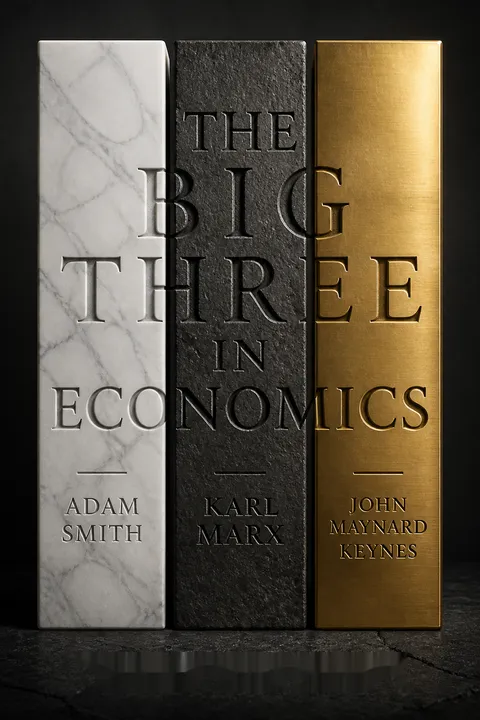
Three economic visions. Adam Smith explains prosperity through decentralized exchange and limited government. Karl Marx sees private ownership dividing society into classes and generating exploitation and crises. John Maynard Keynes sees a market economy vulnerable to slumps that may require public action to restore demand. Skousen follows these arguments through the history of economics, including the thinkers who revised or challenged each one.
A ranking with a viewpoint. The book places Smith first, Keynes second, and Marx third, judging them by economic freedom and growth. That is Skousen's chosen standard, not an objective ranking that all readers must accept. The comparison is most useful as a map of competing answers to three questions: who coordinates production, how gains are shared, and who responds when the economy falters.
The three figures are less like positions on a single political line than specialists diagnosing different problems. Smith emphasizes coordination, Marx emphasizes power and distribution, and Keynes emphasizes instability over time. That distinction helps explain why their ideas continue to appear together in public debate. The ranking also depends on what counts as success. Growth, liberty, equality, security, and political participation are related but not interchangeable measures, so a reader should notice the book's standard rather than mistake it for a neutral verdict.
Build wealth by widening specialization, exchange, and the freedom to produce.
Wealth means what people can use. In 1776, Adam Smith challenged mercantilists who treated a nation's gold and silver as wealth and trade as a contest in which one country must lose for another to win. He argued that prosperity comes from producing useful goods and exchanging them. A pin factory, where workers divide the task into separate operations, illustrates how specialization raises output. Wider trade expands the market and makes further specialization possible.
Freedom enables production. Smith's system of natural liberty allows people to choose work, invest, save, and trade with fewer state-imposed barriers. The book links this argument to rising living standards after the Industrial Revolution, while not proving that Smith's book alone caused them. Its central claim is that an economy can increase the supply of goods for ordinary people, rather than merely redistribute a fixed stock of riches.
Smith's change of focus, from treasure to productive capacity, remains a powerful way to assess economic policy. It directs attention toward whether rules help people create, exchange, and improve useful things. The pin factory also anticipates a broader insight from organizational research: breaking work into tasks can raise efficiency, but coordination and worker knowledge matter too. Specialization is not an automatic good. Its gains can come with monotonous work or dependence, concerns Smith himself recognized when he supported public education.
Let self-interest serve the public only inside rules of justice and competition.
Markets need moral limits. Smith's invisible hand describes how people pursuing private aims can unintentionally benefit others through voluntary exchange. A baker need not act from charity to supply bread, but must offer something customers value. This is not a defense of fraud or unlimited greed. Smith ties the system to justice, honest dealing, and competition, which limits sellers' ability to exploit buyers.
Government still has work. Smith supported national defense, courts that protect rights and enforce contracts, public works, and education. He opposed privileges that let a company suppress competition, warning that organized business interests could seek rules that raise prices. His own career held an irony: the advocate of freer trade later served as a customs commissioner enforcing trade restrictions. The episode underscores how political institutions can diverge from economic principles.
This account avoids the common mistake of treating Smith as either a champion of greed or an opponent of all government. The deeper idea is institutional: self-interest can produce cooperative outcomes when people can choose among alternatives and face consequences for deception. This resembles modern work on incentive design, where the rules shape whether private rewards align with collective goals. The qualification matters. Competition does not by itself resolve pollution, unequal bargaining power, or every abuse of market power, so the quality of law and enforcement remains central.
Treat population and class models as warnings, not unbreakable laws.
Malthus mistook limits for destiny. In 1798, Thomas Malthus argued that population tends to grow faster than food production, eventually driving people toward poverty. The book credits his influence on population studies and Darwin, but argues that his forecast missed technological change, improved farming, longer lives, and falling birthrates as societies became wealthier. Resource limits are real, but his fixed assumptions made them seem inevitable.
Ricardo changed the question. David Ricardo focused less on how wealth grows than on how wages, profits, and rents divide it among workers, capitalists, and landlords. His model suggested that workers would remain near subsistence while landlords gained. Marx drew on this conflict-centered framework. Skousen argues that the focus on distribution and labor value obscured productivity, innovation, and the possibility that economic growth could benefit multiple groups.
The useful lesson is methodological, not that scarcity or inequality can be dismissed. Long-range forecasts are fragile when they hold technology, behavior, or institutions constant. Malthus's missed predictions show how innovation can alter resource constraints, while Ricardo's model makes distribution visible rather than assuming growth lifts everyone equally. Each framework catches something and omits something. A strong economic explanation should ask which assumptions generate its conclusion and whether those assumptions still fit the world being analyzed.
Value follows marginal usefulness, not the hours sunk into production.
The marginal revolution changes the explanation. In the 1870s, Carl Menger, William Stanley Jevons, and Léon Walras independently helped establish marginal utility: the value of an additional unit depends on how useful it is to the person choosing it, given available supply. This resolves the diamond-water puzzle. Water is essential but usually abundant, so an extra unit may be worth little; diamonds are scarce, so another may command much more.
Costs follow value too. This approach challenged the classical labor theory of value, which treated labor time as the source of a good's value. It also linked consumer demand to production decisions and the prices of productive inputs. Eugen Böhm-Bawerk further argued that capitalists contribute by waiting and taking business risks. Together, these ideas weakened Marx's claim that profits are simply value taken from workers.
Marginal analysis clarifies why usefulness and market price are not the same as a good's total importance. It also connects individual choices to the price signals that guide production. But a market price does not settle every question about fairness. Wages and profits depend not only on productivity, but also on bargaining power, law, and ownership. Marginal theory is strongest as an explanation of how prices can emerge from choices, not as a complete moral defense of every distribution those prices produce.
Take Marx's critique seriously without mistaking revolution for an economic plan.
Marx made capitalism look historical. He argued that economic arrangements shape politics, law, and culture, and that private ownership creates conflict between workers and owners. His theory of surplus value treated profit as value extracted from labor. In this view, competition drives firms to accumulate capital, intensify production, and contribute to crises. His language of alienation and class conflict gave a powerful account of why industrial workers and intellectuals could feel excluded from the gains of capitalism.
His forecast and remedy failed. The book argues that wages and living standards rose rather than collapsing toward subsistence, profits did not steadily disappear, and the predicted universal proletarian revolution did not arrive. Command economies also failed to deliver the abundance promised by Marxist theory. Still, the book does not dismiss every question Marx raised: inequality, workplace power, and the tendency to value financial gain above useful production remain subjects worth examining.
Marx's lasting force comes partly from joining economic criticism to a story of historical change. That story can illuminate how ownership and power shape people's opportunities, even when its predictions are unreliable. The distinction between diagnosis and prescription is essential: identifying alienation or concentrated power does not establish that central planning can solve them. Conversely, the failure of planned economies does not make every criticism of markets false. Both claims require evidence about institutions and outcomes, not loyalty to a political label.
Use public spending to counter collapse, not as proof markets never self-correct.
Keynes targets a demand shortfall. During the Great Depression, industrial production and employment collapsed, and Keynes challenged the idea that the economy would quickly repair itself through lower wages and prices. His 1936 General Theory argued that spending could fall so far that resources remained idle for a prolonged period. He summarized total output as consumption, investment, and government spending. If businesses and households would not spend, public projects could add demand and employment.
The multiplier magnifies a first push. Workers paid for a public project spend part of their income, creating revenue for other firms and workers. This chain can make total income rise by more than the initial expenditure. Keynes did not call for replacing all markets with state ownership. His case was for intervention during severe downturns, although he also entertained a larger public role in investment when private spending proved unreliable.
Keynes's enduring contribution is to make aggregate demand a serious question rather than assuming that every unsold good or unemployed worker quickly finds a new buyer or job. In a sharp downturn, private actors may all cut spending at once, making individual caution collectively damaging. The multiplier captures that feedback. Its size is not guaranteed, however. It depends on conditions such as spare capacity, financing, imports, and whether public spending displaces private activity. A tool for a slump is not a universal growth formula.
Track money and incentives, because policy errors can deepen economic disasters.
The Depression became an argument about government. Irving Fisher focused on price stability, while Austrian economists Ludwig von Mises and Friedrich Hayek warned that cheap credit could distort investment and create an unsustainable boom. Milton Friedman and Anna Schwartz later argued that the U.S. money supply fell by more than a third from 1929 to 1933, turning a severe downturn into a much deeper collapse. Their account shifted blame toward Federal Reserve failures rather than inherent market instability.
The debate reshaped economics. Friedman challenged the Keynesian claim that monetary policy was weak and questioned the reliability of deficit spending and the Phillips curve trade-off between inflation and unemployment. The book also treats the collapse of Soviet-style central planning as evidence against Marxist economic prescriptions. These episodes strengthened market-oriented economics, though they do not prove that every market works well or every government intervention fails.
The contrast between market failure and government failure is often presented as a choice, but institutions can produce both. Monetary authorities can intensify a crisis, while financial markets can also create fragile booms. Friedman's historical account usefully restores policy decisions to the causal story of the Depression. The book's broader victory narrative needs restraint, however: the collapse of command economies is strong evidence against comprehensive central planning, not a controlled test proving that unregulated markets are stable or equitable.
Judge capitalism by both rising living standards and its unresolved costs.
The book's verdict is qualified but clear. Skousen argues that Smith's emphasis on productive freedom has outlasted Marx's planned alternative and Keynes's broader reliance on stabilization. He points to rising material living standards, wider access to household goods, and research associating economic freedom with higher incomes. He also stresses the institutional conditions that make markets work: enforceable contracts, property rights, competition, and a reliable legal system.
The argument remains contested. The book acknowledges concerns about inequality, alienating work, market power, and environmental damage, while favoring solutions that preserve markets and strengthen rules. Its conclusion is not that every outcome is fair or that government is unnecessary. Rather, it treats decentralized production and exchange as the more reliable engine of broad prosperity, provided institutions restrain fraud and protect the conditions for genuine competition.
The most durable conclusion is not a simple triumph of one economist, but a test for economic arrangements: what do they produce, for whom, and under what rules? Income and consumer access matter, but so do security, bargaining power, environmental quality, and political voice. This broader scorecard keeps the book's strongest insight, that productive freedom can expand shared material possibilities, while resisting the temptation to treat growth as a complete measure of social well-being.
Analysis
The book works as an argumentative history rather than a neutral survey. Its narrative gives economic thought a clear protagonist, Adam Smith, whose account of decentralized production survives attacks from Marx and Keynes. That structure is memorable because it turns abstract disagreements into three distinct problems: how to coordinate activity, how to divide its rewards, and how to respond when spending and employment collapse. The transition chapters matter. Malthus and Ricardo help explain why classical economics lost confidence, while marginal utility supplies a stronger account of value and weakens Marx's labor-based explanation of profit.
The framework is also deliberately evaluative. Skousen ranks the economists by freedom and growth, so Smith's victory is partly built into the measure. That does not erase the historical evidence he presents, but it means readers should distinguish the account of what each thinker argued from the author's verdict about whose system performs best. The book is most persuasive when it treats markets as institutions requiring justice, competition, and property rights, not as spontaneous magic. It is less persuasive when the collapse of centralized planning is made to imply a general vindication of laissez-faire.
A useful modern synthesis keeps the levels of analysis separate without pretending they are independent. Competitive prices can coordinate dispersed information, yet market power and external costs can distort that coordination. Keynes's demand management can limit a destructive downturn, yet badly designed stimulus can waste resources or create fiscal and monetary risks. Marx's account of class power can identify conflicts that price theory alone does not settle, yet it offers no reliable mechanism for coordinating complex production through central plans. Each thinker is therefore most useful when treated as a diagnostic lens, not a total system. The book's deeper lesson is that economic policy should be judged by institutional detail, evidence, and trade-offs, rather than by whether it sounds purely free-market, socialist, or centrist.
Review Summary
Readers have mixed opinions on The Big Three in Economics. Some praise it as an informative overview of economic history, while others criticize the author's bias towards free-market capitalism and against Marx and Keynes. The book is seen as accessible for beginners but lacking objectivity. Many note the author's strong preference for Adam Smith's ideas and harsh treatment of Marx. Some find value in the historical context provided, while others argue the book misrepresents opposing economic theories.
People Also Read


Glossary
system of natural liberty
Smith's market orderAdam Smith's name for an economic and social arrangement in which people can produce, trade, work, save, and invest with limited state interference. It is not a call for the absence of government: Smith assigns public authority roles in defense, justice, infrastructure, and education, and expects economic activity to operate within laws of justice.
invisible hand
Unintended market coordinationSmith's metaphor for cases in which people pursuing their own aims help coordinate production and exchange without intending to benefit society as a whole. In the book, the concept depends on voluntary exchange, competition, and justice. It does not mean that every private action produces a public benefit or that markets need no legal framework.
Say's law of markets
Production generates purchasing powerThe classical principle that producing and selling goods generates income that can be used to demand other goods. Skousen stresses that this does not mean everything produced is automatically sold. In the classical account, recessions can arise when production is misdirected or goods are produced in the wrong proportions, rather than from a general shortage of spending alone.
marginal utility
Value of one more unitThe usefulness a person assigns to an additional unit of a good, given how much is already available. The marginalist economists used this idea to explain why market value depends on both demand and scarcity. An essential good can have a low price when abundant, while a less essential scarce good can command a high price.
surplus value
Marx's alleged labor extractionMarx's term for the portion of a product's value that, in his theory, workers create but do not receive as wages. He treats profits and interest as forms of this value appropriated by owners of capital. Critics in the book challenge the theory by arguing that capitalists also wait for returns, supply capital, and bear business risks.
historical materialism
Economic forces shape societyMarx's theory that the material and economic organization of society strongly shapes its political, legal, religious, and cultural institutions. Changes in production and ownership create tensions that can transform social arrangements. The theory gives economic structure a central role in history, though it does not mean that ideas and politics have no influence.
effective demand
Spending that sustains outputKeynes's term for the level of aggregate spending that determines how much output firms have reason to produce and how many workers they employ. In the book's account, effective demand includes consumption and investment, with government spending able to support total demand when private spending is weak and resources are idle.
paradox of thrift
Saving can reduce current incomeThe Keynesian claim that when households collectively try to save more during a downturn, reduced consumption can lower business revenue, employment, and national income. As incomes fall, total saving may fail to rise as intended. Critics argue that this account treats saving as if it were not invested, overlooking its role in financing production and future consumption.
natural rate of interest
Rate balancing saving and investmentThe rate associated with the balance between saving and investment in the absence of monetary distortion. Drawing on Knut Wicksell, Mises and Hayek argued that if central banks push market borrowing rates below this level, investment can expand in ways that are not supported by genuine saving, creating an unsustainable boom.
FAQ
What is The Big Three in Economics by Mark Skousen about?
- Comprehensive economic history: The book traces the evolution of economic thought through the lives and ideas of Adam Smith, Karl Marx, and John Maynard Keynes, showing how their theories shaped capitalism, socialism, and macroeconomic policy.
- Integration of theory and history: Skousen connects economic models to major historical events, such as the Industrial Revolution, the Great Depression, and the collapse of communism, illustrating the real-world impact of economic ideas.
- Critical analysis: The book examines the strengths, weaknesses, and ongoing debates surrounding classical economics, Marxism, and Keynesianism, providing a balanced perspective on their legacies.
Why should I read The Big Three in Economics by Mark Skousen?
- Foundational understanding: The book offers clear explanations of the core principles and critiques of Smith, Marx, and Keynes, essential for anyone interested in modern economic debates.
- Contextual insight: Skousen situates economic theories within their historical, political, and social contexts, helping readers appreciate how ideas respond to and shape real-world events.
- Balanced and accessible: The author presents complex theories in an accessible style, challenges simplistic left-right categorizations, and encourages critical thinking about the merits and limitations of each economist.
What are the key takeaways from The Big Three in Economics by Mark Skousen?
- Enduring influence: The ideas of Smith, Marx, and Keynes continue to shape economic policy, debates on government intervention, and discussions about freedom and equality.
- Evolution of economic thought: The book highlights how economic theories adapt to crises, technological change, and political upheaval, with each economist representing a major turning point.
- Ongoing relevance: Contemporary issues like globalization, inequality, and financial regulation are still debated using the frameworks developed by these three thinkers.
What are the best quotes from The Big Three in Economics by Mark Skousen and what do they mean?
- Adam Smith: “Little else is required to carry a state to the highest degree of opulence... but peace, easy taxes, and a tolerable administration of justice.” This underscores Smith’s belief in minimal government and the power of free markets.
- John Maynard Keynes: “In the long run we are all dead.” This famous dictum highlights Keynes’s focus on short-term solutions to economic crises, rather than waiting for markets to self-correct.
- Skousen’s perspective: The book often references the “totem pole” ranking of economists, emphasizing the importance of economic freedom and growth as criteria for evaluating their impact.
What are Adam Smith’s key contributions as described in The Big Three in Economics by Mark Skousen?
- Natural liberty and free markets: Smith advocated for economic freedom, limited government, and the “invisible hand” of self-interest guiding markets toward prosperity.
- Division of labor: He emphasized how specialization increases productivity and wealth, laying the foundation for classical economics.
- Critique of mercantilism: Smith opposed trade barriers and monopolies, arguing that free trade and competition benefit society as a whole.
How does Mark Skousen explain the “invisible hand” concept in The Big Three in Economics?
- Self-regulating markets: The “invisible hand” is Smith’s metaphor for how individuals pursuing their own interests unintentionally promote the public good through voluntary exchange and competition.
- Moral and legal framework: Skousen notes that Smith’s invisible hand assumes a system of justice and ethics, ensuring that self-interest does not devolve into greed or fraud.
- Enduring symbol: Although Smith used the phrase sparingly, it has become a central idea in economics, representing the efficiency and harmony of free markets.
What are Karl Marx’s main economic theories and their impact according to The Big Three in Economics by Mark Skousen?
- Labor theory of value and exploitation: Marx argued that capitalists exploit workers by appropriating surplus value, leading to class conflict and instability.
- Historical materialism: He believed that economic forces drive social change, predicting the eventual collapse of capitalism and the rise of socialism.
- Legacy and limitations: While Marx’s predictions about capitalism’s demise did not materialize as he envisioned, his analysis of class struggle and inequality remains influential in political and social thought.
What are the main criticisms of Karl Marx’s economic theories in The Big Three in Economics by Mark Skousen?
- Labor theory of value flaws: Mainstream economists reject Marx’s focus on labor as the sole source of value, emphasizing subjective utility and consumer demand instead.
- Misunderstanding of capital and entrepreneurship: Marx undervalued the productive role of capitalists and entrepreneurs, who take risks and drive economic growth.
- Failed predictions: Marx’s forecasts of capitalism’s collapse and worsening worker misery have not come true; instead, living standards have generally improved under capitalism.
How does The Big Three in Economics by Mark Skousen describe John Maynard Keynes’s role in economic thought?
- Revolutionizing macroeconomics: Keynes argued that capitalism is inherently unstable and can suffer from prolonged unemployment due to insufficient aggregate demand.
- Advocacy for government intervention: He promoted active fiscal policy, including deficit spending and public works, to stimulate demand during recessions.
- Mixed legacy: While Keynes’s ideas helped address the Great Depression, they also led to debates over inflation, government debt, and the proper role of the state in the economy.
What is the Quantity Theory of Money and how is it treated in The Big Three in Economics by Mark Skousen?
- Fisher’s equation of exchange: The theory links money supply, velocity, price level, and transactions, suggesting that changes in money supply directly affect prices.
- Limitations and critiques: Skousen discusses how the theory failed to predict the Great Depression and how Austrian economists argued that monetary inflation distorts markets.
- Friedman’s revival: Milton Friedman refined the theory, emphasizing that monetary policy is powerful and that inflation is primarily a monetary phenomenon.
How does Mark Skousen explain the Keynesian model of aggregate demand in The Big Three in Economics?
- Aggregate demand components: Keynes’s model (Y = C + I + G) posits that consumption, investment, and government spending determine total output and employment.
- Multiplier effect: Government spending can have a multiplied impact on income and jobs, justifying deficit spending during downturns.
- Critiques: Skousen presents opposing views, noting that saving can fuel investment and growth, challenging Keynes’s assumption that saving is a drag on the economy.
How does The Big Three in Economics by Mark Skousen portray the resurgence of classical economics and free-market ideas?
- Monetarist counterrevolution: Economists like Milton Friedman challenged Keynesianism by emphasizing the importance of monetary policy and market stability.
- Collapse of socialism: The failures of central planning and the fall of the Soviet Union vindicated free-market principles and shifted development economics toward market-friendly policies.
- Modern neoclassical economics: The book highlights the return to classical models, the critique of government failures, and the ongoing debate over the balance between intervention and liberty.
Download PDF
Download EPUB
.epub digital book format is ideal for reading ebooks on phones, tablets, and e-readers.








