Key Takeaways
1. Unprecedented Sibling Power in American Foreign Policy
Never before had siblings directed the overt and covert sides of American foreign policy.
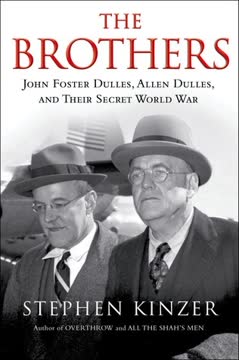
Dual leadership. The Eisenhower administration saw an unprecedented concentration of foreign policy power in the hands of two brothers: John Foster Dulles as Secretary of State and Allen Dulles as Director of Central Intelligence. This unique arrangement meant that the overt diplomacy and the clandestine operations of the United States were guided by a shared worldview and an intimate, unquestioning trust.
Seamless collaboration. Their deep personal bond, cultivated since childhood, allowed them to bypass traditional bureaucratic checks and balances. Decisions that would normally involve extensive debate across departments were often made with a glance or a few words between them, creating a nexus of power unmatched in American history. This intimacy meant that the State Department and the CIA often functioned as a single, unified entity.
Global reach. This brotherly partnership enabled the United States to project its influence globally with remarkable speed and coordination. While Foster articulated the public rationale for American actions, Allen executed the secret campaigns, making the world their shared battlefield and setting in motion processes that would shape international relations for decades.
2. A Legacy Forged in Piety, Diplomacy, and Corporate Influence
Foster and Allen, more than any other Americans of their age, were heirs to this legacy.
Pious upbringing. The Dulles brothers were raised in a devout Presbyterian household, steeped in missionary Christianity. This instilled in them a profound belief in a world divided between righteousness and evil, and a conviction that America had a divine mandate to spread its values and influence globally. Their father, a theologian, and their grandfather, a former Secretary of State, reinforced this sense of moral purpose and national destiny.
Diplomatic heritage. Their family boasted a rich history of diplomatic service, with their grandfather, John Watson Foster, and uncle, Robert Lansing, both serving as Secretaries of State. This exposed them from an early age to the intricacies of international relations and the levers of state power. They learned that America's role was to lead, civilize, and command, a belief that became central to their adult careers.
Corporate globalism. Decades spent as powerful corporate lawyers at Sullivan & Cromwell deeply intertwined their interests with those of America's largest multinational corporations. They believed that promoting free enterprise and American-centered internationalism was beneficial for everyone, blurring the lines between national interest and corporate profit. This experience solidified their commitment to a global economic order that favored American capital.
3. Architects of the Cold War's Manichean Divide
In it Foster saw something he never saw in Nazism: an ultimate evil with which no compromise could ever be possible.
Unwavering anti-Communism. The Dulles brothers were instrumental in shaping America's Cold War narrative, portraying Soviet Communism as an existential threat bent on world domination. Foster, in particular, underwent a "transformation" from a nuanced internationalist to a fervent ideologue, convinced that Communism represented an "alien faith" and an "ultimate evil" that demanded uncompromising resistance.
Rejection of détente. Despite Stalin's death in 1953 and subsequent Soviet overtures for "peaceful coexistence," Foster and Allen categorically rejected these as mere propaganda. They believed any negotiation would be a ruse to weaken American resolve, thereby sharpening and prolonging the Cold War by missing opportunities for de-escalation. This rigid stance prevented exploration of alternative superpower relationships.
Fear as a tool. Foster actively cultivated a sense of imminent danger among Americans, using dramatic rhetoric and public appearances to emphasize the Soviet threat. He believed that fear was a necessary prerequisite for national unity and preparedness, justifying projects like bomb shelters and nuclear weapons tests. This approach, while effective in mobilizing public opinion, also contributed to a climate of paranoia.
4. Covert Action as a Primary Tool: The "New Look" of American Global Intervention
Eisenhower wished to wage a new kind of war. Secretary of State John Foster Dulles plotted it. His brother, Director of Central Intelligence Allen Dulles, waged it.
Eisenhower's mandate. President Eisenhower, wary of conventional warfare after World War II and committed to balancing the budget, embraced a "New Look" defense policy. This strategy prioritized nuclear deterrence and, crucially, covert action as a cost-effective way to combat perceived Communist expansion without deploying large ground forces. The Dulles brothers were perfectly positioned to implement this vision.
CIA's expanded role. Under Allen's leadership, the CIA transformed from primarily an intelligence-gathering body into a global force for paramilitary and regime-change operations. The National Security Act of 1947, with its vaguely worded clause allowing "other functions and duties," provided the legal framework for this expansion, enabling the CIA to engage in propaganda, economic warfare, sabotage, and support for resistance movements.
"Invisible government." The Dulles brothers' close collaboration allowed for a highly centralized and secretive foreign policy. Covert operations were planned and executed with minimal oversight, often without the knowledge of Congress or even other State Department officials. This "invisible government" operated beyond normal accountability, making it easier to undertake controversial actions while maintaining plausible deniability.
5. The First Triumphs: Overthrowing Mossadegh and Arbenz
Allen had shown that he could crush foreign leaders secretly, cheaply, and almost bloodlessly. All wanted to do it again.
Iran: Oil and perceived threat. Mohammad Mossadegh, Iran's nationalist Prime Minister, became the first target. His nationalization of the Anglo-Iranian Oil Company (a Sullivan & Cromwell client) and his neutralist stance were seen by the Dulles brothers as a direct challenge to Western corporate power and a potential opening for Soviet influence. Operation Ajax, a joint CIA-MI6 coup, successfully overthrew him in 1953, restoring the pro-Western Shah.
Guatemala: Bananas and Communism. Jacobo Arbenz, Guatemala's democratically elected president, was the second target. His land reform policies, which threatened the vast holdings of the United Fruit Company (another Sullivan & Cromwell client), and the presence of a few Communists in his government, led the Dulles brothers to label him a "Kremlin puppet." Operation PB/Success, a CIA-orchestrated coup in 1954, replaced Arbenz with a military dictator.
Fueling overconfidence. These early successes, achieved with relatively low cost and perceived secrecy, profoundly influenced the Dulles brothers and the Eisenhower administration. They reinforced the belief that covert action was a potent, efficient tool for shaping global events, leading to a dangerous overconfidence in their ability to depose foreign leaders and control outcomes.
6. Escalating Ambition: The Quagmire of Vietnam and Indonesia
No systematic or serious examination of Vietnam’s importance to the United States was ever undertaken. It was ritualistic anti-Communism and exaggerated power politics that got us into Vietnam.
Vietnam: The "domino theory." The Dulles brothers viewed Ho Chi Minh, Vietnam's Communist nationalist leader, as a critical domino in Southeast Asia. Despite Ho's popularity and the Geneva Accords mandating nationwide elections, they refused to accept his inevitable victory. Instead, they supported Ngo Dinh Diem in South Vietnam, canceled the elections, and launched a covert war, including propaganda campaigns and military aid, setting the stage for deeper American involvement.
Indonesia: Neutralism as betrayal. President Sukarno of Indonesia, a charismatic leader who championed neutralism and flirted with the Soviet bloc, became the fourth "monster." Despite his popularity and the country's strategic importance, the Dulles brothers saw his non-alignment as a betrayal. Operation Archipelago, a large-scale CIA effort to arm and train rebels, aimed to destabilize or even break up Indonesia.
Failures and misjudgments. Both campaigns demonstrated the limits of covert action and the Dulles brothers' "confirmation bias."
- Vietnam: Their refusal to acknowledge Ho's nationalist appeal and their support for Diem's authoritarian regime alienated many Vietnamese and deepened the conflict.
- Indonesia: Archipelago was a spectacular failure, exposed by the capture of a CIA pilot, which ultimately strengthened Sukarno and the Indonesian army, leading to future internal conflicts.
7. The Congo's Tragedy: Lumumba's Assassination and its Aftermath
In high quarters here it is the clear-cut conclusion that if he continues to hold high office, the inevitable result will be at best chaos and at worst pave the way to communist takeover of the Congo with disastrous consequences for the prestige of the UN and the interests of the free world generally.
A "Castro or worse." Patrice Lumumba, the Congo's democratically elected Prime Minister, quickly became a target due to his fiery anti-colonial rhetoric, his appeals to the Soviet Union for aid against Belgian-backed secessionists, and his perceived instability. Allen Dulles, with Eisenhower's tacit approval, ordered his assassination, fearing a "Communist takeover" in Africa's resource-rich heartland.
The plot unfolds. CIA station chief Larry Devlin was tasked with eliminating Lumumba, even receiving lethal poisons from a CIA chemist. Despite these efforts, Lumumba's capture and eventual murder in January 1961 were primarily orchestrated by Belgian agents and Congolese rivals, including Joseph Mobutu, whom the CIA supported. The assassination occurred just days before John F. Kennedy took office.
Devastating consequences. Lumumba's murder, widely condemned globally, plunged the Congo into decades of brutal repression, corruption, and violence under Mobutu's dictatorship. It fueled anti-Western sentiment across Africa and beyond, becoming a symbol of imperialist intervention. Allen Dulles later admitted that the CIA had "overrated the danger" Lumumba posed, a colossal misjudgment with tragic long-term repercussions.
8. The Bay of Pigs Debacle: A Humiliating End to an Era
This was the first time the CIA was fully unmasked seeking to depose the leader of a small country whose crime was defying the United States.
Castro's defiance. Fidel Castro's revolution in Cuba, his nationalization of American businesses, and his growing ties with the Soviet Union were seen as an intolerable threat on America's doorstep. Eisenhower, with Allen Dulles's input, authorized a covert plan to overthrow Castro, initially involving small infiltrations and propaganda.
Allen's detachment. As the plan evolved into a full-scale invasion, Allen Dulles became remarkably detached, delegating primary oversight to Richard Bissell. Despite clear warnings from operational planners about the invasion's flaws and the loss of secrecy, Allen allowed the operation to proceed, driven by a belief that the U.S. would ultimately intervene to ensure success.
Epic failure. The Bay of Pigs invasion in April 1961 was an unmitigated disaster. The small exile force was quickly overwhelmed by Cuban troops, and Kennedy's refusal to provide direct U.S. military support sealed its fate. This public humiliation led to Allen Dulles's dismissal by Kennedy, severely tarnishing his legacy and exposing the CIA's covert capabilities to unprecedented scrutiny and criticism.
9. A Complex Legacy: American Exceptionalism and the Roots of Global Conflict
Americans who seek to understand the roots of their country’s trouble in the world should look not at Foster and Allen’s portraits but in a mirror.
Confirmation bias and egoism. The Dulles brothers suffered acutely from "confirmation bias," rejecting information that contradicted their deeply held beliefs about Soviet malevolence and the righteousness of American power. Their inability to empathize with Third World nationalism, viewing it solely through a Cold War lens, led to destructive campaigns against leaders who posed no genuine threat to U.S. security.
The cost of intervention. Their actions, driven by a sense of American exceptionalism and a belief in their country's providential role, had devastating long-term consequences:
- Vietnam: Plunged into a war costing millions of lives.
- Iran: Led to the rise of violently anti-American zealots.
- Congo: Descended into decades of horrific conflict.
- Cuba: Solidified Castro's regime and pushed it closer to the Soviet Union.
A reflection of America. The Dulles brothers embodied ideals and traits widely shared by Americans in the 1950s: an impatient impulse to act, a belief in reshaping reality, and a conviction that American interests were synonymous with global freedom. Their story is a powerful reflection of how deeply ingrained these attitudes are in the American character, and how they continue to shape U.S. foreign policy.
Last updated:
Review Summary
The Brothers by Stephen Kinzer examines John Foster and Allen Dulles, who served as Secretary of State and CIA Director during the Eisenhower administration. Reviewers praise the book's thorough research and engaging narrative about how the brothers shaped Cold War foreign policy through covert operations in Iran, Guatemala, Vietnam, Congo, Indonesia, and Cuba. Most note the brothers' privileged background, corporate law connections, and rigid anti-communist worldview that equated neutralism with communism. While many appreciate Kinzer's exposure of destructive interventionist policies, some criticize his prosecutorial tone and perceived bias, arguing he oversimplifies complex geopolitical situations and unfairly blames the brothers while absolving Soviet threats.
Similar Books