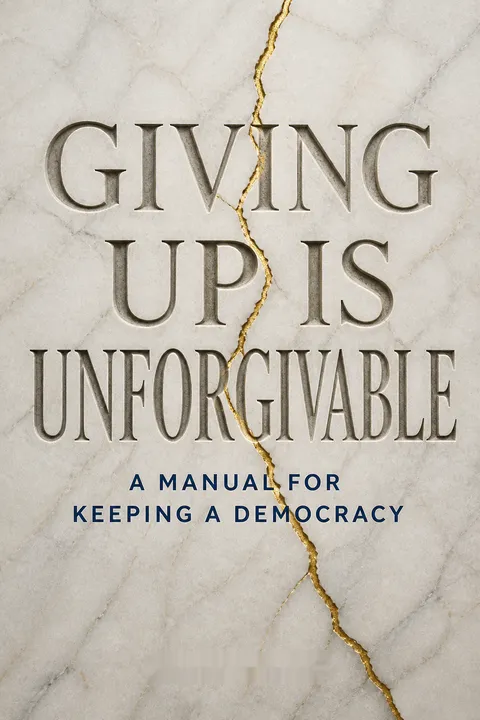


Key Takeaways
Treat gradual attacks on democracy as warnings, not background noise.
Notice the escalation. Vance opens with the familiar frog-in-a-heating-pot story, while acknowledging that it is apocryphal. Its point is about people, not amphibians: when political danger builds incrementally, each new breach can start to feel ordinary. Vance argues that voters had ample warning before the 2024 election, including plans to use government against critics and opponents, yet many were surprised by the speed of the administration's early actions.
Keep your attention active. The book points to more than 140 executive orders in the administration's first 100 days, alongside attacks on federal workers, universities, law firms, and immigration protections. The practical lesson is to assess actions as a pattern, not as isolated headlines. Familiarity with an alarming event does not make it harmless.
What's useful about the frog image is its focus on normalization. Repeated exposure can blunt alarm, especially when each change is small enough to explain away. The metaphor turns attention into a civic skill: compare new actions with constitutional limits and the treatment of earlier targets. Its weakness is that it can imply the public simply failed to notice. People also face limited time, competing needs, and noisy information. A persuasive warning therefore needs more than urgency. It needs credible explanations of what changed, who is affected, and what response is possible.
Make every branch answer to the Constitution, not one leader.
Power needs counterweights. The book presents the Constitution's three branches as a deliberate response to the danger of concentrating authority. In 1803, Marbury v. Madison established judicial review, the power of courts to assess whether government actions conflict with the Constitution. In 1952, Youngstown Sheet & Tube Co. v. Sawyer rejected President Truman's attempt to seize steel mills without authority from Congress or the Constitution. The lesson is not that courts always win, but that presidents remain subject to legal limits.
Checks require participants. Courts cannot act without cases brought by lawyers, and they can decide only the questions before them. Vance also recalls the 1805 Senate decision not to remove Justice Samuel Chase for politically unpopular rulings. Together, these episodes show why litigation, independent judges, and Congress each matter when a president reaches beyond the powers of the office.
The constitutional design is more than a diagram of three boxes. It distributes opportunities to stop an overreach, so that one failure need not end the contest. That redundancy is a strength, but it can also create false comfort: a court ruling has little force if officials refuse to obey it, and a legislature may decline to defend its authority. The cases make legal limits tangible while underscoring a harder truth: institutional checks depend on people willing to use them and a public that accepts lawful outcomes even when disappointed.
Defend institutions without pretending their current occupants are flawless.
Separate structure from performance. Vance argues that American institutions have not simply collapsed, even when officials have weakened their work. The rule of law means government officials, like everyone else, are bound by known laws and independent legal processes. It protects ordinary life as well as abstract rights: contracts, wages, property, and the ability to challenge unlawful detention all depend on rules that are not changed at a ruler's whim.
Watch the theory of power. The unitary executive theory holds that executive authority should be concentrated in the president. Vance describes its extreme form as a justification for demanding loyalty from the federal workforce and resisting checks from Congress and the courts. Her response is to criticize officials who damage institutions, rather than conclude that the institutions themselves are worthless. Reform and accountability are necessary; surrender is not.
This distinction helps avoid two dead ends: treating institutions as sacred and treating them as beyond repair. A court can preserve a constitutional role while its members make decisions that deserve criticism; a civil service can be valuable without every agency being efficient. Institutional defense is strongest when paired with standards for better performance, transparency, and independence. The challenge is to criticize failures precisely. When every flaw is described as proof that the whole system is illegitimate, the distinction between repair and demolition disappears.
Keep democracy because it lets people redirect decisions that shape daily life.
Policy follows participation. Vance's answer to the question of why democracy matters is practical: people can elect representatives, press them to respond, and replace them when they do not. The book traces the United States' changing participation in the Paris climate agreement. Trump withdrew in 2017, Biden rejoined in 2021, and Trump withdrew again in 2025. The reversals show how elections can redirect policy, though they also reveal how fragile long-term commitments become when political priorities swing.
A voice is leverage. The same logic applies to health care, education, housing, and criminal justice. Elected officials have reason to notice what voters demand, especially when those voters organize and keep speaking after election day. Democracy does not guarantee wise policy or quick results. It gives people a means to contest policy and pursue changes without placing their fate entirely in the hands of rulers who cannot be voted out.
The chapter treats democracy as a feedback system: public priorities affect officeholders, and elections provide a means to correct course. The climate example makes that mechanism visible, but also exposes its limits. A policy that changes every few years may be difficult to sustain, even when the underlying problem lasts much longer than an election cycle. Democratic accountability therefore needs ongoing public engagement and durable institutions, not just ballots. The standard is not whether democracy always produces the preferred result, but whether people retain a fair way to challenge it.
Use a flawed system to widen rights, then demand more.
Progress comes through struggle. The American system began with grave exclusions, including slavery and the denial of women's political rights. Vance argues that its imperfections are reasons to fight over who receives its promises, not reasons to abandon the possibility of progress. In 1963, Vivian Malone Jones and James Hood faced Governor George Wallace's resistance as they entered the University of Alabama under federal protection. Their persistence helped open a path for others, though Hood left after only a few months under intense pressure.
Institutions can fail, then be challenged. The Supreme Court's Dred Scott decision denied Black Americans citizenship, and Korematsu upheld the wartime incarceration of Japanese Americans. Later constitutional amendments, civil-rights decisions, public advocacy, and legislative action helped address some of those wrongs. None of this made repair automatic or complete. It shows that citizens can use one institution to challenge another and press the country toward broader inclusion.
The historical cases resist both triumphalism and fatalism. Progress is real, but it is not a straight line, and a later correction cannot erase the suffering caused by an earlier injustice. The book's emphasis on continued struggle also clarifies that institutions are tools, not moral actors: their value depends on who can access them and whether they are held to account. That makes the history demanding rather than comforting. It asks citizens to recognize gains without using them to excuse exclusions that persist.
Require accountability before revisionists turn an attack into patriotic myth.
Memory shapes the next crisis. After the Civil War, broad pardons and incomplete reckoning helped former Confederates recast rebellion as a noble struggle in the Lost Cause story. Vance draws a parallel to January 6, 2021: Republican leaders initially condemned the attack, but the Senate acquitted Trump in his second impeachment trial, 57 to 43, short of the votes needed to convict. The criminal cases against him were later dismissed or delayed after his reelection, while many people who attacked the Capitol received pardons.
Reconciliation is not erasure. Vance argues that the country lost an opportunity to establish responsibility at the top and learn from the attack. The point is not to reject forgiveness, but to recognize that moving on without a truthful account can leave the original threat intact. Without accountability, a story of political violence can be rewritten as a story of heroism, making a future attack easier to excuse.
This argument links justice to public memory. Accountability can mark a boundary around conduct that threatens constitutional government, while a failure to explain what happened leaves a vacuum for mythmaking. Yet accountability must remain lawful and proportionate. Punishing opponents simply because they lost a political struggle would repeat the abuse the system is meant to prevent. The difficult task is to distinguish impartial accountability from revenge, and reconciliation from silence. The book's historical comparison is strongest as a warning about forgetting, not as a claim that the two periods are identical.
Make voting a planned, shared process, not a once-every-four-years ritual.
Follow the whole ballot. Vance describes voting as a four-part process: register, stay registered, cast a ballot, and confirm that it was counted. In 2024, 64.1 percent of eligible Americans voted, meaning many did not participate. Local elections matter too. Mayors, state judges, legislators, sheriffs, and school-board members can shape daily life, and local races may be decided by small margins.
Help remove obstacles. George Sallie, a Selma march veteran in his nineties, was nearly prevented from voting in Alabama's 2020 Democratic primary because he lacked an accepted form of photo ID. A lawyer helped him reach the polling place, where a poll worker who knew him could verify his identity under a provision in the law. The story shows why people can help one another find accurate voting information, arrange rides, or solve practical problems.
The four-step approach turns voting from a single dramatic act into a process that can be checked and supported. It also makes room for social coordination: a reminder, ride, or shared plan can lower the effort required to participate. Still, an individual checklist cannot fix every barrier, and voters should not have to rely on a conveniently present lawyer to exercise a right. The personal work described here is valuable both as direct help and as evidence for the broader case that election rules should be accessible.
Demand evidence before voter-fraud claims become barriers to eligible voters.
Match restrictions to evidence. Vance describes voter fraud claims as a rationale repeatedly used to justify rules that make voting harder, particularly for groups historically targeted by suppression. Research cited in the book found fewer than ten cases of voter impersonation nationwide from 2000 to 2012. A separate review identified 31 credible claims among one billion ballots cast between 2000 and 2014. Those figures do not suggest that election administration should ignore fraud; they question whether broad burdens on voters are a proportionate response.
Check the cost of a rule. Photo identification requirements, voter-roll removals, and proof-of-citizenship proposals can make participation harder for eligible citizens who lack documents, move often, or cannot easily return to an office. Vance urges citizens to scrutinize both the stated purpose and the real effect of election rules. A safeguard should be judged by evidence that it addresses a meaningful risk without needlessly excluding lawful voters.
The important analytical move is to evaluate election rules by both their intended purpose and their distribution of costs. A policy can sound neutral while placing heavier burdens on people with less time, money, transportation, or access to documents. Evidence about rare impersonation helps challenge expansive claims, but it does not resolve every question about election security. The sounder standard is proportionality: define the risk, show that a measure addresses it, and examine who is most likely to bear the burden.
Teach democracy through practice, trusted conversation, and media skepticism.
Make civic knowledge usable. Vance argues that civics education belongs in classrooms and ordinary life: family conversations, book groups, visits to public institutions, and celebrations that explain the history behind national holidays. The book also draws on Finland's media-literacy teaching, where students learn to assess a report's purpose, timing, author, and central claims before accepting it. In a 2023 comparison of information resilience, the United States ranked seventeenth, while Finland and several other northern European countries ranked higher.
Start close to home. Vance's college-age son doubts that protest can change anything, reflecting a generation that has not experienced democracy as reliably responsive. A young voting-rights organizer in Texas found that local elections could make the link between participation and daily issues, such as town policies, more visible to younger voters. Education works best when it builds both knowledge and a lived sense of agency.
Civic education is most persuasive when it connects abstract rules to experiences people can recognize. Media literacy helps citizens slow down before sharing a claim, while local participation can make political influence feel less remote. Neither is a complete antidote to disinformation or political cynicism. A person can evaluate evidence carefully and still disagree about what a policy means; trust also depends on institutions behaving credibly. The section's strongest contribution is its insistence that learning democracy is a continuing social practice, not a one-time school subject.
Choose one durable role; democracy needs citizens, not a rescue fantasy.
There is no substitute cavalry. Vance's central practical claim is that citizens cannot wait for courts, politicians, or lawyers to solve a democratic crisis alone. People can attend protests, contact officials, register voters, tutor students, help neighbors, support local services, or make a point of discussing the Constitution and public life. Small, repeated actions can draw more people into a shared effort without requiring every person to become a public figure.
Set personal limits. Two federal prosecutors, Danielle Sassoon and Hagan Scotten, resigned rather than dismiss a case they believed was being improperly dropped for political reasons. The book presents their decisions as examples of knowing where integrity requires a refusal. Another example comes from a canceled Marine Band student concert: retired military musicians joined the young performers to create a new concert that reached a national audience. Different people can protect democratic values through different kinds of work.
Distributed participation is a more realistic model than waiting for a single heroic intervention. It gives people choices suited to their skills and circumstances, while collective action can make small contributions visible and consequential. The caution is that civic work can become exhausting, especially when framed as an endless personal obligation. A durable role needs boundaries, community, and moments of ordinary life, not just vigilance. The most useful invitation is therefore specific: choose a feasible action, find others who can share it, and keep the commitment sustainable.
Analysis
This book is a legal argument, a historical narrative, and a civic manual written during a fast-moving political crisis. Its central move is to convert constitutional abstractions into everyday stakes: whether a court order is obeyed, whether a worker can be fired for political reasons, whether a voter can cast a ballot, and whether citizens retain a way to change policy. The historical episodes are not ornamental. Marbury and Youngstown explain judicial limits; Selma shows how law, public action, and federal authority can converge; Dred Scott and Korematsu show that institutions can also fail catastrophically.
The book's most useful conceptual distinction is between institutional capacity and institutional performance. Courts, elections, and a professional civil service provide possible checks, but those checks do not enforce themselves. The separation of powers is a design, not a guarantee. It depends on officials who accept limits, litigants who can bring cases, and citizens who recognize why procedural fairness matters even when it protects an unpopular person. This makes the book's optimism conditional rather than complacent: resilience exists, but only when people activate it.
There is also a productive tension between defending democracy and criticizing its failures. Vance argues that abandoning imperfect institutions creates openings for concentrated power, while insisting that citizens demand better from those who operate them. The risk is that readers who already distrust government may hear institutional defense as a request to preserve the status quo. The historical accounts help answer that concern: democratic loyalty is not obedience to every outcome. It is a commitment to contest injustice through public participation and accountable rules.
As a contemporary intervention, the book's partisan frame is explicit, and its examples are selected to support an urgent warning. Readers should distinguish the author's legal analysis from broader claims about political motive, and assess specific events on their evidence. Still, its practical synthesis travels beyond a single election: learn how power is allocated, resist fatalism, protect participation, and help make civic knowledge part of ordinary life. The argument is ultimately less that institutions will save democracy than that citizens must make institutions answer to their promises.
People Also Read






Glossary
Rule of law
Law binds everyoneA system in which laws are publicly knowable, applied consistently, and enforced through independent legal institutions. Government officials are subject to the same legal constraints as other people. In the book, the rule of law is a practical protection against arbitrary power, supporting predictable rights and fair ways to resolve disputes.
Unitary executive theory
Concentrated presidential authorityA theory that executive power belongs to the president and should be controlled centrally by that office. Vance describes its more expansive versions as limiting the independence of executive agencies and resisting checks from Congress and courts. She argues that such a reading can turn an account of presidential authority into a means of accumulating power.
Judicial review
Courts test constitutionalityThe authority of courts to assess whether laws or government actions comply with the Constitution. The book traces the doctrine to Marbury v. Madison, decided in 1803, and presents it as a way for the judiciary to restrain unconstitutional actions by Congress or the president. Courts can exercise this authority only in cases properly brought before them.
Lost Cause
Mythologized Confederate memoryA post-Civil War narrative that recast the Confederacy as a noble cause, often minimizing slavery and portraying rebellion as a principled defense of states' rights. Vance uses the term to explain how incomplete accountability can let political violence be rewritten as patriotic virtue, obscuring the causes and consequences of the original rebellion.
Faction
Interest group against the common goodIn James Madison's usage, a group united by a shared passion or interest that may harm other citizens' rights or the broader public interest. Federalist 10 argues that factions are unavoidable, but a large representative republic with varied interests can make it harder for any one group to dominate government.
Illiberal democracy
Elections without full liberal safeguardsA political system that retains elections while weakening the protections and institutions that make political competition genuinely fair. The book uses Hungary under Viktor Orbán as an example of a leader maintaining elections while tilting the system in his favor. The term warns that the presence of elections alone does not establish a healthy democracy.
Download PDF
Download EPUB
.epub digital book format is ideal for reading ebooks on phones, tablets, and e-readers.








