

Key Takeaways
Judge Christian politics by Jesus's conduct, not the flag it waves
The book's wager. John Fugelsang writes from inside a devout Catholic childhood. His parents, a former nun and Franciscan brother, taught service, forgiveness, and care for vulnerable people. Their faith, he argues, was later used by political figures who preached contempt for the poor, immigrants, and LGBTQ people. His answer is to measure public Christianity against Jesus's actions and teachings, especially his humility, nonviolence, and attention to outsiders.
Faith as a standard. Christian nationalism is the belief that America was meant to be a Christian nation and should be governed according to a particular Christian identity. Fugelsang contrasts this project of dominance with the Bible's red-letter words, a common label for Jesus's sayings in the Gospels. The book is not an argument against belief. It is a case for using Jesus's own teachings to expose faith used as political camouflage.
What's powerful here is the choice to criticize a movement through its own moral vocabulary. This kind of internal critique can reach people for whom an outside attack on religion feels like an attack on family or identity. It also shifts the test from professed belief to observable conduct. The caution is that no single reading of Jesus settles every policy dispute. A fair application needs historical context and room for disagreement, not merely a contest to claim Jesus for one political camp.
Read scripture through genre and context, not selective literalism
A library, not a manual. Biblical literalism, as the book uses the term, treats every biblical passage as direct, factually exact instruction for contemporary life. Fugelsang argues that this approach ignores the Bible's many genres, including poetry, parables, law, and letters written for particular communities. The book points to two different creation accounts in Genesis, differing descriptions of events in the Gospels, and stories such as Jonah's encounter with a great fish to show why context matters.
Consistency is the test. Many self-described literalists do not follow rules about shellfish, mixed-fiber clothing, Sabbath work, or tattoos, yet cite selected passages to condemn minorities. Fugelsang calls this selective interpretation: applying some verses as timeless rules while setting aside others. His practical advice is to ask how a passage fits its historical setting and the moral commitments the reader claims to uphold.
Genre awareness is basic to responsible reading, whether the text is sacred scripture, law, or political speech. It reduces the temptation to treat every sentence as a detachable command. The argument is strongest when it reveals inconsistent standards; it is weaker if inconsistency alone is treated as proof that a passage has no ethical force. Readers can coherently distinguish enduring principles from ancient rules, but they should explain that distinction rather than use it only when convenient.
Keep Paul's letters distinct from Jesus's teachings
Different voices, different settings. Jesus's recorded ministry was a short, local movement among Jewish communities under Roman rule. Paul, who had not met Jesus during his lifetime, later organized communities across the Roman world and wrote letters addressing their immediate disputes. Fugelsang argues that Christians often blur these voices, attributing Paul's statements about sex, gender, and church order directly to Jesus.
Read the letters historically. The book notes that Paul advised celibacy, wrote restrictive instructions about women's roles, and used Greek terms whose meanings remain debated. It also points out that Paul praised women who worked in early churches and urged economic sharing. His letters were eventually included in the New Testament canon, but their later scriptural status does not erase their original contexts. The book's central distinction is not that Paul has nothing to offer, but that his views are not identical to Jesus's.
Distinguishing authors is a form of intellectual hygiene: it prevents a collection of texts from being flattened into one supposedly uniform speaker. The same method applies to constitutions, legal opinions, and institutional archives, where time and circumstance shape meaning. It also guards against caricature. Paul helped build a movement that endured, and his writing contains both hierarchy and generosity. A careful reading can recognize his influence without granting every disputed passage the same status as Jesus's teachings.
Make care for vulnerable people the test of public faith
A concrete moral measure. In Matthew 25, Jesus describes judgment in terms of whether people fed the hungry, cared for the sick, welcomed strangers, clothed the poor, and visited prisoners. Fugelsang treats this passage as a guide not only to private charity but to the conduct of societies. The Bible, he says, returns repeatedly to poverty and justice, while Jesus's teaching makes care for the vulnerable central rather than optional.
Policy has moral consequences. The book connects that ethic to taxes, health care, food assistance, and social safety nets. It also recalls biblical traditions of debt relief and the early Christian community's voluntary sharing of possessions. Fugelsang contrasts direct support for people in need with the promise that wealth concentrated at the top will eventually benefit everyone. The point is not that one party perfectly embodies Jesus, but that policy choices reveal whose suffering is taken seriously.
This argument makes a valuable move from personal virtue to institutional responsibility. In a democracy, voters help shape public systems, so the boundary between private charity and policy is not morally neutral. The underlying question is who bears risk when help is withheld. Still, biblical principles do not mechanically specify program design, budgets, or tradeoffs. Those require evidence about outcomes. The ethical contribution is to keep human consequences visible while policy disagreements are argued on their merits.
Stop using ancient texts to license modern exclusion
Follow the treatment of women. Fugelsang emphasizes that Jesus speaks with women, teaches them, accepts their touch, and includes them in his traveling movement. He highlights the Samaritan woman, whose long conversation with Jesus crosses ethnic and gender boundaries, and Mary of Bethany, who sits as a student. These episodes challenge readings that reduce women to subordinate roles. The book also discusses Mary Magdalene, who is never called a prostitute in the Gospels, despite a long tradition that cast her that way.
Apply the same scrutiny to LGBTQ exclusion. The book argues that Jesus never condemns same-sex relationships, and that passages used against LGBTQ people come mainly from ancient law or later letters. The New Covenant is the Christian belief that Jesus fulfills and supersedes the earlier covenantal law, shifting emphasis toward love, grace, and compassion. Fugelsang notes that translations and historical meanings are disputed, so context matters before using a verse to justify discrimination.
The focus on people Jesus actually encounters is a strong corrective to abstract debates that make marginalized lives disappear. Narrative examples can change moral perception by making exclusion personal rather than theoretical. At the same time, disputed ancient terms cannot be settled by confidence alone, and Christians interpret them differently. A sound case for inclusion should rest on both careful textual work and a clear account of equal dignity, rather than implying that every interpretive question has only one possible answer.
Separate abortion conviction from claims the Bible never makes
A political coalition, not an explicit command. Fugelsang argues that the Bible never directly prohibits abortion and that Jesus never discusses it. He does not claim this proves Christianity is uniformly supportive of abortion rights. Instead, he challenges politicians who present criminal bans as an unmistakable biblical mandate. The book recounts that the Southern Baptist Convention supported legal abortion in resolutions in 1971, 1974, and 1976, before opposition became a defining feature of the religious right.
Ask what the policy does. The author argues that preventing unwanted pregnancies through education and contraception would reduce abortions more effectively than punishment, and describes health risks when abortion care is restricted. His practical point is to distinguish moral opposition to abortion from a claim that government coercion is required by Jesus. He also asks whether policies protect pregnant people and children after birth, not only fetuses before birth.
Separating theological claims from policy claims improves debate: a text may not settle the moral question, and a moral belief does not by itself establish that a ban works. This distinction invites evidence about health, unintended pregnancy, and the consequences of criminalization. The book's historical account also warns against treating today's political alignment as timeless Christian consensus. Because abortion involves competing beliefs about bodily autonomy and fetal moral status, a careful argument should acknowledge those conflicts rather than reduce every opponent to bad faith.
Welcome strangers without confusing border rules with human worth
Hospitality is a repeated command. Fugelsang points to passages in the Hebrew scriptures that tell Israelites to treat foreigners with justice and love, recalling their own history as strangers in Egypt. Jesus extends the same principle through stories such as the Good Samaritan, where a despised outsider acts more compassionately than respected religious figures. In Matthew 25, welcoming the stranger is among the acts by which people are judged.
Law does not erase dignity. The book does not argue that a country cannot regulate immigration. It argues that legal disputes do not justify dehumanizing migrants or ignoring asylum claims. Fugelsang also recalls the Gospel story of Mary, Joseph, and the infant Jesus fleeing to Egypt to escape a threat to the child's life. His challenge is pointed: Christians who honor that family should consider how they treat refugees seeking safety now.
This distinction is useful well beyond immigration: institutions may enforce rules while still recognizing the humanity and rights of the people subject to them. Moral language becomes dangerous when a legal label turns a person into a problem category. The book's scriptural case centers hospitality, but practical immigration policy also involves capacity, procedure, and competing obligations. A humane debate can hold both facts at once: borders exist, and people crossing them remain people deserving due process and safety.
Resist religious stories that turn minorities into national scapegoats
Power often needs an enemy. Fugelsang describes scapegoating as shifting blame for broad social problems onto an identifiable group. He traces how Christians have used scripture to justify slavery, segregation, antisemitism, and hostility toward Muslims and atheists. The supposed Curse of Ham, for example, was used to defend racial slavery even though the biblical passage does not identify Ham's descendants by race. The author also rejects collective blame of Jews for Jesus's death, noting that Roman authorities carried out the execution.
There is another inheritance. Christian reformers, including abolitionists, civil-rights leaders, and religious opponents of segregation, have also used scripture to resist oppression. The point is not that Christianity has a clean record. It is that religious identity can be used either to defend hierarchy or to challenge it, and the historical record includes both.
Scapegoating offers emotional simplicity: one group is blamed, and complex causes seem to disappear. That is why checking the historical record matters as much as checking a verse. The book's strongest contribution is its refusal to let reform traditions erase complicity, or complicity erase reform. The challenge is to apply the same standard to present-day claims about every group, including one's own. A community's moral credibility depends partly on whether it can name harms committed in its name.
Reject violence dressed as faith, from executions to gun worship
The ethic is nonretaliation. Fugelsang reads Jesus's teachings on mercy, forgiveness, and turning the other cheek as a rejection of vengeance, including the death penalty. In the story of the woman accused of adultery, Jesus disrupts a proposed execution by challenging the accusers' right to condemn her. The author argues that this emphasis on redemption conflicts with an irreversible punishment that leaves no room for change.
Do not isolate the sword verse. Luke's account has Jesus tell disciples to obtain swords, a line cited by some Christian gun advocates. Fugelsang says the surrounding passage frames the swords as part of a prophecy about Jesus being treated as a criminal. When a disciple uses one during the arrest, Jesus rebukes him and heals the injured man. The book contrasts this context with a modern Christian nationalism that celebrates militarized images of Jesus.
The attention to context is especially important when a single sentence is used to authorize force. The same applies to political slogans that turn self-defense into a blanket justification for weapons or state violence. A serious counterpoint is that governments also have duties to protect people from harm, so nonviolence raises hard questions about defense and public safety. The book's contribution is not a complete security policy. It is a demand that religious claims confront the human costs of force rather than sanctify them.
Challenge zealotry with evidence, patience, and clear limits
Argue the text, not the caricature. Fugelsang recommends asking questions, citing specific passages, and considering context instead of opening with contempt. A useful discussion begins by finding shared commitments such as compassion and justice, then asks how a particular interpretation fits those commitments. He also warns that a debate may not change the other person's mind. It can still matter to people listening, including family members or coworkers who feel isolated by the dominant view.
Keep the larger story in view. The book opens with the author's parents leaving religious vows to build a family, and closes by presenting that choice as a spiritual decision made in the name of love. Its final distinction is between claiming a Christian identity and trying to follow Jesus's example. The task is to resist cruelty without becoming cruel in return, and to challenge political power without surrendering empathy.
This is a practical account of persuasion under identity threat. Questions can lower defensiveness because they invite a person to explain rather than immediately defend a group. The advice also recognizes that public arguments have multiple audiences: the opponent, observers, and people who may be afraid to speak. Patience has limits, however. Dialogue should not require people targeted by discrimination to endlessly educate their aggressors. Listening is a tool for accountability, not a substitute for boundaries or civic action.
Analysis
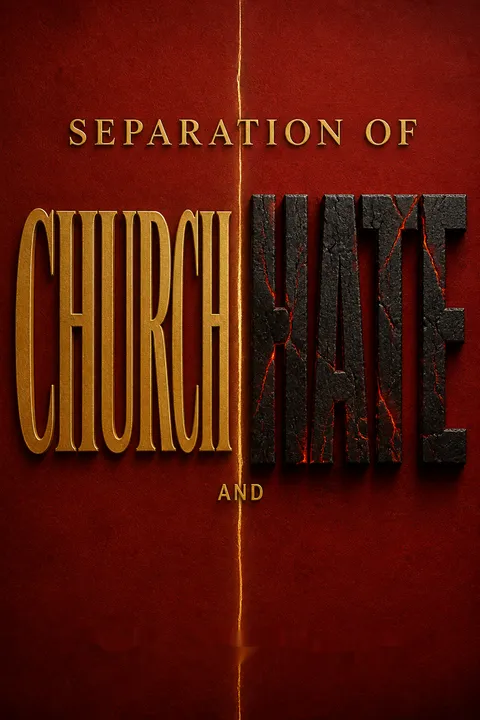
Separation of Church and Hate is a polemical work of religious interpretation, political criticism, and personal narrative. Its organizing move is to treat Jesus's Gospel teachings as an internal measuring stick for claims made in his name. That lets Fugelsang address believers without demanding that they abandon faith, while giving nonbelievers a practical way to engage a political force they cannot simply ignore. The book's family story helps establish that stance: its critique grows out of a household where Christian identity meant service, not a demand for doctrinal conformity.
The most effective method is close reading joined to political history. The author repeatedly asks readers to restore the surrounding verses, identify the speaker, and notice when translations or later traditions shape a modern argument. Matthew 25, the Good Samaritan, and Jesus's response to the arresting party become tests of policy and power. This approach makes selective interpretation visible, and it offers readers concrete questions to use in conversations.
The same strength creates a limitation. The book often presents contested theological interpretations as if they decisively settle contemporary issues. The meanings of ancient words, the relationship between Jesus and Paul, and the political implications of particular passages are debated among scholars and traditions. A strong adaptation should therefore distinguish Fugelsang's argument from uncontested historical fact. Moreover, showing that a policy conflicts with a reading of Jesus does not by itself prove what policy will work best. Empirical questions about health care, poverty, immigration, or gun safety require independent evidence.
Still, the book's central challenge survives those limits: religious authority should be judged by what it produces in public life. Does it protect the vulnerable, constrain domination, and take responsibility for the consequences of its policies? That standard is useful even to readers who do not share the author's theology. Its final invitation is neither to excuse Christianity's record nor to write off all religious people, but to distinguish institutions of power from people trying, however imperfectly, to practice compassion.
Review Summary
Separation of Church and Hate receives mostly positive reviews (4.46/5) for its humorous yet well-researched critique of Christian Nationalism. Readers appreciate Fugelsang's use of biblical scripture to counter fundamentalist arguments on abortion, LGBTQ+ rights, and immigration while emphasizing Christianity's core message of love and compassion. Many find it enlightening and validating, particularly those struggling with reconciling Jesus's teachings with modern right-wing Christianity. Critics note the book's snarkiness, theological inconsistencies, and cherry-picking of scripture—ironically mirroring the behavior it condemns. Some question dismissing Paul's epistles while citing them elsewhere. Overall, readers value its accessibility and humor despite occasional redundancy.
People Also Read









Glossary
Christian nationalism
Faith fused with national ruleA political and religious movement that treats the United States as intended to be a Christian nation and seeks to align public life or government with a particular Christian identity. In the book, this term describes a project of political dominance, not simply personal religious faith or patriotism.
New Covenant
Christianity's renewed divine agreementIn Christian belief, the New Covenant is the relationship between God and humanity established through Jesus's life, teachings, death, and resurrection. Fugelsang uses the concept to explain why Christians generally do not follow ancient Israelite ritual and dietary laws as binding rules, and why Jesus's teachings are central to Christian ethics.
red-letter words
Jesus's sayings in the GospelsA common Christian label for the sayings attributed to Jesus in the Gospels, traditionally printed in red in some Bible editions. Fugelsang uses these passages as a focused ethical standard for assessing claims made in Jesus's name, especially when political arguments rely on other biblical writers or isolated laws.
Seven Mountain Mandate
Religious control of social institutionsA dominionist idea that Christians should gain influence or control over seven areas of society: religion, government, business, education, media, entertainment, and family life. The book argues that this program lacks a direct biblical command and conflicts with Jesus's emphasis on humility and service rather than coercive rule.
liberation theology
Faith focused on ending oppressionA Christian theological approach that places the needs of poor and oppressed people at the center of religious reflection and calls for action against structural injustice. In the book, it represents an active understanding of faith that combines direct assistance with efforts to change systems that produce poverty and exclusion.
prosperity gospel
Faith promised to produce wealthA teaching within some Christian movements that faith, positive speech, and donations can bring material success and good health as signs of divine favor. Fugelsang criticizes it for implying that hardship reflects personal or spiritual failure, and for distracting from Jesus's warnings about wealth and calls to serve others.
Imago Dei
Humanity made in God's imageA Christian theological concept drawn from Genesis, meaning that human beings are created in the image of God. The book invokes it against racial and religious hierarchies: if every person bears God's image, no group can claim superior human worth or use faith to deny others dignity.
Download PDF
Download EPUB
.epub digital book format is ideal for reading ebooks on phones, tablets, and e-readers.








