

Key Takeaways
Treat perception as a survival interface, not a transparent window on reality.
The mystery of experience. Split-brain surgery helped patients with severe epilepsy, but it also revealed how much mental life depends on communication between the brain’s hemispheres. In experiments, one hemisphere could guide a hand to choose an object while the speaking hemisphere could not explain the choice. Brain activity can be linked to experiences such as color and touch, yet correlations do not explain why activity feels like anything at all. Hoffman argues that the assumption that brains produce consciousness may be part of the puzzle.
A useful interface. The book compares perception to a computer desktop. A blue file icon helps someone use a computer, but it does not show the file’s underlying circuitry or data. Likewise, visible objects may guide action without depicting reality’s underlying nature.
The split-brain findings make a powerful case that familiar unity of self is assembled from cooperating processes, not simply given. They do not, by themselves, show that consciousness is independent of brains: disrupting a system can divide its capacities without revealing what experience fundamentally is. The desktop metaphor usefully separates a representation’s practical job from its literal accuracy. Its limit is that an analogy is not yet an explanation of the hidden world. The book’s strongest opening move is therefore diagnostic: correlation-rich neuroscience has not settled the explanatory question.
Evolution may reward fitness-coded perception over truth-tracking.
A theorem with a scope. The Fitness-Beats-Truth (FBT) Theorem is a mathematical result in an evolutionary game model. It compares a strategy that represents reality’s structure with one that tracks fitness payoffs, meaning the consequences of actions for an organism’s survival and reproduction. The theorem says that, under its formal assumptions, selection tends to eliminate truth-tracking strategies. In a simplified example, a creature must find a resource that is beneficial only in an intermediate amount. Knowing merely whether there is more or less of it does not tell the creature whether to approach. A perception that marks safe versus dangerous payoffs is more useful.
The point is not that perception is useless or randomly wrong. It is that usefulness and literal accuracy can come apart, especially when payoffs depend on the organism, its needs, and its rivals.
The evolutionary game framing clarifies a real distinction: information about the environment is not automatically information about what an organism should do. A food source can help one species and harm another. That makes fitness-sensitive perception plausible. The more expansive claim, that selection almost surely eliminates every perception preserving reality’s structure, depends on the theorem’s formal setup and on how its strategies and payoffs represent real organisms. The result challenges a common evolutionary argument for accurate perception, but it should be read as a model-based challenge, not a settled empirical verdict about human vision.
Beauty is a fast, fallible estimate of reproductive opportunity.
A verdict from many clues. Hoffman presents beauty as an unconscious estimate of reproductive potential, not as a direct reading of someone’s worth. The male jewel beetle illustrates the system’s vulnerability: some males mistake shiny, dimpled beer bottles for female beetles and attempt to mate with them. Humans are not immune to misleading cues. The book describes experiments in which observers preferred faces with prominent limbal rings, the dark borders around the iris. The rings can signal youth and eye health. Men also preferred larger irises in female faces, a feature associated with youth.
Signals can be gamed. The book also describes how mate preferences can reflect tradeoffs, including between signs of good genes and signs of likely parental investment. An attraction response is a compressed estimate, not a guarantee.
This account makes attraction legible as a fast judgment built from cues, while the beetle story exposes how a once-useful shortcut can misfire in a changed environment. The same logic appears in other signaling systems: a signal can be informative, deceptive, or both, depending on context. The framework should not be mistaken for a complete account of human desire. Preferences vary across people and settings, and some evolutionary explanations remain contested. The practical lesson is modest: appearance can affect perception, but a biological hypothesis about a cue does not establish a person’s value or prescribe how anyone should behave.
Take sensory icons seriously without treating them literally.
Useful does not mean literal. Hoffman calls the confusion between taking perception seriously and taking it literally the Serious-Literal fallacy. A warning sign for radiation matters because it guides behavior, though its graphic symbol does not resemble radiation itself. In the same way, a perceived snake warrants caution even if the experience is not a picture of reality as it exists independently of anyone observing it. The interface theory of perception (ITP) extends this idea: space and physical objects are useful icons shaped by evolution to guide action.
A vanilla flavor makes the distinction intuitive. The book notes that the molecule vanillin has a chemical structure unlike the taste experience it prompts. Taste can guide eating without depicting molecular structure. Hoffman argues that objects may serve the same kind of practical role.
This distinction is valuable well beyond perception. Maps, gauges, and legal categories can guide consequential decisions without resembling everything they represent. Their reliability is judged partly by what they help users do. Yet usefulness alone cannot show that a representation contains no information about its target. A road map is selective and simplified, but still preserves some relationships among roads. The interface metaphor therefore opens a productive question: which features are merely convenient display choices, and which preserve dependable structure? It is more compelling as a challenge to naïve realism than as proof that perception tells nothing about the world.
Quantum physics weakens simple realism, but does not prove perception creates reality.
Experiments unsettle intuitions. Bell-test experiments compare correlations between measurements of entangled particles. Their results conflict with local realism, the combination of the idea that properties have definite values before measurement and the idea that influences cannot travel faster than light. The Kochen-Specker result challenges a related assumption: that a property has a definite value independent of how it is measured. These findings make observer-independent descriptions harder to defend in their simplest form.
Interpretation remains open. Hoffman connects these results to his proposal that perceptions are observer-specific interfaces. But the experiments do not establish that human consciousness creates particles, or that objects disappear whenever nobody looks. They constrain physical theories and challenge particular realist assumptions. They do not select one complete interpretation of quantum mechanics.
The book is right to use quantum physics as a reason to question everyday intuitions about measurement and properties. It is equally important to keep the inference narrow. Bell-test violations reject a package of assumptions, not every possible form of realism; quantum theory has multiple interpretations, and measurement need not mean conscious observation. This distinction guards against turning scientific strangeness into a blank cheque for any metaphysical claim. The physics supports caution about a simple, observer-free picture. It does not independently verify the full interface theory.
Think of spacetime as a compressed, error-correcting code.
A proposed data format. Hoffman suggests that space, time, and objects compress complex information about fitness into a manageable format. An organism cannot process every feature of its environment, so perception presents a smaller set of actionable signals, such as an object’s shape, color, and distance. The holographic principle in physics offers an intriguing parallel: in certain theories, the information describing a region can be represented on its boundary rather than throughout its volume.
Perception fills gaps. In visual illusions, the mind can complete a line that appears interrupted or infer a three-dimensional cube from a flat drawing. Hoffman interprets such completion as error correction: the perceptual system uses redundancy to recover a useful message despite missing information. He proposes that spacetime’s structure similarly helps encode and protect useful information.
The coding analogy links perceptual science with information theory, where compression removes detail and redundancy helps detect errors. It also helps explain why a quick, imperfect response can be adaptive: mistaking a hose for a snake briefly may cost energy, while failing to react to an actual snake could be fatal. The analogy should not be confused with a demonstrated evolutionary explanation of the holographic principle. In physics, that principle has a technical role, while its connection to fitness-oriented perception is Hoffman’s proposed bridge. That bridge is imaginative and testable in spirit, but remains a hypothesis.
Attention spends detail only where fitness may be at stake.
Vision is selective. The book reports that sharp vision occupies only a small area around the point of gaze, roughly two degrees across, while the eyes jump between fixations several times each second. People therefore experience a richly detailed scene without processing every part at once. Change-blindness experiments reveal the gap: observers can overlook substantial differences between images until attention lands on the altered feature.
Attention can be steered. Color, contrast, size, motion, and orientation can make an item stand out. The book also describes experiments in which changes to people or animals were noticed faster and more accurately than changes to inanimate objects. In advertising, a model’s gaze or pointing hand can direct viewers toward a product, or accidentally send their attention elsewhere.
Selective attention is a scarce-resource problem: the brain cannot inspect every signal at equal resolution, so it prioritizes what seems relevant. This connects naturally to the economics of search, where limited time makes filtering essential. It also explains why visual design is not decoration added after a message; it helps determine whether the message is noticed at all. Still, ancestral priorities do not automatically predict attention in every modern context. Learning, goals, expertise, and culture alter what stands out. Designers can use these tendencies, but effective attention capture is not the same as meaningful communication.
Color and synesthesia reveal how contingent our sensory formats are.
Color is a compact code. Human color vision samples only a narrow band of light and compresses it through three kinds of cone receptors and rods. Other organisms detect different ranges: the book notes that Arabidopsis has eleven kinds of photoreceptors and a cyanobacterium may have twenty-seven. Color can guide behavior without being a feature of reality as experienced by every species.
Hoffman coins chromature for a combination of color and texture. A green textured pattern can suggest edible broccoli, while another green pattern can suggest an unripe strawberry. Synesthesia makes the variability even more vivid. Michael Watson experienced tastes as tactile shapes, describing mint as a smooth, cool column. Such perceptions can be consistent and useful, despite differing from the usual human format.
Sensory diversity is a strong reminder that a species’ perceptual world is not the only possible one. Ecology shapes what information is useful: a bird, a plant, and a human encounter different signals and have different sensory equipment. Synesthesia adds variation within one species, showing that unusual experiences need not be mere confusion. But variation does not establish that all formats are equally useful, or that external structure is absent. Different instruments can register different aspects of the same environment. The evidence challenges a single, human-centered picture of perception more directly than it settles what lies beyond perception.
Treat consciousness-first realism as a research proposal, not a discovery.
A different starting point. Hoffman argues that physicalist theories have not explained how neural activity produces particular experiences, such as tasting coffee or seeing red. He proposes conscious realism: the idea that consciousness is fundamental and that reality consists of interacting conscious agents. A conscious agent is defined by possible experiences, possible actions, and probabilistic rules linking perception, decision, and action. Networks of such agents are meant to provide a foundation from which spacetime and physics could emerge.
A demanding test. The proposal is not simply that every physical object has a mind. It denies that perceived objects are the fundamental furniture of reality. To become a scientific theory, it must explain established physics and evolution, and produce predictions that experiments can distinguish from alternatives.
The proposal takes the explanatory gap seriously rather than declaring subjective experience an illusion or an unexplained extra. Its mathematical formulation is a useful virtue because precision can expose assumptions and invite tests. But mathematics that describes agents does not, by itself, demonstrate that those agents exist fundamentally or explain why their states feel the way they do. The crucial scientific work is to derive known results and generate distinctive predictions. Until that happens, conscious realism is best treated as a research program with an ambitious ontology, not as a conclusion established by the failure of current theories.
Analysis
The book’s most durable contribution is a distinction between perceptual usefulness and perceptual truth. A creature can act successfully using signals that summarize consequences rather than depict underlying causes. That point is intuitively strong, and examples from camouflage, visual attention, and sensory variation make it memorable. It also corrects a common oversimplification: evolution selects for reproductive success, not for truth as an abstract virtue.
The argument becomes more controversial when it moves from that distinction to the claim that evolved perception is almost certainly unable to preserve any structure of objective reality. The FBT Theorem is a formal result within a specified game-theoretic model. Its application to human perception depends on whether the model’s assumptions, strategy definitions, and payoff structures capture the relevant features of biological evolution. A system can track useful consequences while also preserving some stable relationships in its environment. Those possibilities need not be mutually exclusive.
The physics discussion requires similar discipline. Bell experiments and contextuality results challenge particular combinations of assumptions about measurement and properties. They do not show that conscious observers bring the universe into existence, nor do they settle whether spacetime emerges from information, agents, or another structure. Hoffman’s synthesis is a provocative interpretation, not a consensus result of physics.
The final proposal, conscious realism, names a possible response to the hard problem: treat consciousness as basic rather than trying to derive it from matter. Its formal language makes the proposal clearer, but formalization alone is not empirical confirmation. A successful theory would need to explain why particular physical measurements correlate with particular experiences, recover existing physics, and offer tests that distinguish it from rivals.
The book is most persuasive as a disciplined provocation. It asks readers to stop equating a useful representation with a literal picture of reality. Its more expansive metaphysical claims remain open questions. Keeping those levels separate preserves the force of the central insight without mistaking an intriguing model for a proven account of the universe.
Review Summary
Reviews of The Case Against Reality are mixed. Many find the book thought-provoking, praising Hoffman's challenge to conventional perceptions of reality. Some appreciate his evolutionary and cognitive science arguments. However, critics argue the ideas are repetitive, poorly explained, and lack scientific rigor. Several reviewers find the quantum physics discussions confusing and the conclusions about consciousness unconvincing. While some see the book as groundbreaking, others view it as an overreach of philosophical speculation dressed as science.
People Also Read







Glossary
Fitness-Beats-Truth (FBT) Theorem
Selection favors payoff-trackingA mathematical result developed by Hoffman and Chetan Prakash within an evolutionary game-theory framework. It compares perceptions that represent environmental structure with perceptions tuned to fitness payoffs. Under the model’s assumptions, payoff-tracking strategies tend to outcompete truth-tracking ones. The theorem is a formal result about that framework, not an uncontested empirical law describing every perceptual system.
interface theory of perception (ITP)
Perception as an adaptive interfaceHoffman’s theory that evolution shapes perception to guide useful action rather than to reveal reality as it exists independently of an observer. It treats objects, colors, shapes, and spacetime as interface elements that encode information relevant to an organism. The interface can be useful and consequential without being a literal depiction of whatever underlies experience.
Serious-Literal fallacy
Confusing usefulness with literal truthHoffman’s name for assuming that a perception must literally depict reality because it must be taken seriously in practice. A perceived snake, for instance, can warrant immediate caution without proving that reality contains an independently existing object with exactly the experienced appearance. The term marks a distinction between an experience’s practical consequences and its status as a literal picture.
perceive-decide-act (PDA) loop
Experience guides actionA model of an agent interacting with a world through three linked processes: perception, decision, and action. The agent receives an experience, selects an action, and acts in ways that affect subsequent experience. In Hoffman’s framework, natural selection shapes this loop so that experiences tend to guide actions with useful fitness consequences.
chromature
Color combined with textureHoffman’s term for a patterned combination of color and texture. A chromature can carry more specific sensory information than a uniform color patch. For example, different green textures can suggest different foods and prompt distinct reactions. Hoffman argues that chromatures form a rich channel for communicating cues relevant to action and fitness.
conscious realism
Consciousness as fundamental realityHoffman’s proposed ontology in which consciousness, rather than spacetime and unconscious physical objects, is fundamental. It describes reality as a network of interacting conscious agents, with familiar physical objects and spacetime emerging as features of perceptual interfaces. The proposal is distinct from panpsychism, which attributes consciousness to physical objects or their components.
conscious agent
An experiencing, acting systemA formally defined entity with possible experiences, possible actions, and probabilistic rules for perceiving, deciding, and acting. In the book, conscious agents can interact and combine into networks or more complex agents. The mathematical definition specifies a framework for modeling these processes; it does not by itself prove that consciousness is fundamental or explain the felt quality of experience.
Invention of Symmetry Theorem
Perceptual symmetry need not mirror realityA theorem proposed by Hoffman and Prakash stating that symmetries in perception do not, by themselves, entail matching symmetries in objective reality. Its constructive argument describes how perceptual systems can exhibit regularities such as rotation or reflection even if the world underlying those perceptions lacks the corresponding structure. Hoffman links such regularities to efficient coding and error correction.
holographic principle
Boundary data encode a regionA principle in theoretical physics stating that, in relevant frameworks, the information associated with a region of space can be represented on its boundary. It arose from work on black-hole information and entropy. Hoffman connects this principle to the idea that perceived three-dimensional space could be a compact, redundant data format, while treating that evolutionary interpretation as a proposal.
FAQ
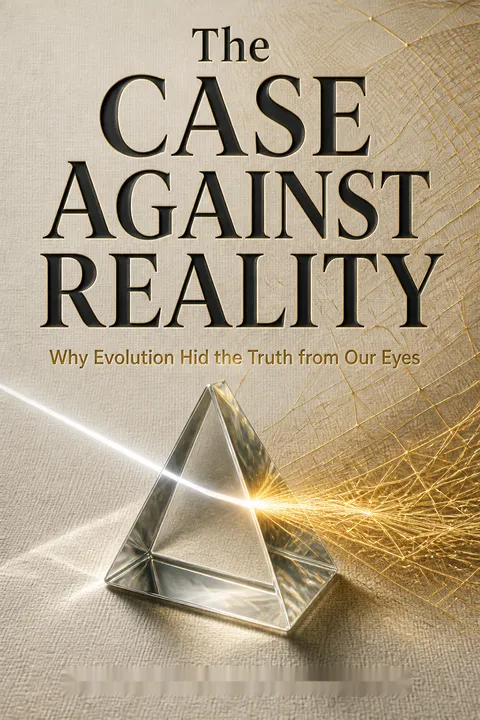
What's The Case Against Reality about?
- Core Thesis: The book argues that our perceptions are not reflections of objective reality but evolved interfaces that prioritize survival over truth.
- Evolutionary Perspective: Hoffman introduces the Fitness Beats Truth (FBT) theorem, suggesting that natural selection favors perceptions that enhance survival rather than accuracy.
- Interface Theory of Perception: It presents the idea that our senses act like a computer interface, simplifying reality to help us navigate the world.
Why should I read The Case Against Reality?
- Challenging Assumptions: The book invites readers to question deeply held beliefs about perception and reality, making it thought-provoking for those interested in philosophy and science.
- Interdisciplinary Insights: Hoffman integrates concepts from evolutionary biology, cognitive science, and physics, offering a comprehensive view of perception.
- Practical Applications: The ideas can be applied to fields like marketing and design, emphasizing the role of perception in decision-making.
What are the key takeaways of The Case Against Reality?
- Perception as an Interface: Our senses provide an interface shaped by evolutionary pressures, prioritizing fitness over accuracy.
- FBT Theorem: The theorem asserts that perceptions enhancing survival are favored, challenging the notion of veridical perception.
- Spacetime and Objects: The book argues that spacetime and objects are constructs of our perceptual interface, not fundamental realities.
What is the Interface Theory of Perception (ITP)?
- User Interface Analogy: ITP suggests our perceptions function like a computer interface, simplifying reality to aid navigation.
- Messages About Fitness: Perceptions are messages about fitness, not reflections of objective reality, shaped by evolutionary pressures.
- Implications for Science: ITP challenges traditional views, suggesting a new framework for understanding consciousness and perception.
What is the Fitness Beats Truth (FBT) theorem?
- Core Concept: The FBT theorem posits that natural selection favors perceptions that enhance fitness over those that reflect truth.
- Mathematical Proof: Hoffman provides a framework showing that as complexity increases, the likelihood of perceiving truth approaches zero.
- Implications for Perception: It suggests our perceptions are not reliable indicators of reality, focusing on survival benefits.
How does evolution shape our perceptions according to Hoffman?
- Survival Mechanism: Evolution shapes our senses to prioritize survival-enhancing information over accurate depictions of reality.
- Fitness Payoffs: Perceptions convey messages about fitness payoffs, guiding actions based on survival potential.
- Distorted Reality: Our understanding of the world is fundamentally distorted by evolutionary pressures.
How does The Case Against Reality relate to modern physics?
- Spacetime is Doomed: Hoffman discusses the idea that spacetime is not fundamental, aligning with contemporary physics theories.
- Quantum Mechanics: The book parallels quantum mechanics, suggesting both challenge traditional notions of reality.
- Holographic Principle: References to the holographic principle support the idea that perceptions are encoded information about fitness.
What role does consciousness play in The Case Against Reality?
- Consciousness as Fundamental: Hoffman suggests consciousness is a fundamental aspect of reality, not a byproduct of physical processes.
- Conscious Agents: The universe may be a network of conscious agents, each with unique experiences and interactions.
- Implications for Understanding Reality: This perspective invites reconsideration of the mind-matter relationship, impacting philosophy and neuroscience.
What are the best quotes from The Case Against Reality and what do they mean?
- “You may want truth, but you don’t need truth.”: Highlights the evolutionary focus on survival over truth.
- “Perception is not a window on objective reality.”: Emphasizes that perceptions are tools, not direct reflections of reality.
- “The probability is zero that we see reality as it is.”: Captures the argument that perceptions are fundamentally flawed.
How does the author use examples to illustrate his points in The Case Against Reality?
- Beetles and Bottles: Illustrates how perceptions can lead to maladaptive behaviors, highlighting the disconnect from reality.
- Necker Cube: Demonstrates how perceptions can shift, showing their constructed nature.
- Miracle Berry: Shows that sensory experiences are unreliable indicators of reality, shaped by evolutionary pressures.
What are the implications of The Case Against Reality for our understanding of truth?
- Truth as a Construct: Suggests truth is shaped by perceptions and evolutionary history, challenging the notion of a single, verifiable truth.
- Subjective Experiences: Emphasizes unique individual experiences, complicating the idea of shared truth.
- Reevaluation of Knowledge: Encourages reevaluation of how we acquire knowledge, considering perceptual limitations.
What role do conscious agents play in Hoffman's theory?
- Fundamental Reality: Conscious agents are proposed as the fundamental building blocks of reality, not physical objects.
- Dynamic Interactions: Each agent perceives, decides, and acts, influencing others and shaping reality.
- Mathematical Framework: The theory allows for precise predictions and analysis of consciousness and perception.
Download PDF
Download EPUB
.epub digital book format is ideal for reading ebooks on phones, tablets, and e-readers.








