

Key Takeaways
Use AI to buy back time, then choose what that time is for.
Time is the real prize. The book treats ChatGPT less as a novelty than as a way to clear routine work: drafting emails, summarising reports, planning events, and getting started on unfamiliar tasks. A study by Noy and Zhang, cited in the book, found that people using generative AI on writing tasks completed work 35 to 50 percent faster, with quality improving by as much as 25 percent. Those results support AI as a productivity aid, not a guarantee for every job or task.
Speed needs a purpose. Technology has often made individual tasks quicker without making people feel less busy. The benefit only becomes leisure if people deliberately protect the time saved for rest, family, or meaningful work.
The distinction between efficiency and a better life is central. In organizational economics, productivity gains can be captured by employers, passed to customers, or enjoyed as leisure. The tool alone does not determine who benefits; workplace norms and personal boundaries do. The cited study offers encouraging evidence for specific writing tasks, but its results should not be treated as a universal forecast. A useful test is not simply whether AI saves minutes, but whether those minutes return to the person doing the work.
Treat fluent answers as drafts, not evidence.
Plausibility is not proof. ChatGPT generates language by predicting likely next words from patterns in training data. That can produce clear explanations and convincing prose, but the system may also fill gaps with invented facts. The book recounts asking for calendar instructions and receiving detailed steps for a settings tab and calendar integration that did not exist. It also describes a fabricated Winston Churchill quotation presented with confidence.
Check what matters. The book advises verifying important claims, especially citations, medical or financial guidance, and practical arrangements. Asking the chatbot for sources can help, but its references may also be inaccurate or fabricated. For consequential decisions, consult reliable primary sources or qualified people rather than treating a polished answer as confirmation.
This is a problem of misplaced trust, not merely occasional factual error. People often use fluency, detail, and confidence as shortcuts for judging credibility, even when those cues do not establish truth. ChatGPT can be valuable for generating explanations or a first map of a topic, but verification must be a separate step. The distinction also suggests a practical division of labor: let the model produce possibilities, then use evidence and expertise to decide which possibilities survive.
Give the model your situation, goal, and desired voice.
Context improves the answer. The book’s prompt-building guide is called Perspective, Purpose, Personality. Perspective explains the situation, such as who the audience is and what is happening. Purpose states what the response should accomplish. Personality sets the tone or style. A request for breakfast ideas becomes more useful when it explains that a family has three children, rushed mornings, and only ten minutes to prepare food.
Aim for useful detail. A vague request tends to produce generic suggestions, while an overloaded prompt can obscure the task. Share the constraints that shape a good answer, such as audience, time, budget, or dietary needs. Clear instructions give the system a better chance of producing something relevant, though they cannot guarantee accuracy.
This framework resembles a good human delegation brief: explain the situation, define success, and specify how the work should be delivered. It also makes hidden assumptions visible. A prompt that names a time limit or audience forces the user to clarify the problem before asking for a solution. That is valuable even when the result is mediocre. The limitation is that users may not know which context matters, so prompts are best treated as working hypotheses, not as a formula that reliably controls every response.
Keep prompting until the output fits the real problem.
Make it a conversation. ChatGPT can respond to follow-up questions, revise a draft, change tone, or add constraints. The book recommends asking for several options rather than settling for the first suggestion, then narrowing the choices through dialogue. Its examples include requesting more affordable or sustainable shops after getting Paris travel recommendations, and asking for an itinerary to group activities more closely together.
Use different angles. Prompts can explore a topic broadly, request step-by-step guidance, invite critique, or ask the system to argue against a popular view. A first answer is often most useful as material to react to. Tell the model what missed the mark, what to remove, and what additional requirement it should respect.
Iterative prompting shifts the user from passive recipient to active editor. That resembles design practice, where prototypes expose assumptions and feedback improves the next version. Asking for opposing arguments or multiple angles can also reduce premature attachment to the first plausible idea. Still, iteration is not verification: a model can become more specific while remaining wrong. Refinement improves fit to the request, whereas independent checking is needed to establish whether the answer fits reality.
Delegate repetitive first drafts, summaries, and meeting admin.
Clear the clerical bottleneck. At work, the book presents ChatGPT as a virtual assistant for drafting emails, proofreading, outlining presentations, generating interview questions, summarising documents, and brainstorming options. One team recorded a meeting, transcribed it, and asked ChatGPT to turn the transcript into action points. A follow-up prompt identified tasks with owners or deadlines. The process took under two minutes, according to the account.
Keep the people involved. The team still needed to fill in missing owners and dates, and the book warns that summaries can omit important details. Meeting participants should consent to recording, and confidential material should not be pasted into a service without understanding its data practices. The strongest use is to reduce tedious processing so colleagues can focus on discussion, decisions, and follow-through.
Meeting notes illustrate a high-value kind of automation: converting unstructured material into a format people can act on. This is cognitive offloading, the use of external tools to reduce memory and organization demands. It can make collaboration easier, but convenience can also hide omissions or turn a disputed conversation into an apparently authoritative record. Teams should preserve access to the original transcript and confirm assignments with participants. The tool can organize the record; it cannot decide what the group actually agreed to.
Apply the same assistant to home life, but verify consequential plans.
Life admin counts as work. ChatGPT can suggest meals around a budget or dietary preference, turn a meal plan into a grocery list, draft a polite complaint, propose workouts, or help organize a birthday party. The book describes a student using it to write a successful appeal of a parking fine, which saved her £60. Such tasks are often small individually, but their accumulation consumes attention.
Check the logistics. A travel itinerary suggested visiting Bonnieux from the Luberon, but its public-transport directions were misleading. Checking a map showed that nearby locations were much closer by car, and that the described train route was not available as stated. The model helped generate destinations, but a person needed to check whether the proposed journey made sense.
Home administration is often invisible labor: planning meals, coordinating schedules, and composing uncomfortable messages. A flexible language tool can lower the effort required to begin these tasks, which may be especially useful when one person carries much of the household load. But personalization is not professional competence. Food allergies, exercise plans, financial choices, and travel logistics can have real consequences. The more costly an error would be, the less appropriate it is to rely on an unchecked generated answer.
Let AI start the work, while humans supply judgment and lived detail.
A draft is a beginning. The book argues that ChatGPT is most useful for overcoming the blank page, generating options, or turning rough material into a workable structure. A person with dyslexia used an AI-powered tool to transform informal notes into professional client emails, while also learning from the rewritten examples. The author likewise used ChatGPT to generate material for her book, then edited, revised, and reshaped it to retain her voice and purpose.
Keep the human contribution visible. Generated copy may be repetitive, generic, or short on empathy and specific experience. Review it for accuracy, tone, originality, and the details only the writer knows. When a task depends on relationship, expertise, or personal accountability, those responsibilities remain with the human using the tool.
The book’s strongest model is augmentation rather than replacement. A rough draft can lower the activation energy of writing, while a language-support tool can widen access for people who find spelling or formal prose difficult. Yet polished text can conceal thin reasoning or erase a writer’s distinctive experience. Human editing is not cosmetic cleanup; it supplies context, values, and accountability. The practical question is therefore not whether AI contributed, but whether a responsible person can stand behind the final work.
Protect private information and challenge the assumptions inside AI outputs.
Risks travel with convenience. The book warns that information entered into ChatGPT may be used in ways users do not expect, so confidential, commercial, or sensitive personal details should be handled cautiously. It also describes risks from AI-assisted scams and misinformation, since generated messages can sound convincing. Bias is another concern: systems can reproduce patterns in their training data. In one example, a response to a lonely user assumed a particular gender and offered an oddly specific form of companionship.
Automation changes work. Some tasks may be displaced, while other jobs and responsibilities may change. The book notes both fears of job loss and forecasts of new work, including roles focused on improving prompts. Neither outcome makes every worker safe or every prediction certain. Use AI critically, and consider who benefits and who bears the costs.
Privacy, bias, and employment are not separate side issues; they shape who can safely use a system and who is affected by its outputs. A useful governance habit is data minimization: provide only the information required for the task. Bias checks also need more than a personal reaction, because a response that seems harmless to one user may stereotype another group. Job forecasts are especially uncertain, so the more grounded response is to examine how specific tasks change rather than make sweeping promises about entire occupations.
Build AI skill through low-stakes experiments, not abstract speculation.
Learn by trying. The book urges readers to test ChatGPT with ordinary tasks, compare its answers with other sources, and notice where it helps or fails. Start with a harmless question, then try asking for a shorter explanation, a different tone, several alternatives, or a step-by-step account. Voice-to-text can also make it easier to describe a problem aloud and turn that description into a prompt.
Carry the skill across tools. The specific applications and features described in the book were changing rapidly even as it was written. The durable capability is learning to explain a task clearly, evaluate the result, and revise the request. That practice helps users make informed choices about new tools without assuming that every new feature is useful or safe.
Small experiments build practical literacy more effectively than either hype or blanket rejection. They reveal what a system does well, what kinds of errors it makes, and what work still requires human knowledge. This is also a form of calibration: users learn how much confidence to place in different outputs. Experimentation should remain bounded, however. A low-risk trial is sensible; exposing sensitive information or relying on an untested system for a high-stakes decision is not the same kind of learning.
Use saved minutes to reclaim leisure, not expand your workload.
Efficiency can raise expectations. The book points out that faster tools can make people less tolerant of waiting and encourage organizations to expect more output in less time. If an email that once took an hour now takes minutes, the recovered time can disappear into another meeting or another assignment unless someone protects it.
Choose the return. Before using AI to accelerate a task, decide what the saved time should make possible: finishing work earlier, spending time with family, resting, or concentrating on work that needs human expertise. The tool can reduce friction, but it cannot set a humane pace on its own. Boundaries around notifications, availability, and workload remain part of using it well.
This closing insight connects personal productivity to the broader question of how technological gains are distributed. Faster work can create genuine freedom, but it can also reset the baseline for what counts as an acceptable workload. That rebound is not inevitable; institutions and individuals make choices about how efficiency is used. The book’s emphasis on leisure therefore works best as a practical commitment, such as blocking protected time, rather than as a hope that productivity tools will automatically deliver balance.
Analysis
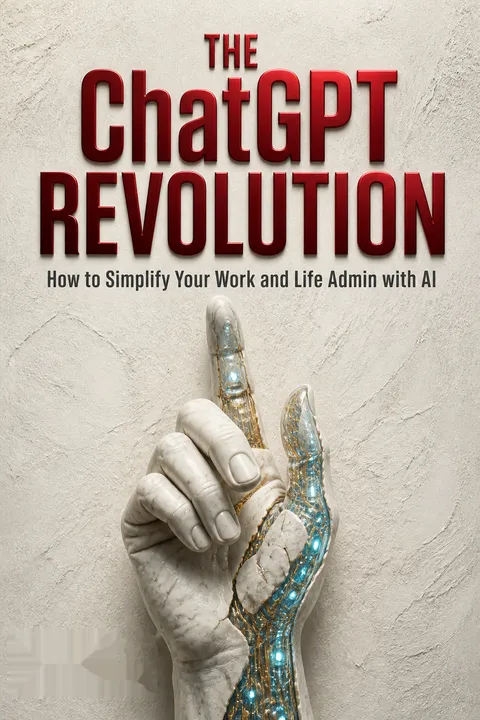
The ChatGPT Revolution is a practical guide to using an early generation of conversational AI for the small, repetitive tasks that crowd out more meaningful work. Its structure moves from basic orientation and prompting to workplace and household applications, then toward creative uses and emerging tools. The organizing argument is straightforward: AI becomes valuable when people use it to reduce administrative friction, while retaining responsibility for what it produces and how saved time is spent.
The book is most useful when it shows the difference between a promising task and a finished result. The fabricated calendar instructions and flawed travel directions expose a key limitation: fluent language can simulate competence without confirming that a process exists or a route works. The meeting-summary and email examples show the complementary strength: turning rough or unstructured material into a draft that a person can review. Together, these cases offer a more reliable mental model than either “AI is a person” or “AI is just search.” It is a flexible language tool whose outputs need context, judgment, and verification.
Its practical range is notable. Work examples include hiring documents, client communications, summaries, brainstorming, and meeting actions. Home examples include meal planning, complaint letters, travel, gifts, and homework support. The book also recognizes accessibility, showing how rewriting can help a dyslexic business owner communicate professionally. These applications are less about spectacular machine intelligence than reducing the cost of getting started.
The limitation is evidential. Many examples are personal anecdotes, and the productivity study cited is not proof that every role will gain the same amount. The book was written during a fast-moving period, so specific products and features should be read as historical snapshots. Its durable contribution is the method: describe the task clearly, experiment, inspect the output, and keep sensitive or consequential decisions under human control. Most importantly, treat efficiency as a chance to reclaim time, not an obligation to produce more.
Review Summary
The reviews for The ChatGPT Revolution are mixed, with ratings ranging from 1 to 5 stars. Positive reviews praise the book for its concise introduction to ChatGPT, practical applications, and time-saving tips. Critics find it repetitive, dry, and lacking new information. Some readers appreciate the examples and prompts provided, while others suggest the content could be found in online blogs. The book is generally considered helpful for beginners but may be less valuable for those already familiar with AI prompting.
People Also Read








Glossary
Prompt
Instruction given to AIA prompt is the question, instruction, or context a user gives ChatGPT to guide its response. It can request information, a draft, a summary, or a particular style. The book emphasizes that useful prompts explain the situation, the goal, and relevant constraints, and that follow-up prompts can refine the initial answer.
Perspective, Purpose, Personality
Three parts of a promptThe book's prompt-building guide asks users to specify Perspective, the situation or audience; Purpose, what the response should achieve; and Personality, the desired tone or style. Together, these details help ChatGPT produce output better suited to a real task, such as adapting a message for a particular recipient or writing in a professional, friendly, or humorous voice.
Next token prediction
Predicting the next word pieceNext token prediction describes how a language model generates text by estimating which next unit of language is most likely given the preceding text. The book uses this idea to explain both coherent responses and made-up details: a likely sequence of words can sound convincing without being factually correct.
Experimental evidence on the productivity effects of generative artificial intelligence
Study of AI writing productivityThis 2023 study by Shakked Noy and Whitney Zhang examined generative AI's effects on professional writing tasks. The book reports that participants using AI completed tasks 35 to 50 percent faster, with quality improving by up to 25 percent. The findings support productivity gains in the studied tasks, but should not be generalized automatically to every occupation or use of AI.
FAQ
What’s "The ChatGPT Revolution" by Donna McGeorge about?
- Practical guide to ChatGPT: The book is a hands-on manual for using ChatGPT and AI to simplify work and life admin, reclaim time, and boost productivity.
- Focus on productivity: It explores how AI, especially ChatGPT, can help with mundane, repetitive, and time-consuming tasks both at work and home.
- Step-by-step approach: Donna McGeorge provides real-life examples, practical exercises, and easy-to-follow advice for integrating ChatGPT into daily routines.
- Empowering readers: The book aims to demystify AI, encourage curiosity, and help readers become more intentional and efficient in their use of technology.
Why should I read "The ChatGPT Revolution" by Donna McGeorge?
- Time-saving strategies: The book offers actionable tips to save hours on tasks like email writing, research, and planning, freeing up time for more meaningful activities.
- Accessible for all levels: Whether you’re new to AI or already experimenting with ChatGPT, the book breaks down complex concepts into simple, relatable language.
- Work-life balance focus: McGeorge emphasizes using AI to reduce burnout and create more space for leisure, family, and personal growth.
- Future-proofing skills: Staying current with AI tools like ChatGPT is essential for remaining competitive and productive in a rapidly changing world.
What are the key takeaways from "The ChatGPT Revolution" by Donna McGeorge?
- Prompts are everything: The quality of your results with ChatGPT depends on how well you craft your prompts—clear, specific, and contextual prompts yield the best outcomes.
- AI as a virtual assistant: ChatGPT can act as your HR admin, personal assistant, brainstormer, summarizer, ghostwriter, and more, both at work and at home.
- Balance benefits and risks: While ChatGPT can boost productivity and creativity, users must be aware of its limitations, such as inaccuracies, biases, and privacy concerns.
- Experiment and adapt: McGeorge encourages readers to stay curious, test everything, and adapt AI tools to their unique needs rather than blindly following advice.
How does Donna McGeorge define and explain ChatGPT in "The ChatGPT Revolution"?
- AI-powered language model: ChatGPT is described as a sophisticated computer program using natural language processing to understand and respond to human language.
- Virtual librarian analogy: McGeorge likens ChatGPT to a librarian who has read every book and can quickly provide information on any topic.
- Not a search engine: Unlike Google, ChatGPT generates direct, tailored responses rather than presenting a list of links to sift through.
- Constantly evolving: The book traces the history of AI and highlights how ChatGPT is regularly updated and improved, making it a tool that will only get better over time.
What are the main pros and cons of using ChatGPT, according to "The ChatGPT Revolution"?
- Pros: Can generate content, be taught, access vast information, work quickly, and summarize complex material.
- Cons: Sometimes "makes stuff up" (hallucinates), can be used for scams, may reflect biases, could impact jobs, and user input may become part of its public dataset.
- Critical thinking required: McGeorge stresses the importance of double-checking ChatGPT’s outputs, especially for accuracy and sensitive information.
- Tool, not replacement: The book emphasizes that ChatGPT is an assistant, not a substitute for human judgment, creativity, or empathy.
What is a "prompt" and why is it so important in "The ChatGPT Revolution"?
- Definition of a prompt: A prompt is the information or question you give to ChatGPT to receive a response; the more specific and detailed, the better the result.
- Crafting effective prompts: Good prompts include context (perspective), purpose, and desired tone or personality, making responses more relevant and useful.
- Types of prompts: The book covers exploratory, customized, context-based, step-by-step, evaluation, and follow-up prompts, each serving different needs.
- Practice makes perfect: McGeorge encourages readers to experiment and refine their prompts, as skillful prompting is key to unlocking ChatGPT’s full potential.
How does Donna McGeorge recommend using ChatGPT at work, based on "The ChatGPT Revolution"?
- Virtual HR and admin: Use ChatGPT to update job descriptions, draft emails, proofread documents, and create interview questions.
- Brainstorming and summarizing: Leverage ChatGPT for idea generation, meeting summaries, and condensing lengthy reports into actionable bullet points.
- Ghostwriting and research: Get help drafting proposals, presentations, and researching industry trends or competitor information.
- Tactful communication: Use ChatGPT to practice difficult conversations, negotiate, or write empathetic messages for sensitive situations.
How can ChatGPT simplify life at home, according to "The ChatGPT Revolution"?
- Meal and menu planning: Generate recipes, shopping lists, and meal ideas tailored to dietary needs, budget, and available ingredients.
- Travel and event planning: Plan holidays, create itineraries, and organize events or parties with detailed schedules and invitations.
- Personal finance and organization: Get advice on budgeting, decluttering, and managing household tasks or schedules.
- Homework and learning support: Use ChatGPT as a study partner, tutor, or resource for explaining concepts and generating practice questions.
What are some advanced or creative ways to use ChatGPT, as described in "The ChatGPT Revolution"?
- Virtual multiplier: Ask for multiple ideas, options, or solutions in one go to maximize creativity and choice.
- Empathy and perspective-taking: Simulate expert voices, draft content from different viewpoints, or explore hopes and fears of target audiences.
- Disruptor and ideator: Challenge conventional wisdom, generate unconventional ideas, or create content with unique angles and tones.
- Content repurposing: Transform long articles into social media posts, tables, or summaries for different platforms and audiences.
What are the limitations and risks of using ChatGPT, according to Donna McGeorge?
- Inaccuracy and hallucination: ChatGPT can confidently provide incorrect or fabricated information, so critical review is essential.
- Bias and ethical concerns: AI reflects the biases in its training data, which can lead to skewed or inappropriate responses.
- Privacy and data security: Anything inputted into ChatGPT may be used to train the model, so confidential or sensitive information should not be shared.
- Job impact and overreliance: While AI can automate tasks, users should focus on using it to enhance, not replace, human skills and judgment.
What practical exercises and experiments does "The ChatGPT Revolution" suggest for getting started?
- Experiment 1: Set up a free ChatGPT account and try basic prompts on topics of interest to see how it responds.
- Experiment 2: Test ChatGPT’s capabilities and limitations by asking questions on various topics and comparing its answers to other sources.
- Experiment 3: Use ChatGPT to summarize large pieces of text, focusing on context, purpose, and tone.
- Experiment 4 & 5: Teach ChatGPT your writing style, or use it to navigate tricky personal or professional situations with tailored prompts.
What are the best quotes from "The ChatGPT Revolution" by Donna McGeorge and what do they mean?
- "Prompts are a crucial part of using ChatGPT effectively." – Emphasizes that the quality of your input determines the usefulness of ChatGPT’s output.
- "You can't break ChatGPT." – Encourages experimentation and reassures users that the tool is user-friendly and forgiving.
- "If you are not comfortable with the information being on the front page of a national newspaper, don't share it with ChatGPT." – Highlights the importance of privacy and caution when using AI tools.
- "Use it to work smarter, not harder." – Reinforces the book’s central message: leverage AI to reclaim time for what matters most, not to fill your day with more work.
What is Donna McGeorge’s overall advice for readers of "The ChatGPT Revolution"?
- Stay curious and experiment: Don’t just accept advice—test everything and find what works for your unique context.
- Start small and build: Begin with simple uses of ChatGPT, then gradually expand to more complex or creative applications.
- Balance technology and humanity: Use ChatGPT to handle routine tasks, but rely on human judgment, creativity, and empathy for the rest.
- Reclaim your time: The ultimate goal is to use AI to create more space for leisure, relationships, and meaningful pursuits, not just to do more work.
Download PDF
Download EPUB
.epub digital book format is ideal for reading ebooks on phones, tablets, and e-readers.








