

Key Takeaways
Lead by asking before advising, and make curiosity part of ordinary work.
The everyday shift. The book argues that coaching is not a special meeting or a new professional identity. It is a small change in daily leadership: stay curious longer, and delay the urge to supply the answer. The payoff is practical. When managers solve every problem themselves, colleagues grow dependent, the manager becomes a bottleneck, and everyone loses time and momentum.
A costly reflex. The book cites a survey in which 73 percent of managers had received coaching training, yet only 23 percent of people being coached reported a significant benefit; 10 percent said coaching had harmed them. Its closing hiking story makes the problem vivid: carrying a 40-pound pack and charging up the wrong route left the author exhausted after hours, while another hiker had barely started. Managers, too, can carry too much and mistake effort for progress.
What's notable is the book's insistence that coaching is a way to redistribute thinking, not simply a warmer style of giving instructions. That aligns with autonomy-supportive leadership, which gives people meaningful choice and encourages competence rather than dependence. Still, questions are not inherently empowering. A manager who asks but has already decided the answer can make inquiry feel like a test. The useful measure is whether the other person gains real influence over diagnosis and action, not whether the manager's sentences end with question marks.
Turn one coaching question into a tiny habit tied to a real trigger.
Design the behavior. Good intentions lose to familiar routines, so the book treats coaching as a habit-building problem. It cites a Duke study estimating that at least 45 percent of waking behavior is habitual, and rejects the popular claim that 21 days reliably creates a habit. Its New Habit Formula links a specific trigger to the old response and a replacement action. For instance: when a colleague asks for an answer, instead of immediately advising, ask what they have considered.
Make practice manageable. The book recommends defining the new action so it takes less than a minute, practicing a small piece repeatedly, noticing when it works, and deciding how to recover after a lapse. A vow connected to helping others can strengthen the reason to persist. The aim is not perfect performance; it is making the better response easier to retrieve in the moment.
This is a practical application of implementation intentions: plans that connect a recognizable cue to a specific behavior are easier to enact than broad goals. The short action also reduces the friction of trying something unfamiliar, while planned recovery limits the all-or-nothing thinking that often follows a missed attempt. One caution: a tiny action can become a ritual without improving the conversation. Practice should include attention to how the other person responds, not just a tally of how often a question gets asked.
Start with their concern, then separate the task from the person and pattern.
Open without taking over. A useful conversation can begin by inviting the other person to name what matters, rather than spending scarce time on small talk, repeating a stale agenda, or assuming the problem is already known. Once a concern emerges, the 3P model offers three lenses: the project itself, the relationships involved, and the person's recurring ways of working. The person chooses where to begin, which keeps the conversation from becoming a manager's diagnosis.
Solve and develop. Project-focused coaching addresses the immediate task. A development-focused conversation also asks what the situation reveals about the person's approach or growth. The distinction matters when a colleague spends the whole meeting complaining about an absent teammate. The useful inquiry is not a verdict on that third person, but a turn toward how the colleague is handling the relationship. Not every conversation needs to become personal; sometimes the task is the right focus.
The three-lens approach resembles a basic systems diagnosis: outcomes can depend on the work, the relationships around it, and repeated behavior. That prevents an easy mistake, such as treating a communication failure as merely a technical problem. It also offers a gentle route from symptoms toward learning without insisting that every work issue is a personality issue. The boundary matters: a manager should not turn routine problem-solving into unsolicited therapy. The other person's choice of focus helps keep development-oriented conversation relevant and proportionate.
Ask for another possibility before your first solution takes over.
Delay the first answer. The book's AWE Question is a brief follow-up that invites someone to continue generating ideas. It counters the Advice Monster, the familiar impulse to fix, explain, and prescribe before the full problem is clear. The first response is often incomplete; asking for more can reveal overlooked options and gives the manager time to listen rather than seize control. The book advises genuine curiosity, one question at a time, and stopping when the person has no more to add.
More options, better odds. Citing Paul Nutt's review of 168 organizational decisions, the book reports that 71 percent began with a binary choice, and that such decisions failed more than half the time. Decisions with additional options had a failure rate around 30 percent. The goal is not endless brainstorming. A few meaningful alternatives can loosen a false either-or and improve the choice.
This technique joins two useful disciplines: expanding the choice set and slowing premature closure. Decision research often finds that people can become trapped by an initial framing, especially when a problem is presented as a yes-or-no decision. A follow-up prompt can expose alternatives without requiring the manager to generate them. But more options are not always better. An overwhelming menu can paralyze, so the conversation should seek a small set of plausible paths, not produce ideas for their own sake.
Make help a negotiated request, not a rescue mission.
Return ownership. Asking what support someone wants forces the request into the open and interrupts the manager's assumption that help means taking over. The book uses Stephen Karpman's Drama Triangle to describe three unhelpful roles: Victim, Persecutor, and Rescuer. A well-meaning manager often defaults to Rescuer, accepting responsibility for problems that belong to someone else. The cost is exhaustion for the manager and less agency for the colleague.
Clarify the need. A stated want may be only the surface of a deeper need, such as understanding, freedom, protection, or participation. Listening for that distinction can reveal what support would actually help. The book also presents TERA, four factors that shape whether an interaction feels engaging or threatening: belonging, predictability, status, and choice. A clear request, an honest answer, and room to decline can preserve agency on both sides.
The strength of this advice is that it treats help as an exchange between adults, rather than a performance of generosity by the more powerful person. That is consistent with boundary-setting and with the idea that autonomy supports motivation. The Drama Triangle is best used as a description of a moment, not a label for a colleague's character. Power still matters: a junior employee may not feel free to state what they need or refuse an offer. Managers have to make that freedom credible through their response.
Every new yes needs a visible no.
Make trade-offs explicit. The Strategic Question asks what a person will stop, defer, or decline in order to honor a new commitment. Strategy, in this view, is not a thick plan; it is choosing where effort goes and what receives none. A new assignment added to a full workload does not become realistic merely because everyone agrees enthusiastically.
Commit slowly. The book recommends asking why the request is being made, what completion means, when it is due, and what should be removed from the current workload. These questions help distinguish a considered request from an automatic transfer of work. Saying yes more slowly creates time to assess capacity. If a refusal is necessary, the book suggests rejecting the task rather than the person, and offering an alternative when possible. A real commitment has boundaries, resources, and a clear cost.
This is a compact way to expose opportunity cost, the value of the best alternative that a decision displaces. It also counters planning fallacy, the common tendency to underestimate the time and effort required for new work. The advice is especially useful in organizations where enthusiasm gets mistaken for capacity. Yet not every trade-off is under an employee's control. When priorities are imposed from above, the strategic conversation may need to focus on visible consequences and resource needs, rather than implying that individuals can simply choose their workload.
Silence and genuine listening give the other person room to think.
Leave thinking space. After asking a question, resist the urge to fill a pause with a hint, another question, or your own answer. A few seconds of silence can let someone form a considered response instead of reaching for the first available one. The book treats that pause as part of coaching, not evidence that the conversation has failed.
Listen, do not perform. Nodding and maintaining eye contact are not substitutes for attention if the manager is busy planning the next question. The book cites research finding that doctors interrupted patients after an average of 18 seconds, a warning about how quickly helpers can redirect a speaker. Ask one question at a time, listen to the answer, and acknowledge it before moving on. Avoid disguising advice as a question, such as asking whether someone has considered the solution already in your head.
Silence can reduce conversational pressure and give a person time to retrieve information or examine an assumption. This matters in hierarchical settings, where a fast answer may be less candid than a thoughtful one. The pause is not automatically productive, however. It can feel intimidating if the manager's expression or authority signals judgment. Patient attention, a non-punitive response, and permission to take time make silence more likely to function as thinking space rather than social threat.
End by naming what mattered, so insight survives the meeting.
Retrieve the learning. The Learning Question invites each person to identify the most useful part of a conversation. Recalling and explaining an insight helps turn experience into memory; being told the lesson is less likely to make it one's own. The book links this to the AGES model of durable memory: Attention, Generation, Emotion, and Spacing. Its emphasis here is Generation, the act of creating and expressing one's own connection to an idea.
Use strong bookends. Start by asking the colleague to choose the concern, and end by asking what proved valuable. The book calls these the Coaching Bookends. It also cites a colonoscopy study related to the peak-end rule: patients whose procedures ended with less discomfort remembered the experience as less painful and were more likely to return. A reflective close gives a conversation a useful ending, while providing feedback about what helped.
The closing reflection turns a conversation from a sequence of suggestions into an opportunity for retrieval practice, a learning method in which recalling information strengthens access to it. It also gives the other person authorship over the takeaway, which may make the lesson more memorable. The peak-end example usefully highlights how endings shape memory, though a conversation is not a medical procedure and the analogy should not be stretched too far. A positive ending cannot compensate for a careless or harmful discussion.
Analysis
The book's central contribution is less a set of seven clever prompts than a reversal of the manager's default role. The manager is often rewarded for speed, expertise, and decisiveness, so advice-giving feels productive even when it creates dependence or solves the wrong problem. The questions interrupt that automatic sequence. They help a colleague define the issue, generate options, state a request, weigh a commitment, and retrieve learning. The method is therefore both interpersonal and organizational: changing who does the thinking can change where work accumulates.
Its strongest design choice is translating a broad aspiration into behaviors small enough to practice. Each question has a likely moment of use, and the habit formula links that moment to a replacement action. This makes the approach more applicable than abstract exhortations to be a better coach. The humor and hiking story also keep the argument grounded in ordinary mistakes rather than presenting leadership as a polished performance.
The approach depends on a condition that deserves attention: inquiry works only when it is sincere and consequential. A manager can ask open questions while retaining all decision authority, then call the result empowerment. In urgent situations, clear instruction may be kinder and safer than extended exploration. In routine situations, the manager must tolerate answers that differ from their preferred solution and distinguish coaching from evaluation. The book's strongest reading is not that questions always beat answers, but that advice should stop being the reflexive first move.
The evidence is suggestive rather than a single proof of the whole method. The book draws on studies of decisions, memory, clinical conversations, and habits, each illuminating a piece of the argument. Those findings support specific mechanisms, such as option generation or retrieval, but do not establish that seven questions alone reliably improve every team. Their value is as a disciplined conversational practice: simple enough to remember, flexible enough to adapt, and powerful when paired with genuine authority-sharing.
Review Summary
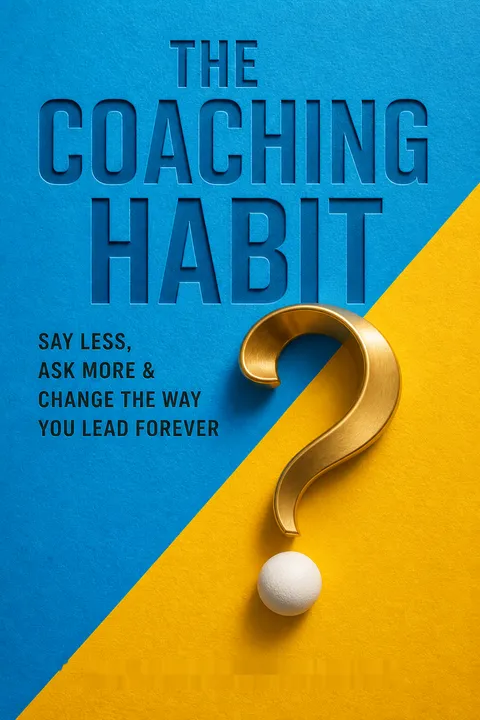
The Coaching Habit receives mixed reviews, with many praising its practical approach to coaching through seven key questions. Readers appreciate its concise format and actionable advice, finding it useful for improving leadership and communication skills. Some criticize the book for being repetitive or lacking depth. Many readers value the emphasis on asking questions rather than giving advice. The book's companion videos and references to other works are generally well-received. Overall, it's considered a helpful resource for those looking to develop a coaching mindset.
People Also Read









Glossary
New Habit Formula
Trigger-linked behavior changeA method for making a new behavior more actionable by identifying the moment that triggers an old habit, naming the old response, and specifying a replacement. The replacement should be small enough to perform quickly. In this book, the formula turns coaching intentions into a repeatable response during ordinary work conversations.
3P model
Three coaching focus lensesA framework for deciding which aspect of a challenge deserves attention: the project or task, the people and relationships involved, and patterns in the person's behavior or way of working. It helps a conversation move beyond the first issue raised while leaving the person being coached room to choose the starting point.
AWE Question
Prompt for another possibilityThe book's name for a short follow-up question that invites someone to add another thought, option, or challenge. It is meant to slow the coach's impulse to advise and to reveal ideas beyond a person's first response. The question should be asked with genuine interest and not repeated after the conversation has run out of energy.
Advice Monster
Reflex to solve for othersThe author's label for the urge to jump into expert mode by giving answers, recommendations, or fixes before understanding the other person's situation. The impulse often feels useful and reassuring to the manager, but can short-circuit the colleague's own thinking and increase dependence. Questions help interrupt the reflex, though advice remains appropriate when the situation calls for it.
Drama Triangle
Three unhelpful interaction rolesA model developed by Stephen Karpman that describes Victim, Persecutor, and Rescuer roles people can adopt in a difficult interaction. The book applies it to workplace helping: a manager who repeatedly takes over may act as Rescuer and unintentionally encourage dependence. The roles describe behavior in a situation, not fixed identities or personality types.
TERA
Four drivers of engagementAn acronym for Tribe, Expectation, Rank, and Autonomy, the factors the book uses to explain how an interaction may feel safe and engaging or risky and disengaging. People assess whether another person is with them, whether the next steps are predictable, how status is being treated, and whether they have meaningful choice. Questions can support choice and participation.
Coaching Bookends
Opening and closing promptsThe pairing of a conversation-opening question that lets the other person choose what matters with a closing question that asks what was useful. The opening avoids defaulting to small talk or a stale agenda. The closing helps participants identify and retrieve the conversation's learning before moving on.
AGES model
Drivers of lasting memoryA framework associated in the book with the NeuroLeadership Institute that identifies Attention, Generation, Emotion, and Spacing as contributors to longer-term memory. The book emphasizes Generation: people are more likely to retain an idea when they create and express their own connection to it, rather than only hearing someone else explain it.
Good Work and Great Work
Routine work versus meaningful impactThe book distinguishes Good Work, the necessary everyday tasks of a role, from Great Work, which has both impact and personal meaning. The distinction is used to frame a leadership challenge: helping people devote more attention to consequential work rather than allowing routine demands and unexamined commitments to consume all available time.
FAQ
What's "The Coaching Habit" about?
- Purpose of the Book: "The Coaching Habit" by Michael Bungay Stanier is about transforming managers and leaders into more coach-like figures by encouraging them to stay curious longer and rush to action and advice-giving more slowly.
- Core Concept: The book introduces a simple yet challenging habit: asking more questions and giving less advice to foster better leadership and management.
- Practical Approach: It provides a fast and practical read, offering seven essential questions that can be used to improve coaching skills in everyday interactions.
- Not Just for Coaches: The book is designed for anyone in a leadership role, not just professional coaches, aiming to enhance their ability to support and develop their teams effectively.
Why should I read "The Coaching Habit"?
- Improve Leadership Skills: The book offers practical tools to become a more effective leader by adopting a coaching mindset.
- Enhance Team Performance: By using the seven questions, leaders can help their teams become more self-sufficient and focused on meaningful work.
- Reduce Overwhelm: It provides strategies to manage workload better and avoid becoming a bottleneck in the organization.
- Build Better Relationships: The book emphasizes the importance of adult-to-adult conversations, helping leaders build more authentic and productive relationships with their teams.
What are the key takeaways of "The Coaching Habit"?
- Seven Essential Questions: The book revolves around seven questions that help leaders coach more effectively by focusing on what truly matters.
- Habit Building: It emphasizes the importance of building a coaching habit through understanding triggers, practicing deeply, and planning for setbacks.
- Focus on Development: The book distinguishes between coaching for performance and coaching for development, encouraging leaders to focus on the latter for long-term growth.
- Engagement and Impact: By asking the right questions, leaders can increase engagement, reduce dependency, and have a greater impact on their teams.
What are the seven essential questions in "The Coaching Habit"?
- The Kickstart Question: "What's on your mind?" to open up meaningful conversations.
- The AWE Question: "And what else?" to explore more options and insights.
- The Focus Question: "What's the real challenge here for you?" to identify the core issue.
- The Foundation Question: "What do you want?" to clarify needs and desires.
- The Lazy Question: "How can I help?" to offer support without taking over.
- The Strategic Question: "If you're saying Yes to this, what are you saying No to?" to prioritize effectively.
- The Learning Question: "What was most useful for you?" to reinforce learning and reflection.
How does "The Coaching Habit" suggest building a coaching habit?
- Identify Triggers: Recognize the moments that prompt old habits and use them to initiate new behaviors.
- Practice Deeply: Focus on small, specific actions that can be repeated and refined over time.
- Plan for Setbacks: Accept that mistakes will happen and have a plan to get back on track.
- Use the New Habit Formula: Combine triggers, old habits, and new behaviors to create lasting change.
What is the difference between coaching for performance and coaching for development in "The Coaching Habit"?
- Coaching for Performance: Focuses on addressing and fixing specific problems or challenges, often short-term and task-oriented.
- Coaching for Development: Shifts the focus to the person dealing with the issue, aiming for long-term growth and learning.
- More Powerful Conversations: Development coaching is more impactful as it encourages self-awareness and personal growth.
- Application of the 3P Model: Helps identify whether the focus should be on projects, people, or patterns to facilitate development.
How does "The Coaching Habit" address the issue of overdependence in teams?
- Encourages Self-Sufficiency: By asking questions instead of giving answers, leaders help team members find their own solutions.
- Reduces Bottlenecks: Leaders avoid becoming the sole problem-solvers, allowing the team to function more independently.
- Increases Autonomy: Team members gain a sense of mastery and control over their work, leading to higher motivation.
- Breaks Vicious Circles: The book identifies and provides strategies to break cycles of overdependence, overwhelm, and disconnection.
What role does neuroscience play in "The Coaching Habit"?
- Risk and Reward Response: The book explains how the brain constantly assesses situations as safe or dangerous, influencing engagement.
- TERA Quotient: Focuses on increasing Tribe, Expectation, Rank, and Autonomy to create a rewarding environment.
- Impact on Engagement: By asking questions, leaders can create a sense of safety and engagement, enhancing team performance.
- Learning and Memory: The book uses neuroscience to explain how asking questions can improve memory retention and learning.
What are some of the best quotes from "The Coaching Habit" and what do they mean?
- "Tell less and ask more." This quote encapsulates the book's core message of shifting from giving advice to asking questions to empower others.
- "We live in the world our questions create." It highlights the transformative power of questions in shaping our understanding and interactions.
- "What people think of as the moment of discovery is really the discovery of the question." This emphasizes the importance of asking the right questions to unlock insights and solutions.
- "Nothing is stronger than habit." It underscores the book's focus on building new habits to create lasting change in leadership behavior.
How does "The Coaching Habit" suggest handling the Advice Monster?
- Recognize the Urge: Be aware of the tendency to jump in with advice and solutions, often prematurely.
- Use the AWE Question: "And what else?" helps manage the impulse to give advice by encouraging further exploration.
- Stay Curious: Focus on asking questions and listening to the answers to keep the conversation open and productive.
- Practice Restraint: Develop the habit of holding back advice until it's truly needed, allowing others to find their own solutions.
How can "The Coaching Habit" help with strategic decision-making?
- The Strategic Question: "If you're saying Yes to this, what are you saying No to?" helps prioritize and focus on what truly matters.
- Clarifies Commitments: Encourages clear and committed Yes decisions, supported by necessary No actions.
- Avoids Overwhelm: Helps leaders and teams manage workload by making conscious choices about priorities.
- Aligns with Goals: Ensures that decisions are aligned with strategic objectives and long-term goals.
What additional resources does "The Coaching Habit" offer for further learning?
- My One Best Question Series: Features videos from business leaders and thought leaders sharing their best questions.
- Top-Shelf Management Books: A curated list of recommended books for further reading on self-management, organizational change, and strategy.
- Box of Crayons Lab: Offers insights and research sources for deeper understanding of the book's concepts.
- Online Tools and Videos: Provides access to videos and tools to help embed the learning and apply the book's principles in real life.
About the Author
Other books by Michael Bungay Stanier




Download PDF
Download EPUB
.epub digital book format is ideal for reading ebooks on phones, tablets, and e-readers.








