

Key Takeaways
Treat meaningful work as a practice, not a promotion or perfect job.
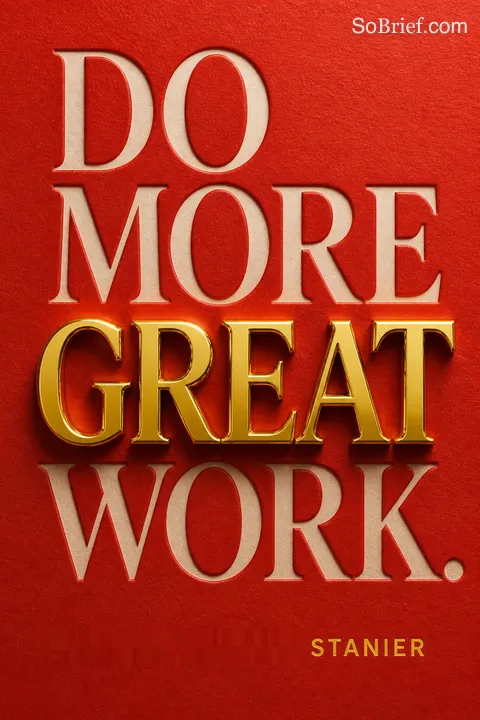
Three kinds of work. Bad Work wastes effort; Good Work is useful, familiar work that you can do well; Great Work feels meaningful, makes a difference, and stretches your abilities. Great Work is not simply work performed flawlessly. It can feel exciting and absorbing, but it can also be uncertain and uncomfortable because the challenge is new and the outcome matters to you.
The balance keeps changing. Great Work can become routine once you master it, while Good Work offers the comfort of familiar competence. The right mix shifts with your circumstances and energy. It might be a brief contribution or a long-running project, and it need not bring public recognition. The aim is not to abandon necessary work, but to make room for more work that matters to you and benefits others.
The useful distinction here is between excellence of execution and significance of contribution. A person can be exceptionally competent at work that feels empty, or feel deeply engaged in work that is still rough around the edges. This resembles the difference between intrinsic motivation, doing something because it is inherently meaningful, and external reward, doing it for status or pay. Yet personal meaning cannot make every job humane: poor management, low autonomy, or chronic overload may require structural change, not a private change of attitude.
Audit your week before deciding what deserves more of your life.
Start with a snapshot. The first exercise asks you to estimate how your work time is divided among Bad, Good, and Great Work, then write down examples for each category. The author reports that people he asked commonly estimated 10-40 percent Bad Work, 40-80 percent Good Work, and 0-25 percent Great Work. These are observations from his workshops, not universal benchmarks.
Compare the picture with reality. Review your calendar or track a week to see where your time actually goes, then compare it with the mix you want. Andy, a marketing leader preparing a product launch, discovered that only about 10 percent of his time went to the strategic work he enjoyed. About 30 percent went to frustrating administration and team friction. The gap helped him see that improving team leadership might itself become meaningful work.
Time audits counter a familiar cognitive error: people often remember vivid tasks and underestimate routine interruptions. A calendar offers a rough behavioral record, while the categories invite reflection about value, not merely minutes. The exercise is strongest when treated as a provisional map rather than a verdict. A week with a deadline, caregiving demands, or a staffing crisis may not represent a normal pattern. Tracking more than once can reveal whether the problem is a temporary spike or the shape of the job itself.
Use remembered peak moments to find the conditions that bring out your best.
Look backward for clues. A peak moment is an episode when you felt especially engaged, capable, and like yourself. Recall several, describe what happened, and look for recurring conditions: the role you played, the people involved, the skills you used, and how you felt. The point is not to list impressive achievements, but to notice what made the experience meaningful.
Name your patterns. The next exercises turn those memories into a personal guide. Describe how you act at your best, then pair those qualities with your familiar less-effective defaults. Also identify people you admire and the qualities you value in them, rather than trying to copy their accomplishments. Sarika, a new technology executive, found that she did her best work by bringing people together, solving problems, and speaking honestly. Those patterns gave her clues about how to contribute in her new role.
This approach uses autobiographical memory as evidence about fit. Repeated episodes can reveal the settings in which a person feels both effective and engaged, which is more actionable than a generic list of strengths. The comparisons with role models also turn admiration into specific behaviors. Still, memory is selective: people may recall dramatic successes more easily than quiet, reliable contributions. A conversation with trusted colleagues can broaden the evidence, but their opinions should complement, not overrule, the person's own experience.
Look for Great Work where your values meet a visible need.
Scan beyond your job description. The book's opportunity exercises ask you to look across projects, relationships, your organization, and the wider world. Include work that could be improved, not just new initiatives. Small irritations can point to larger problems, while a promising opportunity may sit in an area you usually overlook.
Treat friction as information. Carlos, a partner at an accounting firm, initially felt his career was merely comfortable. When he considered what was broken, he saw that the firm itself had stopped growing. His preference for new ideas and entrepreneurial work matched a business need: finding new clients or developing a new market. The key is the meeting point between what matters to you and something that needs attention. Dissatisfaction alone is not a project, but it can reveal where one might begin.
The move from personal preference to a real need prevents meaningful work from becoming self-absorption. It also resembles job crafting, the practice of adjusting parts of a role to better fit a person's strengths and interests. The book's focus on annoyances is a useful form of problem finding: what people tolerate may be a clue to needless friction. But not every irritation should become an individual's improvement project. Persistent dysfunction can reflect inadequate resources or poor leadership, and responsibility should not be shifted onto the person most bothered by it.
Protect meaningful work by negotiating expectations and making low-value tasks merely adequate.
Map both sides of the job. Sort your responsibilities according to whether you care about them and whether your organization values them. Work valued by both can be a base to build on. Work valued by neither is a candidate to stop or complete at the minimum acceptable level. If the organization needs work you dislike, consider delegating it, simplifying it, or doing it more efficiently.
Make room deliberately. Work you care about but the organization overlooks may need to be reframed in terms of its priorities, tested on a small scale, or pursued elsewhere. When a new request arrives, slow down before agreeing. Clarify why you were asked, what completion means, how much time it requires, and what should be dropped to make room. A quick yes can hide a real trade-off.
This is a practical model of competing incentives. It asks the worker to distinguish actual priorities from assumptions, and it treats time as a finite resource rather than a container that can expand indefinitely. Strategic questions can also improve coordination: a manager may not realize that a new task displaces existing work. The caution is that minimal effort is appropriate only where quality, safety, and obligations permit it. Adequacy is not an excuse to neglect work that affects clients, colleagues, or the public.
Choose a promising project with a few honest criteria, then begin.
Limit the menu. The book uses a jam-tasting experiment to illustrate choice overload: among tasters offered six varieties, 30 percent bought jam; among those offered twenty-four, 3 percent did. The lesson is not that fewer choices always win, but that an excess of options can make commitment harder. Bring three to five possible projects to the table, then choose a small set of criteria that matter to you, such as impact, personal interest, and feasibility.
Score, then listen. Rate each option against the criteria and use the results to clarify your thinking, not to manufacture certainty. Carlos compared developing a new market, improving client relationships, and leaving his firm. The exercise helped him see that two options deserved attention, without forcing an artificial either-or decision. The aim is a good starting point, not a flawless lifelong choice.
A short list and explicit criteria reduce the mental burden of comparing unlike possibilities. They also expose hidden priorities: a person who weights learning above speed is making a different choice from someone who needs quick organizational impact. Numerical scores, however, can create false precision. Ratings are judgments, not measurements. The best use of the arithmetic is to make assumptions visible, then ask whether the result still feels sound given the project's reversibility, costs, and likely effect on others.
Generate many routes before committing to the boldest workable one.
Separate invention from judgment. The book describes creativity as a rhythm: first expand the number of possible approaches, then narrow the field. To avoid settling for the first adequate idea, set a short timer and generate several options. Use questions such as what would be easy, surprising, or brave. At this stage, even unrealistic ideas can be useful because they loosen familiar assumptions.
Rehearse different endings. Imagine your project going exceptionally well, going badly, and turning out merely fine. Each version can expose allies, obstacles, fears, and missed opportunities. Then test the level of courage an action requires: a safe option, a moderate one, and a bolder but feasible one. Sarika's imagined scenarios showed that her success depended less on proving her technical skill again and more on building relationships with three influential colleagues.
This combination of idea generation and scenario rehearsal borrows the strengths of divergent thinking and premortem planning. Divergence increases the chance of seeing alternatives; imagining failure helps surface vulnerabilities before they become costly. Neither method predicts the future. A vivid success story can encourage overconfidence, while a worst-case story can amplify anxiety. The productive question is not which imagined ending is certain, but what each version reveals about assumptions and preparations. Courage should mean a considered stretch, not disregard for risk.
Turn intention into a dated next action, backed by people.
Make the commitment concrete. To choose an action, compare what is easiest, what could have the greatest impact, and what you most want to do. Then state what you will do, by when, and the first small step. A project is too vague to act on until its next observable action is clear. Also decide what existing commitment must change to create room; adding a meaningful project without removing anything can turn it into another burden.
Build a support structure. Identify people who offer encouragement, practical expertise, or access and influence. Ask one person to check back on a specific date. The book recommends agreeing in advance on what counts as completion and how you will report it. Janet, a young lawyer, turned an idea about connecting junior colleagues into a concrete plan: organize a gathering, choose a date, and ask a friend to keep her accountable.
A dated action converts an aspiration into an implementation intention: a clear link between a desired behavior and when it will happen. Social accountability can add attention and encouragement, while practical helpers reduce the work's skill or access barriers. The structure should support agency, not become surveillance. Publicly announcing a goal can create pressure without providing useful help, and no accountability partner can create time that is not available. The commitment is most credible when the first step is small and the required trade-off is explicit.
When momentum breaks, diagnose the obstacle and return to your compass.
Expect the rough stretch. Meaningful work can draw criticism, compete with routine duties, and trigger doubts about whether you are the right person. The final exercise treats these setbacks as signals to examine, not proof that the project has failed. Revisit the relevant questions: has the work mix changed, are expectations unclear, have you lost sight of what matters, or do you need help?
Interrupt the spiral. Catastrophizing means leaping from a possible setback to an imagined chain of disaster. Write out the chain and test each link instead of treating the worst ending as inevitable. Also ask what is working and what progress has already occurred. Andy, struggling to lead a team, revisited his priorities, sought relief from other duties, and used a former boss's example to steady his leadership. Revising the plan is part of doing the work.
The book treats persistence as adaptive rather than heroic: when conditions change, return to the problem and adjust the approach. Breaking a feared outcome into separate steps resembles cognitive reappraisal, which can distinguish plausible risks from a runaway prediction. Attention to what is working also prevents a single failure from defining the whole project. A useful limit is that reframing cannot solve every barrier. If the obstacle is sustained overload, discrimination, or lack of authority, the response may need to change the environment, not just the interpretation.
Analysis
The book is best understood as a guided inquiry rather than a universal productivity system. Its central move is to make the reader alternate between inner evidence and outer conditions: memories and admired qualities illuminate what feels meaningful, while projects, frustrations, and organizational expectations reveal where that meaning could be applied. The resulting sequence turns a broad wish for better work into a specific, supported experiment.
Its most distinctive strength is its refusal to equate meaningful work with a dramatic career escape. A leader can find a consequential challenge in repairing team dynamics; an employee can build a useful community without immediately changing jobs. That modest scale makes agency more plausible and keeps purpose connected to contribution. The distinction between work that matters and work performed perfectly also gives readers permission to learn in public rather than wait until they feel fully qualified.
The main limitation is structural. The exercises often imply that a person can negotiate, relabel, or quietly test work, but authority and safety vary widely. A junior employee, a precarious worker, and a senior executive do not have the same freedom to refuse tasks or challenge norms. Nor should organizations use individual meaning-making to excuse preventable bureaucracy or understaffing. The book's tools are most responsible when used alongside a clear-eyed assessment of power, resources, and consequences.
The maps are prompts, not validated diagnostic instruments. Their value lies less in assigning a precise score than in making assumptions discussable, exposing trade-offs, and producing a next action that can be tested. A promising project should generate information as well as progress. If the experiment increases impact and engagement, continue; if it reveals a poor fit or an unacceptable cost, revise the plan. That experimental stance captures the book's practical wisdom: meaningful work is not discovered fully formed, but built through attention, choice, collaboration, and adjustment.
Review Summary
Do More Great Work receives mixed reviews, with an average rating of 3.84/5. Many readers find the book's exercises and "maps" helpful for self-reflection and career development. Some praise its practical approach and insights, while others consider it basic or repetitive. Critics note that full engagement with the exercises is necessary to benefit from the book. Positive reviewers appreciate its focus on identifying and pursuing meaningful work, while negative reviews cite a lack of originality or depth. Overall, the book seems most valuable for those seeking guided self-exploration in their professional lives.
People Also Read








Glossary
Great Work
Meaningful, stretching contributionWork that matters personally, contributes something useful or consequential, and engages or stretches the person doing it. It is defined by meaning and impact, not by flawless performance, prestige, or public recognition. It can appear in a single moment, a project, or an ongoing commitment, and its balance with routine work changes over time.
Good Work
Useful, familiar workThe competent, productive work that draws on a person's existing training and experience. Good Work is often comfortable and necessary, both to individuals and to organizations. It can be engaging or mundane, but because it is familiar, it may eventually offer less challenge or meaning than it once did.
Bad Work
Pointless effortWork that wastes time and energy without a worthwhile purpose. In the book, it includes needless bureaucracy, unproductive meetings, and outdated processes that obstruct rather than support useful work. The suggested response is to question whether it can be stopped, reduced, or redesigned, rather than treating it as an unavoidable measure of busyness.
Peak moment
An episode of deep engagementA remembered instance when someone felt unusually engaged, capable, and authentic while contributing to something meaningful. The exercise uses several such episodes to identify recurring behaviors, roles, skills, and circumstances. The emphasis is on the person's experience and patterns, not simply on external achievement or praise.
Great Work Project
A focused meaningful challengeA specific project or challenge chosen as a practical focus for doing more Great Work. It should connect what matters to the person with an opportunity or need in the surrounding world. It need not be a permanent commitment or a perfect choice; it provides a manageable starting point for generating options, taking action, and learning.
First-idea-itis
Settling for the first adequate ideaThe tendency to adopt the first idea that seems coherent, tolerable, and easy enough to implement. The book argues that this habit is common when people are rushed to act. Short, structured idea-generation exercises help create alternatives before evaluation begins, reducing the chance that familiarity or convenience will decide by default.
Immunity to change
Hidden commitments preserving habitsA concept associated in the book with Robert Kegan and Lisa Laskow Lahey. A person may sincerely want to change but remain attached to an unspoken commitment that the current behavior protects, such as being liked or avoiding conflict. Naming that competing commitment can explain why good intentions repeatedly fail to alter behavior.
Catastrophizing
Escalating a risk into disasterA pattern of thought that rapidly turns a possible difficulty into a chain of increasingly severe imagined consequences. The book's exercise asks readers to write out that chain and examine the likelihood of each link. The purpose is to distinguish a real obstacle that needs preparation from an extreme prediction that is paralyzing action.
FAQ
What's "Do More Great Work" about?
- Focus on Meaningful Work: "Do More Great Work" by Michael Bungay Stanier is about identifying and focusing on work that is meaningful and impactful, rather than just busywork.
- Framework for Change: The book provides a framework to help individuals transition from doing good work to great work by using practical tools and exercises.
- Personal and Professional Growth: It emphasizes personal and professional growth by aligning one's work with their values and aspirations.
- Practical Tools: The book includes 15 maps or exercises designed to help readers identify what matters most to them and how to achieve it.
Why should I read "Do More Great Work"?
- Identify Great Work: It helps you identify what constitutes great work for you personally, which can lead to greater job satisfaction and fulfillment.
- Actionable Steps: The book provides actionable steps and exercises to help you transition from busywork to work that truly matters.
- Expert Insights: Contributions from thought leaders like Seth Godin and Leo Babauta offer additional perspectives on doing great work.
- Self-Discovery: It encourages self-discovery and helps you align your work with your core values and strengths.
What are the key takeaways of "Do More Great Work"?
- Three Types of Work: The book categorizes work into Bad Work, Good Work, and Great Work, urging readers to focus on the latter.
- Maps for Guidance: It offers 15 maps or exercises to guide readers in identifying and doing more great work.
- Role of Courage: Courage is essential for stepping out of comfort zones and taking on great work projects.
- Support Systems: Building a support system is crucial for sustaining great work efforts.
How does Michael Bungay Stanier define "Great Work"?
- Meaningful and Impactful: Great Work is defined as work that is meaningful to you and has a significant impact.
- Engaging and Stretching: It is work that engages you, stretches your abilities, and aligns with your values.
- Balance of Comfort and Discomfort: Great Work provides a sense of comfort through its meaningfulness but also involves discomfort due to its challenges.
- Organizational Value: For organizations, Great Work drives innovation and strategic difference.
What are the "15 Maps" in "Do More Great Work"?
- Guidance Tools: The 15 maps are exercises designed to help you identify and do more great work.
- Structured Approach: They provide a structured approach to self-discovery and action planning.
- Diverse Focus Areas: Each map focuses on different aspects, such as identifying peak moments, understanding your best self, and finding role models.
- Practical Application: The maps are practical and can be revisited multiple times for ongoing guidance.
How can I identify my "Great Work" according to the book?
- Peak Moments: Reflect on past peak moments where you felt most engaged and fulfilled.
- Role Models: Identify role models and the qualities you admire in them to understand what you aspire to.
- Self-Assessment: Use the maps to assess your current work mix and identify areas for improvement.
- Opportunities and Challenges: Look for opportunities and challenges in your current environment that align with your definition of great work.
What is the "This, Not That" exercise in the book?
- Behavioral Insight: This exercise helps you identify what you're like at your best and what you're like when you're not at your best.
- Metaphorical Comparison: It uses metaphorical comparisons to articulate your best and less-than-best states.
- Self-Reflection: Encourages self-reflection to understand your strengths and areas for growth.
- Practical Application: Helps you focus on behaviors that align with doing more great work.
What role do "Role Models" play in "Do More Great Work"?
- Inspiration Source: Role models serve as a source of inspiration and guidance for identifying great work.
- Qualities and Characteristics: The book encourages identifying the qualities and characteristics you admire in your role models.
- Personal Alignment: Helps you align your work with the values and traits you aspire to embody.
- Practical Exercise: The book includes an exercise to list role models and the attributes you wish to emulate.
How does the book suggest handling "Bad Work"?
- Identify and Eliminate: The book suggests identifying bad work and finding ways to eliminate or minimize it.
- Focus on Value: Encourages focusing on work that adds value and aligns with your goals.
- Efficiency and Delegation: Recommends delegating or finding more efficient ways to handle necessary but uninspiring tasks.
- Mindset Shift: Promotes a mindset shift from tolerating bad work to actively seeking great work opportunities.
What are some of the best quotes from "Do More Great Work" and what do they mean?
- "You can’t do a project. You can only do the next step." - Emphasizes the importance of breaking down projects into actionable steps.
- "Great Work is what we all want more of." - Highlights the universal desire for work that is meaningful and fulfilling.
- "Stop making everyone happy." - Encourages focusing on what truly matters rather than trying to please everyone.
- "Ask for help." - Stresses the importance of seeking support and collaboration in doing great work.
How does "Do More Great Work" address the concept of "Courage"?
- Essential for Great Work: Courage is essential for stepping out of comfort zones and taking on great work projects.
- Facing Challenges: Encourages facing challenges head-on and not shying away from difficult tasks.
- Incremental Steps: Suggests taking incremental steps to build courage and confidence over time.
- Support Systems: Recommends building a support system to bolster courage and sustain efforts.
What additional resources does "Do More Great Work" offer?
- Online Tools: The book offers online resources, including downloadable map templates and an eCourse.
- Interviews and Insights: Features interviews with thought leaders for additional insights and inspiration.
- Great Work Movie: Provides access to the Great Work Movie for visual inspiration.
- Further Reading: Includes a list of recommended books and resources for deepening your understanding of great work.
About the Author
Other books by Michael Bungay Stanier


Download PDF
Download EPUB
.epub digital book format is ideal for reading ebooks on phones, tablets, and e-readers.








