

Key Takeaways
Stop budgeting hours; create the mental conditions for valuable work
Time was not the cure. While writing his first book, David Kadavy cleared his calendar, fired clients, and tried to force progress through long writing days. He remained blocked until a casual conversation with Diego, a stranger in Costa Rica, relaxed him enough to write a chapter in an hour. The discovery changed his question from how to find more time to how to enter a state of mind suited to the work.
Creative work is different. Repeating a known sequence, such as moving iron efficiently, can reward faster execution. Work that requires a novel, useful idea cannot be measured so neatly: the breakthrough may arrive suddenly, after preparation and rest. Mind management means arranging energy, attention, and conditions so valuable thinking can happen, rather than treating every hour as an equal unit of output.
The distinction is useful because it separates throughput from judgment. A person can type quickly, attend every meeting, and still avoid the difficult thinking that changes a project. This also resembles the difference between optimizing a known process and exploring an uncertain one: the first benefits from measurement, while the second needs room for unexpected results. The argument is strongest for work whose value depends on originality. It is less applicable to routine work, where schedules and efficiency remain important. The practical challenge is not to reject time management, but to stop asking it to solve a problem of attention and insight.
Treat empty time as creative capital, not a scheduling failure
Busyness has a cost. The book describes research in which moderately busy knowledge workers reported 19 percent less creative thinking, while those under extreme busyness reported 45 percent less. The sharp drop suggests that packed schedules do more than reduce time for brainstorming. They also leave less mental capacity for the work itself, and the reported effects persisted beyond the busiest day.
Leave room to think. Kadavy points to examples such as Bill Gates taking private think weeks and writers setting drafts aside before revising. Unscheduled time can let ideas settle, connections form, or a stale approach lose its grip. This is not an argument for idleness as a virtue. It is a case for protecting open space when the desired result is insight, rather than filling every gap with another task or meeting.
A calendar can look efficient while quietly taxing attention. Cognitive science describes a related problem as attention residue: after switching tasks, some attention remains attached to the previous one. That helps explain why a day packed with short appointments can feel busy without producing sustained thought. Still, empty time is not automatically useful. Without a clear problem to incubate, slack can become avoidance or drift. The useful combination is purposeful preparation followed by protected openness. A person should know what question is being carried, while resisting the urge to demand an immediate answer.
Protect your groggy first hour for ideas, then edit when alert
Use the right hour. Kadavy argues that the mind's sharpest period is not always its most creative. Soon after waking, mild grogginess may loosen the prefrontal cortex, the brain region involved in planning and suppressing distractions. That can make it easier to notice unusual connections, though it can also make focus harder. He uses the first hour of the day for his most important project, before email and other demands take over.
Separate generating from refining. His morning writing begins with rough ideas, then later work becomes more analytical. After building this routine in Medellín, he published 80,000 words in 2016, compared with 20,000 the year before. The point is not that everyone should write at dawn. The useful experiment is to identify a personal window for idea generation, then reserve a sharper period for editing and checking details.
This approach treats attention as state-dependent rather than as a steady resource. It also resembles chronotype research, which warns against assuming that one schedule suits every body. The author's own account includes that caveat: the best window can vary by person. The distinction between generating and editing is especially practical because evaluation can prematurely shut down possibility. At the same time, grogginess is not a productivity drug. The book cautions against deliberately losing sleep, since rest supports memory and learning. A better principle is to use naturally occurring energy patterns, not damage them.
Prepare deeply, step away, let insight arrive, then test it
Creativity has stages. Psychologist Graham Wallas organized a process described earlier by scientist Hermann von Helmholtz into four stages: Preparation, gathering and understanding the material; Incubation, stepping away while the problem rests; Illumination, the sudden arrival of a possible answer; and Verification, testing whether the idea works. The stages can repeat and overlap, rather than forming a tidy one-way sequence.
A flash is only a start. Paul McCartney's melody for Yesterday came to him in a dream, but he spent about a year and a half checking whether it was original, developing its arrangement, and finding its lyrics. Likewise, Kadavy's late-night research sessions prepared material that became easier to write after sleep. When a solution will not come, the framework suggests adding preparation or incubation instead of treating the block as proof of failure.
The framework helps explain why visible output is an unreliable measure of progress. Reading, collecting examples, and letting a question rest can be productive even when no finished page appears. Sleep research on memory consolidation offers one plausible mechanism: rest can strengthen relationships among ideas, not merely preserve isolated facts. The stages should still be treated as a map, not a law. Some tasks require deliberate analysis from the outset, and some creators alternate between exploration and testing rapidly. The value lies in diagnosing what kind of work is missing, not in forcing every project into a rigid sequence.
Name the mental state before choosing the task or tool
Work has different moods. Kadavy identifies seven mental states: Prioritize, Explore, Research, Generate, Polish, Administrate, and Recharge. Prioritizing chooses what matters; exploring gathers open-ended material; research answers specific questions; generating makes a draft or other artifact; polishing improves it; administration handles supporting details; and recharging restores energy. He groups them as PER Golf, PAR, to make the sequence easier to remember.
Shape the conditions. A notebook is a grippy tool: difficult to misuse for browsing, useful for loose exploration. A laptop is slippy: fast for producing finished work, but full of distractions. Kadavy also uses places and rituals to cue particular kinds of attention. A small, quiet room may help detailed editing, while a broad view may invite big-picture thinking. Match the task, tool, and setting, then avoid switching states without a reason.
Naming work states makes an invisible source of friction easier to notice. A stalled writing session may actually be a research question in disguise, while browsing can masquerade as preparation when it has no specific purpose. The model also connects to implementation intentions, in which people decide in advance what action belongs in a particular situation. But a task's state is not always obvious. Early exploration can look like production, and a walk can be either creative work or recovery. The labels work best as a diagnostic vocabulary, not a test of whether someone is doing creativity correctly.
Use clock-time for predictable steps, event-time for discovery
Different work needs different time. Clock-time organizes activity by fixed hours and deadlines. Event-time organizes it around completion or circumstance, such as continuing a conversation until its purpose is met. The book argues that clock-time suits predictable tasks, while event-time better accommodates creative problems whose solutions arrive unpredictably. Neither approach is universally superior.
Build a weekly rhythm. Kadavy reserves early-week energy for generating and exploring, then moves toward research, polishing, and administration as the week progresses. He keeps Mondays and Tuesdays free of meetings when possible, and places financial review on Friday. A weekly review helps him decide in advance when to handle upcoming obligations, so they do not intrude on his strongest creative periods. Readers can adapt the pattern to their own energy, responsibilities, and deadlines rather than copying his calendar.
The clock-time and event-time distinction offers a helpful counterweight to the assumption that every valuable activity can be forecast by duration. It is particularly useful in collaborative work, where deadlines matter but discovery cannot be scheduled with precision. Yet event-time can impose costs on other people if it becomes an excuse for lateness or indefinite meetings. The solution is not to choose one temporal culture for everything. Teams can set firm boundaries around delivery and coordination while protecting less measurable time for exploration. A weekly rhythm creates structure without pretending that creative progress is linear.
Give hard projects a tiny dose, then let them incubate
Start the mental work. The Minimum Creative Dose is the smallest action that gives a project material to work with. It might be a few notes, a rough sketch, or a short burst of drafting. The action need not produce something finished. Its value is that the problem now has details for the mind to keep processing during other activities or sleep.
Use the gap. Kadavy describes watching the same short section of a Spanish-language film repeatedly. At first it sounded like meaningless noise; with repetition, phrases became recognizable and usable in daily conversation. He also alternates between two writing tasks, allowing one to rest while he works on the other. Small starts reduce the intimidation of a large project, while deliberate gaps can help loosen fixation and reveal connections.
A tiny action is effective partly because it lowers the psychological cost of starting, and partly because it supplies concrete cues for attention to revisit. This is more than a motivational trick: an unfinished question can make relevant information easier to notice in the environment. The method is especially valuable when a project feels too large to hold in working memory. Its limit is equally important. Small doses do not guarantee progress if they never lead to practice, feedback, or decisions. Incubation complements effort; it cannot replace it.
Standardize repeatable steps so fresh energy stays available for ideas
Build a flexible process. Creative Systems are repeatable processes that carry work from idea to delivery while leaving room for unpredictable thinking. Kadavy calls his evolving checklists Sloppy Operating Procedures: working notes that improve each time he repeats a task, rather than rigid instructions written perfectly in advance. He develops them through recurring work, such as producing a weekly podcast.
Make repetition serve variety. After refining his podcast process, he could batch interviews and production tasks, and split script writing into short sessions separated by incubation. A task that had once taken about an hour of concentrated effort came to require roughly fifteen minutes of focused drafting. Standardizing recurring decisions moved podcast production to the back burner, freeing his best energy for new work. Constraints are useful when they simplify the process without flattening what makes the work worth doing.
This is a creative version of process improvement: automate the decisions that recur so attention can go toward the decisions that matter. The distinction between a standard procedure and a living, imperfect checklist is important. A process should reduce cognitive load without claiming that the work itself is predictable. Repetition also makes it possible to learn where a workflow is genuinely wasteful. The risk is over-standardization. If every project is forced into an old template, the system can preserve yesterday's assumptions. A useful procedure therefore needs regular revision, not just compliance.
Make your workflow flexible enough to keep creating through chaos
Life can overturn the plan. After visa problems, disruptive travel, and his mother's sudden brain hemorrhage, Kadavy could not maintain his usual routine. He lowered his writing target to 250 words a day, kept his podcast going through established processes, and made time to support his father. The system helped him continue where possible without pretending grief left his capacity unchanged.
Capture, then sort. The Creative Cascade is a chain of inboxes that moves ideas from quick capture, such as a pocket notebook, into project notes or a weekly review. Task Triggers are reliable cues that prompt a task in the right context. Organizing tasks by mental state makes it easier to choose work that fits available energy. Some ideas can remain in Creative Simmer, stored without pressure to become finished projects.
Resilience here is not relentless output. It is the ability to preserve options, reduce decisions, and scale expectations when circumstances change. That distinction matters in grief and other crises, when cognitive capacity can shrink for reasons no productivity technique can erase. The cascade also separates remembering an idea from committing to execute it, an important protection against turning every spark into an obligation. A resilient system should allow work to pause, shrink, or stop. Its purpose is to support a life, not to make every life event productive.
Analysis
The book's central contribution is a change in the unit of productivity. Instead of treating hours as interchangeable containers for output, it asks how energy, attention, and mental state affect the value of those hours. That shift is persuasive because creative work is nonlinear: research, rest, and drafting can each be essential, even when only one produces visible pages. The narrative gives the idea credibility by showing its evolution from a painful writing block to a disciplined, repeatable practice, then testing that practice against immigration problems and bereavement.
The frameworks are practical because they operate at several scales. The Four Stages diagnose project progress. The Seven Mental States help select immediate work. Creative Cycles organize energy across days or weeks, while Creative Systems reduce repeated decisions. The cascade of inboxes preserves ideas without requiring immediate commitment. Together, these models translate an abstract claim about creativity into choices a reader can make about schedule, tools, and task design.
There is also a useful tension between structure and openness. The book does not simply praise spontaneity: it recommends weekly reviews, first-hour routines, task labels, and repeatable procedures. Yet it argues that those structures should protect uncertainty rather than eliminate it. This is a stronger position than either rigid scheduling or unbounded freedom. The system is a scaffold around creative work, not a machine for predicting insight.
The main limitation is generalizability. Kadavy's ideal routine depends on substantial control over work, location, and obligations. Many people cannot reserve mornings, choose a quiet workspace, or postpone administrative tasks. Some physiological claims about grogginess and divergent thought are presented as useful tendencies, but individual chronotypes and task demands vary. The most transferable lesson is therefore not to copy his schedule or rituals. It is to observe personal patterns, distinguish types of work, and build the smallest amount of structure that protects good thinking without making ordinary life seem like a productivity defect.
Review Summary
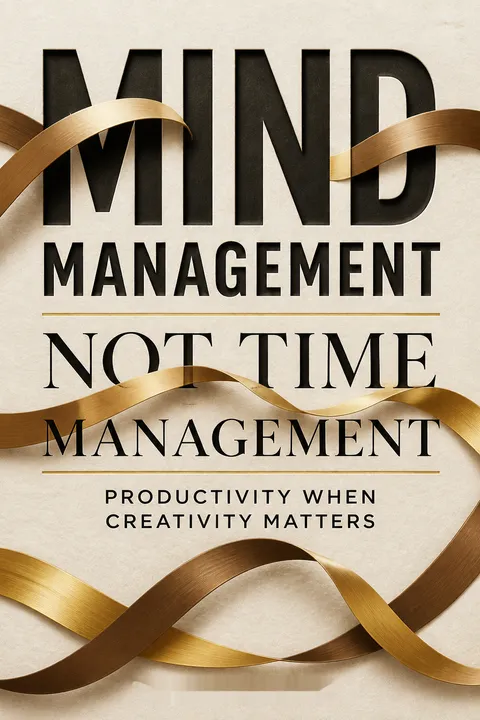
Mind Management, Not Time Management offers a fresh perspective on productivity, focusing on managing mental states rather than time. Readers appreciate Kadavy's unique approach, personal anecdotes, and practical tips for creative work. The book explores concepts like the Four Stages of Creativity and Seven Mental States, providing insights into optimizing creative energy. While some found it repetitive or too personal, many readers found value in its strategies for enhancing productivity and creativity. Overall, the book resonates with those seeking to improve their creative output and work processes.
People Also Read




Glossary
Mind Management
Direct creative energyAn approach to productivity that manages attention, energy, and mental state rather than trying only to fit more tasks into available hours. It asks what kind of thinking a task requires, when that thinking is most available, and what conditions help it happen.
Creative Sweet Spot
Best conditions for creationThe time and place in which a person is most able to do valuable creative work. It is identified through observation and experimentation, then protected as a central part of one's schedule. It may support idea generation rather than the most alert or analytical state.
Four Stages of Creativity
A map of creative progressA model describing Preparation, Incubation, Illumination, and Verification. Preparation builds knowledge of a problem; Incubation gives the mind time away from active effort; Illumination is a sudden possible insight; and Verification tests and improves that idea. The stages can overlap, repeat, or unfold at different speeds.
Seven Mental States of Creative Work
Seven modes of workKadavy's categories for different kinds of creative activity: Prioritize, Explore, Research, Generate, Polish, Administrate, and Recharge. Each calls for a distinct kind of attention. Matching the task to the current state, or changing conditions to support the needed state, can reduce friction and unnecessary switching.
Creative Cycles
Repeating focus and releaseRepeatable patterns that alternate concentrated effort with periods of rest or different activity. They can follow daily, weekly, seasonal, or cultural rhythms. The cycles support stages of creative work by giving projects time for preparation, incubation, insight, and evaluation instead of demanding constant progress.
Minimum Creative Dose
Smallest useful project actionThe smallest action that gives a creative problem material to work with. It may be a short draft, a few notes, a sketch, or another brief engagement. The goal is not immediate completion, but to lower the barrier to starting and leave details for further thought during periods away from the project.
Sloppy Operating Procedure
An evolving creative checklistA working document that records questions, observations, and repeatable steps while a creative process is being learned. It is intentionally incomplete and revised through repetition, unlike a fixed standard procedure. Its purpose is to reduce recurring decisions while preserving flexibility for judgment and improvement.
Creative Cascade
A chain for captured ideasA series of inboxes through which ideas move from quick capture into more specific notes, project files, or review systems. A person can record an idea without acting on it immediately, then process it when the appropriate time and mental state arrive. The cascade reduces the burden of remembering while protecting attention.
Task Triggers
Cues that prompt actionStimuli deliberately placed to remind someone to perform a task in an appropriate context. Effective triggers are reliable, context-specific, easy to implement, and closely connected to the action. They can attach new tasks to existing routines or environments, reducing dependence on memory and last-minute reminders.
Creative Simmer
Ideas held without pressureA state for ideas or projects that are recorded and allowed to develop in the background without an obligation to finish them. A simmer project may become useful when new circumstances or material appear, or it may remain unfinished. The concept allows stored possibilities without treating each one as a failed commitment.
FAQ
What's "Mind Management, Not Time Management" about?
- Focus on Mind Management: The book emphasizes managing your mind rather than just managing your time to enhance productivity, especially when creativity is crucial.
- Creative Age Shift: It discusses the shift from a time management paradigm to a mind management approach, suitable for the creative age where novel and useful ideas are valued.
- Four Stages of Creativity: The book introduces the Four Stages of Creativity—Preparation, Incubation, Illumination, and Verification—as a framework for understanding and enhancing creative processes.
- Practical Strategies: It provides practical strategies and systems to optimize creative energy, such as finding your Creative Sweet Spot and using Creative Cycles and Systems.
Why should I read "Mind Management, Not Time Management"?
- Enhance Creativity: If you struggle with creative blocks or want to enhance your creative output, this book offers insights and strategies to manage your creative energy effectively.
- Beyond Time Management: It challenges traditional time management techniques, offering a fresh perspective that prioritizes mental states and creative processes.
- Practical Tools: The book provides actionable tools and methods, such as the First Hour Rule and Creative Systems, to help you implement mind management in your daily life.
- Personal Growth: By understanding and applying the concepts, you can achieve personal growth and a more fulfilling creative life.
What are the key takeaways of "Mind Management, Not Time Management"?
- Creative Sweet Spot: Identify the time and conditions where you do your best creative work and build your schedule around it.
- Four Stages of Creativity: Recognize and respect the stages of Preparation, Incubation, Illumination, and Verification in your creative process.
- Seven Mental States: Understand and utilize the Seven Mental States of Creative Work—Prioritize, Explore, Research, Generate, Polish, Administrate, and Recharge.
- Creative Systems and Cycles: Develop repeatable systems and cycles that align with natural rhythms to enhance creative productivity.
How does David Kadavy define the "Creative Sweet Spot"?
- Optimal Time and Place: The Creative Sweet Spot is the time and place where you do your best creative work, characterized by a balance of divergent and convergent thinking.
- Morning Grogginess: For many, this spot is in the morning when the prefrontal cortex is less active, allowing for more insights and creative thinking.
- First Hour Rule: Kadavy suggests using the first hour of your day for your most important creative work to harness this sweet spot.
- Personal Experimentation: Finding your Creative Sweet Spot requires experimenting with different times and environments to see what works best for you.
What are the Four Stages of Creativity according to David Kadavy?
- Preparation: This stage involves gathering information and immersing yourself in the problem, setting the groundwork for creative insights.
- Incubation: During this stage, you step away from the problem, allowing your subconscious to process and form connections.
- Illumination: This is the "aha" moment when a creative insight or solution suddenly becomes clear.
- Verification: The final stage involves refining and evaluating the idea to ensure it is both novel and useful.
What are the Seven Mental States of Creative Work?
- Prioritize: Focus on deciding what needs to be done and in what order, often involving planning and organizing.
- Explore: Engage in open-ended exploration without a specific goal, allowing for curiosity and new ideas to emerge.
- Research: Conduct focused searches for specific information needed to advance your work.
- Generate: Create the actual work, whether it's writing, designing, or any other form of creative output.
- Polish: Refine and perfect the work, focusing on details like grammar, structure, and presentation.
- Administrate: Handle the necessary but non-creative tasks that support your creative work, such as emails and scheduling.
- Recharge: Take time to rest and replenish your energy, ensuring you have the mental resources for future creative work.
How can I implement the First Hour Rule from "Mind Management, Not Time Management"?
- Dedicate First Hour: Spend the first hour of your day working on your most important creative project without distractions.
- Avoid Interruptions: Do not check emails, social media, or engage in any other activities that could interrupt your focus.
- Consistency is Key: Make it a daily habit to ensure you consistently harness your best creative energy.
- Adapt to Your Needs: While the first hour is recommended, adapt the rule to fit your personal schedule and energy levels.
What are Creative Cycles and how do they enhance productivity?
- Rhythmic Patterns: Creative Cycles are repeatable patterns of focus and release that align with natural and cultural rhythms.
- Harness Natural Rhythms: By aligning your work with daily, weekly, or seasonal cycles, you can optimize your creative energy.
- Preparation and Incubation: These cycles incorporate stages of Preparation and Incubation, allowing for more effective Illumination and Verification.
- Perpetual Creativity Machine: When mastered, Creative Cycles help you maintain a steady flow of creative output with less effort.
How do Creative Systems differ from traditional productivity systems?
- Focus on Creativity: Creative Systems are designed to support the unpredictable nature of creative work, unlike rigid traditional systems.
- Minimum Creative Dose: They emphasize taking small, consistent actions to keep projects moving forward and allow for Incubation.
- Sloppy Operating Procedures: These are flexible, evolving processes that adapt to the needs of creative projects.
- Back-Burner Projects: Creative Systems allow you to manage projects with minimal active intervention, freeing up energy for new ideas.
What role do Task Triggers play in managing creative energy?
- Stimulus-Response Mechanism: Task Triggers are stimuli that remind you to perform specific tasks, helping you stay organized.
- Reliable and Context-Specific: Effective triggers are reliable, context-specific, and easy to implement, ensuring tasks are done at the right time.
- Reduce Mental Load: By using Task Triggers, you reduce the mental load of remembering tasks, freeing up energy for creative work.
- Integrate with Inboxes: Task Triggers work with inboxes to ensure ideas and tasks are captured and processed efficiently.
What are some of the best quotes from "Mind Management, Not Time Management" and what do they mean?
- "Things are not difficult to make; what is difficult is putting ourselves in the state of mind to make them." – This quote emphasizes the importance of mind management in the creative process.
- "Time is not prescriptive, time should be descriptive." – Kadavy suggests using time as a guide rather than a constraint, allowing for more effective creative work.
- "The point of time is to use time as a guide to living a fulfilling life." – This quote challenges the traditional view of time management, advocating for a focus on meaningful living.
- "You can’t rush creative work." – It highlights the necessity of respecting the natural pace of creativity, rather than forcing it into rigid schedules.
How can I apply the concepts from "Mind Management, Not Time Management" to my daily life?
- Identify Your Sweet Spot: Experiment with different times and environments to find when and where you are most creative.
- Respect the Four Stages: Allow time for Preparation, Incubation, Illumination, and Verification in your creative projects.
- Use Mental States: Organize your tasks by mental state to match your energy levels and focus throughout the day.
- Build Creative Systems: Develop repeatable processes that align with natural rhythms to enhance your creative productivity.
About the Author
Other books by David Kadavy

Download PDF
Download EPUB
.epub digital book format is ideal for reading ebooks on phones, tablets, and e-readers.








