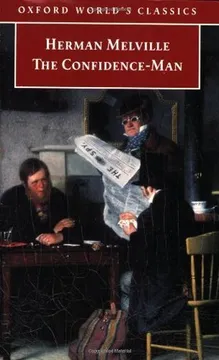


Plot Summary
A Slate Against No Trust
At sunrise on April Fools’ Day, a solitary man in cream-colored clothes steps aboard the Mississippi steamer Fidèle without luggage or companions. A notice warns passengers to watch for an impostor, and the stranger answers it by writing charitable sentiments on a slate. The crowd jostles and mocks him; when porters nearly knock him over, his gestures reveal that he is both deaf and unable to speak.
He retreats to the forecastle and falls asleep. Nearby, the barber hangs a sign announcing that he will not extend credit, a blunt counterpoint to the stranger’s appeal for trust. The boat departs carrying a crowd drawn from every station and region, making its decks a moving cross-section of American life.
The opening makes suspicion a public habit before the stranger has done anything to deserve it. The passengers read a warning about an impostor, then treat the mute as a nuisance rather than a person whose behavior might complicate their assumptions. The barber’s refusal of credit is ordinary commerce, but beside the slate it becomes a social creed: protection against deception can look sensible while also foreclosing generosity. The April Fools’ setting makes certainty itself precarious. Melville begins not with proof of fraud but with a contest over who gets to define the evidence.
Guinea Becomes the Test
Passengers turn Black Guinea, a homeless Black man with crippled legs, into a target for pennies tossed toward his open mouth. When a wooden-legged passenger claims Guinea is faking his disability, the crowd swings from amusement to suspicion, then back toward sympathy when a young clergyman challenges the accusation.
Guinea names several people aboard who might vouch for him, but the clergyman cannot find them, and doubt returns. A Methodist minister confronts the wooden-legged skeptic, who is driven off after the minister shakes him by the collar.
Yet the minister himself grows uncertain. Henry Roberts, a country merchant, finally gives Guinea money despite the crowd’s judgment. At the next landing, the gray-coated collector says he helped Guinea ashore, leaving the clergyman regretful that he never spoke with him.
The crowd does not merely assess Guinea’s story; it repeatedly changes the standard of proof. His body first serves as entertainment, then as evidence of fraud, then as an object of pity. The crowd’s confidence shifts with social cues, especially the skeptic’s accusation and the minister’s forceful defense, rather than with new facts. Roberts’s gift matters because it breaks the group’s consensus, though the crowd treats his generosity as a reproach. Guinea’s departure denies everyone a final verdict. The scene exposes how charity can become a public performance in which the giver’s self-image competes with the recipient’s need.
Ringman Borrows a Past
A respectable man in mourning approaches Roberts as an old business acquaintance named John Ringman. Roberts cannot remember him, but Ringman supplies a detailed account of their supposed meeting and uses Roberts’s past brain fever to explain the gap in his memory.
The invented familiarity softens the merchant, who listens to a tale of hardship and gives Ringman a banknote. Ringman then presents an opportunity in Black Rapids Coal Company shares, claiming the company is ready to sell stock cheaply after a manipulated panic.
Roberts, who has avoided speculation, becomes tempted by the prospect. Ringman leaves him not only poorer but uneasy about having suspected a man who seemed so dignified. The stranger’s performance makes Roberts question his own judgment more than Ringman’s claims.
Ringman’s most effective instrument is not a forged document but Roberts’s willingness to distrust his own memory. He converts a personal limitation into moral leverage: if Roberts cannot recall the meeting, he is invited to treat Ringman’s account as a charitable correction. The later stock tip deepens the trap because a gift appears to be repaid with useful information, letting exploitation masquerade as gratitude. Roberts’s self-reproach is part of the transaction. Once he fears being unkind, he becomes easier to persuade. The episode shows how trust can be manufactured by making skepticism feel like a character flaw.
Tacitus Meets the Weed
Leaning beside the rail, the man in mourning takes a young student’s copy of Tacitus and warns that its grim view of humanity could turn him into a cynic. He urges the student to prefer cheerful reading and argues that suffering should deepen confidence in people rather than destroy it. The student listens awkwardly but does not surrender his book or accept the stranger’s invitation to trust him.
His quiet refusal leaves the man in mourning disappointed. The exchange establishes a pattern that will recur aboard the Fidèle: the stranger does not simply request money. He first tries to define distrust as ugliness, then asks his listener to prove moral goodness through an act of confidence.
The student is not persuaded by a direct argument about whether people are good. The stranger tries to govern the terms of interpretation, treating serious historical writing as poison and cheerful reading as ethical medicine. That move is psychologically deft because it recasts doubt as a failure of temperament rather than a response to evidence. The student’s reserve gives the scene its small but important resistance: he does not debate every claim, yet he also does not yield the trust being solicited. Melville shows persuasion working as a demand for self-definition. To refuse is made to feel like confessing oneself morally defective.
Benevolence Has a Price
A gray-coated solicitor asks passengers to support a supposed Widow and Orphan Asylum serving Seminole families. Two men rebuff him, but a wealthy gentleman gives generously and discusses a grand plan to consolidate charities into a universal benevolence fund.
The solicitor praises the scheme, then asks for subscriptions, only to receive another small contribution when the gentleman reaches his landing. In the ladies’ saloon, a recently widowed passenger is first pressed to demonstrate confidence by giving twenty dollars; only afterward does the collector identify his cause.
Her sympathy for the alleged orphans overcomes her hesitation. Meanwhile, the young clergyman learns that Guinea has left the boat and regrets his earlier uncertainty. Charity circulates aboard, but no passenger can establish whether the appeals are genuine.
The solicitation turns compassion into a test whose rules are controlled by the solicitor. The widow is asked to demonstrate trust before learning the stated purpose, so her eventual donation cannot be separated from the pressure to prove herself charitable. The wealthy gentleman’s immense philanthropic scheme also reveals the appeal of benevolence when it can be organized, calculated, and scaled. The clergyman’s regret over Guinea offers a quieter counterpoint: good intentions can arrive too late to help. Across these encounters, charity remains emotionally real even when its institutional claims are unverifiable. Melville refuses to let uncertainty erase either the possibility of fraud or the human value of giving.
Coal Shares Change Hands
A brisk traveler carrying a transfer ledger claims to be the president and transfer agent of Black Rapids Coal Company. The student questions him, studies a company statement, then buys shares despite the agent’s earlier claim that the transaction is unsuitable aboard ship.
Later, Roberts recognizes the company name on a book left by a friendly passenger. The passenger challenges Roberts to trust the book without inspecting it, and the merchant accepts the offer to transact business.
Their purchase gives Ringman’s earlier stock tip practical force, though the book never settles whether the agent’s identity and documents are authentic. Afterward, Roberts begins telling his companion about people aboard whose suffering has drawn his concern, opening the way for the embedded stories that follow.
The stock dealings shift the book’s uncertainty from personal charity into financial procedure. A ledger, printed statement, and official title appear to promise verifiable facts, yet each can be trusted only through another person’s assurance. The student performs caution by examining the pamphlet, while Roberts treats examination itself as unnecessary once he has chosen to believe. Neither posture gives the reader conclusive access to the company’s truth. Roberts’s later stories suggest that he needs his companion to interpret his own compassionate responses. In this novel, commerce and moral judgment share a vulnerability: both depend on evidence whose meaning is never wholly independent of the observer.
Goneril’s Household Splinters
Roberts recounts the story of an unfortunate man whose wife, Goneril, mocked others, tormented their young daughter, and grew jealous of the child. The husband finally left with the girl, but a court proceeding favored Goneril, cost him his money, and damaged his reputation.
He fled after hearing she might have him confined as insane, and he now seeks enough help to return to his child. Roberts presents him as a patient man injured by injustice.
His companion resists the account, suggesting the husband exaggerated Goneril’s faults and should have handled her more persuasively. Roberts tries to accept this charitable interpretation, but champagne loosens his restraint and he suddenly admits that comfort and confidence cannot make harsh realities disappear.
The story tests whether charitable interpretation remains humane when it denies the sufferer’s account. Roberts’s companion does not simply urge forgiveness; he revises the facts until Goneril’s cruelty becomes a mutual misunderstanding and the husband’s escape a possible overreaction. That optimism protects a belief in providence at the cost of listening to pain. Roberts’s outburst matters because it reveals that his public faith in reassurance coexists with a private conviction that some injuries resist consolation. Alcohol does not create his doubt so much as release it from social discipline. The scene makes compassion and truth appear not as allies by default but as obligations that can pull against each other.
The Miser Risks His Gold
In the dim emigrants’ quarters, the old miser coughs and asks for water. The man attending him first offers comfort, then asks for one hundred dollars, promising to return it multiplied through a secret investment. The miser distrusts the proposal and clutches his savings, but the visitor presents confidence as more valuable than the gold itself.
Exhausted and eager to believe that his money can still do something for him, the old man hands over ten gold coins. The visitor leaves without a receipt, and the miser’s late attempt to call him back goes unheard. His body and his savings have both been entrusted to a stranger, while the promise remains too vague to verify.
The miser’s choice is not a simple conversion from greed to trust. His attachment to money has become a defense against dependence, yet illness makes that defense feel useless: he cannot preserve his life by guarding his pouch. The confidence seller exploits this narrowing horizon by offering not ordinary interest but a secret transformation of wealth. The lack of a receipt is presented as proof of faith, turning the absence of security into the very evidence the miser is asked to accept. Melville frames the transaction as a late-life gamble in which hope and desperation are difficult to distinguish.
The Herb Doctor Prescribes Hope
A herb doctor works on a chronically ill passenger who has already endured several failed treatments. He condemns mineral medicine and presents his own vegetable remedy as nature’s cure, but refuses to name its ingredients or explain its action.
The sick man challenges this contradiction, asking why trust should require him to stop questioning. The doctor concedes that he cannot promise a full recovery, yet encourages a modest improvement and charges for a box of six vials.
Elsewhere, he offers passengers a pain medicine guaranteed to help, including emotional suffering. A forest-dwelling stranger calls the claim a lie and strikes him. After the man leaves, the doctor returns part of his sales to charity, but the passengers remain divided about his sincerity.
The herb doctor’s appeal depends on a double standard. He presents confidence as indispensable to healing, then demands that patients distrust competing practitioners and verify his own product through special wrappers. The sick passenger sees the logical fracture clearly, but illness makes rational refusal costly: rejecting the medicine also means rejecting one of the few remaining forms of hope. The doctor may believe some of what he sells, and his charitable return of proceeds complicates a simple verdict. The episode treats self-deception as a possible ingredient in fraud. A person can exploit others while also inhabiting the optimistic story that makes the exploitation feel benevolent.
Happy Tom Tells the Truth
The herb doctor approaches a crippled veteran, Thomas Fry, expecting a war story, but Fry explains that he was a New York cooper jailed as a witness after a killing. Without friends to provide bail, he spent years in a damp cell, became permanently disabled, and later discovered that his only brother had died.
Fry admits that he invents more patriotic versions of his history because passengers give more readily to a soldier than to a man damaged by the courts. The doctor initially doubts the account, then defends Fry from a passenger who wants to expose him. He offers free liniment; Fry accepts, then insists on paying. Later, the old miser returns, unable to locate the investor who took his gold, and buys the doctor’s remedy.
Fry’s confession makes deception a response to the audience’s preferences. His real suffering is less marketable than an honorable battlefield injury, so he edits his history to fit the charity passengers already know how to give. The herb doctor’s change of stance is significant but incomplete: he protects Fry from public humiliation without becoming a reliable judge of truth. The miser’s return links the novel’s separate frauds through a shared vulnerability, since he now treats the doctor’s product as credible partly because the missing investor recommended it. Trust travels through borrowed reputations, even when the original source has vanished.
Pitch Hires a Promise
A Missouri bachelor named Pitch attacks the herb doctor’s faith in nature, arguing that floods, disease, and personal loss have taught him to distrust it. He then meets a representative of the Philosophical Intelligence Office, who offers to supply a reliable servant.
Pitch recounts years of failed hires, including a courteous boy whose manners concealed neglect and theft. The agent counters that boys are unfinished adults and may outgrow early faults; Pitch, intrigued despite himself, pays a fee and travel money for a supposedly excellent fifteen-year-old.
At Cairo, he watches the agent leave the boat and begins suspecting that the smooth talker has duped him. The swampy landscape and the agent’s departure sharpen his fear that he has mistaken eloquence for evidence.
Pitch’s skepticism is not abstract misanthropy. It grows from repeated employment failures and from his belief that human beings convert dependence into an opportunity to exploit him. The agent’s developmental argument unsettles him because it asks him to treat character as unfinished rather than fixed. Yet Pitch does not become trusting; he reframes the purchase as an experiment and keeps suspicion close at hand. Cairo’s landscape prompts him to revisit the transaction, showing how quickly a person’s confidence can reverse when circumstances alter. The scene makes his cynicism both a protective adaptation and a source of vulnerability to anyone who learns how to argue against it.
Pitch Rejects the Cosmopolitan
A brightly dressed traveler with a pipe approaches Pitch and argues that solitude has made him unfair to humanity. The traveler urges him to join the boat’s convivial life, using stories about sobriety, isolation, and friendship to make social pleasure sound like a cure. Pitch answers with jokes and suspicion, repeatedly treating the traveler as another operator.
Their dispute turns personal when Pitch grips the traveler’s hand and declares that he recognizes a disguised misanthrope. The traveler denies the charge and leaves disappointed, unable to make his warmth convincing to a man who regards sociability as a cover for taking advantage. Pitch remains alone, more certain that charm itself can be a warning sign.
The cosmopolitan tries to convert Pitch by making sociability the evidence of goodness. Pitch reverses the test: because people gather for their own purposes, public warmth may conceal private appetite. Neither man can fully escape the other’s framework. The traveler’s persuasive ease resembles the very performance Pitch distrusts, while Pitch’s refusal makes him appear to confirm the charge of emotional isolation. Their failed encounter is less a debate won by either side than a collision between two methods of risk management. Melville asks whether fellowship can be freely chosen when every invitation may also be a strategy.
Moredock Makes Hate Personal
A new passenger tells the cosmopolitan about Colonel John Moredock, drawing on Judge James Hall’s account of frontier Indian-hating. Moredock’s mother and most of his family were killed by raiders when he was young; he responded by hunting the perpetrators and later continued killing Indigenous people.
The narrator also describes Moredock as hospitable and affectionate toward his own family and neighbors. The cosmopolitan rejects the idea that a loving man can be defined by such hatred, while the narrator insists that Moredock’s violence grew from losses and fears shared across the frontier.
The two men debate whether religion and confidence in humanity are compatible with such vengeance. Their disagreement ends not in resolution but in an invitation to drink together.
Moredock’s story resists a clean division between moral character and violent action. His grief explains the origin of his vengeance but cannot make the victims of that vengeance disappear. The narrator’s account also reveals how communities turn repeated injury into inherited expectation, teaching hatred as practical wisdom. The cosmopolitan wants to preserve a universal ideal of human kindness, but that ideal risks flattening the history that produced frontier fear. The tale therefore tests charity against collective memory. Rather than settle the argument, Melville leaves both men with an uncomfortable fact: a person can be loving within one circle and lethal beyond it.
Ten Eagles Restore Charlie
Over wine, the cosmopolitan and his new companion, Charlie Noble, celebrate friendship and discuss trust, humor, and the press. When the cosmopolitan finally asks for fifty dollars, Charlie recoils, calls him a beggar, and abandons the genial role he has played.
The cosmopolitan arranges ten gold coins around him and performs a mock spell; Charlie immediately resumes his former warmth and treats the rupture as a joke.
The visitor then tells the story of Charlemont, a merchant who abruptly withdrew from friends after financial ruin, rebuilt his fortune abroad, and returned to society without explaining his earlier change. The tale leaves Charlie unsettled, as the cosmopolitan’s performance has shown how quickly friendship can become rejection when money enters the room.
The gold coins act as theatrical props, but the real transformation occurs in Charlie’s social posture. His friendly identity lasts only while no material need is placed before it. The cosmopolitan’s mock magic exposes that instability without proving whether he seeks money sincerely or is staging another test. Charlemont’s story extends the question from a single outburst to an entire life: withdrawing first may protect a person from anticipated rejection, but it also deprives friendship of the chance to answer. The scene refuses an easy moral distinction between generosity and manipulation, since each may appear as a role performed under pressure.
Winsome’s Friendship Has Terms
A mystic named Mark Winsome warns the cosmopolitan that his companion may be a Mississippi swindler, then introduces Egbert, his practical disciple. Egbert explains Winsome’s philosophy through a hypothetical request: when a close friend asks for a loan, he refuses, arguing that money would turn social friendship into a creditor’s claim.
To demonstrate, he recounts China Aster, a candle-maker who accepts a loan from his prosperous friend Orchis, then struggles through failed ventures, mounting interest, and worsening debt.
China Aster dies before repaying, and his family loses its security. The tale ends with a town inscription blaming his ruin on confidence and a friendly loan. The cosmopolitan rejects Egbert’s doctrine, gives him a coin, and leaves the partnership of theory and practice broken.
Egbert’s philosophy protects friendship by excluding one of its most concrete tests: whether a friend will help when help is costly. His account of China Aster makes this exclusion appear prudent, but the story’s tragedy also depends on bad ventures, predatory lending, and the candle-maker’s limited choices. The moral carved over the grave reduces a complicated chain of causes to a warning against confidence. The cosmopolitan’s coin is both an act of generosity and a final rebuke to a system that cannot imagine assistance without contamination. Melville makes ethical consistency look less like wisdom than a way to avoid being answerable to another person.
Cream Lowers His Guard
After leaving Egbert, the cosmopolitan visits William Cream’s barbershop and objects to Cream’s sign refusing credit. He persuades the barber to hide it and try trusting every customer for the rest of the voyage, then drafts an agreement promising to cover any losses.
Cream asks for a cash deposit before accepting this promise. The cosmopolitan refuses, arguing that such caution contradicts the experiment, receives his shave, and departs without paying. Cream retrieves the sign and tears up the agreement.
His friends later call the visitor an extraordinary original, prompting the narrator to interrupt the story with a meditation on what makes a character truly original. The episode brings the book’s recurring dispute over trust down to a razor, a signed paper, and an unpaid bill.
Cream’s bargain reveals the asymmetry inside calls for trust. The cosmopolitan asks the barber to risk real income while offering only a conditional promise; when Cream requests security, that request is used to accuse him of violating the spirit of the experiment. The barber’s return to his sign is not simple defeat. He has tested the stranger’s principle and found that its advocate exempts himself from its costs. The narrator’s discussion of originality broadens the episode beyond a trick: the cosmopolitan’s singularity lies in how each encounter makes an abstract belief materially consequential. Trust is never merely an idea aboard this boat; somebody pays for it.
The Bible Meets the Money Belt
Late in the night, the cosmopolitan asks an old passenger to let him read the boat’s Bible. Passages warning against trusting friends trouble him, but the old man identifies them as apocryphal and dismisses their authority.
A ragged boy then sells the passenger a small door lock, a money belt, and a pamphlet for detecting counterfeit bills. The old man studies his banknotes against the detector, becomes confused, and keeps examining them. He also asks about a life preserver, and the cosmopolitan offers him a stool that may float.
The old passenger leaves for his cabin carrying these safeguards. The cosmopolitan extinguishes the lamp and guides him into darkness, while the novel ends without confirming whether the protections or the reassurance deserve belief.
The final sequence gathers the book’s competing forms of security into one tired traveler’s hands: scripture, a lock, a belt, a counterfeit guide, and a floating stool. Each promises protection, yet each also creates a new object of doubt. The old man dismisses the Bible’s warnings by appealing to its uncertain status, then buys devices designed precisely because strangers and money may be dangerous. His actions are not hypocrisy so much as the ordinary effort to live with incompatible needs. The cosmopolitan offers help while leaving the lamp dark. The ending preserves the unresolved choice at the book’s center: whether safety requires trust, suspicion, or some fragile mixture of both.
Analysis
The novel builds its plot as a chain of encounters rather than a single pursuit. Each passenger receives a different version of the same problem: whether to trust someone whose need, credentials, or intentions cannot be verified. Money supplies the clearest test, but Melville extends the question to medicine, religion, friendship, race, journalism, and the reading of fiction itself. The Fidèle’s changing population makes certainty difficult by design. A witness leaves before being questioned; a book may be genuine yet poorly understood; a painful story may be truthful but exaggerated; a friendly gesture may be both kind and strategic.
Melville’s sharpest psychological insight is that gullibility and suspicion are not opposites so much as rival attempts to escape vulnerability. Roberts fears becoming cruel, the miser fears losing control, Pitch fears being used, Cream fears losing income, and the sick passengers fear that refusing hope will finish what illness began. Each can be manipulated because each has a legitimate need. The confidence-seeker’s power lies in discovering which need is most exposed and then presenting surrender as virtue.
The embedded tales resist a stable moral. China Aster’s ruin can be read as proof that lending destroys friendship, but also as proof that debt, bad luck, and inadequate protection destroy people. Moredock’s grief explains his hatred without cleansing its violence. Thomas Fry’s false war stories reveal a social appetite for legible suffering. These stories make interpretation itself part of the action: every listener must choose what to believe, and every choice risks either injury or complicity.
The ending offers no final key. The old traveler buys protections while trusting a stranger to lead him, and the lamp goes out before the reader can assess the result. Melville does not simply condemn confidence or praise skepticism. He shows that ethical life requires judgments made without guarantees, while warning that any person who claims certainty, whether optimistic or cynical, may be using it to avoid responsibility.
Review Summary
Reviews of The Confidence-Man are mixed, averaging 3.62/5. Admirers praise its postmodern structure, sharp satirical wit, and timeless critique of American society, capitalism, and human gullibility. Many consider it an underappreciated masterpiece alongside Moby-Dick, noting its philosophical depth and relevance to modern politics. Critics, however, find it frustratingly plotless, dense, and impenetrable, with convoluted prose and unresolved symbolism. Most agree it is a challenging read best suited to those already familiar with Melville's work.
People Also Read





Characters
The Confidence Man
The shifting confidence-seekerThe recurring figure who approaches passengers through changing appearances and appeals. He asks for trust in many forms, including alms, investments, medical faith, social warmth, and unpaid credit. His arguments often expose the listener’s own needs: the wish to be charitable, the fear of seeming cruel, the hope of recovery, or the desire to belong. The book leaves room to question whether every apparent guise belongs to one stable identity, and whether he is a human swindler, a symbolic force, or something less easily classified. What remains consistent is his ability to make confidence feel like a test of character.
Pitch
The armed skepticA Missouri bachelor dressed in animal skins and carrying a rifle, Pitch distrusts employers, servants, nature, and the philosophies used to explain them. His views grow from remembered losses and repeated disappointments, not from detached theorizing. He is funny, combative, and difficult to persuade, yet he listens closely when someone offers a new account of human development. His suspicion protects him from easy assurances while also isolating him from ordinary fellowship. The encounters aboard the Fidèle reveal a man who wants reliable evidence but is still vulnerable to arguments tailored to his experience.
The Cosmopolitan
The genial world-travelerThe most sustained persona in the boat’s night voyage, the cosmopolitan presents himself as a sociable defender of mankind. He smokes, drinks, tells stories, and treats strangers as potential companions. His friendliness can soften hostility, but it can also carry a request or a test. He is particularly interested in people who distrust others, and he tries to draw them into social life by argument and performance. The role’s relation to the earlier confidence-seeking figures remains open to interpretation, which makes his warmth difficult to accept at face value. His charm is both an ethical appeal and a source of unease.
Henry Roberts
The charitable merchantA forwarding merchant from Wheeling, Roberts is naturally generous and tries to judge people kindly. He gives money to Black Guinea and becomes receptive to strangers who present their needs with dignity. He is also a practical businessman, cautious about speculation until a persuasive account draws him toward coal shares. Roberts’s identity is shaped by the tension between moral instinct and commercial judgment: he wants to help without being foolish, yet he worries that caution itself may be a failure of character. His reflections on other passengers make him an important witness to the boat’s competing claims about suffering.
Mark Winsome
The practical mysticA reserved, scholarly traveler whose appearance recalls a thinker more suited to lecture rooms than riverboats, Winsome presents a philosophy meant to guide practical life. He argues that abstract ideas must be tested by their consequences in business and friendship. His doctrine is not delivered as detached speculation: he introduces Egbert as the living proof of his teaching. Winsome’s calm authority contrasts with the cosmopolitan’s sociable theatricality, but both claim to understand how people should relate to one another. His presence turns philosophical disagreement into a question of everyday conduct.
Egbert
The merchant discipleWinsome’s well-dressed disciple presents himself as a practical man of business rather than a dreamer. He translates his master’s philosophy into a rule against lending money to friends, insisting that financial obligations can corrupt social bonds. His manner is measured and his reasoning elaborate, but the hypothetical loan exposes how radically his idea of friendship excludes material assistance. Egbert is important not as a villain but as a sincere advocate of a system whose neat boundaries can leave a person in need without help.
Thomas Fry
The injured cooperA crippled former cooper, Fry has endured imprisonment, illness, poverty, and the loss of family ties. Because passengers respond more readily to a decorated war story than to an account of institutional failure, he sometimes alters his tale while begging. His humor is harsh, his movements restless, and his understanding of charity shaped by long experience of being overlooked. Fry forces the herb doctor and the passengers to confront the difference between a person’s actual suffering and the story that makes suffering easy to recognize.
William Cream
The barber with a signCream runs the Fidèle’s barbershop and protects his livelihood with a visible refusal to extend credit. He is competent, practical, and more perceptive than his customer initially assumes. The cosmopolitan persuades him to test a radically different business policy, but Cream insists that any promise of protection should carry material security. His bargaining reveals the gap between an ideal of universal confidence and the everyday responsibility of supporting a family.
Black Guinea
The mocked crippleA homeless Black man with impaired legs, Guinea earns coins by playing a tambourine and making himself the target of passengers’ tossed pennies. His good humor does not prevent him from showing distress when the crowd suspects his disability is false. He appeals to the passengers’ sense of fairness and names people who might vouch for him, but the boat’s shifting attention makes proof difficult. Guinea’s brief appearance exposes the humiliating conditions under which the poor are asked to perform gratitude and establish their deservingness.
The wooden-legged skeptic
The sour accuserA limping, sharp-eyed passenger claims Black Guinea is faking his disability and urges the crowd to distrust him. His own impaired leg does not make him more sympathetic; instead, he converts suspicion into a show of superior insight. He resists the crowd’s changing judgments and mocks the clergyman’s defense of charity. His bitter wit makes him more than a simple antagonist: he voices the danger of fraud while also showing how easily suspicion becomes its own form of cruelty.
Goneril
The feared wifeGoneril appears in the story told by the man in mourning. Her husband describes her as cold, domineering, and jealous of their young daughter, while the surrounding community and the legal process respond differently to the family dispute. The account is deliberately mediated through a distressed narrator and then reinterpreted by a listener who doubts its fairness. Goneril’s character therefore matters as a test of how confidently an audience can judge someone it never meets directly.
The unfortunate man
The exiled husbandThe husband in the story of Goneril claims that he left home to protect their daughter from her mother’s treatment. He presents himself as patient and wronged, and says that a court deprived him of money, custody, and reputation. His account reaches the reader through other passengers, making his credibility part of the larger debate over testimony. He represents the person whose need is real but whose story cannot be independently checked.
The old miser
The hoarder in distressAn elderly, chronically ill passenger clings to his gold and fears both death and theft. His cough, frailty, and isolation make him dependent on whoever offers practical help, even as his habit of distrust warns him against strangers. He calculates every expense and asks for documentation, but the possibility of profit and relief can still overcome his caution. Through him, the novel examines how money can function as both a defense against helplessness and a lure into further dependence.
The herb doctor
The hopeful healerA traveling seller of herbal remedies, he combines medical claims with arguments about nature, faith, and confidence. He can be patient and generous, but he also refuses to disclose ingredients and urges sick people to trust treatments they cannot evaluate. His conduct resists a simple label: he gives medicine freely to one injured passenger and directs part of his sales to charity, yet he sells certainty where certainty is unavailable. He embodies the uneasy overlap between sincere belief and persuasive commerce.
Charlie Noble
The convivial companionA passenger who becomes the cosmopolitan’s drinking companion, Charlie praises friendship, humor, and social warmth. His easy manner is tested when conversation turns from general benevolence to a direct request for money. He is quick to enjoy conviviality but less comfortable when it carries an obligation. His scenes make him a counterpart to the cosmopolitan: both perform sociability, but their performances answer different needs.
Frank Goodman
The borrowing friendA name used within the cosmopolitan’s story of friendship and money, Frank Goodman is the friend who asks Charlie for help. The role turns an abstract debate about loyalty into a personal test, exposing how quickly generosity can give way to suspicion.
China Aster
The struggling candle-makerA poor candle-maker supporting a family, China Aster is honest, hardworking, and anxious to improve his business. His limited means make a friendly loan tempting, while his scruples warn him that borrowed money may become a burden. His story is presented through Egbert’s chosen moral framework, so its events are also an argument over whether caution protects people or abandons them.
Orchis
The prosperous friendA shoemaker who rises to wealth through a lottery prize, Orchis offers money to his friend China Aster in an apparently generous gesture. His fortunes, health, marriage, religious affiliations, and financial losses all influence the way he deals with the loan. Orchis matters because his changing circumstances complicate the assumption that a friend’s present kindness guarantees future conduct.
Colonel John Moredock
The frontier avengerMoredock is remembered as an Illinois frontiersman whose family was attacked by Indigenous raiders. His pursuit of revenge became a defining force in his life, even though the story also portrays him as hospitable and devoted to his household. He is presented through a passenger’s retelling of Judge James Hall, not through direct action aboard the boat. His history makes private grief and collective prejudice difficult to separate.
The young student
The cautious readerA shy traveler carrying Tacitus, the student listens as the man in mourning warns him against pessimistic writing and invites him to trust a stranger. He declines to follow the stranger’s lead. His quiet resistance shows that refusal need not take the form of a public argument.
The gray-coated solicitor
The charity collectorA solemn man soliciting money for a claimed widow and orphan institution, he presents organized benevolence as a reason to trust him. Passengers respond differently to his appeal, and the book supplies no independent confirmation of the institution. His role continues the uncertainty surrounding charity and credible appearances.
The young clergyman
The earnest advocateA young Episcopal clergyman tries to defend Black Guinea against suspicion and seeks out people who might confirm the cripple’s story. When he cannot find them, his confidence weakens. His good intentions are genuine, but the episode shows how easily they can be redirected by a crowd’s changing judgment.
The old passenger
The guarded believerA kindly elderly traveler reads the Bible late at night and holds a simple faith in providence. He dismisses troubling passages as belonging to an uncertain portion of the book, then listens to a ragged boy selling devices for protecting money and cabins. His practical purchases coexist with his religious reassurance, making him a vivid portrait of someone trying to stay safe without surrendering belief.
The boy peddler
The sharp-eared vendorA ragged young peddler moves through the boat selling small locks, money belts, and a counterfeit detector. His business depends on making travelers imagine the dangers they might otherwise ignore. He is observant, quick-witted, and alert to what the adults around him reveal, even when they mistake him for a simple child.
The wealthy philanthropist
The grand benefactorA polished passenger with gold sleeve-buttons gives money to the gray-coated solicitor and imagines uniting charities into a vast system of benevolence. His generosity is real, but his confidence in a comprehensive solution exceeds his willingness to act beyond a donation. He represents philanthropy as both personal pleasure and ambitious social design.
Plot Devices
The Fidèle
A floating social cross-sectionThe Mississippi steamer gathers travelers of different races, classes, occupations, and beliefs, then carries them through a sequence of encounters. Its decks, cabins, saloons, and emigrants’ quarters create sharply different settings for charity, commerce, illness, and private debate. Passengers continually board and leave, so identities and claims cannot easily be checked. The boat makes the novel’s central problem physical: strangers share space and must decide whether to help, avoid, or exploit one another. Its voyage offers forward motion without a conventional destination or final solution.
The Changing Guise
A mask for testing beliefThe recurring confidence-seeking figure appears through a series of roles associated with charity, investment, medicine, philosophy, and sociability. The repeated requests create links among otherwise separate episodes, while the changing appearances prevent passengers and readers from establishing a fully secure identity. Some characters connect one figure to another; other moments leave room for coincidence or uncertainty. The device makes performance part of the evidence: a person may seem different because the role has changed, or the apparent unity may be something the audience imposes.
Confidence as Currency
Trust becomes a transactionAcross the boat, confidence is asked for in place of proof, security, medical evidence, or an established relationship. A passenger may be urged to give money to demonstrate charity, buy a remedy without knowing its ingredients, invest without documentation, or extend credit to a stranger. These exchanges let Melville test how moral language changes when the listener bears the financial or physical risk. Confidence can enable humane action, but it can also be used to make caution appear selfish. The device ties the novel’s philosophical arguments directly to concrete losses and obligations.
Stories Inside Stories
Testimony becomes contested evidencePassengers tell accounts of Goneril, Thomas Fry, Colonel Moredock, Charlemont, and China Aster. Each embedded story gives a listener a case to interpret, but its facts are filtered through a narrator with a particular purpose. The same suffering can be framed as proof of injustice, as a reason for optimism, or as a warning against helping. These tales widen the novel beyond the boat while preserving its central uncertainty: readers must judge not only what happened, but why the teller chose that version and what moral conclusion it is meant to support.
Promises of Protection
Safety multiplies suspicionSigns, ledgers, printed statements, medicine wrappers, locks, money belts, counterfeit guides, and life preservers promise ways to manage risk. Yet every safeguard raises another question about whether it is genuine, sufficient, or being sold by someone trustworthy. The final passenger gathers several such protections while still depending on the cosmopolitan to guide him through darkness. These objects turn the novel’s abstract arguments into props with practical consequences, showing that neither faith nor suspicion can remove uncertainty from ordinary life.
Download PDF
Download EPUB
.epub digital book format is ideal for reading ebooks on phones, tablets, and e-readers.








