Key Takeaways
1. Ideas Shape Reality: The Enduring Quest for Ultimate Truth
Hitler so feared the consequences of my friend’s ideas that he did everything possible to eliminate him—and his ideas.
Ideas are dangerous. Philosophy, far from being an abstract academic pursuit, profoundly shapes civilizations and individual lives. The story of a German philosophy professor, persecuted by the Nazis for his "dangerous" ideas, vividly illustrates that what people believe has real-world consequences, sometimes devastating ones. Ideas precede products, policies, and even persecutions, making foundational thinking essential.
The ancient quest. Early philosophers in the Aegean world embarked on a quest for ultimate reality, seeking the archē or fundamental substance of all things. They grappled with the problem of unity in diversity—how disparate elements fit into a coherent whole—and the desire for cosmos (order) over chaos. This foundational search for underlying principles laid the groundwork for both philosophy and science.
Early theories. Thinkers like Thales, who proposed water as the archē, sought a single element manifesting in all states (liquid, gas, solid) and explaining life and motion. Pythagoras found ultimate reality in numbers, emphasizing the formal over the material. Heraclitus saw constant flux, with "all things flowing," orchestrated by an impersonal logos. Parmenides, conversely, argued for unchanging "being," deeming change an illusion, posing a profound dilemma for subsequent philosophy.
2. Plato's Ideal Forms and Aristotle's Grounded Logic
For Plato, knowledge that is restricted to the material world is at best mere opinion and at worst ignorance.
Socrates' legacy. Socrates, the "gadfly of Athens," challenged the Sophists' relativism, which asserted "man is the measure of all things" and denied objective truth and virtue. Socrates insisted that knowledge and virtue are inseparable, pioneering the Socratic method of questioning to uncover universal truths and precise definitions, ultimately dying for his convictions. His pursuit of truth laid the groundwork for his most famous student.
Plato's two worlds. Plato, synthesizing Heraclitus's flux and Parmenides' permanence, posited two realms: the primary, "more real" world of eternal, perfect Ideas (Forms) and the secondary, imperfect world of material objects. His famous cave analogy illustrated that sensory experience offers only shadows of true reality, while genuine knowledge comes from recollecting innate Ideas. For Plato, education was about leading the soul from darkness to light, from opinion to true knowledge.
Aristotle's grounded reality. Aristotle, Plato's most brilliant student, rejected the separation of Forms from matter. For him, all substance is a combination of form and matter, with forms (or entelechy) existing within individual entities, determining their nature. He developed formal logic as the "organon" of all science, emphasizing the law of noncontradiction and the categories of being. His "four causes" (formal, material, efficient, final) explained change, culminating in the concept of an "unmoved mover"—pure actuality and the ultimate cause of motion.
3. Augustine's Synthesis: Faith, Reason, and the Problem of Evil
“If I err, I am.”
Post-classical challenges. After Aristotle, philosophical schools like Stoicism (ataraxia through imperturbability) and Epicureanism (ataraxia through refined hedonism) shifted focus to ethics, while skepticism (Pyrrho, Arcesilaus) cast doubt on the certainty of knowledge. Neoplatonism, particularly Plotinus's concept of "the One" from which all reality emanates, offered a spiritual alternative to materialism and a formidable challenge to nascent Christianity.
Augustine's quest for certainty. Augustine, a former Manichaean and skeptic, found certainty in self-consciousness, famously stating, "If I err, I am," predating Descartes' Cogito. He argued that even doubt proves existence, and that the law of noncontradiction is undeniable. For Augustine, all truth is God's truth, and knowledge, whether scientific or theological, depends on divine revelation—a light necessary for the mind to see.
Creation and evil. Augustine championed the biblical doctrine of creation ex nihilo, asserting that God's creation was voluntary, purposive, and originally good, rejecting the Greek notion of eternal matter or inherently evil physicality. He defined evil as a privatio boni (privation of good), not a substance, and attributed its origin to man's free will. Fallen humanity, he argued, lost libertas (true liberty) and the posse non peccare (ability not to sin), becoming non posse non peccare (unable not to sin), necessitating divine grace for salvation.
4. Aquinas's Grand Synthesis: Bridging Nature and Grace
Grace does not destroy nature but fulfills it.
The Angelic Doctor. Thomas Aquinas, the "Angelic Doctor," epitomized scholastic philosophy, aiming to create a coherent, comprehensive system of thought through rigorous logic and disputation. Often misunderstood by Protestant critics, Aquinas did not separate nature and grace but distinguished them to demonstrate their ultimate unity, arguing that grace perfects and fulfills nature, rather than destroying it.
Complementary truths. Aquinas believed philosophy and theology played complementary roles in the quest for truth, both ultimately dependent on God's revelation. He distinguished between natural (general) revelation, accessible through reason and nature, and special (biblical) revelation. Some truths, like God's plan of salvation, are known only through Scripture, while others, like the body's circulatory system, are found in nature. "Mixed articles," such as the existence of God, could be known through both.
Proofs for God's existence. Departing from Anselm's ontological argument, Aquinas offered five cosmological proofs, reasoning from the cosmos back to God:
- Motion: Everything moved is moved by another, requiring an unmoved mover.
- Efficient Cause: Every effect has an antecedent cause, necessitating a first uncaused cause.
- Necessary Being: Contingent beings imply a necessary being that cannot not be.
- Degrees of Perfection: Relative perfections imply an absolute standard of perfection.
- Order/Teleology: The purposeful order in unintelligent things implies an intelligent director.
Aquinas stressed that this knowledge of God from nature is mediate, analogous, and incomplete, but nevertheless true and valuable.
5. The Dawn of Modernity: Descartes' Rational Doubt and Locke's Empirical Foundations
Cogito, ergo sum, “I think, therefore I am.”
Skepticism's rise. The intellectual landscape after Aquinas saw a resurgence of skepticism, challenging objective truth and leading to fideistic skepticism, which argued that certainty about God could only come from faith. Amidst the Copernican Revolution and the Protestant Reformation, René Descartes sought a new foundation for certainty, turning to the mathematical model of clear and distinct ideas.
Descartes' quest for certainty. Descartes, the "father of modern philosophy," employed systematic doubt, rejecting anything about which he could imagine the slightest doubt, including sensory perceptions and even the possibility of a deceiving demon. He found his indubitable first principle in Cogito, ergo sum ("I think, therefore I am"), asserting that the act of doubting itself proves the existence of a thinking self. From this, he reasoned to the existence of a perfect God (as the cause of his idea of perfection) and then to the external world.
Locke's blank slate. John Locke, the "father of modern empiricism," challenged rationalism's innate ideas with his concept of tabula rasa (blank slate). He argued that all knowledge is a posteriori, derived from experience through simple ideas (from sensation and reflection) which the mind then combines into complex ideas. Locke distinguished between primary qualities (inherent in objects, like solidity) and secondary qualities (powers to produce sensations in us, like color). His political philosophy, influential in America, grounded civil law in natural law, which in turn is rooted in God's eternal law, emphasizing private property and the social contract.
6. Hume's Skeptical Assault: Undermining Causality and Knowledge
The fact that the wrong cause may be assigned to an effect does not, however, mean that all causes are therefore “wrong.”
Berkeley's idealism. Preceding Hume, George Berkeley famously asserted Esse est percipi ("To be is to be perceived"), arguing that all we can know are ideas. He denied the existence of unperceived material substance, concluding that objective reality persists because it is continuously perceived by God, making God the indispensable perceiver. This set the stage for a deeper dive into the nature of perception and knowledge.
Hume's radical empiricism. David Hume, taking empiricism to its skeptical extreme, reduced all mental content to impressions (original sensory data) and ideas (copies of impressions). He argued that complex ideas are formed by the imagination associating simple ideas based on:
- Resemblance
- Contiguity in time and space
- Cause and effect
Hume's most devastating critique targeted the idea of causality, asserting that we never perceive a "necessary connection" between cause and effect, only constant conjunction and temporal priority.
The problem of causality. For Hume, our belief in causality is merely a psychological habit or custom, not a rational certainty. He argued that "anything can produce anything" because we have no direct impression of causality itself. This skepticism extended to the self, substance, and God, as none are derived from original impressions. Hume also dismissed miracles as violations of natural law, which is established by uniform experience, thus circularly precluding their possibility. His work plunged philosophy into a crisis, awakening Kant from his "dogmatic slumber."
7. Kant's Copernican Revolution: The Limits of Pure Reason and the Moral Imperative
What is necessary for knowledge to take place?
A new synthesis. Immanuel Kant's philosophy marked a revolutionary turning point, seeking to reconcile rationalism and empiricism. Disturbed by Hume's skepticism, Kant insisted that scientific knowledge was possible but also that God and moral freedom could not be accounted for by "pure reason." He employed a "transcendental method," asking what conditions are necessary for knowledge to occur.
Mind shapes experience. Kant agreed that knowledge begins with experience (empiricism) but argued that not all knowledge arises from experience (rationalism). The mind is not a blank slate but possesses a priori "pure intuitions" of space and time, and "categories of understanding" (like causality) that actively organize sensory data. We don't just passively receive reality; our minds structure it. Thus, knowledge is a synergistic process between the senses and the mind.
Phenomenal vs. noumenal. Kant famously distinguished between the phenomenal world (the world of appearances, as experienced by our senses and structured by our minds) and the noumenal world (the "thing-in-itself," or Ding an sich, which exists independently but is unknowable to us). God, the self, and the Ding an sich reside in the noumenal realm, beyond the reach of theoretical reason. While he denied that God's existence could be rationally demonstrated, he affirmed it as a necessary postulate for morality, arguing for a "categorical imperative" and a just Judge to ensure ethical meaning.
8. Marx's Materialist Dialectic: Economics as the Engine of History
Man is unique because he makes his own activity the object of his consciousness and will.
Hegel's influence. Karl Marx, deeply influenced by Hegel's dialectical view of history, inverted his mentor's idealism. For Hegel, history was the unfolding of "Absolute Spirit" or Reason through a dialectical process of thesis, antithesis, and synthesis, leading to higher levels of truth. Marx, however, replaced Hegel's "dialectical idealism" with "dialectical materialism," asserting that economic forces, not ideas, are the true engine of historical change.
Man the maker. Marx redefined humanity as Homo faber ("man the maker"), emphasizing labor as the primary means of human self-realization and identity. He argued that the way humans produce goods, particularly through the "means of production" (tools and resources), determines their social relations and the structure of society. The Industrial Revolution, by separating workers from ownership of tools and products, led to profound dehumanization.
Alienation and class struggle. Marx identified four forms of alienation under capitalism: from nature, from oneself, from one's "species being" (creative freedom), and from other people. He saw capitalism as reducing society to two classes—the bourgeoisie (owners) and the proletariat (workers)—with the owners exploiting labor to create "surplus value." This economic substructure, he argued, determined society's superstructure, including religion ("the opiate of the masses") and law, which served the ruling class's interests. Marx predicted a worker's revolution leading to a classless, utopian society, a vision that ultimately failed in practice.
9. Existentialism's Divide: Kierkegaard's Leap of Faith vs. Nietzsche's Will to Power
“An objective uncertainty, held fast through appropriation with the most passionate inwardness,” he says in Concluding Unscientific Postscript, “is the truth, the highest truth there is for an existing individual.”
The Danish gadfly. Søren Kierkegaard, often called the father of modern existentialism, reacted against the abstract rationalism of Hegel and the nominal Christianity of his age. He emphasized the individual's subjective experience, passion, and decisive choice in navigating "three stages along life's way": the aesthetic (living for pleasure), the ethical (living by universal moral rules), and the religious (a passionate, personal commitment to God).
The leap of faith. For Kierkegaard, true faith requires a "leap" into objective uncertainty, exemplified by Abraham's willingness to sacrifice Isaac—a "teleological suspension of the ethical" for a higher, personal command from God. This leap is not rational but passionate, embracing dread and anxiety. He argued that "truth is subjectivity," meaning truth is found not in objective facts alone, but in the inward, passionate appropriation of belief by the individual.
Nietzsche's declaration. Friedrich Nietzsche, the father of atheistic existentialism, famously declared "God is dead," attributing God's demise to "pity" and blaming Christianity for the "decadence" of Western culture. He saw Christian virtues like meekness and humility as a "herd morality" that suppressed humanity's fundamental drive: the "will to power." Nietzsche advocated for a "master morality" where superior individuals, or "supermen" (Übermensch), create their own values, embracing strength, courage, and the will to overpower, even in the face of nihilism.
10. Sartre's Radical Freedom: Existence Precedes Essence in a Godless World
“Hell is—other people!”
Phenomenological roots. Jean-Paul Sartre, a leading figure in 20th-century existentialism, built upon the phenomenology of Edmund Husserl and Martin Heidegger. Husserl emphasized "intentionality"—consciousness is always consciousness of something—and "bracketing" objective reality to focus on subjective experience. Heidegger explored Dasein ("being there"), arguing that man is "thrown" into existence and must choose between inauthentic (conforming to norms) and authentic (facing anxiety and nothingness) existence.
Existence precedes essence. Sartre's core tenet, "existence precedes essence," directly stems from his atheism. Without a God to design or create humanity, there is no pre-given "human nature" or purpose. Man simply exists, and only afterward defines himself through his choices and actions. He distinguished between l'en-soi (being-in-itself, like an object) and le pour-soi (being-for-itself, conscious subjectivity), with the latter making humans responsible for their own meaning.
The burden of freedom. For Sartre, human existence is freedom; man is "condemned to be free." This absolute freedom means man is morally autonomous, with no objective rules or norms governing his behavior. This freedom, coupled with the "abandonment" of a Godless universe, creates profound anxiety. Sartre argued that God's existence and man's absolute freedom are mutually exclusive, and that the "gaze" of others (and especially an omniscient God) reduces one to an object, destroying subjectivity, leading to his famous conclusion in No Exit: "Hell is—other people!"
11. Darwin and Freud: Reshaping Human Origins and Religious Impulse
If our origin and destiny are meaningless, how can our lives now have any meaning?
Darwin's revolution. Charles Darwin's The Origin of Species profoundly impacted Western thought, challenging traditional views of human origins and dignity. Building on uniformitarian geology, Darwin proposed that all life descended from a single primordial form through macroevolution, driven by:
- Individual differences within species.
- Overproduction of offspring.
- Natural selection, where environmental pressures favor traits for survival and reproduction.
This theory sparked intense controversy, particularly regarding its implications for human dignity and moral accountability in a world without divine creation.
Freud's psychological insights. Sigmund Freud, the founder of psychoanalysis, explored the psychological roots of culture and religion. He hypothesized that individuals are inherently at odds with civilization, which imposes burdens and restrictions (like sexual expression) to maintain order. Freud argued that religion arises from a deep psychological need, serving as an "illusion" to:
- Exorcise the terrors of nature (by personalizing and sacralizing impersonal forces).
- Reconcile humanity to the cruelty of fate.
- Compensate for the sufferings and privations imposed by civilization.
He traced religion's origin from animism to complex monotheism, linking the image of God as father to primordial guilt from a tribal struggle.
12. The Enduring Choice: Reconciling Reason, Faith, and the Transcendent
We must choose instead between Kant and Thomas Aquinas.
Crisis in modern thought. The 20th century saw philosophy dominated by existentialism and analytical philosophy, often retreating from grand metaphysical questions. Pragmatism, exemplified by John Dewey, dismissed epistemology as a "pseudo-problem," contributing to anti-intellectualism in education. Logical positivism, with its self-defeating verification principle, and linguistic analysis, which narrowed philosophy's scope to language, further signaled a "metaphysical surrender."
The search for meaning. Dissatisfied with naturalism and the "death of God," many sought to reconnect with the transcendent through various means, from skeptical fideism to mysticism. Etienne Gilson observed that the "gods of modern philosophy" are often mere byproducts of the decomposition of the Christian God, highlighting the profound impact of theological assumptions on philosophical systems.
Gilson's stark choice. In the face of this ongoing crisis, Gilson argued that the fundamental choice for modern thought is between Immanuel Kant and Thomas Aquinas. Kant, by limiting reason to the phenomenal world and banishing God to the unknowable noumenal, paved the way for religious agnosticism and nihilism. Aquinas, conversely, offered a robust classical synthesis, demonstrating how natural theology could bridge special revelation and general revelation, allowing for a coherent understanding of nature and God. This choice, Gilson contended, is crucial for reconstructing metaphysics and living a life coram Deo—before the face of God.
Last updated:
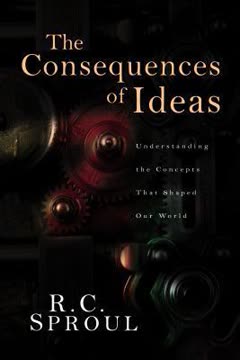
Review Summary
The Consequences of Ideas by R.C. Sproul receives mixed reviews averaging 4.18/5 stars. Readers praise Sproul's clear writing style and accessible overview of Western philosophy from ancient Greeks to modern thinkers like Freud and Sartre. Many find it excellent for beginners, though some criticize it as too simplistic for advanced readers or too complex for complete novices. A common complaint is that despite the title, Sproul inadequately addresses how philosophical ideas actually influenced society and culture. The book's Christian perspective is appreciated by some but seen as limiting by others. Several note it works well as an introductory text or homeschool curriculum.