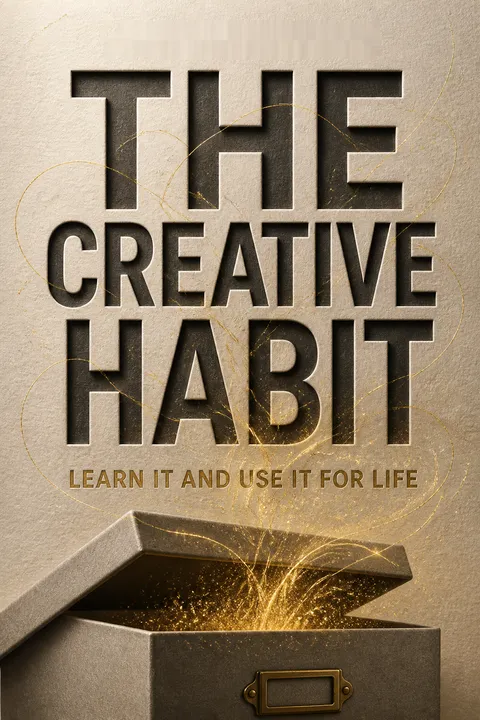


Key Takeaways
Treat creativity as trained work, not a lightning strike.
The empty room is familiar. Tharp opens with a deadline: in five weeks, she must present a new dance program, yet half the performance is still unknown. The dancers will arrive soon. Her answer is not to wait for inspiration, but to rely on years of daily practice. The same principle applies beyond art: creative work belongs to engineers, parents, researchers, and anyone facing a problem without an obvious solution.
Practice makes possibility usable. Tharp argues that talent needs preparation and craft to become work the world can experience. Her example is Mozart, often portrayed as a divinely effortless genius. In her account, his musical gifts were developed through his father’s teaching, extensive study, and relentless practice. Creativity can surprise, but skill and repetition help turn surprise into something finished.
What's striking is the book's refusal to make discipline the enemy of originality. Routine is presented as infrastructure: it gets a person into the room often enough for unpredictable ideas to appear. That resembles the distinction in skilled learning between acquiring components and combining them fluently. The analogy has limits, since repetition can also reinforce stale habits, and access to time, training, and quiet is not equally distributed. Still, the central claim is useful: inspiration may be uncontrollable, but the conditions for meeting it can be designed.
Make the first step automatic before fear gets a vote.
A ritual lowers the starting cost. Tharp's morning workout begins with the same small action: getting into a taxi and telling the driver where to go. Once the cab is moving, she has stopped debating whether to exercise. A yoga practitioner she knows uses a candle to mark the start of practice; composer Igor Stravinsky began work by playing a Bach fugue. Each action reliably ushers its maker into the work.
Name what holds you back. Tharp lists common creative fears, including ridicule, having nothing worthwhile to say, and discovering that an idea cannot match its imagined version. Writing a fear down makes it more specific and less like an all-powerful fog. She also recommends temporarily removing distractions, such as multitasking or habitual media, to protect attention. The ritual need not be impressive. It needs to make beginning easier.
The strength of a ritual is that it shifts effort from deliberation to sequence. Behavioral research often finds that stable cues help routines persist, though the cue itself does not guarantee meaningful work. A candle can signal commitment, but it cannot write the page. The most useful test is whether a ritual reliably moves someone into the activity rather than becoming a more comfortable substitute for it. Naming fears adds another advantage: a vague threat becomes a claim that can be examined, answered, or accepted without obeying it.
Find your creative signature before stretching beyond it.
Notice how you see. Tharp calls a person's recurring creative tendencies their creative DNA: not literal genetics, but the durable preferences and habits that shape their work. One clue is focal length, the distance from which someone tends to observe. Ansel Adams favored vast landscapes; novelist Raymond Chandler built scenes from close-up particulars. Choreographer Jerome Robbins often placed characters in relation to one another as watchers and watched.
Identify your native material. Tharp contrasts Robbins's narrative attention to specific lives with George Balanchine's more abstract evocation of life itself. She uses the Greek terms bios, a particular life with a story, and zoe, life as a larger force. Neither approach is superior. Knowing which comes naturally can prevent false starts and clarify where a deliberate stretch might be worthwhile. The book's self-inventory asks readers to examine early memories, ambitions, habits, fears, and admired artists for recurring patterns.
This framework turns self-knowledge into a practical artistic instrument. In psychology, people often work more effectively when they can name their preferences without mistaking them for fixed limits. The danger is treating a pattern as destiny: a close observer can learn to work at a larger scale, and a habitual storyteller can experiment with abstraction. Tharp's distinction is most valuable as a starting map, not a border. It helps separate a meaningful stretch from an attempt to imitate someone else's temperament.
Mine memory for connections, not just facts.
Memory supplies creative material. Tharp distinguishes recall from the more inventive act of connecting stored experiences in new ways. She describes muscle memory, in which repeated movements remain available to a dancer without conscious step-by-step thought. She also points to sensory memory: a taste or smell can summon a scene and its feelings. A business executive she knows rereads old correspondence and finds that forgotten names and details help generate fresh ideas.
Borrow skill through close attention. Tharp learned dance by studying accomplished performers and following their movements. She also describes writers such as Proust and Chandler studying or imitating admired writers as a way to absorb technique. A photograph, an old document, or an earlier work can become a prompt for new associations. The point is not to reproduce the past exactly, but to give the imagination more material to rearrange.
The account treats memory less like a filing cabinet and more like a network of associations. That is a productive model: recall can make distant experiences available to present problems, while practice embeds procedures that conscious explanation struggles to capture. Studying predecessors can likewise reveal craft that passive admiration misses. The boundary matters, though. Copying is useful as apprenticeship, not as a finished artistic identity. The learner has to notice what is being absorbed, then transform it in response to a different purpose.
Capture the mess, but do not confuse research with creation.
Give ideas a home. Tharp keeps a box for each dance, filling it with notes, recordings, images, objects, and research. The box marks a commitment, preserves details that might otherwise disappear, and lets her revisit a project when it stalls. For her Broadway show Movin' Out, the collection grew to twelve boxes. It included Billy Joel recordings, historical material, design references, and written goals such as telling a story and paying dancers well.
Preparation has a boundary. The box is raw material, not the finished work. Tharp compares it to a journalist's notebook: reporting supports a story, but the story still has to be written. A project can become trapped in endless research because research feels safer than making choices. Her practical advice is to begin before the archive feels complete, trusting that captured material can be revisited rather than mastered all at once.
The box is both an external memory and a permission structure. It lowers the cost of exploration because fragments can be kept without being immediately organized into a final argument. This resembles an artist's portfolio or a researcher's lab notebook: accumulation makes patterns visible over time. Yet archives can become monuments to deferred action. A useful collection should feed decisions, not merely expand. Setting a point at which research must produce a sketch, draft, or prototype keeps storage connected to making.
Scratch for small sparks, then connect them into a workable idea.
Start with a fragment. Tharp calls scratching the active search for material that might spark a project. It can mean reading, observing strangers, visiting a new place, studying nature, or improvising physically. A student in Robert Pirsig's writing class could not write about the United States or even the town of Bozeman. When told to focus on a single brick on the local opera house, she began writing and produced far more than the assignment required. Narrow attention gave her a foothold.
Make ideas multiply. Tharp's example of a producer asking David Mamet for a plot begins with two men and becomes more promising when a bear is added. One small idea opens a door; combining it with another creates momentum. Tharp improvises in the studio, records the session, and reviews the results later. She also recommends changing the setting or imposing a playful constraint to shake loose habitual thinking.
Scratching describes a form of deliberate exposure: gather varied inputs, act on them, and allow combinations to emerge. It counters the fantasy that a finished concept must arrive intact. The emphasis on physical improvisation is especially useful because action can produce information that contemplation cannot. But not every collision is insight, and novelty alone is a weak standard. Selection still matters. The process works best when a person can generate freely first, then judge which fragments have enough energy or coherence to develop.
Give each project a private spine that keeps choices coherent.
A spine is the work's guiding intention. Tharp defines it as the central idea that helps a creator decide what belongs, especially when the work becomes confusing. It may be a theme, image, story, or structure, and the audience does not need to know it. Her dance inspired by Euripides' The Bacchae began with the idea of hubris, then developed into a conflict between a god and a king, represented through a river image. The finished dance moved far from its source, but that starting framework helped shape it.
Use the spine as a test. Tharp compares the idea to a North Star: when a choice threatens to pull the work off course, ask whether it serves the intended effect. For a silent dance about couples, her underlying arc followed a relationship from early attraction to enduring acceptance. A strong spine also helps the maker know when the work is finished, rather than lingering indefinitely in enjoyable but unproductive tinkering.
A spine offers coherence without requiring literal explanation. In design, a comparable principle is a constraint that guides choices while leaving room for invention. The private nature of the idea matters: an artist can use a source or metaphor as scaffolding without forcing the audience to decode it. One caution is that a guiding concept can become an excuse to ignore what the work actually does. The spine should help interpret the emerging piece, not overrule evidence that its strongest elements are pointing elsewhere.
Plan the frame, then stay alert for useful accidents.
Planning should not become a cage. Photographer Richard Avedon prepared his equipment and met his subjects, but did not dictate the exact portrait in advance. When Charlie Chaplin briefly dropped his guarded expression and made a comic gesture, Avedon recognized the moment and took the picture. Preparation gave him the judgment to notice what chance supplied.
Limits can sharpen choices. Tharp contrasts a difficult New York City Ballet project, where abundant resources and grand ambitions led her into poor decisions, with a later ballet made under severe time and budget limits. The tighter conditions forced her to focus and plan more carefully. Her Broadway show Movin' Out also required major changes after its Chicago opening confused audiences. Rather than protect the original plan, she simplified the story and rebuilt the opening. Preparation matters, but revising in response to reality matters more.
This is a persuasive account of adaptive planning: preparation creates readiness, while feedback prevents a plan from becoming self-protective fiction. In engineering, prototypes serve a similar purpose by making assumptions visible before full investment. The examples also complicate the popular belief that more resources automatically produce better work. Scarcity can focus attention, though severe scarcity can also block ambitious work altogether. The practical aim is not deprivation. It is to distinguish resources that enable the core idea from resources that inflate its scale.
Practice weak skills, and treat failure as information about the work.
Craft expands what can be attempted. Tharp argues that ideas need practical skills behind them. Dancers train basic technique; writers build command of language; musicians learn their instruments. Practice is most useful when directed toward weaknesses, not merely toward the skills that already feel rewarding. She also urges creators to preserve enough inexperience to risk unfamiliar approaches instead of repeating a successful formula.
Diagnose the kind of failure. Tharp separates failure of skill, failure of concept, failure of judgment, and failure of nerve. Each calls for a different response: learn the missing craft, abandon a weak idea, remove material that does not belong, or act despite fear. Her three-hour improvisations may yield only thirty seconds worth keeping. That waste is part of private experimentation. Public failure, such as Movin' Out's troubled first version, can also become useful when honest criticism leads to specific revision.
The key distinction is between failure as verdict and failure as diagnosis. A weak result can reveal a missing technique, a flawed premise, or an unwillingness to make a necessary cut. That turns criticism into a decision rather than a judgment of personal worth. The emphasis on private experimentation also makes risk more sustainable: not every trial needs an audience. Still, persistence is not automatically virtuous. A creator needs criteria for stopping, or resilience can become an expensive way to defend an idea that no longer merits investment.
Protect a sustainable creative bubble, not a perfect life.
A creative life is built for the long run. Tharp says she did not feel like a master choreographer until her 128th ballet. She points to artists whose work continued changing over decades, and to the Beatles' short but clearly developing run of albums, as examples of continuity rather than a single early triumph. A creative bubble is a protected state in which attention and daily life are organized to support work. For novelist Philip Roth, that meant a secluded studio and a deliberately spare routine.
Make the conditions fit real life. Tharp does not claim that everyone can or should live monastically. A bubble might be a quiet room, a scheduled hour, or a focused collaboration. The book closes with her dancers returning to rehearsal after the September 11 attacks. Their familiar practice did not erase grief, but it gave them a way to act within it. Habit, over time, can become a source of steadiness and renewal.
The long view shifts creativity from a sequence of grand breakthroughs to a durable relationship with a craft. That framing makes room for changing ability, changing interests, and work that develops through accumulation. The bubble is strongest as a boundary around attention, not as an ideal of total isolation. Caregiving, employment, and community are not simply distractions; they can also shape the work and sustain the worker. A practical version therefore protects regular contact with the craft while remaining porous enough to let life continue to matter.
Analysis
The book's central paradox is that creative freedom depends on structure. Tharp does not claim that routines manufacture originality. They reduce the friction around beginning, preserve material, and create repeated opportunities for discovery. Her sequence is practical: prepare an environment, learn the self that enters it, gather and record inputs, generate fragments, give the work a guiding intention, then revise against what actually happens. Craft makes ideas executable; judgment selects among them; persistence keeps the cycle alive.
The most distinctive contribution is the insistence that creative work is not a mysterious exception to ordinary labor. A choreographer's studio is treated as a workplace with deadlines, collaborators, logistics, drafts, and quality control. This makes the advice portable while keeping its source visible: movement, rehearsal, and the realities of making dances provide the book's strongest examples. The account of Movin' Out is especially valuable because it shows the method under public pressure. Early success and expensive production did not make the first version work. Audience confusion and criticism supplied information that preparation alone could not.
The book is less convincing when its metaphors sound universal. A personal ritual can help one person and burden another; a creative bubble can protect attention but may shift costs onto family or colleagues. Tharp acknowledges some of these tensions, though the book's energetic celebration of focus can understate unequal access to time, money, training, and supportive collaborators. Likewise, describing creative tendencies as DNA is evocative but risks making preferences seem more fixed than they are.
Read most usefully, the advice is not a recipe for constant productivity. It is a toolkit for moving between modes: disciplined practice and unfiltered exploration, immersion and distance, persistence and abandonment. Its strongest promise is modest but powerful. A person cannot guarantee that the work will be brilliant, but can become more prepared to begin, more alert to material, and more capable of improving what the first attempt reveals.
Review Summary
The Creative Habit receives mostly positive reviews for its practical advice on cultivating creativity through routines and hard work. Readers appreciate Tharp's insights on overcoming creative blocks, developing discipline, and recognizing inspiration. Some find her tone condescending and her examples too dance-focused. Many praise the exercises and real-life anecdotes, finding them applicable across various creative fields. Critics note the book's emphasis on privilege and lack of diverse perspectives. Overall, it's considered a valuable resource for artists and creative professionals seeking to enhance their practice.
People Also Read



Glossary
The Creative Habit
Creativity through repeated practiceTharp's central idea that creative work can be supported by repeatable routines, preparation, and sustained practice. Habit does not dictate what a person creates or guarantee quality. It makes it more likely that the person will enter the work, develop skill, gather material, and remain available to ideas.
Creative DNA
Recurring creative tendenciesTharp's metaphor for the durable preferences, habits, and points of view that shape a creator's work. These may include the scale at which someone observes, the kinds of subjects that attract them, and recurring contrasts in their practice. The term is not a claim about literal genetic determination.
Scratching
Searching actively for ideasTharp's term for the exploratory activity used to find small pieces of material that can start a creative project. Scratching may involve reading, observing, traveling, studying other work, imposing a constraint, or improvising. Its purpose is to create contact with possible ideas, not to wait passively for a complete concept.
Spine
A project's guiding intentionThe core idea, image, theme, or structure that helps a creator shape a work and evaluate choices during its development. Tharp treats the spine primarily as a private guide, not necessarily as an explanation for the audience. It can keep a project coherent, help recover direction when work stalls, and clarify when it is complete.
MQ
Metaphor quotientTharp's shorthand for the ability to notice and create meaningful correspondences between apparently different things. She presents metaphor as a basic creative capacity: a movement can suggest a wave, a sound can evoke a scene, or one artwork can illuminate another. MQ is an interpretive idea, not a standardized measurement.
The Bubble
Protected creative attentionTharp's term for a state or environment organized to keep attention connected to creative work. It can involve solitude and reduced distractions, but it need not mean living alone or withdrawing from society. The form depends on the creator: a private studio, a focused workplace, or a bounded period of concentrated practice can all serve this function.
rut
Effort without forward progressA condition in which work continues but repeats familiar moves without producing meaningful development. Tharp distinguishes a rut from a complete block because the creator is still active, yet feels stuck, bored, or frustrated. A rut may come from a weak idea, changed circumstances, bad timing, or methods that no longer fit.
groove
Fluent creative momentumA period when work moves forward with unusual ease, coherence, and energy. Tharp compares it to an athlete being in the zone, while noting that it can be difficult to identify until it ends. A groove may last hours or much longer and can arise through a breakthrough, compatible material, or a fruitful collaborator.
validation squad
Trusted, candid reviewersTharp's name for a small group invited to assess work in progress. Members should have sound judgment, care about the creator, lack a competitive agenda, and be willing to criticize honestly. The group provides useful feedback without replacing the creator's responsibility to make the final decision.
FAQ
What's The Creative Habit about?
- Focus on Creativity: The Creative Habit by Twyla Tharp delves into the nature of creativity, emphasizing that it can be cultivated as a habit rather than relying on sporadic inspiration.
- Practical Guidance: The book offers practical exercises and insights to help individuals develop their creative potential across various artistic disciplines.
- Personal Experiences: Tharp shares her experiences as a dancer and choreographer, highlighting the roles of routine, preparation, and discipline in the creative process.
Why should I read The Creative Habit?
- Enhance Creativity: The book provides tools to unlock your creative potential and integrate creativity into your daily life.
- Practical Exercises: It includes actionable exercises that encourage active engagement with creativity, making it a hands-on guide.
- Inspiration from a Master: Twyla Tharp's insights, drawn from decades of experience in the arts, offer valuable lessons for enhancing creative skills.
What are the key takeaways of The Creative Habit?
- Creativity is a Habit: Tharp emphasizes that creativity is a skill developed through consistent practice and routine.
- Importance of Preparation: The book highlights the significance of preparation, stating that knowing how to prepare is essential for creativity.
- Embrace Rituals: Establishing rituals and routines can help overcome creative blocks and foster a conducive environment for creativity.
What are the best quotes from The Creative Habit and what do they mean?
- “Creativity is a habit...”: This quote underscores that creativity results from good work habits, not just inspiration.
- “You can’t just dance...”: Tharp stresses the need for a clear concept to guide the creative process, beyond mere artistic activity.
- “The box is the raw index...”: This refers to Tharp's method of using a physical box to organize ideas, highlighting the importance of preparation.
How does Twyla Tharp define creativity in The Creative Habit?
- Creativity as a Skill: Tharp defines creativity as a skill accessible to everyone, not just artists, and can be developed through practice.
- Connection to Routine: She emphasizes that creativity thrives on routine and discipline, suggesting that good habits nurture creative impulses.
- Universal Application: Tharp believes creativity is relevant in various fields, enhancing problem-solving and innovation.
What exercises does Tharp recommend in The Creative Habit?
- “Where’s Your ‘Pencil’?”: This exercise encourages identifying essential creative tools and always having them on hand for inspiration.
- “Build Up Your Tolerance for Solitude”: Practicing solitude helps individuals become comfortable with being alone, crucial for creative thinking.
- “Face Your Fears”: Identifying and confronting personal fears related to creativity reduces anxiety and promotes an open creative mindset.
How does Tharp suggest overcoming creative blocks in The Creative Habit?
- Embrace Scratching: Tharp introduces "scratching," exploring various sources of inspiration to stimulate creativity.
- Physical Movement: She emphasizes physical activity to break through creative blocks, suggesting movement can lead to new ideas.
- Change Your Environment: Tharp advises changing surroundings or taking field trips to stimulate fresh perspectives and ideas.
What is the significance of rituals in The Creative Habit?
- Establishing Routine: Rituals create a structured environment that fosters creativity, making it easier to begin the creative process.
- Commitment to the Process: Rituals eliminate doubt, allowing individuals to commit to creative endeavors without hesitation.
- Personal Examples: Tharp shares her morning workout ritual, illustrating how routines prepare the mind and body for creative work.
What is the concept of "scratching" in The Creative Habit?
- Exploratory Process: "Scratching" involves exploring various sources of inspiration to stimulate creativity, akin to digging for treasure.
- Generating Small Ideas: It's about generating small ideas that can lead to larger concepts, encouraging a playful approach to creativity.
- Combining Ideas: Scratching often involves combining disparate ideas to create something new, highlighting the importance of connection.
How does The Creative Habit address the relationship between creativity and discipline?
- Creativity Requires Discipline: Tharp argues that creativity involves discipline to practice and refine one’s craft regularly.
- Routine as a Foundation: Establishing a routine helps develop habits necessary for sustained creative output.
- Balancing Freedom and Structure: Tharp discusses balancing structured routines with freedom to explore, essential for successful creativity.
How can I apply the concepts from The Creative Habit to my own life?
- Establish a Routine: Create a daily routine that incorporates time for creative practice, as consistency is key.
- Engage in Exercises: Implement exercises like “Do a Verb” to stimulate creativity and inspire new ideas.
- Reflect on Your Spine: Identify core themes or ideas that resonate with you and use them as guiding principles in your creative work.
What are some common mistakes to avoid in the creative process, according to The Creative Habit?
- Overthinking Structure: Avoid fixating on structure, which can stifle creativity; flexibility is crucial for idea flow.
- Sticking to Obligation: Obligation should not be the primary motivator; passion and commitment drive creativity.
- Using the Wrong Materials: Avoid pursuing goals with inadequate resources; adaptability is essential for creative success.
Download PDF
Download EPUB
.epub digital book format is ideal for reading ebooks on phones, tablets, and e-readers.








