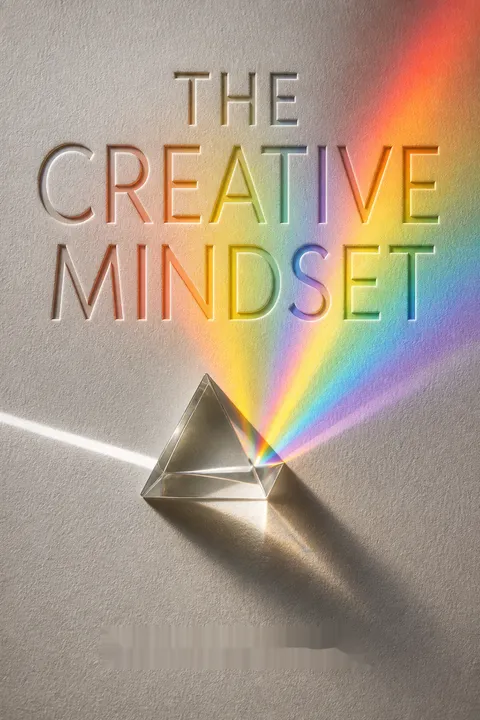


Key Takeaways
Treat creativity as useful novelty built from small, deliberate changes.
Start with what exists. The book treats creativity as the conception of something both new and useful, while innovation is putting that idea into practice. Its term "creativizing" means adding to or changing an existing thing until it becomes more useful, beautiful, or distinctive. This makes creativity a craft, not a mysterious gift reserved for celebrated geniuses.
Jim, a real estate agent, noticed older friends sharing a house near a university and began marketing student rentals to retirees. Starbucks grew through a similar series of additions: from selling beans to serving espresso, then building a café experience. In both cases, close observation and modest changes opened a larger opportunity.
What's compelling is the shift from invention as a lightning strike to improvement as a learnable practice. It resembles evolutionary adaptation: variation matters, but so does selection in a real environment. Small changes can accumulate into consequential innovation, though smallness itself is no guarantee of impact. Jim's insight and Starbucks' expansion worked because they met recognizable needs and found people willing to adopt them. The useful question is not whether an idea is revolutionary, but whether it improves an experience enough that someone changes behavior.
Define the challenge before spending energy inventing its solution.
Find the real question. The first skill, Clarify, means investigating what actually needs to change, why it matters, and whether the work is worth doing. One study cited in the book found that 48 percent of surveyed school superintendents identified problem solving as creativity's clearest expression, while business leaders more often emphasized spotting and articulating problems.
Meredith planned a training company for nonprofits, then realized she was reproducing the consulting job she wanted to leave. Questions from her husband helped her identify the work she truly wanted: executive coaching. The authors recommend gathering facts, observations, interpretations, impressions, experiments, and other people's testimony, then turning the findings into a clear challenge statement. Conversations with practitioners can reveal what a plan on paper misses.
Problem definition is a powerful form of leverage because it determines which solutions become visible. This aligns with design research, where observing users often exposes a different need than the one initially requested. Meredith's pause saved her from efficiently building the wrong career. Still, interviews are not neutral windows into reality: people may describe preferences that differ from their choices, and insiders can defend existing arrangements. Strong clarification therefore pairs listening with observation, small tests, and an honest check on the creator's own motivation.
Borrow practices across worlds, then adapt them to local realities.
Search beyond your field. Replicate means noticing a useful practice in one setting and reapplying its underlying logic somewhere else. The book calls one method "search and reapply": observe how another person or organization handles a task, then consider whether the approach fits your own challenge.
A group of Mayo Clinic physicians studied service at a Ritz-Carlton and borrowed lessons for welcoming and guiding patients. Marketing executive Loni drew on the attentive conversations she had with an older park regular, Archie, to create intergenerational dialogues among coworkers. The book also urges field trips, conversations with people outside one's usual circle, and observation of natural forms. Biomimicry, the study and adaptation of nature's designs or processes, offers another source of patterns.
This is disciplined borrowing, not plagiarism or superficial imitation. The key move is to identify the function beneath a practice: hospitality, information flow, or adaptation to changing conditions. That resembles ethnography, which learns from people in context rather than treating a visible behavior as a universal recipe. Cross-domain borrowing can also fail when the receiving environment has different incentives or constraints. A practice that delights hotel guests may not transfer unchanged to a clinic, where privacy, urgency, and clinical duties shape the experience.
Combine distant inputs to escape the ideas your routine already produces.
Make room for unlikely links. Elaborate means generating new possibilities by adding, altering, or connecting ideas, including ideas that do not usually appear together. In the book's central example, Ralph combined restaurant performance data, an emerging computer network, and the familiar format of baseball cards. Store managers could then compare sales and quality measures in a form people could quickly understand.
Several prompts help loosen habitual thinking. SCAMPER invites people to consider changing, combining, reusing, removing, or rearranging parts of an idea. The Thinking Hats method asks a group to examine a challenge through distinct lenses, including evidence, emotion, criticism, possibility, new options, and process. Random words can serve as another spark. The goal is to generate alternatives before deciding which deserve attention.
Ralph's solution shows that creativity can come from recombination rather than invention from nothing. Cognitive science describes this as a central feature of thought: familiar elements are retrieved and assembled into new configurations. Structured prompts help because they interrupt default responses, while distinct viewpoints make a group less likely to confuse its first consensus with the best answer. But novelty prompts can produce noise as well as insight. They work best when anchored to a clearly defined challenge and followed by evidence-based testing.
Use analogies to transfer structure, not just borrow attractive imagery.
Build a useful bridge. Associate means using a comparison to move understanding from a familiar domain into a less familiar one. In a project to coordinate a sprawling company's divisions, consultant Anita's team compared the organization to a NASCAR race. The race-car driver, pit crew, spectators, and race itself helped clarify roles, coordination, and missing responsibilities.
A related method, Synectics, uses a metaphorical excursion: identify a root cause, explore an apparently unrelated comparison, and transfer relevant features back to the original problem. The comparison should reveal relationships, not merely sound clever. The book warns that shallow analogies can mislead. Comparing a government budget to a household checkbook, for instance, may conceal important differences in how each can use money.
Analogy is a form of compressed reasoning: a familiar system lets people reason about relationships they cannot yet see directly. Its power depends on structural fit. A useful comparison transfers a pattern, such as coordination among specialized roles, rather than decorative details. This is why analogies can both generate ideas and expose gaps. They also carry risk: a vivid metaphor can smuggle in assumptions and make a weak proposal feel intuitive. Testing which features actually map across domains keeps the bridge from becoming a trap.
Make the idea a shared story, or stakeholders may abandon it.
Give people a role. Translate means communicating an idea as a story others can understand, enter, and help shape. Stories make a plan more than a collection of features: they explain who acts, what changes, and why the change matters. Storyboards let a group arrange events and revise the sequence together.
A university residence was designed as an interdisciplinary living and learning community. Faculty, students, and project leaders helped shape its vision, but finance decision-makers were not meaningfully included. When a rent calculation and a no-sublet rule threatened the project, those stakeholders saw a financial problem rather than a mission worth protecting. The experiment unraveled. By contrast, the Dos Equis campaign refreshed an aging beer brand by giving it a vivid, memorable character and a new public identity.
A shared narrative acts like coordination infrastructure. It gives people across departments a common account of what the work is for, which can matter as much as the technical plan. The residence hall's failure is especially instructive because the missing participants were not peripheral: they controlled a condition essential to survival. Yet narrative can also oversimplify or manipulate. A persuasive story should clarify trade-offs and invite scrutiny, not replace budgets, evidence, or the voices of people who bear the costs.
Map plausible futures before committing resources to a single design.
Make uncertainty visible. Scenario making explores how current forces could produce different future conditions. A team identifies relevant drivers, considers best and worst cases, and develops other plausible outcomes. The purpose is not to predict exactly what will happen, but to prepare a group to notice changes and adjust.
Software developer Sanjay struggled to explain a technical strategy to a team that could not see its future consequences. Asking one developer to describe the best and worst outcomes made the trade-offs clearer. The team then identified forces such as cyberattacks, compatibility demands, and regulation, and built shared scenarios. Morphologies offer a complementary tool: break a product or story into attributes, then recombine those elements to explore alternatives. One method maps uncertainty; the other expands the design space.
Scenario work is most useful when treated as rehearsal rather than prophecy. It helps teams ask what evidence would signal a changing environment, and what decisions remain robust across several outcomes. This is closely related to stress testing in finance and engineering. Its limits matter: scenarios can inherit the group's blind spots, and unexpected events may invalidate their assumptions. The exercise improves readiness, not certainty. Pairing scenarios with observable indicators and revisiting them as conditions change prevents a compelling narrative from hardening into a forecast.
Separate imagination from judgment, then choose ideas that can travel.
Use two different filters. Evaluate means selecting ideas after generating them. The authors distinguish divergent thinking, which opens up many possibilities without immediate judgment, from convergent thinking, which narrows the field using practical criteria. They ask teams to consider both a concept's potential influence, interest, imagination, urgency, and direction, and its cost, timing, feasibility, acceptability, and usefulness.
Javier, a lawn-care owner, compared serving two distant communities with concentrating on one neighborhood and adding seasonal work. After calculating equipment, fuel, and maintenance costs, he estimated that the focused plan could raise his take-home earnings by 30 percent. The book's effort-versus-payoff grid also helps people distinguish promising low-effort gains from demanding projects with little return. A rejected museum idea to let artworks speak on social media shows how a group's conventional tastes can suppress a promising experiment.
Separating generation from evaluation reduces a common group error: rejecting unfamiliar ideas before their implications can be examined. The two-stage process also prevents the opposite mistake, treating novelty as proof of value. Javier's calculation grounds creativity in opportunity cost, not just excitement. However, forecasts about feasibility and market interest are often uncertain. Small pilots can improve decisions by replacing confident estimates with observed behavior. Evaluation should therefore rank ideas, but also identify what evidence would justify advancing, revising, or stopping each one.
Protect creative windows with movement, rest, and repeatable surroundings.
Prepare for the spark. The book argues that creativity cannot be summoned on command, but people can learn the conditions in which their thinking works well. It calls periods of deep involvement "flow states." The suggested practices are practical: notice when ideas come most easily, capture them, take restorative breaks, walk outside, and adjust the work environment to support concentration.
Jasmin, a pharmaceutical scientist, deliberately learned from innovation seminars, other industries, and collaborators before developing a more open approach to generating ideas. Her career illustrates the book's central point: creative skill grows through repeated practice, not a single flash of insight. The six skills can be used in sequence, but the authors emphasize adapting the order to the challenge. Preparation makes a person more ready to recognize and develop an opportunity when it appears.
The advice balances two conditions that are often treated as opposites: focused effort and mental distance. Walking or resting can loosen a stuck line of thought, while a reliable place to record ideas prevents useful insights from evaporating. This resembles research on incubation, where time away from a task can support new associations, though it does not guarantee a breakthrough. Flow is also not equally available to everyone: caregiving, workload, disability, and workplace control shape access to uninterrupted time. A useful creativity routine should fit the person's real constraints, not idealize them away.
Analysis
The book's most valuable claim is not simply that anyone can be creative. It is that practical creativity can be decomposed into trainable moves: notice a challenge, inspect how others solve related problems, combine inputs, reason by comparison, communicate a possible future, and select what deserves a test. That converts an intimidating identity claim, "I am not creative," into a sequence of behaviors that can be practiced.
The sequence also describes a social process, not merely private inspiration. Jim's business insight depends on noticing an unexpected household arrangement. Loni's workplace practice grows from a friendship across generations. The university residence fails because its financial stakeholders do not share the project's story. Across these cases, innovation depends on access to information, trust, authority, and resources. A personal mindset helps someone notice possibilities, but organizations determine whether those possibilities can be tried and sustained.
The framework is best understood as a field guide rather than a validated cognitive map. The authors explicitly present the skills as a practical synthesis, not a precise account of neural stages. That modesty matters: real creative work loops backward. Evaluation can expose a badly framed problem; a failed prototype can reveal a new user need; a story can generate fresh associations. The sequence provides useful scaffolding, but treating it as a strict pipeline would make it less useful.
A second tension concerns the celebration of copying and small moves. Borrowing is often the fastest route to useful improvement, but transfer requires judgment about context, power, and unintended effects. A hotel service ritual cannot simply be installed in a clinic without attention to clinical needs. Likewise, a compelling analogy can organize thought while concealing important differences. The book's own strongest advice is therefore its insistence on clarification, local knowledge, and evaluation. Creativity is not novelty for its own sake. It is a disciplined attempt to make something work better for people, followed by honest attention to whether it actually does.
Review Summary
The Creative Mindset receives mostly positive reviews, with an average rating of 3.74/5. Readers appreciate its practical exercises, clear structure, and concise approach to teaching creativity skills. Many find it useful for both personal and professional development, praising its ability to spark innovation and fresh thinking. Some reviewers note that while the content is well-summarized, it may not offer much new information for those already familiar with creativity techniques. Overall, readers value the book's accessible guidance on developing a creative mindset and its potential to enhance problem-solving abilities.
People Also Read





Glossary
CREATE
Six creative thinking skillsA mnemonic for Clarify, Replicate, Elaborate, Associate, Translate, and Evaluate. These skills describe a practical route from understanding a challenge to generating, communicating, and selecting ideas. The authors present the sequence as a flexible guide rather than a scientifically fixed process, so people can revisit or reorder skills to fit the work.
creativizing
Improving what already existsThe authors' term for adding creativity to something existing so that it becomes more useful, beautiful, novel, or otherwise improved. It emphasizes developing an idea by changing or repurposing available materials and practices, rather than assuming that creativity must begin with a completely original invention.
search and reapply
Transfer a practice across settingsA method for finding useful practices in unfamiliar places and adapting them to a familiar challenge. The observer studies how another person, organization, or environment works, identifies the function behind the practice, and considers how that function could be applied in a different context.
biomimicry
Adapt designs found in natureThe practice of observing forms, functions, or processes in nature and adapting relevant features for human-designed objects or systems. The book's method breaks down both the object being redesigned and the natural model into attributes, then selects and tests features that could improve the design.
SCAMPER
Prompts for changing an ideaA creativity technique that uses action-oriented prompts to generate variations on an existing idea. It invites people to consider substitutions, combinations, adaptations, modifications, new uses, removals, and reversals or rearrangements. The prompts help make familiar products or processes less fixed and easier to rethink.
Thinking Hats
Structured perspectives on a challengeA group or individual method for considering a challenge through different kinds of thinking. The book describes perspectives focused on facts, feelings, critical judgment, possibilities, new alternatives, and process. Taking them separately helps surface reactions and assumptions that a single discussion can overlook.
Synectics
Solve through unrelated comparisonsA group creativity method that uses metaphor to approach a problem from a different domain. Participants identify a root cause, explore a comparison that is not obviously related, transfer relevant features of that comparison back to the problem, and combine the resulting possibilities into a potential solution.
morphologies
Recombine a design's componentsA method for exploring alternatives by dividing a product, service, or story into categories of attributes and functions, listing possible options for each, and combining those options in new ways. It makes a complex design easier to inspect and can expose combinations that conventional thinking misses.
scenario making
Explore plausible future conditionsA planning method that identifies forces likely to affect a challenge over a defined time period and develops several possible outcomes. Scenarios can include best, worst, and more likely cases. They are tools for considering consequences and adapting to new information, not claims that one future can be predicted precisely.
GE Work-Out evaluation grid
Compare effort with potential payoffAn effort-versus-payoff tool the authors use to help prioritize ideas and activities. It distinguishes options by the work required and the likely value returned, helping teams notice easy gains, ambitious opportunities, demanding special cases, and low-value distractions. The book applies the same prioritization logic to projects and everyday responsibilities.
flow states
Periods of deep creative engagementPeriods when attention and activity align in a way that supports intense involvement in work. The book argues that people can become more aware of conditions associated with their own flow, such as time of day, setting, movement, or rest, and build routines that make productive creative work more likely.
FAQ
What's "The Creative Mindset" about?
- Practical Creativity: "The Creative Mindset" by Jeff DeGraff and Staney DeGraff focuses on practical, everyday creativity that can transform ordinary tasks into extraordinary outcomes.
- Six Essential Skills: The book introduces six essential creative thinking skills, summarized by the acronym CREATE: Clarify, Replicate, Elaborate, Associate, Translate, and Evaluate.
- Democratizing Innovation: It emphasizes that creativity is not just for geniuses but can be developed by anyone to drive personal and organizational innovation.
- Real-World Application: The authors draw from over thirty years of experience working with Fortune 500 companies to provide a systematic approach to mastering creativity.
Why should I read "The Creative Mindset"?
- Develop Creativity: It offers a structured approach to developing creativity, which is a valuable skill in both personal and professional settings.
- Practical Techniques: The book provides actionable techniques and exercises that can be easily integrated into daily routines to enhance creative thinking.
- Inspiration and Motivation: Through real-life examples and stories, the book inspires readers to see creativity as accessible and achievable.
- Broaden Perspectives: It encourages readers to challenge assumptions and explore new ways of thinking, which can lead to innovative solutions.
What are the key takeaways of "The Creative Mindset"?
- Creativity is Learnable: Creativity is not an innate talent but a skill that can be developed through practice and the right mindset.
- Six Skills Framework: The CREATE framework provides a clear roadmap for enhancing creativity through specific skills.
- Importance of Mindset: A creative mindset is crucial for recognizing opportunities and overcoming challenges in innovative ways.
- Continuous Improvement: Creativity is an ongoing process that involves experimenting, learning, and refining ideas.
How does the CREATE framework work in "The Creative Mindset"?
- Clarify: Focus on identifying and understanding the real challenge or opportunity before seeking solutions.
- Replicate: Borrow ideas from other fields or nature and apply them to your own context to spark innovation.
- Elaborate: Connect unrelated ideas to generate new concepts and expand on existing ones.
- Associate: Use analogies and metaphors to bridge gaps between different ideas and create new insights.
- Translate: Turn ideas into compelling stories that can inspire and engage others.
- Evaluate: Assess ideas based on their potential impact and feasibility to select the best ones for implementation.
What is the significance of the "Creative Mindset" in the book?
- State of Mind: The Creative Mindset is a way of thinking that involves being open to new ideas and opportunities.
- Preparation for Creativity: It requires preparation and a willingness to challenge assumptions and explore new perspectives.
- Foundation for Skills: A creative mindset is essential for effectively applying the six skills outlined in the book.
- Everyday Application: It encourages readers to integrate creativity into their daily lives, making it a habitual practice.
How can I apply the "Clarify" skill from "The Creative Mindset"?
- Identify the Real Problem: Focus on understanding the true challenge or opportunity before jumping to solutions.
- Ask Questions: Use probing questions to gain clarity on the issue and uncover underlying causes.
- Gather Information: Collect relevant data and insights to inform your understanding of the problem.
- Craft a Clear Statement: Define the challenge in a concise and specific way to guide your creative efforts.
What is the "Replicate" skill in "The Creative Mindset" and how can it be used?
- Borrow Ideas: Look for successful ideas in other fields or nature and adapt them to your own context.
- Field Trips: Explore new environments and observe how things are done to gain fresh perspectives.
- Make New Friends: Engage with people who have different viewpoints to expand your thinking.
- Copy Nature: Use biomimicry to draw inspiration from natural processes and designs.
How does "Elaborate" enhance creativity according to "The Creative Mindset"?
- Connect Ideas: Link unrelated concepts to generate new ideas and expand on existing ones.
- Use Random Words: Employ random words to stimulate creative connections and break habitual thinking patterns.
- SCAMPER Technique: Apply the SCAMPER method to modify and improve ideas through substitution, combination, and other actions.
- Thinking Hats: Use different perspectives to explore various aspects of a problem and generate diverse solutions.
What role do analogies play in the "Associate" skill from "The Creative Mindset"?
- Bridge Ideas: Analogies help connect different ideas by highlighting similarities and creating new insights.
- Adaptive Reasoning: Use analogies to change perspectives and explore new ways of thinking about a problem.
- Imaginary Friends: Consult imaginary advisors to gain diverse viewpoints and challenge your assumptions.
- Synectics: Engage in metaphorical excursions to explore alternative domains and generate creative solutions.
How can storytelling be used to "Translate" ideas in "The Creative Mindset"?
- Create Compelling Narratives: Turn ideas into stories that inspire and engage others, making them more relatable and memorable.
- Storyboarding: Use visual storyboards to map out the sequence and elements of your story, allowing for easy adjustments.
- Morphologies: Break down stories into components and reassemble them in new ways to explore different possibilities.
- Scenario Making: Develop scenarios to anticipate future outcomes and plan for various possibilities.
What are the best quotes from "The Creative Mindset" and what do they mean?
- "Creativity starts with creating a better mindset, a new mindset, a creative mindset." This quote emphasizes the importance of mindset in fostering creativity and innovation.
- "Anyone can learn to be more creative." It highlights the book's core message that creativity is a skill that can be developed by anyone.
- "The next big thing most likely will be small." This suggests that innovation often comes from small, incremental changes rather than grand, sweeping ideas.
- "Creativity is just connecting things." This quote, attributed to Steve Jobs, underscores the idea that creativity involves making connections between seemingly unrelated concepts.
How can I evaluate ideas effectively using "The Creative Mindset"?
- Divergent Criteria: Assess ideas based on their influence, interest, imagination, urgency, immediacy, and direction.
- Convergent Criteria: Evaluate ideas for cost, time, feasibility, acceptability, and usefulness.
- Positive and Negative Aspects: Consider the pros and cons of each idea to determine its potential impact.
- GE Work-Out Grid: Use this tool to prioritize ideas based on their payoff and implementation difficulty, focusing on small and big wins.
Download PDF
Download EPUB
.epub digital book format is ideal for reading ebooks on phones, tablets, and e-readers.








