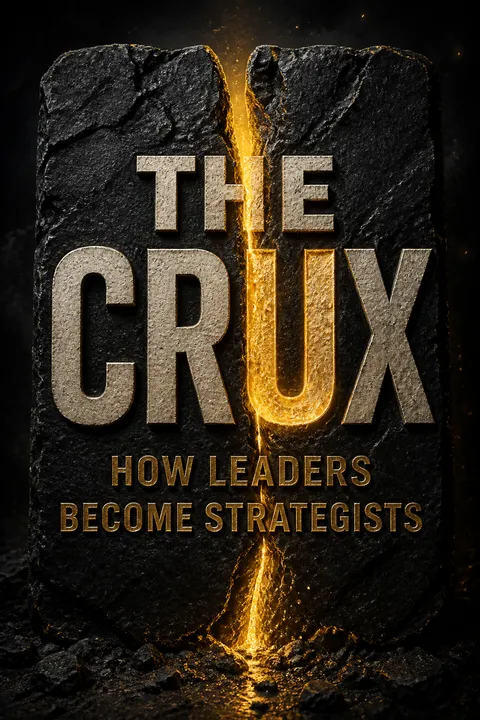


Key Takeaways
Find the hard move that unlocks the whole strategic climb
The crux is the blockage. In bouldering, a climber can manage the first few moves and still fall at the crux, the most difficult move on the route. Rumelt uses the term for the critical part of a challenge that is also realistically solvable through focused action. Strategy is the work of finding that point and designing a way through it, not simply demanding more effort.
SpaceX found its move. Elon Musk treated the cost of reaching orbit as a problem of rocket reuse, then focused on the obstacle that made reuse difficult: returning safely through the atmosphere. SpaceX designed a rocket that could slow itself with its engines and land upright, rather than rely on a complex heat-shield approach. By 2018, the Falcon 9’s cost per pound to low-Earth orbit was reported as 23 times lower than the space shuttle’s. The lesson is not that every problem has a clever trick, but that effort scattered across the wrong obstacles rarely changes the outcome.
What's striking is the distinction between effort and leverage. A team can work harder on every visible symptom and still leave the binding constraint untouched. The climbing image helps make strategy concrete: progress depends not on eliminating difficulty, but on discovering which difficulty controls the route. The idea also guards against simplistic claims of guaranteed success. A solvable crux is a judgment under uncertainty, not proof that the challenge can be conquered. Leaders should treat their diagnosis as a reasoned bet and remain alert to evidence that the apparent key move is not holding.
Diagnose the blockage before turning ambition into a target
Targets do not explain how. Carolyn, a health-products planner, was asked by her new CEO to create a strategy for at least 15 percent annual profit growth. She wanted a roadmap to bridge the gap between current performance and the target. But the target named a desired result, not the obstacle preventing it. Rumelt argues that strategy begins by examining the actual situation, then identifying which ambitions can be advanced. A “bundle of ambitions” means the competing hopes, values, and intentions held by leaders and stakeholders; they cannot all be pursued at once.
Netflix shows why diagnosis matters. In 2017, the company reported a cash outflow of $1.8 billion even as it grew. Content owners were reclaiming shows, competitors were entering streaming, and the cost of winning subscribers had risen. A strategy exercise therefore had to ask whether Netflix could use its international foothold to create compelling content for audiences across borders, rather than merely announce growth goals. A good objective follows from such analysis; a target declared beforehand can pressure people to invent a story that makes the numbers look achievable.
The distinction between aspiration and diagnosis is useful well beyond corporate planning. In medicine, a desired outcome is not a treatment plan; in engineering, a performance specification does not identify the failure mechanism. Targets can still coordinate action once leaders understand the problem, but they are poor substitutes for that understanding. The harder issue is that diagnosis can unsettle established interests: deciding which ambition matters most means deciding which ones wait. A credible strategy therefore needs both analytical clarity and a candid account of what the organization is choosing not to pursue.
Use frameworks to notice, then design your own way through
Strategy is designed, not deduced. Rumelt distinguishes familiar choice problems, where alternatives are known, from engineering-design problems, where something new must be created, and “gnarly challenges,” where the problem itself is unclear and cause and effect are uncertain. Many strategic situations are gnarly. They require a diagnosis and an invented response, not a formula that converts goals into actions.
Paradigm Corp. illustrates the trap. Its leaders selected broad differentiation and faster product launches from established strategy categories. Those labels did not address the company’s real troubles: weak control over manufacturing and slow-growing major customers. Once these issues were faced, management developed a more grounded response, redirecting sales toward growing smaller firms and separating standard products from special ones. Analytical frameworks can direct attention toward useful questions, but they cannot supply the specific move. The strategist must create alternatives, test their logic against what is known, and translate a promising design into coordinated action.
This argument makes a valuable distinction between maps and routes. A framework can reveal what to inspect, while a strategy must connect the local facts to a workable intervention. The danger is not using models, but mistaking their categories for causal explanations. Still, design should not become a license for intuition alone. An inventive proposal earns credibility when it states its assumptions, identifies what evidence would disconfirm them, and shows why the chosen actions fit the diagnosed obstacle better than plausible alternatives.
Change the comparison, and yesterday's obvious answer may collapse
Frames steer diagnosis. A frame is a point of view that highlights some facts and obscures others. Rumelt recommends reframing a challenge, asking why it is difficult, comparing it with other situations, and making assumptions explicit. Analogies can reveal a useful pattern, but an analogy can also mislead when important differences go unnoticed.
The iPhone exposed a false comparison. Microsoft, Nokia, and other observers treated smartphones as if they would follow the personal-computer market: open systems would spread, hardware would become interchangeable, and Apple would remain a small niche. But the phone market had different dynamics. Apple combined phone, music player, and full Web access in one device, then supported it with a growing app ecosystem. Its competitors were reasoning from the PC market’s history, including the mistakes that enabled clones, rather than examining the actual needs and structure of mobile use. A changed frame can reveal a possibility that familiar categories make invisible.
The practical power of reframing lies in making assumptions inspectable. People often call a view “reality” when it is actually a compressed model of reality. The iPhone case shows how an analogy can create confidence while hiding a key difference. Yet novelty alone does not validate a new frame: every situation can be described in many ways, and some are merely clever. Strong reframing earns its place by explaining more of the evidence and suggesting actions that can be tested.
Choose challenges that are vital and realistically movable
Importance needs a second test. An “addressable strategic challenge,” or ASC, is both critical to the organization and plausibly surmountable with its available power, skills, resources, and time. Importance alone can trap a team in an overwhelming issue; easy problems alone can consume attention without changing the organization’s prospects. The crux usually lies where a serious challenge is hard, but not hopeless.
Plan Dog was a prioritization choice. In 1940, US military planners judged they could not decisively fight major wars in Europe and Asia at the same time. They gave priority to defeating Germany and supporting Britain, while accepting a defensive posture in the Pacific. This was not a claim that the Pacific mattered little. It was a judgment about where concentrated effort had the best chance of changing the outcome. When a critical challenge seems unaddressable, Rumelt advises breaking it into smaller parts, finding the constraint that makes it difficult, or admitting that competing requirements create a “null set,” with no feasible solution unless at least one requirement is relaxed.
The two-part test disciplines both ambition and avoidance. Organizations often gravitate toward challenges that are familiar and manageable, while the most consequential obstacles remain untouched. The ASC idea forces explicit comparison rather than allowing every issue to claim top priority. Addressability, however, is not a fixed property of a problem: a new capability, partner, or time horizon can change it. The rating process should therefore prompt debate about assumptions, not turn judgment into a mechanical scorecard.
Strategy requires authority to redirect people, money, and attention
Focus has organizational consequences. Choosing a crux means giving some activities priority over others. Rumelt calls strategy an exercise of power because important change requires people and resources to move away from established routines. Vision statements cannot do that by themselves. Leaders need enough authority to make choices stick, and sometimes they must build that authority before they can implement a business strategy.
Nora Frank built influence indirectly. At GrandCo, product development, manufacturing, sales, and marketing were split across functions, leaving no leader responsible for the whole nautical-products business. Nora believed the company should move beyond yachts toward fleet-management products, but lacked budget authority. She created a “virtual division” by bringing relevant people together, assembling a shared view of the business, and coordinating product decisions. The group gradually won approvals; a later CEO made it a formal division and put Nora in charge. Her path shows that where direct authority is missing, a strategist may first need to create a coalition and demonstrate the value of coordinated action.
This is a bracing corrective to leadership advice that treats alignment as a matter of inspiring language. Strategy reallocates scarce resources, so someone’s work, status, or preferred project may lose. Naming power makes those consequences visible instead of disguising them as a communication problem. At the same time, authority alone is not strategic competence. A leader can force a coherent but mistaken plan. The strongest use of power is to protect honest diagnosis, concentrate effort, and make responsibility clear enough that new evidence can still change the course.
Make the parts of your plan strengthen, not sabotage, each other
Coherence multiplies effort. Coherent actions support one another rather than pulling in opposite directions. Rumelt calls the minimum standard “minimum coherence ”: at the very least, a company’s policies should not directly undermine its chosen competitive approach. A tightly focused firm can go further, designing activities that reinforce one another and make the whole harder to imitate.
Petzl built trust through fit. The climbing-equipment maker aligned its product focus, technical knowledge, safety reputation, and rapid response to users facing risk. When New York firefighters needed an escape system, Petzl developed and revised the device quickly after training exposed a rope problem. By contrast, the space shuttle tried to satisfy multiple constituencies at once: human spaceflight, military requirements, and low-cost satellite launches. Those aims produced costly compromises, including a crewed vehicle for routine payloads and complex systems that undermined the promise of cheap reuse. The lesson is that a list of individually appealing actions can still add up to an internally contradictory strategy.
Coherence is more than consistency in a slide deck. It is a property of the operating system: incentives, products, processes, and skills must point in compatible directions. This offers a useful diagnostic question: if one action succeeds, does it make the other actions more effective, or does it create new friction? The standard should still fit the organization. Large, diversified institutions cannot always reproduce the tight integration of a specialist company, but they can avoid direct contradictions and clarify which units are pursuing which priorities.
Grow by extending distinctive value, not by merely getting bigger
Advantage begins with an asymmetry. A company needs something competitors cannot easily match, such as special knowledge, know-how, position, efficiency, or skill at managing a complex system. The “value gap” is the difference between what buyers are willing to pay and the cost of providing the product; distinctive advantage means creating more of that value than rivals do. Growth is strongest when a company improves this advantage, then extends it to more customers or adjacent needs.
Varnico grew through extension. The food-processing service company first improved how regional teams shared customer solutions and trained staff. It then used its new customer-oriented data system to serve larger processors whose internal service teams feared being displaced. The software supported those employees instead, opening a new market. Rumelt warns against acquisitions made just to inflate revenue: acquisitions are most defensible when they add complementary skills, technology, or market access that advances an existing strategy. Simplifying the business can also free attention and resources for growth.
The distinction between value creation and size is important because growth metrics can reward expansion that weakens the underlying business. The Varnico example shows a more durable logic: understand what customers need, improve the system that serves them, and then extend that capability where it fits. This also gives acquisitions a sharper test than vague claims of synergy. A purchase should solve a strategic constraint or accelerate a proven source of value. Even then, integration costs and overpayment can consume the very advantage the deal was meant to create.
Review strategy as a journey, not an annual budget ritual
Strategy changes with the terrain. A company does not face one permanent challenge. Salesforce moved from launching cloud-based customer software, to finding customers, to serving smaller firms, and then to building a broader platform. Each response changed what the company could attempt next. Strategy is therefore an ongoing sequence of diagnoses and actions, not a timeless slogan about a desired destination.
The Strategy Foundry makes that work concrete. Rumelt’s method brings a small group of senior leaders together, separately from budgeting, to identify challenges, examine what makes them difficult, narrow attention to a few important and addressable issues, and design actions. FarmKor’s three-day session moved from a long list of priorities to a focus on higher-value crops and collaboration with lead customers. The group also wrote down assumptions to check as events unfolded, a practice Rumelt calls “strategic navigation.” This approach keeps strategy distinct from management tools such as scorecards, and from quarterly earnings pressure, which can reward short-term appearances over investments that build future value.
A recurring strategy process makes uncertainty manageable without pretending it can be eliminated. Shorter commitments can lower the political cost of setting aside a favored project because priorities can be revisited as evidence changes. The Foundry also makes the quality of discussion part of the strategy: confidential input and deferred judgment can surface inconvenient facts before a group settles on action. Its limits matter. A workshop cannot compensate for leaders who lack business knowledge, refuse disagreement, or will not support the resulting choices.
Analysis
Rumelt’s central contribution is to relocate strategy from aspiration to diagnosis. Instead of asking first where an organization wants to end up, he asks what presently blocks meaningful progress, which part of that blockage matters most, and whether the organization can act on it. The crux is valuable because it joins three judgments that are often separated: importance, difficulty, and addressability. This makes strategy less like choosing from a consultant’s menu and more like designing a route through uncertain terrain.
The book’s stories show that the framework applies across very different settings. SpaceX focused on reentry as the barrier to rocket reuse. Netflix’s challenge was not simply to grow, but to secure content and scale as suppliers and rivals changed the market. Nokia’s decline illustrates how internal structure can become part of the competitive problem. The Strategy Foundry then offers a process for moving from a crowded inventory of concerns to a limited set of actions, with explicit assumptions that can be checked.
The strongest insight is also a demanding one: strategic focus is not just mental concentration. It changes budgets, authority, status, and routine. A leader who names a crux but leaves the organization’s incentives and decision rights untouched has produced analysis, not strategy. Rumelt is also right to distinguish a desired result from an explanation of how to achieve it. Targets can coordinate execution, but they cannot manufacture a causal path.
A useful caution is that addressability may be underestimated precisely when the needed capability is absent. If leaders treat current competence as a hard boundary, they may abandon transformative challenges too quickly. The framework partly answers this by asking whether the problem can be decomposed, whether a partner or new resource could alter the odds, and whether the time horizon should change. Ultimately, crux selection remains judgment, not calculation. Its quality depends on intellectual honesty, broad knowledge, and a willingness to revise the diagnosis when the world disagrees.
Review Summary
The Crux: How Leaders Become Strategists receives mostly positive reviews, with readers praising Rumelt's challenge-based approach to strategy. Many find it a valuable complement to his previous work, offering practical insights on identifying and addressing core business challenges. Some criticize the book's structure and anecdotal style, while others appreciate its real-world examples. Reviewers highlight Rumelt's emphasis on problem-solving over goal-setting and his critique of traditional strategic planning methods. The book's "Strategy Foundry" concept is noted as a useful framework for developing effective strategies.
People Also Read






Glossary
Crux
Critical solvable blockageThe crux is the most consequential part of a larger challenge that can plausibly be overcome through focused, coordinated action. It is not necessarily the whole problem or the easiest issue. Finding it requires judging both what matters and what the organization can realistically address.
Gnarly challenge
Unstructured strategic problemA gnarly challenge has no clear, agreed definition, no ready-made set of alternatives, and no reliable map from actions to outcomes. It often contains conflicting ambitions and uncertain causes. Strategy work must first make sense of the situation, identify a tractable core, and design possible responses.
Addressable strategic challenge
Important, plausibly solvable issueAn addressable strategic challenge, or ASC, passes two tests: it is important to the organization, and it appears possible to surmount with its resources, skills, authority, and time. The assessment is contextual rather than permanent. A challenge’s addressability can change when the organization gains capabilities, breaks it into smaller problems, or changes its time horizon.
Bundle of ambitions
Competing organizational aspirationsA bundle of ambitions is the collection of goals, values, fears, and desired futures held by a person or organization. These intentions may conflict and cannot usually all be pursued at once. Strategy helps determine which ambitions can be advanced in the current situation and which must be deferred or relinquished.
Null set
No feasible solutionA null set occurs when the constraints imposed by competing values, policies, or demands leave no feasible course of action. Progress requires relaxing or removing at least one constraint. The concept warns that persistent indecision may reflect incompatible requirements rather than a shortage of information or effort.
Minimum coherence
No directly conflicting actionsMinimum coherence is the basic requirement that an organization’s actions and policies do not directly contradict one another. A company cannot sensibly claim that innovation is its advantage while cutting the relevant research, or promise rapid delivery while removing the capacity needed to provide it. More ambitious strategies make activities reinforce each other.
Strategy Foundry
Challenge-based leadership workshopA Strategy Foundry is a structured process for a small group of senior leaders to identify and diagnose challenges, select a few that are important and addressable, and design coherent actions. It is held apart from budgeting and typically uses confidential interviews, written questions, group discussion, and a clear commitment to the chosen actions.
Strategic navigation
Track assumptions against eventsStrategic navigation means making the assumptions behind a strategy explicit and checking them as events unfold. Because a strategy is a design under uncertainty, some assumptions may prove wrong. Reviewing them allows leaders to adapt actions without mistaking an initial plan for an unchangeable commitment.
Value gap
Buyer value minus provision costThe value gap is the difference between what a buyer is willing to pay for a product or service and the cost of providing it. A company creates more value by raising what customers value, lowering its costs, or both. A stronger competitive position exists when this gap exceeds competitors’.
FAQ
What's The Crux: How Leaders Become Strategists about?
- Focus on Strategy Creation: The book emphasizes that strategy is not just about setting goals but involves understanding and addressing critical challenges.
- Challenge-Based Approach: Richard P. Rumelt advocates for diagnosing situations and focusing on the most addressable issues, contrasting with traditional goal-setting methods.
- Real-World Examples: Case studies, including Netflix and SpaceX, illustrate how effective strategists identify and navigate their cruxes.
Why should I read The Crux by Richard P. Rumelt?
- Practical Insights: The book offers actionable insights for leaders on diagnosing and tackling complex challenges, moving beyond theory to real-world applications.
- Understanding the Crux: Readers learn to identify the crux of their challenges, crucial for effective decision-making and strategic planning.
- Broad Applicability: Concepts are applicable across various industries and organizational sizes, making it valuable for anyone in a leadership role.
What are the key takeaways of The Crux?
- Importance of Diagnosis: Effective strategy begins with a thorough diagnosis of challenges faced by an organization.
- Focus on Addressable Challenges: Concentrate on challenges that are both important and addressable, termed as Addressable Strategic Challenges (ASCs).
- Coherent Action: Creating coherent actions that align with the identified strategy ensures organizational alignment towards common goals.
What is the "crux" in the context of The Crux?
- Definition of Crux: The crux is the most critical part of a set of challenges that can be solved through coherent action.
- Three-Part Strategic Skill: Identifying the crux involves judgment about important issues, understanding difficulties, and maintaining focus.
- Real-World Application: Examples like Elon Musk's focus on reusability in SpaceX illustrate the concept's practical application.
How does Richard P. Rumelt suggest diagnosing challenges in The Crux?
- Reframing and Analogy: Use these tools to gain new insights by changing perspectives and drawing parallels to similar situations.
- Collecting and Clustering Issues: Compile a comprehensive list of problems and opportunities, then cluster them into related groups.
- Filtering for Importance and Addressability: Prioritize challenges based on their importance and addressability for maximum impact.
What is the ASC method mentioned in The Crux?
- Definition of ASC: Addressable Strategic Challenge (ASC) identifies challenges that are both important and solvable.
- Importance and Addressability: Evaluate challenges based on their importance to the organization and their addressability.
- Practical Application: Streamline strategic efforts and avoid getting bogged down by less critical issues using the ASC framework.
What is the "Strategy Foundry" method in The Crux?
- Collaborative Framework: A structured process where executives focus on identifying and addressing key challenges.
- Three-Day Workshop: Typically lasts three days, fostering creativity and commitment through deep engagement.
- Focus on Challenges: Prioritizes understanding the crux of challenges rather than merely setting performance goals.
How does The Crux differentiate between strategy and management?
- Strategy vs. Management: Strategy focuses on overcoming challenges, while management deals with day-to-day operations.
- Avoiding Confusion: Warns against confusing strategic planning with management tasks, which can dilute effectiveness.
- Coherent Action: Strategy involves creating coherent actions aligned with challenges, while management prioritizes operational efficiency.
What are some examples of successful strategies from The Crux?
- Netflix's Transition: Successfully transitioned from DVD rentals to streaming by focusing on content acquisition and production.
- SpaceX's Reusability Focus: Elon Musk's focus on rocket reusability significantly reduced launch costs and disrupted the aerospace industry.
- Petzl's Quality and Trust: Coherent strategy around high-quality climbing equipment and quick response to customer needs built a strong brand reputation.
What are some examples of strategic failures discussed in The Crux?
- Kodak's Downfall: Failed to adapt to the digital photography revolution despite having early technology.
- BlackBerry's Decline: Lost market dominance due to an inability to respond to changing consumer preferences.
- General Motors' Issues: Organizational dysfunction and failure to learn from past mistakes led to significant challenges.
What are the best quotes from The Crux and what do they mean?
- "Strategy is a mixture of policy and action designed to surmount a high-stakes challenge.": Strategy involves understanding challenges and the actions needed to overcome them.
- "Effective people gain insight through finding and concentrating attention on the crux of a challenge.": Identifying the crux allows leaders to focus efforts for significant impact.
- "To act effectively, you must fully examine the mix of problems and opportunities, identify the crux, and take actions aimed at overcoming it.": Highlights the necessity of thorough analysis and focused action in strategic planning.
How does The Crux address the concept of disruption?
- Understanding Disruption: Discusses disruption theory and critiques its oversimplification, emphasizing various sources of disruption.
- Examples of Disruption: Companies like Kodak and BlackBerry failed to recognize disruptive threats, illustrating the importance of awareness.
- Strategic Response: Organizations need flexible strategies responsive to potential disruptions, requiring a deep understanding of market dynamics.
About the Author
Other books by Richard P. Rumelt

Download PDF
Download EPUB
.epub digital book format is ideal for reading ebooks on phones, tablets, and e-readers.








