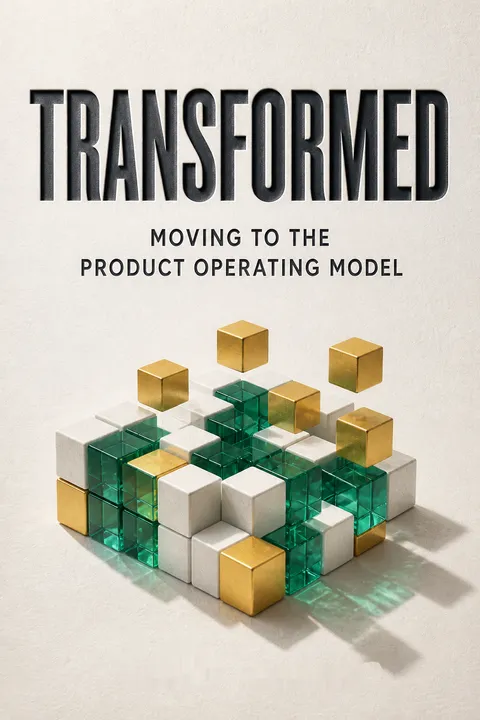


Key Takeaways
Transform the operating model, not merely the software delivery ritual
Principles, not labels. The product operating model is a way to organize technology work around repeatedly creating solutions customers value and the business can sustain. It is not a prescribed process, job title, or Agile checklist. A transformation changes how products are built, how teams find solutions, and how leaders choose which problems deserve investment.
A cautionary pattern. One company hired hundreds of engineers, gave business analysts product titles, and added formal delivery controls. Releases slowed, technical debt remained, and the effort failed. The lesson is that visible structural change can leave decision-making and incentives untouched. The model matters because technology is meant to power the business, not merely fulfill requests from it.
What's striking is the book's insistence that organizational change is not the same as installing a new process. That aligns with sociotechnical thinking: tools, roles, authority, and incentives work as a connected system. A company can copy the ceremonies of a successful organization while preserving the old allocation of power, producing familiar outcomes in new vocabulary. The model is strongest where technology materially shapes customer value. It should not become a universal management fashion; teams still need to adapt practices to their products, risks, and constraints.
Keep teams with products long enough to learn from what they build
Products outlast projects. Project teams disband after delivering a specified piece of work, often losing the knowledge they gained and leaving nobody responsible for the result. Durable product teams keep improving an area over time, so they can apply customer learning, maintain the technology, and own business outcomes rather than just hand over features.
Shorter feedback loops. The book calls for small, reliable releases at least every two weeks, supported by instrumentation that shows whether the product works and how people use it. Trainline moved from eight-week releases toward cloud delivery, ultimately releasing more than 100 components a week. The book also recommends ongoing investment in technical debt, often 10-30% of engineering capacity, so old shortcuts do not make each improvement slower.
The case for durable teams resembles feedback control: frequent observations let a system detect errors and adjust before they grow. Smaller releases also reduce the number of changes investigators must consider when something breaks. The important distinction is that deployment frequency is not a proxy for customer value. A team can ship tiny changes at high speed and still make a poor product. Frequent delivery creates the learning opportunity; clear outcome measures and customer contact determine whether the organization uses it well.
Give teams problems and outcomes, not stakeholder-written feature lists
Start with the need. In a feature-team model, stakeholders specify what to build, while the team is judged on delivery. If the feature produces no value, responsibility becomes a blame contest. An empowered team instead receives a customer or business problem and a desired result, then investigates possible solutions. The book calls this work product discovery: testing ideas quickly, before committing to the full cost of building them.
Test the costly unknowns. Teams examine whether customers will want a solution, whether people can use it, whether the business can support it, and whether engineers can build it. The book cites estimates that 70-90% of conventionally specified solutions miss their intended results. Prototypes can test ideas in a fraction of the time and cost of production development, reducing waste and improving time to business impact.
This approach counters a familiar planning error: treating a proposed solution as if it were already a validated need. It also resembles experimental science, where a hypothesis is exposed to evidence before resources scale up. The discipline is not simply to test more, but to choose tests that could change a decision. Some problems require production-level trials or careful qualitative judgment, and not every meaningful outcome can be measured quickly. Discovery is useful when it improves judgment, not when experimentation becomes another ritual to complete.
Put product, design, and engineering in the room before building
Different expertise, shared work. A capable product team combines knowledge of customer value and business constraints, skill in shaping a usable experience, and technical judgment about what can be built. The product manager typically leads the first area, the product designer the second, and the tech lead the third. They collaborate during both discovery and delivery, rather than passing requirements from one role to the next.
Access creates understanding. Teams need direct contact with users and customers, product data, business stakeholders, and engineers. A prototype gives those people something concrete to discuss before expensive implementation begins. The team structure, called team topology in the book, defines which product areas teams own and how their responsibilities connect. Clear ownership and fewer dependencies help teams act without waiting for a chain of approvals.
This design draws on the value of cognitive diversity: specialists notice different risks, and collaboration can combine those views into a solution no single role would produce alone. The arrangement works only when expertise is respected rather than collapsed into consensus meetings. Direct customer access also needs safeguards, including privacy protections and coordination with sales or service teams. Removing intermediaries should improve learning, not create unmanaged customer contact or disregard the knowledge already held by people in those functions.
Choose a few strategic bets using customer evidence, not annual lobbying
Vision sets direction. A product vision describes a customer future the organization hopes to create, often several years away. Product strategy decides which problems to tackle now in service of that direction. It draws on product usage and sales data, conversations with customers, changes in technology, and developments in the market. Leaders must focus on a small number of important opportunities instead of trying to satisfy every stakeholder at once.
Trainline found leverage. Research across its target markets surfaced seven recurring customer problems, including difficulties beyond the act of buying a ticket. A test of mobile tickets suggested that easier purchasing could increase rail use. These findings helped the company look beyond its inherited identity as a ticket seller and invest in a broader travel experience. Strategy makes choices visible, including the work the company will decline.
The distinction between a customer-centered future and near-term strategic choices is valuable because it separates inspiration from resource allocation. The latter is a portfolio problem under uncertainty: a company cannot pursue every plausible opportunity with equal intensity. Evidence improves those choices, but it does not eliminate judgment. Customer interviews can reveal pain without showing which solution will scale, while usage data can describe behavior without explaining it. Strong strategy combines both forms of evidence with a willingness to revise assumptions.
Make the CEO the visible sponsor, then earn stakeholder trust through evidence
Transformation crosses boundaries. Product changes affect sales, marketing, finance, customer success, human resources, and other functions. A technology leader may guide the work, but cannot resolve resistance from executives outside that leader's authority. The CEO must make the change credible, explain why it matters, and support new ways of working when they disrupt established control.
Promises need evidence. A high-integrity commitment is a date-specific promise made by the team responsible for delivery after it has investigated what the work involves. This is different from placing dates on every roadmap item. Product teams build trust by sharing evidence, engaging stakeholders early, and tying their work to business results. Executives contribute by sharing the broader context teams need to make sound decisions.
The CEO's role is more than sponsorship in name. It addresses a classic principal-agent problem: teams cannot take responsibility for outcomes if powerful parts of the organization can override priorities or withhold cooperation. At the same time, central sponsorship does not mean the CEO should make every product decision. Effective leadership supplies context and protects decision-making close to customers and technology. The model depends on trust, but trust is earned through reliable conduct, transparent reasoning, and credible commitments, not declarations of empowerment.
Coach people into new capabilities instead of relabeling old roles
Titles are not skills. A business analyst or product owner does not become a capable product manager through a new title alone. Product managers need working knowledge of customers, data, the market, and the business. Designers must shape the whole product experience, while engineers, especially tech leads, need to help assess what should be built as well as how to build it.
Managers build the muscle. Product leaders recruit, assess, and coach people, and create the context teams need to make decisions. The book says first-level managers may spend up to 80% of their time on staffing and coaching. It also warns that product managers commonly need active coaching to learn their customers and business. Some existing employees can grow into new roles, but organizations must be willing to make different staffing choices when they cannot.
This emphasis treats organizational capability as something developed through practice, feedback, and selection, rather than something conferred by a chart. It also gives managers a concrete responsibility beyond reviewing performance: helping people improve at their craft. The standard has to be applied fairly. A capability gap may reflect weak coaching, poor role design, or limited access to customers, not simply an individual's shortcomings. Clear expectations and genuine development opportunities make a demanding skills reset more credible and less likely to become a disguised purge.
Use transformed capabilities to respond when a crisis destroys the old plan
Preparation changes the response. CarMax had begun building an online and in-store buying experience before the pandemic. When sales fell more than 75% in early April 2020, teams accelerated virtual assistance, online purchases, trade-in offers, and touchless delivery. They tested risky parts of the experience in small groups, then regionally, before rolling it out nationally within six months. The company recovered lost sales and went on to improve the customer experience.
Capabilities transfer. Gympass used customer learning to expand from gym access into home-based wellness when facilities closed. Kaiser Permanente developed a nationwide, around-the-clock virtual care service in four months. These cases do not show that a particular process guarantees success. They show how customer access, cross-functional teams, and rapid testing can help organizations adapt when familiar plans stop working.
The stories illustrate organizational resilience as a capability built before a shock, rather than improvisation summoned by executive urgency. Teams with established customer relationships and delivery practices can redirect effort more quickly because they are not learning every operating habit during the emergency. Yet successful cases are selected examples, not a controlled comparison with companies that used the same methods and failed. Their strongest lesson is practical: readiness expands the range of responses available, while sound judgment still determines which response is safe and valuable.
Run the transformation as a measured campaign, not a one-off launch
Begin with a truthful assessment. Speak with people from executives to engineers, inspect evidence such as release patterns and prototypes, and distinguish what teams say from what they do. Then choose an adoption path. Pilot teams can test the new model with willing participants before it spreads; focused early wins give the rest of the organization proof that the change is practical.
Keep defending progress. The book estimates that a serious transformation may take six months to two years. Named owners, regular updates, and repeated explanation of the product vision and results help sustain attention. Progress can be undone when a CEO or product leader leaves, when the old project office returns as a control mechanism, or when urgency fades. Transformation is therefore continuous work, not a launch date.
The campaign framing fits change management as a process of learning and coalition building. Pilots contain early uncertainty, while visible results can make unfamiliar practices more believable. However, a pilot should not become a showcase isolated from core operations; its lessons need a route into staffing, finance, and company-wide decisions. Measurement also needs care. Release speed, customer conversations, and ideas tested are useful indicators of developing capability, but business and customer outcomes remain the real test of whether the transformation is working.
Analysis
TRANSFORMED is a leadership and operating-model guide, built around principles, implementation advice, and cases from companies including Trainline, Adobe, Datasite, and CarMax. Its audience ranges from CEOs and finance leaders to product managers and engineers. The challenge in compressing it is that its central proposal is not a single technique. It is a linked set of changes to team authority, staffing, strategy, customer contact, engineering practice, and company culture.
The book's strongest contribution is its causal picture of why conventional technology work disappoints. Feature lists separate the people requesting value from the people building the solution. Project funding fragments learning and ownership. Infrequent releases delay feedback. The proposed alternative reconnects those pieces: durable teams investigate problems, test assumptions, deliver incrementally, and answer for results. This is more than a product department redesign. It is a way to use technology investment as a continuing organizational capability.
The case studies make the idea tangible. Trainline's shift from a ticket reseller toward a broader travel service, and CarMax's rapid expansion of online purchasing under pandemic restrictions, show how teams can respond to opportunities that a fixed project plan might not anticipate. The evidence is illustrative rather than conclusive: successful transformations are highlighted, but the cases do not establish that the operating model alone caused each result. Leadership quality, market position, capital, timing, and execution also matter.
The argument is demanding in ways that are easy to underestimate. It expects senior leaders to release some control, product leaders to become skilled coaches and strategists, and organizations to upgrade engineering systems while still serving customers. It also assumes the company can distinguish genuine discovery from poorly designed experimentation and can protect customers while testing ideas.
The most useful way to read the book is as a set of operating principles, not a universal blueprint. Its practical test is whether teams have the skills, access, authority, and feedback needed to solve important problems responsibly. If those conditions are absent, adopting Agile terminology or reorganizing teams will not produce the promised transformation.
Review Summary
Transformed receives mixed reviews, with ratings ranging from 2 to 5 stars. Many readers find it repetitive of Cagan's previous works, particularly for those familiar with "Inspired" and "Empowered." Some appreciate its focus on organizational transformation and product operating models, while others criticize its lack of depth and practical advice. The book is seen as more valuable for executives and newcomers to product management, offering case studies and principles for transforming companies. However, some readers feel it lacks originality and serves more as a sales pitch for consulting services.
People Also Read







Glossary
Product operating model
Principles for product workA way of organizing a company that uses technology to create solutions customers value and the business can sustain. It emphasizes empowered, cross-functional teams, ongoing product ownership, customer and business evidence, and accountability for results. It is a conceptual model based on principles, not a single prescribed process or methodology.
Product discovery
Testing solutions before buildingThe work a product team does to determine which solution is worth building. Teams investigate assumptions and risks using methods such as prototypes, customer interviews, and data experiments. Discovery aims to establish evidence about customer value, usability, technical feasibility, and business viability before the greater time and expense of full implementation.
Product delivery
Building and releasing solutionsThe work of implementing, testing, and delivering a product solution to customers. In the product model, delivery relies on small, frequent, reliable releases, automated testing where appropriate, instrumentation, monitoring, and deployment systems that support safe changes and quick recovery when problems arise.
Product vision
A future better for customersA description of the customer-centered future a product organization seeks to create, typically over several years. It gives teams and stakeholders a shared direction and helps people understand how different product areas contribute to a larger purpose. It is meant to inspire and guide, rather than specify a list of features.
Product strategy
Choosing important problems nowThe leadership work of deciding which customer or business problems deserve attention in pursuit of the product vision. It combines focus with insights from customers, product data, technology, and market conditions. Its practical output is a set of priority problems and objectives assigned to product teams, rather than a comprehensive list of features.
High-integrity commitments
Evidence-based delivery promisesDate-specific promises made only after the team responsible for delivery has investigated the work, addressed important product risks, and considered its other obligations. They are reserved for situations where a dependable date matters, such as a partner need or coordinated launch. The book argues they should be meaningful exceptions, not routine roadmap guarantees.
Team topology
How teams divide product ownershipThe way an organization defines the responsibilities, scope, and relationships of its product teams. A thoughtful topology aims to give teams meaningful ownership and autonomy while keeping them aligned. Poorly designed boundaries can create excessive dependencies, slow work, and leave teams feeling responsible for only small fragments of a product.
Outcome-based roadmaps
Roadmaps framed around resultsA transition technique that converts a roadmap of requested features into the problems those features are intended to solve and the results that would indicate success. Teams can then explore different solutions instead of being bound to the requested implementation. The technique helps stakeholders shift discussion from deliverables and dates toward customer or business outcomes.
FAQ
What's Transformed: Moving to the Product Operating Model about?
- Focus on Transformation: The book explores how organizations can shift to a product operating model, requiring a cultural change in product development and delivery.
- Empowered Teams: It emphasizes the role of cross-functional, empowered product teams in solving customer problems rather than just delivering stakeholder-driven features.
- Case Studies: Real-world examples from various companies illustrate successful transformations and the principles that contributed to their success.
Why should I read Transformed: Moving to the Product Operating Model?
- Practical Guidance: Offers actionable insights and techniques for leaders aiming to implement a product operating model.
- Addressing Challenges: Tackles common objections and challenges during transformation, providing strategies to overcome them.
- Expert Authors: Written by industry experts Marty Cagan and his team, drawing on decades of experience in product management.
What are the key takeaways of Transformed: Moving to the Product Operating Model?
- CEO's Role: Highlights the critical role of the CEO in driving transformation and supporting product teams.
- Outcome Focus: Advocates for a shift from output (features) to outcomes (customer satisfaction and business impact).
- Continuous Learning: Stresses the need for a culture of experimentation and learning, allowing quick iteration based on feedback.
What is the Product Operating Model defined in Transformed: Moving to the Product Operating Model?
- Conceptual Framework: Described as a model based on first principles, focusing on customer-centric solutions.
- Empowerment and Collaboration: Emphasizes empowering teams to solve problems collaboratively, moving away from top-down feature dictation.
- Adaptability: Encourages organizations to adapt practices based on their unique contexts and challenges.
How does Transformed: Moving to the Product Operating Model suggest companies should change how they build products?
- Frequent Releases: Advocates for small, frequent, and reliable releases to iterate quickly based on user feedback.
- Continuous Delivery: Emphasizes CI/CD practices to enhance product quality and responsiveness to market needs.
- Focus on Learning: Encourages minimizing waste by learning from experiments and testing ideas before full-scale development.
What are the roles of product managers, designers, and tech leads in the Product Operating Model?
- Product Managers: Responsible for understanding customer needs and ensuring solutions are valuable and viable.
- Product Designers: Focus on usability and user experience, ensuring products meet customer expectations.
- Tech Leads: Oversee solution feasibility, aligning technical aspects with product team goals.
What is the significance of product discovery in Transformed: Moving to the Product Operating Model?
- Understanding Needs: Crucial for identifying the right problems to solve and aligning solutions with customer needs.
- Rapid Experimentation: Encourages rapid experimentation to test ideas quickly and efficiently.
- Iterative Process: Highlights product discovery as an ongoing process for adapting and refining solutions based on feedback.
How does Transformed: Moving to the Product Operating Model address objections from stakeholders during transformation?
- Identifying Concerns: Outlines common objections from stakeholders and provides strategies to address them.
- Building Trust: Emphasizes transparency and communication to build trust and ensure alignment on goals.
- Engagement and Collaboration: Advocates involving stakeholders in the product discovery process to foster collaboration.
What are some of the innovation stories shared in Transformed: Moving to the Product Operating Model?
- Almosafer: Adapted to the pandemic by leveraging its product model to meet new customer needs.
- CarMax: Transformed operations to enhance its omnichannel experience during the pandemic.
- Trainline: Shifted from a legacy model to a tech-powered product organization, improving market position.
What are the principles of a strong product culture as described in Transformed: Moving to the Product Operating Model?
- Principles Over Process: Prioritizes principles fostering innovation and responsiveness over rigid processes.
- Trust Over Control: Advocates for a culture of trust, empowering teams to make decisions and take ownership.
- Learning Over Failure: Encourages viewing failures as learning opportunities, promoting continuous improvement.
What are the best quotes from Transformed: Moving to the Product Operating Model and what do they mean?
- "Shipping features won't necessarily solve the underlying problem for the customer or the business.": Emphasizes solving real customer problems to create value.
- "Empowerment depends on a degree of trust.": Highlights the necessity of trust for effective collaboration and decision-making.
- "The promise is not to build—and certainly not to ship—any solution that does not meet the critical needs of the business.": Stresses alignment of product work with business objectives and customer needs.
How can organizations measure the success of their transformation to the product operating model?
- Key Performance Indicators (KPIs): Establish clear KPIs aligned with business outcomes to track effectiveness.
- Customer Satisfaction Metrics: Measure customer satisfaction and engagement to assess product alignment with user needs.
- Continuous Improvement: Adopt a mindset of continuous improvement, regularly reviewing processes and outcomes for enhancement.
About the Author
Other books by Marty Cagan

Download PDF
Download EPUB
.epub digital book format is ideal for reading ebooks on phones, tablets, and e-readers.








