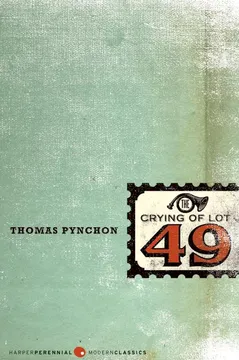


Plot Summary
Pierce's Last Appointment
The news arrives while Oedipa Maas is still moving through the safe repetitions of her life with her husband, Mucho. Her former lover Pierce Inverarity has died, and a codicil names her executor of his sprawling California estate. She cannot make Mucho help her, and their lawyer, Roseman, explains that settling the estate means sorting its businesses, debts, and property.
A late-night call from her psychiatrist, Dr Hilarius, adds to her unease: he presses her to join a drug experiment she has already refused. Oedipa accepts the assignment anyway, partly because she wants to know why Pierce chose her. She leaves their home in Kinneret for San Narciso, expecting legal work, not a new way of seeing the world.
The estate makes Oedipa responsible for a past she had treated as finished, while her husband and doctor offer little dependable support. Her decision to go is neither heroic nor fully voluntary: curiosity gives her a task when her ordinary life has begun to feel airless. The novel’s mystery therefore starts as an administrative obligation, a practical demand that gradually becomes a test of how much meaning a person can bear to find.
A Bet in Echo Courts
In San Narciso, Oedipa meets Metzger, the lawyer assigned to help administer Pierce’s estate. At the Echo Courts motel, his former career as a child actor becomes a strange performance: they watch a film from his childhood, bet on whether its trapped heroes survive, drink, and become lovers.
The film ends with its characters dead, so Oedipa claims the wager and Metzger jokes that the prize is himself. Their affair unsettles her, but the estate work continues.
Later, at The Scope, an electronics workers’ bar, Oedipa meets Mike Fallopian, a member of a political society that secretly routes letters through Yoyodyne’s internal mail. In the women’s room she finds a cryptic address for a service called W.A.S.T.E. and copies its unfamiliar horn-like emblem. An odd mark has become a question she can carry.
Metzger’s movie wager blurs performance and lived experience before Oedipa has a framework for interpreting either. The film’s shifting reels make outcomes feel manipulable, while her affair gives the estate a personal complication. At The Scope, the coded mail system turns that unease outward: secrecy may be a private joke, a practical workaround, or evidence of a world operating beside official channels. Oedipa begins collecting signs before she knows what would count as proof.
Bones Beneath Fangoso
At Pierce’s artificial-lake development, lawyer Manny Di Presso escapes two men pursuing him and explains why: his client, a Mafia-connected supplier, claims Pierce never paid for human bones used in cigarette-filter research and in the lake’s underwater attractions.
The bones came from American soldiers killed in Italy, a past injury now repackaged as commercial material. The next day Oedipa and Metzger attend The Courier’s Tragedy, a revenge play whose plot includes murdered guards, recovered bones, and a message written in bone-derived ink.
Its final act introduces the name Trystero, an alleged enemy of the historical Thurn and Taxis postal service. Oedipa asks director Randolph Driblette about the ending. He resists treating the play as a fixed text, insisting that performance gives it a life no script can fully contain.
Fangoso Lagoons makes the estate’s wealth physically visible: a landscaped pleasure site conceals human remains, then sells them back as atmosphere. The play turns that disturbing transaction into a structure of political memory, where bones return as evidence and messages. Yet Driblette’s insistence on performance complicates Oedipa’s search for an authoritative source. If a director can change a play’s meaning by staging it, then the mystery may depend less on locating a definitive text than on deciding who gets to make signs speak.
The Horn Appears Everywhere
At a Yoyodyne shareholders’ meeting, Oedipa gets separated from the tour and meets engineer Stanley Koteks, who resents the company’s policy of claiming its workers’ inventions. He recognizes the emblem she copied and hints that it belongs to an unofficial network.
Oedipa finds the same device on a ring owned by Mr Thoth, a resident of Pierce’s retirement home, and then on a supposedly ordinary stamp from Pierce’s collection. Philatelist Genghis Cohen identifies the stamp as a deliberate counterfeit: its watermark resembles a post horn with a mute, and its image contains a planted error.
Other altered stamps repeat the pattern. The mark is no longer a single bathroom scrawl. It suggests an organized attempt to silence, or replace, established systems of communication.
Oedipa’s evidence now crosses corporate, personal, and archival spaces, but each source is imperfect. Koteks is guarded, Thoth’s recollection comes through an old man’s dream, and Cohen can authenticate a forgery without identifying its maker. The muted horn offers an elegant hypothesis: an alternative service has chosen opposition to the official postal emblem as its signature. Yet the pattern’s coherence is precisely what makes it dangerous. It may be evidence, or the shape Oedipa’s attention imposes on unrelated fragments.
A Machine Without Proof
Oedipa drives to Berkeley to compare editions of The Courier’s Tragedy and finds that the copy she bought contains a Trystero line absent from the scholarly edition. The discrepancy deepens when she visits John Nefastis, an inventor introduced through Koteks.
His Maxwell’s Demon machine is supposed to move a piston if a person can mentally communicate with an imaginary sorting intelligence. Oedipa concentrates, but nothing happens; Nefastis then makes an unwelcome sexual advance, and she flees.
In San Francisco, trying to test the pattern beyond Pierce’s property, she encounters a man wearing the muted-horn pin. He identifies it as a sign of Inamorati Anonymous, a private support network for people struggling with love, and traces its emblem to a strange discovery involving a gasoline-stained stamp.
The failed machine offers a miniature of Oedipa’s predicament. It promises a visible result if an invisible process is real, but provides no reliable way to distinguish failure of the theory from failure of the observer. The altered play text creates the same problem in scholarly form. Meanwhile, the San Francisco pin shows that the emblem can carry meanings other than a postal conspiracy. Oedipa’s investigation gains texture, but not certainty; every new explanation multiplies the possible connections instead of closing them.
The City's Hidden Routes
Through the night, Oedipa finds the muted horn in places far from Pierce’s estate: on gang clothing, handwritten notices, a newspaper, and the belongings of people living at the city’s margins.
She meets Jesus Arrabal, a Mexican anarchist she once encountered with Pierce, and learns that he too sees miracles as intrusions from another possible world. An old, grieving sailor gives her a letter for his estranged wife and directs her to a W.A.S.T.E. mailbox beneath a freeway.
Oedipa posts it, then follows a carrier as he collects letters and passes the sack between couriers. The route leads to Nefastis’s Berkeley neighborhood. She has now witnessed an actual alternative delivery system, but nothing proves that its users belong to one ancient organization or share a single purpose.
The night’s encounters widen the question from whether Trystero exists to what an unofficial network might serve. The people Oedipa observes are not a unified political body; they are lonely, eccentric, excluded, or simply unwilling to use ordinary channels. The sailor’s letter gives the system a human purpose that theories of conspiracy can obscure. Following the carrier confirms the machinery of W.A.S.T.E., while leaving its history and scale unresolved. Oedipa has evidence of a route, not a map of its meaning.
A Husband Becomes Many
Back in Kinneret, Oedipa finds Dr Hilarius’s clinic under siege. He has barricaded himself in his office with a rifle, believing men are hunting him. During the standoff he reveals that he once worked at Buchenwald on experiments designed to induce insanity, and that his later psychiatric practice was an attempt at atonement.
Oedipa helps the police take him into custody. At the station, Mucho reports on the incident while speaking with a new calm. He admits that Hilarius has supplied him with LSD and describes hearing voices and music as layers of sound that can be separated, combined, and shared. The pills have eased his old nightmares, but Oedipa sees that he is becoming remote from the person she married. She refuses his offer of the drug.
Hilarius’s breakdown exposes the violence beneath his professional identity: his faith in treatment has been built over a history he cannot undo. Mucho’s transformation offers a different danger. His new perceptual openness seems healing because it quiets his nightmares, yet it also weakens the boundaries that make him recognizable to Oedipa. Both men seek relief from painful limits, but their altered states leave her less able to rely on familiar authorities or intimate bonds.
The Men Leave the Map
At Echo Courts, Oedipa learns that Metzger has withdrawn from the estate and run off with one of the teenage Paranoids’ girlfriends. She also discovers that Driblette has walked into the Pacific, leaving no explanation for why he changed the play’s ending.
Professor Emory Bortz, who edited the scholarly edition, shows Oedipa competing versions of the text and historical material about Trystero. She traces its beginnings to Hernando de Tristero, a disinherited claimant who opposed the Thurn and Taxis postal monopoly in sixteenth-century Europe.
Later accounts suggest the group survived revolutions and postal crackdowns by shifting its methods and moving to America. The sources remain partial, sometimes contradictory, and often speculative. As the people who might clarify her questions disappear or fall silent, Oedipa continues assembling a history from fragments.
Oedipa’s guides do not simply provide answers; they withdraw, leaving her with the materials they helped uncover. Driblette’s death is especially destabilizing because he had argued that meaning lived in the performance, and his own reasons are now inaccessible. Bortz supplies a historical lineage, but the archive cannot guarantee that its claims describe a continuous organization. The novel makes research emotionally costly: every added document expands the possible story while making the original witnesses less available.
Lot Forty-Nine Waits
Oedipa’s confidence erodes when Mike Fallopian suggests that Pierce may have arranged the clues as an elaborate hoax. She checks the estate and finds that many places connected to Trystero, including the bookstore, theatre, and college, belonged to Pierce.
A new account of Tristero’s history arrives, but she does not verify it. Cohen then reports that the altered stamps will be sold together as lot 49, and that an unnamed book bidder has tried to inspect them privately.
Oedipa seeks reassurance from the anonymous man she met in San Francisco, but he refuses to settle whether their meeting was staged. She can neither dismiss the network nor prove Pierce designed it. At the auction, she enters the room and waits for the sale to begin, unable to know who will answer the evidence with a bid.
The ending refuses the conventional reward of a solved mystery. Oedipa can explain each clue through a real network, Pierce’s design, her own pattern-making, or some combination, and the estate links those possibilities without deciding among them. The auction converts interpretation into an event she can witness but not control: someone may publicly claim the stamps, yet even that act would not settle their history. Her inheritance has become a question about the country’s unseen lives, not a puzzle with a final key.
Analysis
The Crying of Lot 49 makes interpretation an activity with consequences. Oedipa’s clues are not simply riddles placed before her; they are documents, performances, business records, postal marks, and human encounters, each carrying a different standard of reliability. A philatelist can verify that a stamp is counterfeit without knowing who altered it. A courier can prove that W.A.S.T.E. delivers letters without proving that Tristero directs the network. A theatre director can make a disputed line feel decisive onstage, then leave no account of why he chose it. The book keeps separating the existence of evidence from the authority to explain it.
That uncertainty is psychologically precise. Oedipa begins with a life she experiences as muted and repetitive, so the signs offer not only a mystery but a possible exit from passivity. Her attention makes the world vivid, yet the same attention can become a trap: every new association creates more paths to follow and fewer ways to know when to stop. The novel does not reduce this tension to a diagnosis. Oedipa may be discovering a genuine counter-network, elaborating Pierce’s private joke, or responding to a culture whose neglected people and histories are already scattered across the landscape. These explanations can overlap without becoming equivalent.
Communication is the novel’s central material problem. Official channels promise order while routinely flattening individual voices into commercial messages, bureaucratic records, and broadcast sound. W.A.S.T.E. offers an alternative, but it is secretive, fragmented, and no guarantee of solidarity. The novel’s most humane moments occur when Oedipa encounters people as people, especially the sailor who entrusts her with a letter, rather than treating them solely as clues. Her inheritance may be less a hidden organization than the obligation to notice lives that systems make easy to overlook. The auction ending preserves that obligation without granting the comfort of a verdict.
Review Summary
Reviews of The Crying of Lot 49 are polarizing, with an overall rating of 3.69/5. Admirers praise Pynchon's dense, witty prose, rich symbolism, and exploration of communication, entropy, and 1960s American counterculture. Many find the novel rewarding despite — or because of — its deliberate ambiguity and unresolved mystery surrounding protagonist Oedipa Maas and the shadowy Tristero postal conspiracy. Critics, however, find it pretentious, inaccessible, and frustratingly inconclusive. Several reviewers note it improves upon rereading, and most agree it remains Pynchon's most accessible work.
People Also Read





Characters
Oedipa Maas
Reluctant pattern hunterOedipa is a California housewife whose routines have left her feeling buffered from her own life. Named executor of her former lover Pierce Inverarity’s estate, she approaches the task with little legal knowledge but a growing appetite to understand what his property contains. She is observant, self-questioning, and prone to testing possibilities, yet she also knows that attention can become fixation. Her marriage to Mucho and former relationship with Pierce complicate her sense of loyalty and independence. Oedipa’s central psychological tension is not simply whether she can solve a mystery, but whether she can trust her own need for meaning without surrendering to it.
Pierce Inverarity
Absent estate magnatePierce is a wealthy California land developer and Oedipa’s former lover. His business interests range across real estate, aerospace investment, entertainment, and consumer products, giving his estate the reach of a small private world. Oedipa remembers him as playful, unpredictable, and possessive, but also as someone who kept parts of himself inaccessible. His decision to name her executor places her back in contact with a man she had thought finished with her, even though he is no longer present to explain his intentions. He represents both material power and the interpretive problem of reading motives into a person who cannot answer.
Mucho Maas
Sensitive radio husbandMucho is Oedipa’s husband and a radio disc jockey who carries emotional scars from his earlier work selling used cars. He is unusually sensitive to the suffering and residue embedded in ordinary objects, and he struggles to believe in the commercial world that now employs him. His affection for Oedipa is genuine, but the couple has difficulty speaking plainly about their fears, needs, and betrayals. Mucho’s interest in music and sound makes him receptive to new ways of hearing, while his vulnerability can leave him seeking escape rather than connection. He gives Oedipa a close view of how expanded perception can feel like relief and disorientation at once.
Metzger
Actor turned estate lawyerMetzger is the lawyer appointed to assist Oedipa with Pierce’s estate. Once a child actor known as Baby Igor, he is handsome, glib, and alert to the theatrical possibilities of almost any situation. His legal training and former screen career make him comfortable moving between fact, performance, and persuasion. He treats Oedipa’s uncertainty as an opening for flirtation, but he is also practical about the estate and its liabilities. Metzger’s ease can be charming or evasive, leaving Oedipa unsure whether he is offering companionship, manipulating a scene, or simply enjoying his own improvisations.
Dr Hilarius
Compromised psychiatristDr Hilarius is Oedipa’s psychiatrist, a European refugee who runs a practice in Kinneret and studies the effects of psychoactive drugs. His manner mixes clinical theory with eccentric experiments and poorly concealed personal investment. He presses Oedipa to join a drug study even after she questions his motives, suggesting that his professional boundaries are unreliable. Beneath his suburban identity lies a history he has tried to manage through therapeutic belief and self-discipline. Hilarius embodies the uncomfortable gap between treating mental suffering and understanding its causes.
Roseman
Family legal adviserRoseman is Oedipa and Mucho’s family lawyer. Though distracted by his own private fantasies and ambitions, he explains the practical demands of probate and points Oedipa toward the work ahead. His mixture of professional usefulness and personal foolishness keeps him from becoming an unquestioned authority.
Mike Fallopian
Private-mail historianFallopian is a member of the Peter Pinguid Society and a researcher writing about private mail delivery in the United States. He is distrustful of government monopolies and corporate power, though his politics do not fit neatly into a familiar left-right divide. He introduces Oedipa to covert mail practices and later asks her to separate documented evidence from interpretation. His skeptical questions make him more than a source of clues: he is one of the few people willing to challenge the story she is building.
Randolph Driblette
Theatre director and actorDriblette directs The Courier’s Tragedy and plays Gennaro, the play’s surviving administrator. He is fiercely committed to performance and skeptical of attempts to reduce a play to its printed wording. That conviction makes him a compelling but frustrating guide for Oedipa, who wants to trace the history behind his choices. He sees the stage as an independent act of creation, not merely a delivery system for an author’s sentences.
Manny Di Presso
Lawyer on the runDi Presso is a lawyer and former actor who knows Metzger from an unrealized television project. At Fangoso Lagoons, he is fleeing men connected to his client, whose claim against Pierce’s estate concerns unpaid payment for human remains. His hurried explanations reveal a chain of businesses that turned wartime deaths into commercial materials. Di Presso is self-protective and comic under pressure, but his case introduces a moral cost that the estate’s polished developments conceal.
Genghis Cohen
Estate stamp expertCohen is a philatelist hired to inventory and appraise Pierce’s stamp collection. Careful, learned, and initially reserved, he notices technical irregularities that Oedipa would not know how to identify. His expertise can establish that a stamp is counterfeit, but it cannot identify the person who made it or explain the intention behind it. Cohen represents the limits of specialist knowledge as well as its value.
Stanley Koteks
Disgruntled Yoyodyne engineerKoteks is an engineer at Yoyodyne who resents the corporation’s claim to inventions created by its employees. He is alert to the ways large organizations turn individual work into anonymous teamwork and carefully guards his own ideas. His encounter with Oedipa links corporate frustration to an underground emblem, but he becomes cautious when she asks too directly about it.
John Nefastis
Inventor of the Demon machineNefastis is an inventor who has built a machine inspired by James Clerk Maxwell’s thought experiment about sorting molecules. He believes that a gifted person can communicate mentally with the machine’s imagined intelligence. His confidence in the device contrasts with Oedipa’s demand for a testable result. He is also socially predatory, treating her visit as an opportunity to pursue sex rather than respecting her purpose.
Emory Bortz
Scholar of WharfingerBortz is an English professor and editor of a scholarly edition of Richard Wharfinger’s plays. His knowledge helps Oedipa compare textual versions and reconstruct the possible history of Trystero. He enjoys building imaginative historical scenarios from sparse evidence, which makes him stimulating company but not a wholly neutral guide. Bortz demonstrates how scholarship can illuminate the past while also filling its silences with conjecture.
Jesus Arrabal
Exiled Mexican anarchistArrabal is a Mexican anarchist whom Oedipa met years earlier with Pierce. He lives in exile and remains committed to the possibility of spontaneous, leaderless collective action. His political faith gives him a language for thinking about miracles as interruptions of ordinary reality. He once recognized something unsettling in Pierce’s embodiment of concentrated wealth, a perception that stays with Oedipa after Pierce is gone.
Mr Thoth
Keeper of inherited memoryMr Thoth is a ninety-one-year-old resident of Vesperhaven House. His stories about his grandfather, a Pony Express rider, mix childhood memory, television, dream, and inherited family violence. A signet ring he owns gives Oedipa another encounter with the unfamiliar horn emblem.
Arnold Snarb
Anonymous recovery contactArnold Snarb is the name displayed on a tourist badge worn by a man Oedipa meets in a San Francisco bar. He identifies himself as a member of Inamorati Anonymous, a discreet support network for people trying to resist romantic attachment. His anonymity suits the group’s purpose, but it also limits what Oedipa can learn from him.
Miles
Echo Courts bandleaderMiles is a teenage clerk at the Echo Courts motel and a member of the Paranoids, a young band whose members perform with affected British accents. He is brash, opportunistic, and attentive to the sexual and musical currents around him. Through the group, he brings an unruly youth culture into Oedipa’s otherwise adult investigation.
Caesar Funch
Radio station program directorFunch oversees programming at the station where Mucho works. He clashes with Mucho over the disc jockey’s image and worries that Mucho is losing his distinct personality. His commercial concerns make him an imperfect observer, but his unease gives Oedipa an outside measure of the change she sees in her husband.
Plot Devices
W.A.S.T.E.
Alternative mail routeW.A.S.T.E. is a covert system of mailboxes, carriers, and handoffs that operates outside the United States Postal Service. Oedipa first encounters its name and emblem on a bathroom wall, then follows a carrier and watches the network move letters through the city. It provides tangible evidence that some people choose a separate means of communication, but the system’s existence does not prove that every user belongs to Tristero or shares its history. The device makes a literal route out of the novel’s larger question about who is excluded from official channels.
The muted post horn
A recurring signalThe horn emblem, often shown with a mute, appears on stamps, a ring, a lapel pin, graffiti, and other marks. It links the Thurn and Taxis postal service to the name Tristero and suggests a deliberate rival system. Its repetition is persuasive to Oedipa because it connects otherwise distant people and objects. Yet the emblem never settles whether the pattern is a genuine historical network, a prank organized through Pierce’s estate, or a structure her attention is making from coincidence.
The Courier's Tragedy
A play inside the mysteryRichard Wharfinger’s revenge play contains lost guards, recovered bones, coded messages, and a reference to Trystero. Oedipa’s copies do not agree about the crucial line, while director Randolph Driblette alters the stage version. The play therefore supplies both a possible historical clue and a model of unstable interpretation. Its words can be compared, but the performance may carry meanings that no surviving text can confirm. The device asks whether a sign’s authority comes from its original author, its later editor, or the person who stages it.
Maxwell's Demon machine
A test of perceptionInventor John Nefastis’s machine is built around the imagined Maxwell’s Demon, which sorts fast and slow molecules and appears to challenge the second law of thermodynamics. Nefastis claims that a mental sensitive can communicate with the Demon and make a piston move. Oedipa’s attempt produces no reliable result. The machine dramatizes the difference between a theory and evidence: an invisible process may exist, but the observer needs a trustworthy way to tell it from expectation, error, or performance.
Pierce's estate
A map of hidden ownershipPierce’s estate gives Oedipa a practical reason to travel through San Narciso and examine a wide range of businesses and properties. Its holdings include developments, investments, and locations that intersect with her discoveries. Because Pierce cannot explain his motives, every connection can be read as ordinary business, deliberate preparation, or coincidence. The estate begins as an inventory problem and expands into a map whose boundaries Oedipa cannot confidently distinguish from the larger society around her.
Download PDF
Download EPUB
.epub digital book format is ideal for reading ebooks on phones, tablets, and e-readers.








