

Key Takeaways
Teach customers across the lifecycle, not just after the contract is signed.
Learning starts early. Customers learn while researching a problem, evaluating a trial, onboarding, using features, and seeking deeper mastery. Without a deliberate strategy, they still learn, but may conclude that a product is confusing or irrelevant. Education can improve lead quality before purchase, help prospects reach value during trials, and reduce reliance on one-to-one onboarding after purchase.
Scale changes the stakes. In the authors' 2020 industry report, 96 percent of companies said customer training mattered, yet only 14 percent believed most of their customers were adequately trained. As products grow more complex and companies move beyond early adopters, structured learning becomes part of the customer experience, not an optional support add-on.
The lifecycle framing is powerful because it treats learning as an influence on customer decisions, not merely a response to support problems. It also exposes a common organizational blind spot: marketing, sales, support, and product teams may all teach customers, but without coordination those lessons can conflict. The risk is defining education too broadly and making one team responsible for every communication. Clear ownership of learning goals, paired with shared responsibility for delivery, helps preserve both coherence and practical accountability.
Start with the customer's job, then teach the product as a means.
Outcomes beat feature tours. Customers want to do their work more effectively, not memorize a product menu. The book calls a user's important realization of how a tool helps them make progress an aha! moment. For a landing-page tool, that means teaching how to create a page that converts, rather than merely where to enter a heading or add a link.
Map progress over time. At Asana, customers found a blank task list overwhelming. A practical lesson built around an editorial calendar offered context and a reason to begin. The team also learned that people think about a project before breaking it into tasks, so arranging education in that order helped learners reach value sooner. The goal is to shorten time to value, or TTV, the time until customers experience meaningful benefit.
This approach resembles the distinction in product design between a feature and the job it enables. Starting with the work context gives learners a mental model for why a procedure matters, which can make unfamiliar steps easier to remember and adapt. It also prevents education from becoming disguised advertising. A useful test is whether the customer could apply the underlying skill outside the vendor's software. If not, the lesson may be teaching navigation more than capability.
Build learning paths for distinct learners, not a fictional average user.
Different people need different starts. A learning persona is a fictional profile built from recurring learner needs, such as role, experience, goals, and motivation. The book's Asana examples include an experienced user seeking advanced tips, a new user who recognizes a problem but not the solution, and a reluctant employee who has been told to adopt a tool. A generic introduction would likely bore the expert and fail to persuade the reluctant user.
Ask, then segment. Short onboarding questions, surveys, support conversations, and job-role information can help identify these differences. Needs also change with proficiency: a beginner may need a first successful workflow, while a mature user may need guidance on expanding adoption across a team. Personas should represent common patterns without pretending to describe every individual.
Personas are useful when they function as hypotheses that teams test, rather than labels treated as permanent truths. The distinction between a willing learner and a resistant one is especially important: the latter may need a reason to change before needing instructions. But segmentation has costs. Too many tracks can overwhelm learners and create a maintenance burden, so the most useful categories are those tied to meaningfully different goals or starting knowledge.
Teach the vital 20 percent first; give edge cases another place to learn.
Prioritize the common path. Applying the 80/20 rule, the authors argue that a relatively small share of possible content often covers most customers' important needs. Trying to explain every feature and exception can overload learners, dilute the core lesson, and consume production time. Focus first on recurring use cases that help customers reach value; use a community or searchable support resources for unusual questions.
Use evidence to choose. Explicit data includes customers' stated goals, survey responses, and support questions. Implicit data includes product analytics, search terms, drop-off points, and feature usage. For example, repeated searches for a feature with no useful documentation may signal a content gap. Combining customer testimony with usage patterns helps teams teach the right material, at the right stage, instead of building a curriculum around internal assumptions.
This is a practical response to a familiar information-design problem: more material can make the essential material harder to find. A strong core curriculum also creates a better base for deeper optional learning. The principle needs one guardrail, however. Low-frequency knowledge can still be crucial when an error carries serious consequences, as in safety or compliance contexts. Prioritization should consider both how many people need information and the cost of not knowing it.
Treat education like a product launch, with owners, scope, and trade-offs.
Make the plan visible. A development plan states who the education serves, what it teaches, when and where it appears, why learners should care, and how success will be assessed. The RASCI model assigns people as responsible for doing work, accountable for its outcome, supportive, consulted, or informed. The authors recommend one accountable owner for each task so decisions do not disappear into a committee.
Balance the constraints. The project management triangle describes the tension among scope, time, and resources. If a launch date moves forward, the team may need to reduce production complexity or add capacity. A short screencast can suit a changing feature, while a polished experience may be justified when brand perception is central. Modular work and early drafts make it easier to gather feedback before expensive production begins.
The planning tools turn education from a favor requested of busy specialists into a managed business deliverable. RASCI is particularly helpful when subject experts, product teams, and instructional designers share work but have different authority. Still, a matrix cannot resolve every disagreement. The plan needs an explicit decision process for scope changes, because product releases and learner needs often shift after approval. Lightweight governance can clarify responsibility without freezing the work.
Choose formats by learning goal, then reinforce before customers forget.
Match the medium to the task. Microlearning is brief, focused material for a specific need; macrolearning develops a larger skill through a course, learning path, or instructor-led session. The book recommends mixing formats rather than expecting one course to do everything. A customer might take an onboarding course, use short reminders or help articles over the following weeks, then attend advanced training.
Build reusable pieces. Modular content gives each lesson a focused purpose and lets teams combine or update pieces without rebuilding an entire course. This also helps with the forgetting curve, the decline in recall over time when learning is not reinforced. Templates can speed production. At Asana, a monthly product-update video became quicker to make after the team recorded reusable introductions and endings in one session.
The format decision is best understood as a question of fit, not a contest between video, courses, and live instruction. Short modules can lower the cost of revisiting information, while live sessions provide interaction and access to expertise. The danger is reducing every subject to tiny clips. Complex judgment often requires connected practice, feedback, and reflection, so brevity should remove friction without fragmenting the skill being taught.
Make every lesson useful, findable, and easy to finish.
Design for the learner's attention. Start with a clear learning objective, ideally one central objective for each lesson. Bloom's Taxonomy helps distinguish basic recall and understanding from applying, analyzing, and creating. Merrill's First Principles of Instruction emphasizes real problems, prior knowledge, demonstrations, practice, and integration. These ideas point toward teaching realistic work, not elaborate fictional scenarios that learners struggle to connect to their jobs.
Remove avoidable friction. Mayer's multimedia principles support focused visuals, close placement of related words and images, segmented content, and learner control over pace. A course can be accurate yet fail if navigation is confusing, text is dense, or the value is unclear. The book also rejects matching instruction to supposed visual or auditory learning styles, favoring evidence-based strategies such as practice, feedback, observation, and discussion.
The strongest design principle here is coherence: each element should help the learner understand or use the skill. That principle connects instructional design to interface design, where unnecessary choices and visual clutter compete for attention. A polished experience is not automatically an effective one, though. Engagement is valuable when it supports thinking or practice, not when animation and gamification become decoration. Accessibility also deserves to be part of design from the start, not a final compliance pass.
Put education where customers look, and make its value obvious.
Distribution is part of design. An admin may benefit from an in-product guide, while an executive may respond better to a concise email. Help articles belong where customers troubleshoot; academies suit deeper learning; social and marketing channels can reach prospects. Clear titles, search optimization, a visible next step, and a direct explanation of what learners gain all make content easier to find and choose.
Make access intentional. The authors cite a benchmark split of roughly 75 percent paid training and 25 percent free content, with free material often including basic help and introductory education. Paid courses or certifications can signal value, but price should reflect market demand and the outcomes delivered. Distribution also requires accessible formats, captions, screen-reader-friendly pages, and localization that accounts for language, culture, and available technology.
This section treats discoverability as an educational problem: a lesson that cannot be found has little practical value. It also recognizes that price, channel, and format shape who gets access, not just how a company earns revenue. A paid credential may increase commitment, but charging for essential support can create avoidable barriers. The useful distinction is between baseline knowledge customers need to use the product and premium learning that provides additional depth or career value.
Track learning through behavior, not just clicks and completions.
Measure in layers. The adapted Kirkpatrick model moves from engagement and reaction to learning, behavior, and business results. Views and enrollments show reach; assessments can indicate whether learners understood material; product adoption and TTV reveal whether behavior changed. Completion rates are easy to report but can be manipulated by splitting a course into smaller units, so they should not stand alone.
Connect education to action. In one Optimizely test, an in-product guide was associated with feature engagement rising from 13 percent in the comparison group to 51 percent among users shown the guide. Where experiments are impractical, compare trained and untrained customer groups, while recognizing that correlation does not establish cause. A useful measurement system also distinguishes reach across accounts, the number of trained users within each account, and how deeply individuals engage.
The measurement ladder helps teams avoid confusing activity with impact. A thousand course views are evidence of distribution, not proof that customers learned or that the business benefited. The Optimizely example is compelling because it connects instruction to a specific action, although results from one feature and context may not generalize. Cohort comparisons can guide decisions, but selection effects matter: already successful customers may be more likely to seek training.
Use feedback to improve content, then tell the business what changed.
Treat content as maintained work. Review search queries, support tickets, learner comments, and completion funnels to spot missing, confusing, or outdated material. A help-content matrix compares how often an article is found with how helpful readers say it is: high-traffic, low-helpfulness pages need repair, while useful but overlooked pages need promotion. At CustomerGauge, shortening and strengthening training helped raise completion from about 30 percent to between 80 and 90 percent.
Translate impact carefully. Return on investment compares monetary benefits minus training costs, divided by those costs. Direct course revenue is easiest to count; support savings, faster onboarding, retention, and adoption require connecting education data to other business systems. The authors caution that causation is hard to prove. A focused narrative with one or two metrics, tied to a current company priority, is more persuasive than a slide deck of every available statistic.
Iteration is the bridge between measurement and better learning: data identifies friction, but human feedback helps explain it. The CustomerGauge result shows how redesign can improve use, although completion alone does not prove mastery. The same restraint applies to ROI. Correlation can be useful for operational decisions, but leaders should treat it as evidence with uncertainty, not as a guaranteed causal claim. Transparent limits can make a business case more credible, not less.
Build an education engine that matures from live help to company-wide strategy.
Progress in stages. The Customer Education Maturity Model describes five stages: live, one-to-one training; basic digital resources; more personal and consumable learning; demonstrated business impact; and advanced, integrated learning. The stages are a diagnostic, not a race. A small program may first need repeatable help content, while a mature one may connect learning data with product and customer systems.
Share the work across the company. Mature programs bring education into product releases, align with marketing and customer success, and reuse modular content across audiences. The book's future outlook includes learning inside products, better-connected data, and new contextual formats such as augmented reality. The underlying leadership shift is from maintaining a backlog of courses to building a repeatable process that anticipates customer needs and improves with evidence.
The maturity model usefully separates scale from sophistication. Moving beyond live training is not automatically progress if customers lose access to the human help their situation requires. The strongest model is therefore hybrid: standardize recurring needs, preserve expert assistance for complex cases, and use evidence to decide where each belongs. The whole-company emphasis also matters because customers experience one vendor, not its internal org chart. Coordination should improve consistency without making every interaction sound scripted.
Analysis
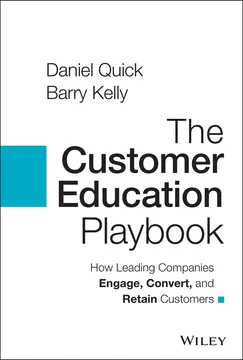
The book's central contribution is to reposition customer education from a collection of assets into an operating system for customer value. Its 12-step Playbook connects business goals, customer jobs, learner differences, instructional design, distribution, measurement, and organizational influence. The sequence matters: content production is not the first question. The first question is what customers are trying to accomplish, and what the business needs to change for that accomplishment to create durable value.
The most persuasive parts are concrete. A blank project tool can overwhelm a newcomer, but a guided use case gives that person a reason to act. A help center can reduce repeated support work, while an academy can build deeper expertise. Modular content can be distributed in several places and updated without rebuilding entire courses. These examples show that education is simultaneously product experience, service design, and a form of operational leverage.
The argument also contains a productive tension. Customer education should serve the customer's goals, yet the business measures it through adoption, retention, expansion, and revenue. Those interests often align, but not invariably. A feature can be adopted without improving a customer's work, and training can make a product seem more useful than it is. Responsible programs should measure customer outcomes alongside vendor outcomes, and should not treat usage as proof of value by itself.
The evidence base is practical rather than uniformly causal. The authors favor cohort comparisons and operational data because rigorous experiments are often difficult, while acknowledging selection effects. That is a sensible stance for practitioners, provided conclusions remain proportional to the evidence. Training participants may already be more motivated or successful. The strongest programs can improve this evidence over time by testing targeted interventions, defining meaningful behaviors, and combining analytics with direct customer feedback.
Ultimately, the Playbook asks companies to professionalize an activity they already perform. Customers learn from documentation, sales calls, support replies, peers, and product interfaces whether or not a formal education team exists. The strategic choice is not whether learning happens, but whether those experiences form a coherent, measurable path toward outcomes customers actually value.
People Also Read


Glossary
Customer Education Playbook
Twelve-step education strategyThe authors' twelve-step method for planning, creating, distributing, measuring, and improving customer education. It begins by aligning education to business goals and customer success, then addresses learner needs, project planning, formats, instructional design, trainers, distribution, evaluation, iteration, and return on investment.
Learning persona
Profile of learner needsA fictional profile representing a recurring type of learner, defined by characteristics such as role, goals, prior experience, motivation, and knowledge gaps. Teams use learning personas to design relevant learning paths and anticipate barriers. They should capture common patterns without implying that every customer fits a single profile perfectly.
Aha! moment
Realization of product valueA meaningful experience in which a customer recognizes how a product can help them make progress in their work. Organizations can identify these moments by studying product behaviors associated with sustained use and by asking customers what value they experienced. Education can then guide learners toward those moments.
RASCI Model
Project-role assignment frameworkA method for clarifying project responsibilities. The letters identify people who are Responsible for work, Accountable for its outcome, Supportive of its completion, Consulted for expertise, or Informed of progress. The book recommends clear ownership, including a single accountable person for each task, to reduce confusion across teams.
Project management triangle
Scope, time, resource trade-offA planning model that describes the relationship among project scope, timeline, and resources. Changing one element can require adjusting another to protect quality. In customer education, a fixed launch date or small team may mean narrowing content, lowering production complexity, or adding resources.
Bloom's Taxonomy
Levels of learning objectivesA framework for describing increasingly complex learning, from remembering and understanding to applying, analyzing, evaluating, and creating. In the book, it helps designers write objectives and sequence lessons so learners build foundational knowledge before being asked to use skills in unfamiliar situations.
Merrill's First Principles of Instruction
Problem-centered learning frameworkAn instructional framework emphasizing real-world problems, activation of prior knowledge, demonstration of skills, learner application, and integration of new learning. The book uses it to argue that effective customer education should connect directly to tasks learners recognize and give them opportunities to practice and reflect.
Mayer's Principles of Multimedia Learning
Guidance for multimedia designResearch-based principles for presenting words, images, narration, and video in ways that support learning. The book highlights removing irrelevant material, placing related words and visuals together, presenting matching narration and imagery at the same time, segmenting material, and allowing learners control over pace.
Adapted Kirkpatrick Model of Evaluation
Levels for evaluating learningAn adaptation of the Kirkpatrick framework used to assess customer education through engagement, learner reaction, learning, behavior, and business results. The book treats these as increasingly consequential kinds of evidence, from whether customers find content to whether learning changes product use or contributes to organizational outcomes.
Help Content Optimization Matrix
Traffic and helpfulness gridA tool for prioritizing knowledge-base articles by comparing how often customers find them with how helpful they consider them. High-traffic, low-helpfulness articles need improvement; helpful articles with little traffic need promotion; strong articles should be maintained; and weak, little-used articles may be archived.
Customer Education Maturity Model
Five-stage program roadmapA model describing customer education programs across five stages, from live, person-to-person instruction through digital foundations, personalized learning, demonstrated business impact, and advanced integrated learning. It is intended to help teams identify current challenges and next priorities, not to rank every organization on a single universal timetable.
Customer Learning Management (CLM) system
Connected customer learning platformThe authors' proposed future system for connecting learning technology with product, support, and other business data. Such a platform could help teams identify customer friction, recommend relevant learning, and assess how education relates to adoption or retention. The book presents it as a future direction, not an established standard.
Download PDF
Download EPUB
.epub digital book format is ideal for reading ebooks on phones, tablets, and e-readers.








