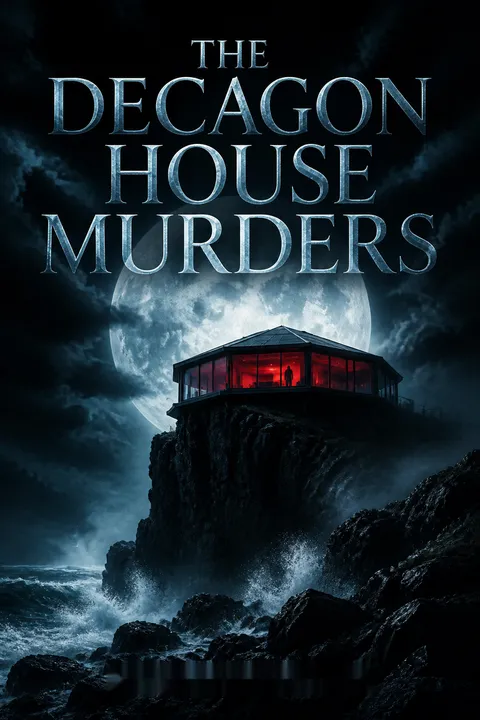


Plot Summary
Prologue
On a dark breakwater, a man considers a revenge killing he knows will make him a criminal. He does not plan every move. Instead, he has built a framework that can bend with chance, and he intends to punish his targets one by one inside a house with ten equal sides. Before leaving, he seals a written confession in a small green bottle and throws it into the sea, asking the water to judge what he is about to do.
The opening gives the murderer a private courtroom before the story supplies the crime. His insistence that he is not a god sits uneasily beside his plan to judge and sentence other people, exposing the self-authorization at the heart of revenge. The bottle matters because he does not seek ordinary secrecy: he wants his guilt preserved for an authority beyond human law. Yet his flexible plan already admits what he cannot control. Chance, which he recognizes intellectually, will eventually become the force that tests his claim to command events.
The Decagon House
Six members of a university Mystery Club sail to Tsunojima, where their friend Van has prepared the abandoned Decagon House for a weeklong stay. They use aliases taken from famous mystery writers, debate whether detective fiction is an intellectual game, and admire the building's ten-sided hall.
Their host points out the ashes of the Blue Mansion, where architect Nakamura Seiji, his wife, and two servants died in a fire six months earlier. The gardener vanished, and the police suspected him. Leroux, soon to edit the club magazine, asks everyone to write stories during the trip. Carr arrives in a sour mood, while Orczy quietly reveals her unease about visiting the island.
The house turns the club's literary preferences into a physical environment. These students have chosen a place where isolation, a suspicious cast, and a past crime resemble the fiction they discuss, so their pleasure in the setting is also a blind spot. They treat the island as a curated puzzle rather than a real location marked by loss. The aliases sharpen that ambiguity: adopting famous detective writers gives each student a role before any danger begins, encouraging them to interpret events as performances. The unexplained disappearance of the gardener is the first crack in their confidence that the story will obey familiar rules.
A Letter from Seiji
On the mainland, former club member Kawaminami finds a typed letter signed by Nakamura Seiji, whom he knows died in the Blue Mansion fire. The letter accuses the club members of causing Seiji's daughter Chiori's death at their New Year's party, where she drank too much and suffered a fatal heart attack after Kawaminami had left.
He learns that other students received letters and discovers the group has gone to Tsunojima. At Seiji's brother Kōjirō's home, he meets Shimada Kiyoshi, a mystery enthusiast and Kōjirō's friend. Kōjirō dismisses the letter as a tasteless prank, but Kawaminami and Shimada suspect it points toward unfinished questions about both Chiori's death and the Blue Mansion murders.
The letter binds two tragedies together without proving that they share a cause. Chiori's death was treated as an unfortunate party accident by the students, but the accusation forces Kawaminami to consider how collective irresponsibility can disappear behind the word accident. His response is active rather than defensive: he searches for recipients, visits Kōjirō, and brings Shimada into the inquiry. The parallel between a dead man's signature and an unresolved crime invites supernatural explanations, but the more unsettling possibility is human authorship. Someone is using the authority of the dead to make the living reconsider what they have chosen to forget.
Seven Red Warnings
On the students' second morning, Orczy finds seven white plastic plates on the hall table, each bearing red lettering. Ellery asks the group to admit who made them, but everyone denies responsibility. Carr calls them murder warnings; Poe argues they may belong to an elaborate game, and the others cling to that explanation because no one can contact the mainland.
Ellery locks the plates in a kitchen drawer, yet each person leaves the hall watching the others. Orczy is especially shaken: she has come to the island to mourn Chiori, her one close friend, but has told no one why. The group continues its day under a new pressure, unable to decide whether the plates are theater or a genuine promise.
The plates work because they make interpretation itself a group conflict. Carr sees a threat, Poe offers a fictional game, and the rest accept the least frightening account without evidence. The Mystery Club's habits, normally a source of shared pleasure, now provide language for evading danger. Orczy's private grief makes her the most vulnerable to the difference between a puzzle and a life: she knows the house is connected to Chiori, while the others see a destination for a writing retreat. The plates also replace ordinary trust with surveillance. Nobody needs to accuse anyone aloud; each person is already measuring the others for signs of guilt.
The Gardener's Shadow
Kawaminami and Shimada visit Yoshikawa Masako, the missing gardener's wife. She says her husband left for Tsunojima before the fire and called to report that Kazue was ill, but insists he was not capable of murder. She also recalls that Seiji showed little affection for Chiori, while Kazue adored her. Masako adds that the fortune supposedly stolen by the gardener was largely gone, weakening the police theory.
Morisu, another former club member who has received a letter, joins the mainland discussion and suggests the burned body identified as Seiji might actually have been someone else's. Shimada considers whether Seiji survived, while the investigators begin to suspect a hidden relationship between Kazue and Kōjirō.
The inquiry gains force by replacing a convenient suspect with a set of incompatible facts. Masako's account weakens both the robbery motive and the affair rumor, but it cannot establish what happened inside the mansion. The possible body switch offers a classic mystery solution, yet it also demonstrates how little certainty can be extracted from a fire-destroyed crime scene. Morisu's measured speculation appears to complement Kawaminami's restless curiosity and Shimada's imagination. The three men do not merely reconstruct a past crime; they are also being guided toward an explanation that may shape how they interpret the danger on the island.
Two Hands Missing
On the island, Agatha finds a plate naming Orczy as the first victim on her door. Inside, Orczy has been strangled in her bed, and her left hand has been cut off and taken. Poe examines the body, while Carr's demand to inspect the room turns grief into a fight over who controls the evidence.
That night, Carr collapses after drinking coffee and dies despite Poe's attempt to help him. The group cannot tell which cup was poisoned, and Ellery's questions only deepen suspicion of Agatha and Poe. By morning, another plate marks Carr as the second victim, and his severed left hand has been left in the bathtub. The matching mutilations recall Kazue's missing hand.
The deaths transform a staged warning into a mechanism for dismantling the group. Orczy's quiet vulnerability makes her first death feel less like a contest between detectives than an attack on the person least equipped to defend herself. Carr responds by demanding access to the body, revealing how quickly the club's intellectual habits can displace ordinary mourning. The severed hands encourage the survivors to link the murders to Kazue's death, but the repeated gesture also conceals a more intimate motive. As suspicion spreads, even medical knowledge and careful questioning cannot restore security. Poe can describe the injuries, but he cannot make the others trust one another.
The Room Below
After Carr's death, Ellery proposes that the burned Blue Mansion may conceal an underground room. He finds a covered opening among the ruins, descends, and trips over fishing line stretched across the stairs. Poe and Van pull him clear; Ellery escapes with a sprained ankle and discovers that someone recently cleared a patch of floor below.
The line came from Poe's fishing gear, which means an outsider could have entered the unlocked house and taken it. The survivors argue over whether to search one another's rooms, but fear prevents them. Agatha's nerves finally break: she throws a plate at Van, then begs to leave. Poe gives her sleeping tablets, and the exhausted group retreats separately behind locked doors.
The underground room makes the threat tangible without identifying its source. Ellery's near fall punctures his performance as an unflappable detective, while the stolen fishing line suggests access beyond the people the group can see. Yet the survivors cannot convert that clue into a practical response: searching rooms would expose them to one another, and staying together feels no safer. Agatha's breakdown is not simply fear; it is the collapse of the social polish she has relied on to remain in control. Poe's act of care briefly restores trust, but the tablets also introduce a quiet instrument that can be used in ways no one considers.
Chiori's Hidden Parentage
On the mainland, Shimada confronts Kōjirō with his theory that Chiori was his daughter, not Seiji's. Kōjirō denies the claim, but finally admits the affair with Kazue and confirms that Seiji had sent him Kazue's severed hand on the night of the Blue Mansion tragedy. Kōjirō says Seiji had grown consumed by jealousy after Chiori's death severed the last bond he believed connected him to Kazue.
Seiji killed Kazue and the servants, then died by fire himself. Kōjirō had understood the danger but failed to call the police, fearing scandal. The revelation gives the old massacre a motive, yet Shimada and Kawaminami still do not know who is sending the new letters.
Kōjirō's account replaces the image of a vanished mastermind with a domestic catastrophe rooted in possession, shame, and belated guilt. Seiji's love for Kazue becomes inseparable from his effort to keep her, while Kōjirō's silence makes him morally implicated even though he did not commit the murders. Chiori's paternity clarifies why Seiji's affection for her was troubled, but it does not reduce the tragedy to a single explanation. The revelation also tempts the mainland investigators to believe they have solved the island's present danger by understanding its past. That confidence is premature: knowing a motive is not the same as identifying the person acting on it now.
The Last Survivors
Agatha dies after using lipstick poisoned with cyanide, and the plate naming Leroux as the third victim appears on his door. His room is empty; the others find him beaten to death among the Blue Mansion ruins. Ellery studies the rain-softened footprints and concludes that the killer approached and left by sea, prompting his theory that Seiji is hiding nearby.
Later, Poe dies after smoking a poisoned cigarette. Ellery notices that one cup in the Decagon House has eleven sides, not ten, and uses it to open a concealed room beneath the kitchen. There, he and Van find a passage leading toward the coast and a decomposed body, apparently the missing gardener. The house soon burns, with Ellery trapped inside.
The deaths leave the survivors with evidence that points in several directions at once. Agatha's poisoned cosmetic turns self-presentation into a danger, while Leroux's footprints expose a route the others had not considered. Ellery's deduction about the sea is logical but incomplete, and the hidden room rewards his attention to the house's geometry even as it encourages him to trust his own theory too much. The eleven-sided cup is both clue and misdirection: a single irregular object unlocks the architecture but cannot, by itself, name the killer. The fire then destroys the setting that might have corrected his conclusions, turning the puzzle's final solution into a matter of testimony.
The Detective Is Blamed
Police identify six dead students and initially suspect Matsu'ura Junya, the club member known as Ellery, of killing the others before dying by fire. At the club's later questioning, the assumed account seems to leave Morisu, who had appeared to investigate from the mainland, outside the tragedy.
The narrative then reveals that Morisu was the unseen hand behind the murders and had taken Van's place in the island story. He had loved Chiori and blamed the six students for her death after they pressured her to drink. He used the letters, plates, poisons, stolen boat, and a fabricated mainland alibi to direct suspicion toward Seiji and Ellery. He drugged Ellery and set the house alight, then escaped.
The solution exposes a crime of authorship as much as a sequence of killings. Morisu uses the club's aliases, the parallel mainland narrative, and the reader's trust in a stable cast to hide the fact that the apparent seventh islander is not an innocent witness. His revenge depends on making the survivors interpret events through the very mystery conventions they admire. That design does not make his actions inevitable or justified; it shows how easily grief can become a private ideology when the bereaved person appoints himself judge. The false accusation of Ellery completes the performance by leaving Morisu not only alive, but apparently absent from the crime.
Epilogue
At dusk, Morisu sits by the sea grieving for Chiori when Shimada approaches and hints that he has found another explanation for the deaths. Morisu refuses to hear him. Then a child discovers the green bottle Morisu once threw into the water, with his confession still inside.
Morisu gives it to the child and asks him to pass it to Shimada. The bottle returns the judgment he tried to surrender to the sea, placing the evidence back in human hands.
The bottle's return does not deliver a clean moral verdict; it removes Morisu's ability to pretend that guilt belongs to an unreachable court. Shimada's renewed suspicion suggests that the killer's intellectual construction has not fully controlled what others can infer. The child becomes an unplanned courier between private remorse and public consequence, echoing the chance Morisu acknowledged at the beginning. By handing over the confession, Morisu finally stops managing every interpretation of his crime. Whether this act comes from conscience, exhaustion, or a need to be judged remains unsettled, which preserves the story's distinction between explaining revenge and excusing it.
Analysis
The novel makes genre knowledge both a tool and a trap. The students understand conventions such as the isolated setting, staged victim order, suspicious host, and hidden room, so they can generate explanations quickly. But familiarity also narrows what they can imagine: the island becomes a puzzle to solve, and real fear is repeatedly recast as an entertaining game. The killer exploits that habit by supplying clues that point toward Seiji, then allowing Ellery's intelligence to strengthen the false theory.
The parallel mainland chapters complicate the reader's sense of who is safe and where the story's center lies. Kawaminami and Shimada investigate an earlier massacre while believing the immediate danger belongs to the island. Their discoveries about Chiori's parentage and Seiji's jealousy are true, but they do not solve the murders now unfolding. The book separates factual explanation from useful explanation: learning the truth about the past can still lead investigators toward the wrong person in the present.
At the emotional center is the difference between grief and the authority Morisu claims on its behalf. Chiori's death followed a group's careless pressure, a failure that deserves remorse. Morisu turns that remorse into a private sentence against everyone he considers responsible, treating the dead girl's memory as permission to kill. His meticulous plan cannot restore her or make the deaths proportionate. The returning confession bottle therefore offers no easy absolution. It places responsibility back among the living, where Morisu's self-appointed judgment can finally be examined.
Review Summary
The Decagon House Murders is a Japanese mystery novel that pays homage to Agatha Christie's "And Then There Were None." Seven university students visit an isolated island where murders occurred six months prior. As they're killed one by one, they must solve the mystery. Readers appreciate the clever plot twists and surprising ending, though some find the characters underdeveloped. The novel's translation can feel stilted at times. Overall, it's praised for its puzzle-like nature and intriguing storyline, making it a cult classic in the locked-room mystery genre.
People Also Read
Characters
Morisu Kyōichi
The bereaved club memberA former Mystery Club member who has withdrawn into painting and private grief. Morisu is thoughtful, restrained, and wary of acting on curiosity alone; his friend Kawaminami once relied on him to test impulsive theories. His quiet manner conceals how deeply he has been shaped by earlier losses, including the death of Chiori, whom he loved. He is drawn to careful observation and to the moral limits of investigating other people's secrets. The contrast between his reflective temperament and his capacity for intense feeling makes him an important counterweight to Shimada's exuberant speculation.
Kawaminami Taka'aki
The restless investigatorA former Mystery Club member whose curiosity sends him from a suspicious letter to the homes of people connected with the Tsunojima case. Kawaminami is energetic and quick to pursue a lead, but knows that excitement can outrun sound judgment. He once worked well with Morisu, whose caution balanced his own appetite for action. Chiori's death gives the new accusation a personal weight, even though he left the party before she died. His willingness to investigate makes him a useful bridge between the island story and the mainland inquiry.
Shimada Kiyoshi
The imaginative investigatorA mystery enthusiast, Buddhist priest's son, and friend of Kōjirō, Shimada joins Kawaminami's inquiry after the letter arrives. He is playful in manner but sharp in observation, and his imagination readily builds possibilities from incomplete evidence. Unlike Morisu, he is less troubled by the ethics of pursuing private truths, a difference that creates friction between them. Shimada's willingness to follow an unlikely theory helps reopen the Blue Mansion case, while his personal connections give him access that a conventional investigator might not have.
Nakamura Chiori
The lost club juniorA quiet university student who died after drinking too much at the Mystery Club's New Year's gathering. Chiori was close to Orczy and loved in secret by someone within the club. She rarely sought attention and was remembered as considerate, but the circumstances of her death reveal how easily a timid person's limits can be ignored in a lively group. Chiori is absent from the island action, yet her life connects the club's careless past to the danger that follows. Her memory means different things to her friends, her family, and those who believe they failed her.
Nakamura Kōjirō
The architect's brotherA high-school teacher and Buddhist studies researcher, Kōjirō inherited Tsunojima after his brother's death and later sold it. His calm, orderly life contrasts with the violence attached to the island. As Chiori's uncle, he has reason to feel protective of her memory, while his closeness to the Nakamura family gives him knowledge the investigators lack. He is reluctant to revisit painful events and private relationships, making his guarded manner both understandable and difficult for others to interpret.
Nakamura Seiji
The island's dead architectA gifted architect who designed the Blue Mansion and the Decagon House, Seiji was fascinated by unusual structures and hidden mechanisms. He withdrew to Tsunojima with his wife, Kazue, and became known as an eccentric recluse. The fire that destroyed his home and killed its residents left behind a missing gardener and questions about whose body had been found. Seiji's obsessive designs and the stories surrounding his death make him a persistent presence in the minds of those who investigate the island.
Ellery
The self-styled detectiveA confident law student who takes his alias from a celebrated detective writer, Ellery enjoys the logic and theatrical performance of mystery fiction. He practices card magic, likes to control a discussion, and assumes a natural place at the center of any puzzle. His calm can look like composure or detachment, and his arguments often unsettle friends who would rather accept a comforting explanation. Ellery's fascination with fair clues makes him attentive to details, though his confidence can encourage him to treat uncertain possibilities as a contest he can master.
Poe
The medical-minded smokerA bearded medical student, Poe is the group's most practical source of knowledge about injuries and illness. He speaks sparingly, smokes heavily, and often cuts through Ellery's intellectual games with blunt common sense. His long friendship with Orczy gives him a protective instinct toward her, while his training makes the others look to him when they need medical judgment. He tries to keep the group grounded, though the island's isolation leaves even his expertise with few tools and no reliable way to summon help.
Carr
The resentful novelistA law student and prolific club writer, Carr is prickly, proud, and quick to take Ellery's teasing as a personal challenge. He has recently been rejected by Agatha and Orczy, leaving him embarrassed and irritable during the trip. He dislikes being treated as a supporting figure in Ellery's intellectual games and often voices suspicions others hesitate to say aloud. His abrasive manner makes him an easy target for blame, but it also exposes the tensions the club's friendly traditions have allowed to accumulate.
Leroux
The eager club editorA literature student newly appointed editor of the club magazine, Leroux hopes to produce a strong anniversary issue and persuades the group to write during the trip. His round glasses and earnest manner make him seem less imposing than Ellery, but he takes the club's work seriously. Leroux is both a reader of mysteries and a person who knows that fiction cannot fully prepare anyone for real violence. Under pressure, he struggles to make sense of what he has seen, and his attention to detail becomes more important than his confidence.
Agatha
The confident pharmacy studentA glamorous pharmacy student, Agatha is sociable, assertive, and comfortable taking charge of practical tasks such as cooking. Her confidence can shade into impatience, especially when she feels the men expect women to serve them. She encourages Orczy to trust herself, even as she fails to grasp the full depth of Orczy's private grief. Agatha values beauty and composure, but those habits are not mere vanity; they are part of how she maintains control in a group where attention and status matter.
Orczy
Chiori's shy confidanteA timid literature student and skilled traditional painter, Orczy was Chiori's closest friend. She is self-conscious around the more glamorous Agatha and often retreats into imagined worlds and the stories she writes. Her decision to visit Tsunojima is an act of private mourning, though she worries it may be an intrusion on the dead. Orczy's reserved nature does not mean she feels little; she carries affection and grief intensely, but has difficulty making either visible to the people around her.
Van
The island's apparent hostThe science student who seems to have arranged the group's stay, Van prepares food, bedding, and fuel for the house. He is mild, often unwell, and more comfortable supporting the others than leading their debates. His presence gives the trip a practical organizer and a reason the students feel entitled to enter the abandoned property. Because he is quiet and physically vulnerable, others alternately worry about him and suspect him.
Shimada Osamu
The investigating inspectorA prefectural police inspector and Kiyoshi's older brother, Osamu questions the Mystery Club members after the fire. He is brisk and practical, but his interest in detective fiction makes him willing to hear how the students understood their friends. His investigation must rely on the physical evidence left after the house burns, so his conclusions remain shaped by what can still be recovered.
Plot Devices
The Decagon House
A geometric sealed settingNakamura Seiji's ten-sided annex turns the island stay into a closed-circle puzzle. Its identical rooms, confusing doorways, and central hall make movement hard to track, while the lack of electricity and telephone service cuts the students off from outside help. The building's geometry becomes more than atmosphere: a mismatch hidden among its decagonal objects eventually points toward concealed architecture. The setting also invites the club members to believe they are living inside the kind of mystery they admire.
The Red Plates
A staged murder sequenceSeven plastic plates marked with red lettering appear in the hall and on bedroom doors. Their victim labels transform an unexplained prank into a schedule that the students cannot ignore. Because the group has no way to contact the mainland, the plates intensify suspicion and make each survivor watch the others. They also encourage the club members to interpret violence as a mystery-game convention, a response that delays their recognition of a real killer.
The Eleven-Sided Cup
A clue hidden in plain sightMost of the house's tableware follows Seiji's ten-sided design, so one cup with eleven sides appears to be another eccentric ornament. Ellery first treats it as a possible marker in Carr's poisoning, then recognizes its unusual shape as the key to a concealed mechanism beneath the kitchen. The cup links the house's visual motif to its hidden architecture. Its usefulness as a clue also reminds the reader that a detail can have more than one function.
The Typed Letters
A mainland investigation lureLetters signed in the name of the dead architect accuse the Mystery Club members of causing Chiori's death. Their neat, word-processed form avoids handwriting clues and makes the sender seem both deliberate and difficult to identify. They draw Kawaminami and Shimada into a renewed investigation of the Blue Mansion while encouraging them to suspect that Seiji may still be alive. The letters also create a parallel narrative: while the island group faces danger, the mainland investigators build theories from incomplete information.
Inherited Mystery Aliases
Names that obscure identityThe club members inherit aliases drawn from famous mystery writers, a tradition that signals prestige within the group and supports its playful literary culture. In the story, the names also make it easier to mistake a role for a person and to accept a cast that appears more settled than it is. Their use encourages both characters and readers to sort people according to familiar detective-fiction types. The resulting uncertainty helps the novel hide who is present, who is absent, and whose account of the island should be trusted.
館シリーズ Series
Download PDF
Download EPUB
.epub digital book format is ideal for reading ebooks on phones, tablets, and e-readers.








