

Key Takeaways
Use design thinking as an adaptable learning mindset, not a fixed recipe
Start with the situation. Design thinking is a human-centered way to learn what people need, generate possible responses, and improve them through repeated trials. Its familiar phases are useful landmarks, not a mandatory sequence. A team may return to observation after a prototype exposes a mistaken assumption, or combine the approach with analytical methods when the problem calls for them.
Peter, an experienced product manager, initially suspected the method was too unstructured to produce useful results. Working with customers and colleagues from different fields changed his mind: the process became valuable when a skilled facilitator helped the group learn together. The book’s practical advice is to adapt tools to the organization rather than copy another company’s culture or process wholesale.
The strongest case for flexibility is that innovation problems differ in what is unknown. Sometimes the user’s need is unclear; sometimes the technology or the route to adoption is the real uncertainty. A single script cannot address all three equally well. The discipline lies not in following every stage, but in making the current uncertainty explicit and choosing a way to investigate it. Flexibility also has a failure mode: teams can rename improvisation as design thinking. Clear learning goals and evidence of user contact help distinguish genuine adaptation from an unstructured workshop.
Meet real users before your assumptions become the product
Leave the conference room. Needfinding means discovering what people are trying to accomplish by observing them and asking about real experiences. It is not a request for customers to approve a finished idea. The team should notice its assumptions, seek people outside its own social circle, and record what users actually say and do. Open questions about a recent event usually reveal more than asking whether someone would like a hypothetical feature.
Priya’s senior-health project shows why. Her first concept was a bulky, simplified phone for older adults. At a retirement home, she found residents already using modern devices, including an iPhone user who cared about style. The mismatch came from designing for a stereotype rather than learning from people’s everyday lives. Interviews, observation, and testing assumptions can be fitted into ordinary routines, not reserved for a special research day.
This approach resembles field research in anthropology: behavior in context can expose needs that people may not articulate in an abstract interview. It also counteracts projection, the tendency to treat one’s own preferences as universal. A useful safeguard is to compare what people say with what they do, while remembering that neither observation nor a handful of conversations represents an entire market. Extreme users can reveal emerging needs, but their solutions may not suit the broader population. Research should therefore sharpen hypotheses, not turn a few vivid stories into certainty.
Rewrite the problem until it opens useful possibilities
Choose the right boundary. A problem statement shapes the solutions a team can imagine. Asking why can broaden the challenge toward its underlying purpose; asking how can make an expansive challenge more manageable. The book distinguishes well-defined problems, which have relatively clear answers, from ill-defined and wicked problems, where the problem itself may change as possible solutions are explored.
Consider a simple product challenge: improving a ballpoint pen. Asking how to open a can with fewer tools would lead somewhere else than asking how to reduce wasted food. Neither question is automatically better. Teams should begin with a provisional challenge, test whether it is too narrow or too broad, and revise it as they learn. A design brief can align the team on users, scope, constraints, and what must be learned without dictating the answer.
Problem framing is a form of power: it determines which causes count, whose experience matters, and what outcomes look like success. The book’s advice to start even when the ideal framing is unclear is valuable because framing itself can be tested. Yet broadening a question is not always virtuous. A vast social challenge may overwhelm a team with limited authority or resources. A productive brief links an important underlying need to a tractable next investigation, without pretending that a manageable slice solves the whole system.
Generate widely, then narrow with evidence instead of attachment
Make room for uncertainty. Teams need both divergent thinking, which expands the range of ideas, and convergent thinking, which selects and improves promising options. The uncomfortable transition between them is sometimes called the groan zone: a period when many possibilities compete and the group does not yet know which to pursue. It is not necessarily evidence that the process is failing.
The book recommends separating idea generation from evaluation, using prompts from other industries, and temporarily lifting normal constraints to uncover less obvious options. Then teams cluster ideas, choose candidates, and build prototypes for testing. Deadlines can help a group shift from exploration to decisions. But selection should not become a popularity contest within one team. Outside feedback and explicit criteria reduce the risk of protecting an idea simply because its creators are attached to it.
The alternation between expansion and selection resembles creative work in science: exploration produces candidate explanations, while testing constrains which ones survive. The useful insight is that discomfort can be part of moving between these modes. Still, sheer idea count is a weak proxy for originality or value. A room can fill with variations on the same assumption. Facilitators can improve the search by changing the prompt or perspective, then judging ideas against user needs, feasibility, and the learning each experiment could produce.
Build the cheapest prototype that can answer your riskiest question
Make ideas testable. A prototype is a rough representation that lets people experience an idea and gives a team a chance to learn. It might be a paper sketch, role play, cardboard model, clickable screen, or a minimal working product. The appropriate level of detail depends on the question: a sketch may test whether a concept is understandable, while a more developed model may be needed to examine how a service works in context.
The book’s central discipline is to test assumptions rather than pitch a solution. Define what the team wants to learn, let users interact without coaching them toward approval, observe what they do, and record feedback. For online pages, an A/B test can compare versions, ideally changing one element at a time. A prototype earns investment by reducing uncertainty, not by looking finished.
This is experimental thinking applied to product development. A well-designed test can prevent a team from spending heavily to perfect a feature users do not need. The key phrase is the riskiest question: testing a trivial detail while the core value proposition remains untested creates activity without much learning. Early prototypes are also easy to misread. A negative response may reflect confusing presentation rather than a bad underlying idea, while enthusiastic reactions may not predict actual use. Pairing observed behavior with careful follow-up questions helps interpret the result.
Build teams with deep expertise, broad curiosity, and room to disagree
Combine different strengths. The book describes T-shaped people as specialists with deep knowledge in one area and enough breadth, curiosity, and empathy to collaborate across disciplines. Interdisciplinary teams can create a shared solution, while a collection of specialists working separately may produce a compromise assembled from competing priorities. Teams need a common purpose, clear ways of working, and trust that makes it possible to challenge ideas without humiliating their authors.
The physical environment can support that work. Flexible furniture, visible walls, and simple materials make it easier to move, sketch, and build together. A facilitator helps the group share information, hear quieter participants, and endure disagreement rather than forcing a premature answer. These conditions are not decoration: they shape who contributes and how ideas become visible. A colorful room cannot compensate for a team that is unsafe to speak honestly.
Interdisciplinary work benefits from cognitive diversity, but diversity alone does not guarantee integration. Different specialists may use the same words differently or disagree about what counts as evidence. Shared artifacts, such as sketches and prototypes, can give them something concrete to debate. Psychological safety matters because new ideas often sound incomplete before they are clarified. However, the book’s emphasis on team composition should not imply that personality labels or thinking-style tests can reliably predict performance. Observable collaboration and the quality of the team’s work are stronger guides.
Bring decision-makers and implementers into the work before launch
Design for adoption. A promising prototype can still fail when legal, technology, marketing, management, or operations teams encounter it only at the end. Their concerns may be legitimate, but late objections can expose a gap between the team’s concept and the organization’s ability to deliver it. Mapping stakeholders early helps identify who has authority, resources, expertise, information, or knowledge of user needs.
The book argues that design thinking remains limited when isolated in a creative department while the company preserves silos elsewhere. A more integrated organization connects work across functions and gives teams enough autonomy to act. The transition can begin with a small team, then expand as people learn. In larger organizations, teams can coordinate through shared missions and cross-team communities. The practical test is not whether a workshop felt innovative, but whether a useful solution reaches users and can be supported.
This insight connects product innovation with organizational design. An organization is part of the solution’s environment, not merely the place where the solution is made. Early involvement can surface constraints while there is still time to adapt, and it can give affected colleagues a stake in the outcome. Yet stakeholder inclusion should not become a veto parade. Teams need a clear decision process and a distinction between people who must decide, people who must contribute expertise, and people who need to be informed. Otherwise, broad participation can slow the work it is meant to improve.
Use future scenarios and systems maps to expose what a product changes
Look beyond the immediate user. Strategic foresight is a way to explore and shape plausible futures rather than simply extend current trends into forecasts. Teams examine the past and present, investigate changing needs, develop possible solutions, and build a vision that can guide action. The book describes using distant-future scenarios to question familiar assumptions, then working backward to identify choices that matter now.
Systems thinking adds a view of how components, people, and institutions affect one another. A self-driving car, for example, is not just a vehicle: it interacts with roads, sensors, passengers, traffic, and the wider transport system. Mapping relationships and feedback can reveal consequences that a product-only view misses. The two approaches complement each other: design thinking brings human needs into focus, while systems thinking helps examine interdependence and unintended effects.
Future scenarios are most useful as structured provocations, not predictions to be treated as facts. They help teams ask what would have to change for a preferred future to become plausible. Systems maps serve a similar purpose by making relationships visible, though every map leaves something out. Choices about system boundaries can hide affected groups or long-term consequences. A strong practice therefore revises the map as evidence changes and asks who is absent from it. Foresight becomes practical when a vision leads to experiments, capabilities, and decisions in the present.
Design business models around shared value, not a product alone
Make the whole offer work. A business model must connect a customer problem and value proposition with customers, costs, revenue, and delivery. The lean canvas helps teams summarize these assumptions and revise them as experiments produce evidence. It complements design thinking: understanding a user’s problem is not yet proof that a business can serve it sustainably.
For products involving multiple organizations, a business ecosystem view considers each actor and the value moving among them, including money, services, information, or data. Every participant needs a reason to join. Marc’s proposed health-record service, for instance, depends not only on patients but also on health providers and other participants who must see value in sharing and using information. A minimum viable ecosystem is a small, testable version of that network. It lets a team learn whether the relationships work before attempting a broad rollout.
The ecosystem perspective addresses a frequent blind spot in business planning: value can depend on coordinated participation, not just a compelling offer to one buyer. Mapping incentives can expose who bears costs, who receives benefits, and who might resist. That analysis also raises questions of governance and fairness, especially when sensitive data is involved. A small network can test whether participants cooperate, but success in a pilot does not guarantee that the model scales. Larger networks introduce new bargaining power, rules, and risks that the initial experiment may not reveal.
Pair human insight with data, and make digital trust part of the design
Join evidence sources. The book’s hybrid model combines design thinking with data analytics. Interviews and observation can uncover context and emotion; data can reveal patterns across interactions that small research samples may miss. When practitioners and data specialists work together, they can compare these forms of evidence, build a clearer point of view, and test ideas with prototypes, models, or dashboards.
Digital services also reshape customer experience across channels. A person may move between an app, a website, a community, and a human adviser, so the handoff should not force them to repeat information or lose progress. As machines take on more autonomous tasks, trust, emotion, and ethical judgment become design questions. Artificial intelligence can personalize routine interactions, but the book reserves human attention for specialized, unusual, or emotionally demanding situations.
Combining qualitative and quantitative evidence can correct the blind spots of either approach alone. Data shows what happens at scale, but without context it may not explain why; interviews explain lived experience, but cannot by themselves establish how common a pattern is. The combination is strongest when each source can challenge the other. Personalization also carries a cost: data collection can feel intrusive, and automated decisions can be difficult to contest. Convenience is not a substitute for consent, transparency, or a clear path to human assistance.
Analysis
The book’s central argument is that innovation is not a contest to produce the cleverest idea in a workshop. It is a continuing process of learning from people, revising the problem, testing possible responses, and organizing the business to deliver what proves useful. Its three-part journey moves from individual practice, through organizational change, toward the design of digital products and wider systems. The recurring fictional practitioners make that broad agenda tangible: Peter learns to facilitate, Lilly moves between teaching and venture-building, and Marc confronts the challenge of turning technical possibility into a workable health-care network.
The book is most valuable as an operating manual. It gives readers practical ways to observe users, frame challenges, make rough prototypes, gather feedback, and visualize complex relationships. It also insists that the work cannot stop at the prototype. Cross-functional collaboration, stakeholder involvement, business-model testing, and ecosystem incentives determine whether a solution survives contact with the organization and the market. Its insistence that design thinking should be adapted, rather than copied as a rigid sequence, is particularly important for practitioners.
Its breadth is also its main tension. The playbook moves from empathy and sketching to artificial intelligence, strategy, and decentralized business ecosystems. These subjects do connect, but each demands different expertise and evidence. A simple prototype can test usability; it cannot settle questions of data rights or ethical responsibility. A vivid user story can challenge assumptions; it cannot stand in for representative research. The book’s own strongest principles suggest how to manage this range: make assumptions visible, test consequential claims, and involve the people affected.
The most durable lesson is therefore not a particular tool. It is a habit of switching lenses. Look closely at an individual’s experience, then zoom out to the system and organization that shape it. Return to the user with a concrete experiment. That cycle keeps human needs in view without pretending that good intentions, attractive spaces, or energetic workshops are enough to make innovation work.
Review Summary
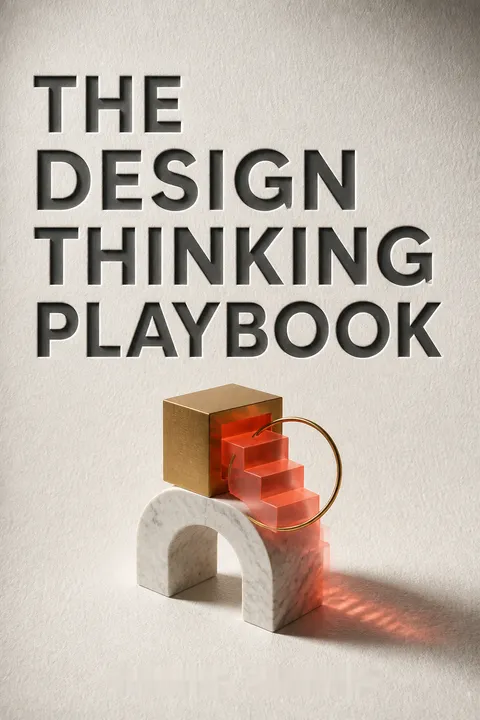
The Design Thinking Playbook receives mixed reviews. Some praise its comprehensive coverage of design thinking tools and visual approach, finding it practical and inspiring. Others criticize its dense content, awkward writing style, and lack of depth. Positive reviewers appreciate its combination of design thinking with systems thinking and its relevance to digital transformation. Critics argue it's superficial, poorly structured, and difficult to read. The book's format and layout are also points of contention. Overall, it seems to be a valuable reference for some, but challenging for others to engage with effectively.
People Also Read



Glossary
Needfinding
Researching real user needsNeedfinding is the process of learning what people need through observation and conversation in the contexts where their experiences occur. It asks teams to distinguish observed behavior from assumptions, investigate real examples, and revise their understanding as evidence accumulates. Its purpose is not to ask users to design a solution, but to uncover motivations and problems that a solution might address.
Point of view
Focused user problem statementA point of view, often shortened to PoV, condenses research into a focused statement about a particular user, a need, and the insight that explains why the need matters. It gives ideation a direction without prescribing a specific answer. Teams can express it as a challenge question and revise it when observation or testing reveals a different need or perspective.
Groan zone
Unsettled transition between ideasThe groan zone is the difficult interval between generating many possibilities and selecting a direction. Participants may feel confused or impatient because competing ideas have not yet been resolved. In the book’s account, this discomfort can signal that a team is working through differences rather than failing. Facilitation, clear criteria, and evidence from users can help the group move through it.
T-shaped people
Deep expertise plus broad collaborationT-shaped people have deep skill in a particular discipline and a broader capacity to understand and work with people from other fields. The vertical stroke represents specialist expertise; the horizontal stroke represents qualities such as empathy, curiosity, and collaboration. The idea is to build teams that combine real technical or professional depth with the ability to create solutions across disciplinary boundaries.
Strategic foresight
Exploring and shaping plausible futuresStrategic foresight combines a future-oriented mindset with methods for exploring possible changes and acting on the opportunities they reveal. Rather than treating one forecast as certain, teams examine the past and present, develop plausible future scenarios, and consider what choices made now could support a desired direction. It links long-term vision with nearer-term experiments and organizational decisions.
Minimum viable ecosystem
Small testable network of participantsA minimum viable ecosystem is an early, limited version of a business network used to test whether its participants can create and exchange value. It extends the logic of a minimum viable product beyond one offering: the experiment also examines relationships among users, partners, and providers. The aim is to learn how the network functions before investing in a larger ecosystem.
Business ecosystem
Network of interdependent value creatorsA business ecosystem is a network of organizations and people whose activities interact in creating and delivering value. It may include customers, suppliers, platforms, service providers, and other participants. Designing one requires more than defining a company’s own product: teams must consider participants’ roles, incentives, relationships, and exchanges of tangible or intangible value.
Hybrid model
Design thinking combined with analyticsThe hybrid model combines human-centered design methods with data collection and analysis. Qualitative observations and interviews help explain users’ contexts and needs; analytics can reveal patterns across larger volumes of behavior. Teams bring these findings together to refine the problem, create and test solutions, and use evidence from both people and data to guide decisions.
Robona
Profile of an interacting robotA robona is a profile of a robot or autonomous object considered alongside a human persona. It helps a team think through the relationship between a person and a machine, including how they exchange information, interpret emotion, learn, and respond to one another. The concept is intended to make the machine’s role in a human-machine experience visible during design.
FAQ
What's The Design Thinking Playbook about?
- Comprehensive Guide: The Design Thinking Playbook by Michael Lewrick is a detailed guide on applying design thinking to digital transformation in teams, products, services, and businesses.
- Focus on Innovation: It emphasizes fostering innovation through understanding user needs, generating ideas, and prototyping solutions.
- Interdisciplinary Collaboration: The book highlights the importance of diverse perspectives and interdisciplinary teams in enhancing creativity and innovation.
Why should I read The Design Thinking Playbook?
- Practical Tools: The book provides practical tools and methods to foster innovation within organizations.
- Real-World Applications: It includes case studies and examples that demonstrate the application of design thinking in various contexts.
- Mindset Shift: Encourages a shift towards empathy and user-centered design, crucial in today’s business environment.
What are the key takeaways of The Design Thinking Playbook?
- Empathy is Essential: Understanding user needs through empathy is a cornerstone of design thinking.
- Iterative Process: Design thinking involves continuous testing and refinement of ideas and prototypes.
- Collaboration is Key: Successful design thinking relies on collaboration among diverse team members.
How does The Design Thinking Playbook define design thinking?
- User-Centered Approach: Design thinking is a human-centered approach focusing on user needs and experiences.
- Iterative Process: It involves empathizing, defining problems, ideating, prototyping, and testing solutions.
- Collaboration and Creativity: Emphasizes collaboration among interdisciplinary teams to generate creative solutions.
What methods are introduced in The Design Thinking Playbook?
- Empathy Mapping: Helps teams build empathy with users by visualizing their thoughts, feelings, and experiences.
- SCAMPER Technique: Encourages teams to Substitute, Combine, Adapt, Modify, Put to other uses, Eliminate, and Rearrange ideas.
- Prototyping and Testing: Emphasizes testing with real users to gather feedback and iterate on designs.
How can I apply design thinking in my organization according to The Design Thinking Playbook?
- Create a Culture of Innovation: Foster an environment that encourages experimentation and open communication.
- Utilize Interdisciplinary Teams: Assemble diverse teams to tackle design challenges from multiple perspectives.
- Iterate and Learn: Implement a cycle of prototyping, testing, and refining solutions based on user feedback.
What are the benefits of interdisciplinary teams according to The Design Thinking Playbook?
- Diverse Perspectives: Interdisciplinary teams bring varied expertise, leading to more innovative solutions.
- Enhanced Problem-Solving: Collaboration fosters creative problem-solving and idea generation.
- Shared Ownership: Teams develop a sense of shared ownership and commitment to outcomes.
How does The Design Thinking Playbook suggest designing a creative space?
- Flexible Environment: Create a workspace that can be rearranged to accommodate different activities.
- Inspiring Elements: Incorporate colors, materials, and tools that encourage collaboration and innovation.
- Natural Light and Space: Ensure ample natural light and room for movement to enhance the atmosphere.
What is the importance of prototyping in design thinking according to The Design Thinking Playbook?
- Tangible Representation: Prototyping allows ideas to be visualized and tested in a tangible form.
- Iterative Learning: Encourages continuous refinement based on user interactions and insights.
- Risk Mitigation: Helps identify potential issues before full-scale implementation, reducing failure risk.
What are the best quotes from The Design Thinking Playbook and what do they mean?
- “Love it, change it, or leave it!”: Emphasizes adaptability and responsiveness to feedback.
- “Design thinking is not a structured process!”: Highlights the flexible nature of design thinking.
- “Keep your personality!”: Encourages authenticity in the design process to foster creativity.
How does The Design Thinking Playbook suggest measuring customer centricity?
- Customer Centricity Score (CCScore): A method to assess the level of customer focus within an organization.
- Involvement of Employees: Emphasizes gathering insights from various organizational levels.
- Iterative Improvement: Advocates for continuous feedback to enhance customer centricity.
What are the challenges of implementing design thinking in traditional organizations according to The Design Thinking Playbook?
- Resistance to Change: Overcoming inertia requires strong leadership and a clear vision.
- Siloed Departments: Breaking down barriers is essential for fostering interdisciplinary teamwork.
- Lack of Understanding: Providing training and resources can help build awareness and support.
Download PDF
Download EPUB
.epub digital book format is ideal for reading ebooks on phones, tablets, and e-readers.








