

Key Takeaways
Understand mind as a living process shared by brain and relationships
A wider definition. Siegel’s field of interpersonal neurobiology, or IPNB, brings neuroscience, psychology, development, and anthropology into one account of human experience. His working definition treats mind as an embodied and relational process that regulates the flow of energy and information. The brain supplies the bodily machinery; relationships carry signals between people; mental life emerges through their interaction. This is not a claim that people literally share one brain. It is a reminder that the supposedly private mind is shaped by other people’s words, expressions, and responses.
Experience changes biology. Neural connections strengthen or weaken with use, while experience can affect how genes are expressed without changing the DNA sequence. Early relationships matter greatly, but brain development continues throughout life. Nature and nurture are not opposing explanations: each shapes how the other unfolds.
The framework’s strength is its resistance to a false choice between biology and experience. It resembles systems approaches in ecology, where an organism cannot be understood apart from its environment, and in network science, where a node’s behavior depends partly on its connections. This gives clinicians and caregivers a useful map across levels of explanation. The caution is that a broad definition of mind can become difficult to test. IPNB is most persuasive as an integrative lens, not as a settled scientific verdict about where mind begins or ends.
Read attachment as adaptation, not a permanent verdict on a child
Caregiving shapes expectations. Attachment is an inborn system that draws infants toward caregivers for safety and comfort. Repeated responses help a child form an internal working model of what to expect from that caregiver. In Mary Ainsworth’s Strange Situation, a brief separation and reunion reveal how infants seek comfort and return to play. Secure infants usually do both; avoidant infants minimize visible bids for comfort; ambivalent infants remain distressed; disorganized infants show conflicted or disoriented behavior.
Patterns are not destiny. In the low-risk samples reviewed, roughly 55 to 65 percent of infants were securely attached. Disorganized attachment appeared in about 20 to 40 percent of general samples and averaged about 70 percent among maltreated infants. These are sample estimates, not universal rates. The Adult Attachment Interview examines how adults make sense of childhood relationships. Its classifications predict infant attachment, but neither insecurity nor security alone determines a child’s future.
Attachment theory is especially useful when it explains behavior as a strategy learned in a particular relationship, rather than as a defect inside a child. That perspective can replace blame with curiosity and make caregiving interventions more responsive. It also fits transactional developmental models: a child’s temperament affects caregivers, whose responses in turn shape the child. The categories should not be treated as permanent personality types or as a report card on parents. Culture, changing circumstances, other caregivers, and later relationships all complicate the picture.
Treat memory as a changing reconstruction, not a stored recording
The past leaves different traces. Siegel defines memory broadly as the way past events affect future functioning. Implicit memory includes learned emotions, bodily reactions, images, and behaviors, often without a feeling of remembering. Explicit memory supports conscious recall of facts or personal episodes. Infants can learn through implicit memory before they can tell a life story. The gradual development of autobiographical memory helps explain why most adults cannot consciously recall their earliest years.
Recall reshapes recollection. Remembering is not retrieving a perfect file. A cue activates fragments of past experience, which combine with current mood and other memories. A vivid sense of certainty does not guarantee accuracy. The book describes a woman whose account of an abusive father came with trembling hands and a frozen posture, signals of distress beyond her spoken words. Such cues can guide compassionate inquiry, but they do not prove exactly what happened.
This account usefully separates the persistence of learned reactions from conscious autobiographical recall. It also supports an essential safeguard in clinical and legal settings: confidence and vividness are not reliable stand-ins for historical accuracy. Contemporary memory research likewise treats recollection as reconstructive and sensitive to suggestion. The distinction between implicit and explicit memory can clarify why a person may react strongly without recalling an origin. It cannot, by itself, establish that a specific hidden event occurred. Careful listening and careful evidence must travel together.
Notice emotion before it hardens into a story or reaction
Meaning begins before words. Siegel proposes that emotion starts with an orienting response, the mind’s automatic signal that something matters. Appraisal then evaluates the event and mobilizes the body toward approach or withdrawal. These early shifts may develop into familiar emotions such as fear, anger, or joy, but they can also remain vague sensations of energy, tension, or unease. Emotion, in this account, helps organize brain activity and communicate significance between people.
People read one another. A child facing an unfamiliar situation may look at a caregiver’s face and voice for clues about how to respond. Tone, timing, posture, and expression carry information that words alone may miss. The author calls emotional processes changes in integration, meaning shifts in how mental and bodily systems connect. This is a useful proposal, not a universally accepted definition of emotion.
The emphasis on early appraisal helps explain why a reaction can arrive before a person can explain it. It also connects emotion research to embodied cognition, the idea that bodily signals participate in judgment and perception rather than merely following them. The proposal that emotion is a shift in integration is elegant, but it stretches one term across many processes. Emotions also involve learning, culture, language, and physiology. The model works best as a way to inspect how feelings organize attention and action, not as a complete account of every emotion.
Interrupt familiar states before they become your only reality
The mind forms grooves. A state of mind is a temporary pattern linking attention, emotion, memory, expectations, and behavior. Repeated patterns become more likely to recur, a process Siegel describes using complexity theory and the term attractor states. A familiar setting can activate an old pattern even when circumstances have changed. The book’s example is an adult returning to a childhood home for a holiday and finding herself slipping into old family roles while her parents respond as if she were still a teenager.
Aim for flexible stability. Continuity makes experience familiar; flexibility lets a person adapt to what is new. Too much rigidity limits change, while chaotic shifts make behavior hard to organize. Siegel presents integration as linking distinct parts without erasing their differences. In practice, noticing the cue and the pattern it evokes can create room to respond to the present rather than simply reenact the past.
Attractor states offer a memorable account of why familiar environments can provoke disproportionate reactions. The idea also fits research on context-dependent learning: what is accessible in one setting may be harder to reach in another. It makes family conflict less mysterious by showing how each person’s response can reinforce the others’. Still, complexity theory is a metaphorical bridge here, not a diagnostic tool that identifies a precise neural mechanism in a particular family. The practical value lies in spotting repeated loops, not in labeling them with scientific-sounding certainty.
Widen your tolerance by learning your body’s early warning signals
Arousal has a threshold. The window of tolerance is the range of emotional activation in which a person can still think, feel, and act flexibly. Beyond it, high arousal may bring impulsive action or panic; shutdown may bring numbness or withdrawal. The range varies with temperament, experience, social setting, and even ordinary conditions such as exhaustion.
Catch the shift sooner. Siegel illustrates this with an attorney who erupts at a colleague after a missed deadline. The mistake touches an old shame about disappointing her mother, and anger overwhelms her ability to reflect. In therapy, she learns to notice tension and agitation, connect the present trigger to its older meaning, and recover more deliberately. Tracking sensations, naming feelings, and seeking support can help, though they are not substitutes for professional care when distress is severe.
The window metaphor translates regulation into a question people can use: am I still able to think and choose? It also underscores that self-control is not purely a matter of willpower; sleep, stress, bodily arousal, and social safety matter. Emotion labeling and reappraisal have support across psychological research, but the book’s clinical story is an illustration, not a controlled test of treatment. No single technique reliably expands everyone’s tolerance. The useful starting point is observing a person’s specific warning signs and what helps restore steadiness.
Repair disconnection instead of demanding perfect attunement
Connection is reciprocal. In a therapy session described by Siegel, a quiet patient grows increasingly tense as she struggles to talk about a difficult visit with her mother. The therapist notices his own body tightening and tentatively recognizes the visit as painful. When the patient finally says it was horrible, both bodies relax. The point is not mind-reading. It is that careful attention to words and nonverbal signals can help another person feel understood.
Ruptures are ordinary. Parents, partners, teachers, and therapists will miss signals or need time apart. A healthy relationship does not require constant agreement or matching moods. It requires noticing when connection has broken and making a sincere attempt to reconnect. In attachment relationships, sensitive responses help children borrow another person’s regulation before they can manage difficult feelings more independently.
The chapter’s strongest relational insight is that repair matters more than flawless attunement. This fits developmental research on caregiver-child interaction, where brief mismatches are expected and the return to coordination is consequential. It also guards against turning empathy into compulsory emotional mirroring. Healthy connection includes boundaries, difference, and the ability to disengage when needed. The therapist’s bodily response is valuable as information, but it is not proof of what the patient feels. Attunement works best when it remains tentative and open to correction.
Build a coherent life story without trusting every vivid memory
Stories organize experience. Autobiographical memory and narrative help connect past events with a person’s present identity and anticipated future. Children develop this capacity partly through conversations with adults who ask about what happened and how the child felt. In one study described in the book, conversations between 17 mothers and children were recorded from ages two to four; adolescents whose mothers had elaborated more during these conversations later reported earlier childhood memories.
Coherence is not a transcript. Family language and culture influence which events become central and how a person tells them. Talking about experience can help connect memories and feelings, especially after painful events. But a well-shaped story is not automatically accurate, and a sparse or unusual narrative does not prove trauma. A coherent account means a person can reflect on experience and its effects, not that every detail has been independently verified.
Narrative offers a bridge between private experience and shared understanding. Its developmental value is plausible: conversation gives children language for linking events, motives, and feelings. It also explains why identity is partly social rather than simply a private archive. Yet narrative coherence should not be confused with truthfulness, mental health, or a culturally universal style of selfhood. Some communities emphasize personal milestones; others emphasize relationships and shared events. The sound use of life stories is interpretive: they can illuminate meaning while remaining open to revision and corroboration.
Promote health by linking differences, not erasing them
Integration is the organizing principle. Siegel defines integration as linking differentiated parts into a functioning whole. He argues that health depends on this balance, while impaired integration tends toward rigidity, chaos, or both. The idea applies across levels: bodily signals and thought, different memory systems, distinct self-states, and separate people in a relationship. It does not mean blending everything into sameness.
Practice noticing and connecting. The Wheel of Awareness is a reflective exercise that pictures awareness as a hub and its contents as points around a rim. Those contents include the senses, the body, mental activity, and relationships. A person can direct attention toward each area, distinguish it from the act of noticing, and then observe how the parts relate. The epilogue extends integration to memory, narrative, time, relationships, and a sense of connection beyond the individual.
Integration gives the book a useful shared language for experiences that otherwise look unrelated, from emotional overwhelm to communication problems. The image of linking rather than blending is especially important: healthy coordination preserves distinct perspectives. In systems thinking, a whole can gain capacities that none of its parts has alone, yet coordination does not guarantee harmony or justice. The framework becomes most useful when translated into observable questions: what is disconnected, what is fused, and what would a more flexible link look like? It should guide inquiry, not replace specific assessment.
Analysis
The book’s central contribution is a bridge between levels of explanation that are often separated: neural activity, subjective experience, relationships, and development. Its account of the mind as embodied and relational pushes against both biological determinism and the idea that experience can be understood by introspection alone. Attachment, memory, emotion, and self-regulation are presented as interacting processes rather than isolated topics. The result is a coherent narrative: early caregiving helps shape regulation and expectations, those patterns influence later relationships, and new relationships can still support change.
The framework is clearest when it stays close to observable processes. A caregiver notices a child’s signals, responds contingently, and helps the child recover from distress. Repeated interactions become expectations. A person later reacts to a current event through those expectations, sometimes without recognizing their origin. This sequence is clinically intelligible and consistent with developmental research on co-regulation and attachment. Siegel also makes an important ethical distinction: insecurity is a risk factor, not a diagnosis, and a child’s adaptation should not be mistaken for a character flaw.
The book is less secure when proposed mechanisms are presented alongside established findings without enough separation. Its accounts of hemispheric styles, mirror neurons, specific prefrontal functions, and trauma-related neural changes are sometimes more speculative than the broad relational claims. The idea of integration is powerful, but so inclusive that chaos or rigidity can explain almost any difficulty unless researchers define measurable criteria. Likewise, the Adult Attachment Interview assesses narrative organization, not an objective recording of childhood.
A modern reader can retain the book’s most durable lesson without treating every neural explanation as settled: people develop through reciprocal transactions among bodies, histories, and social worlds. Relationships can shape regulation, but they do not act alone. Temperament, culture, material conditions, chance, and later experience also matter. The practical value of IPNB is therefore less a universal brain map than a disciplined habit of asking how separate processes connect, where they fail to connect, and what kind of relationship or support could make more flexible functioning possible.
Review Summary
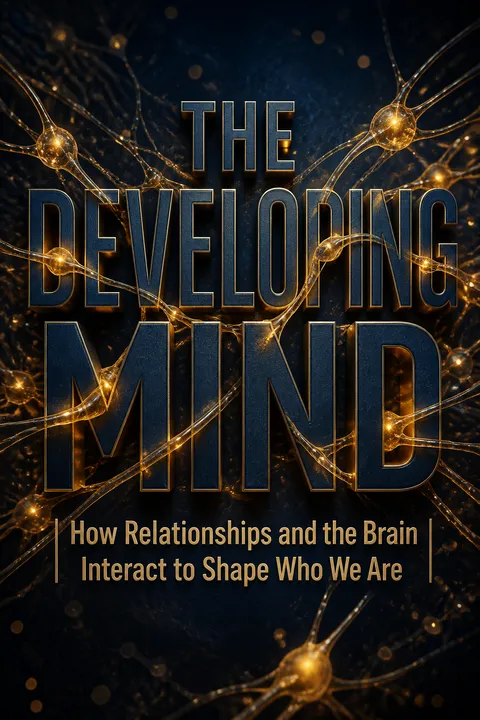
The Developing Mind, Second Edition receives mostly positive reviews for its comprehensive exploration of neurobiology, attachment theory, and personal psychology. Readers praise Siegel's synthesis of complex scientific concepts and their practical applications. Many find the book transformative, offering insights into relationships, emotions, and self-understanding. However, some criticize its repetitiveness, dense writing style, and occasional oversimplification. Despite these drawbacks, the book is widely regarded as an important resource for psychologists, educators, and parents interested in understanding brain development and human behavior.
People Also Read






Glossary
Interpersonal neurobiology
Integrates mind, brain, relationshipsAn interdisciplinary approach that draws on fields such as neuroscience, psychology, development, and anthropology to understand how mind, brain, body, and relationships interact. Siegel uses it to connect subjective experience with neural processes and social communication, rather than explaining mental life through brain activity alone.
Integration
Links distinct partsThe connection of differentiated elements into a functioning whole. In Siegel’s framework, integration preserves the distinct qualities of its parts while coordinating them. It can describe neural circuits, mental processes, self-states, or relationships. The author proposes that flexible integration supports well-being, while disrupted integration can appear as rigidity, chaos, or both.
Implicit memory
Past learning without recallMemory that affects present perception, emotion, bodily sensation, or behavior without the subjective feeling of remembering. It includes learned responses and mental models formed through repeated experience. Because it does not require conscious attention, implicit memory can shape reactions before a person can identify what past experience may be influencing them.
Explicit memory
Conscious recall of informationMemory that, when retrieved, includes a sense of remembering. It includes semantic memory for facts and episodic or autobiographical memory for personal events. In Siegel’s account, explicit memory depends on attention and developing brain systems that support context, sequence, and a sense of the self across time.
Internal working model of attachment
Expectations about caregiver relationshipsA set of expectations shaped by repeated interactions with an attachment figure. A child uses this model to anticipate whether a caregiver will be available, comforting, distant, or frightening. It influences how the child approaches relationships and regulates distress. Siegel emphasizes that such models can change as a person encounters new experiences.
Adult Attachment Interview
Assesses attachment narrativesA semistructured interview that asks adults to describe childhood relationships with caregivers and reflect on how those experiences affected them. Trained raters assess the organization and coherence of the person’s account, not simply whether the childhood was described as positive or negative. Research in the book links these classifications with infant attachment patterns.
Mindsight
Perceives minds within experienceSiegel’s term for the ability to perceive the internal mental life of oneself and other people, rather than attending only to outward behavior. It includes noticing feelings, intentions, beliefs, and bodily signals. In the book’s framework, mindsight can support reflection and more responsive communication.
Window of tolerance
Usable range of emotional arousalThe range of emotional activation within which a person can continue to think, feel, and respond flexibly. Outside this range, high arousal may overwhelm reflection, while low-arousal shutdown may bring numbness or withdrawal. Its width can vary with temperament, past experience, current stress, and the surrounding relationship.
Attractor states
Repeated patterns that recurIn Siegel’s use of complexity theory, attractor states are reinforced patterns of activity that become more likely under familiar conditions. A repeated emotional or behavioral response can function this way: cues associated with earlier experience activate a familiar cluster of attention, memory, feeling, and action. The term describes a pattern, not a diagnosis.
Wheel of Awareness
Maps attention and experienceA reflective practice that represents awareness as the hub of a wheel and the things a person can notice as points around its rim. These include sensory input, bodily experience, mental activity, and connections with others. The exercise directs attention among these areas and distinguishes the act of awareness from its contents.
FACES
Qualities of integrated flowAn acronym Siegel uses for the qualities he associates with healthy integrated functioning: flexible, adaptive, coherent, energized, and stable. It summarizes his proposal that well-being involves coordinated change rather than either rigid sameness or chaotic instability. FACES is a conceptual guide in the book, not a standardized clinical measure.
FAQ
What's The Developing Mind about?
- Interdisciplinary Approach: The Developing Mind by Daniel J. Siegel explores the relationship between the mind, brain, and interpersonal relationships, integrating neuroscience, psychology, and anthropology.
- Interpersonal Neurobiology: It introduces interpersonal neurobiology (IPNB), suggesting that the mind emerges from neural processes and relational experiences, emphasizing the role of interactions in shaping mental life.
- Attachment and Development: The book discusses how early attachment experiences influence emotional regulation, memory, and overall development throughout life, highlighting the importance of secure attachments.
Why should I read The Developing Mind?
- For Professionals: Essential for mental health, child development, and education professionals, offering insights into how relationships shape brain development and mental health.
- Updated Research: The second edition includes over a decade of new findings, making it a current resource supported by the latest research in neuroscience and psychology.
- Practical Applications: Concepts can be applied in therapy, parenting, and education to foster healthy relationships and emotional well-being.
What are the key takeaways of The Developing Mind?
- Mind, Brain, and Relationships: Emphasizes the interconnectedness of mind, brain, and relationships as "three aspects of one reality," crucial for understanding development and mental health.
- Importance of Attachment: Secure attachments are foundational for healthy emotional and cognitive development, influencing brain structure and function.
- Neuroplasticity and Growth: The brain's plasticity allows for development and change in response to experiences, highlighting potential for healing and growth.
What is interpersonal neurobiology (IPNB) according to The Developing Mind?
- Definition of IPNB: Described as "an embodied and relational process that regulates the flow of energy and information," integrating various disciplines to understand how relationships shape the mind and brain.
- Three Aspects of Reality: IPNB posits that mind, brain, and relationships are interconnected aspects of human experience, offering a holistic understanding of mental health.
- Practical Implications: Understanding IPNB can inform therapeutic practices, parenting strategies, and educational approaches, promoting healthier relationships and emotional resilience.
How does attachment influence development according to The Developing Mind?
- Attachment System: Motivates infants to seek proximity to caregivers, crucial for survival, with secure attachments providing a "secure base" for exploration and emotional regulation.
- Internal Working Models: Children develop models based on caregiver experiences, influencing future relationship expectations and behaviors.
- Long-term Effects: Early attachment shapes emotional regulation, social competence, and cognitive functioning, with secure attachments promoting resilience.
What are the different types of attachment styles discussed in The Developing Mind?
- Secure Attachment: Characterized by trust and a healthy balance of intimacy and independence, leading to positive relationships and effective emotional regulation.
- Insecure Attachment: Includes avoidant and ambivalent styles, with avoidant individuals distancing emotionally and ambivalent individuals exhibiting anxiety and uncertainty.
- Disorganized Attachment: Marked by confusion and disorientation, often linked to frightening or inconsistent caregiving experiences.
What role does memory play in the development of the mind according to The Developing Mind?
- Types of Memory: Distinguishes between implicit (nonconscious) and explicit (conscious) memory, both shaping our sense of self and interactions.
- Memory and Identity: Autobiographical memory development is crucial for creating a coherent life narrative, influencing identity.
- Impact of Relationships: Interpersonal experiences affect memory processes, with caregiver discussions enhancing children's recall and integration of experiences.
What is the significance of the "Adult Attachment Interview" (AAI) in The Developing Mind?
- Purpose of the AAI: Assesses an adult's attachment state of mind by exploring childhood experiences, revealing how these shape current attachment patterns.
- Predictive Power: Correlates strongly with the attachment styles of the adult's children, indicating lasting effects of early experiences.
- Narrative Coherence: Reflects the ability to integrate past experiences, essential for healthy emotional functioning and self-reflection.
How does stress and trauma affect memory and development according to The Developing Mind?
- Impact on Memory: Stressful experiences can impair explicit memory encoding, with high stress hormones blocking hippocampal functioning.
- Implicit Memory Retention: Implicit memories of trauma can remain intact, influencing behavior and emotional responses, leading to intrusive memories.
- Long-term Consequences: Chronic stress and trauma can cause lasting changes in brain structure and function, increasing psychological disorder risks.
What is the concept of "mindsight" in The Developing Mind?
- Definition of Mindsight: The ability to perceive the mind of oneself and others, facilitating emotional regulation and interpersonal understanding.
- Developmental Importance: Develops early through caregiver interactions, shaping emotional understanding and relationship formation.
- Therapeutic Applications: Can be cultivated through therapy, enhancing emotional awareness and improving relational dynamics.
How does The Developing Mind explain the role of neuroplasticity?
- Lifelong Brain Change: The brain remains plastic throughout life, forming new connections in response to experiences, challenging the notion of fixed development.
- Critical Periods: Highlights "windows of opportunity" for developing skills like language and emotional regulation, with missed opportunities leading to deficits.
- Therapeutic Implications: Understanding neuroplasticity allows for interventions to reshape emotional responses and improve mental health.
What are some practical strategies for fostering integration and emotional well-being from The Developing Mind?
- Mindfulness Practices: Enhance emotional regulation and promote brain integration, fostering awareness of thoughts and feelings.
- Reflective Dialogue: Encourages open communication about emotions, enhancing understanding and connection in relationships.
- Therapeutic Interventions: Therapy provides a safe space for exploring attachment histories and developing mindsight, facilitating emotional integration and healing.
About the Author
Other books by Daniel J. Siegel







Download PDF
Download EPUB
.epub digital book format is ideal for reading ebooks on phones, tablets, and e-readers.








