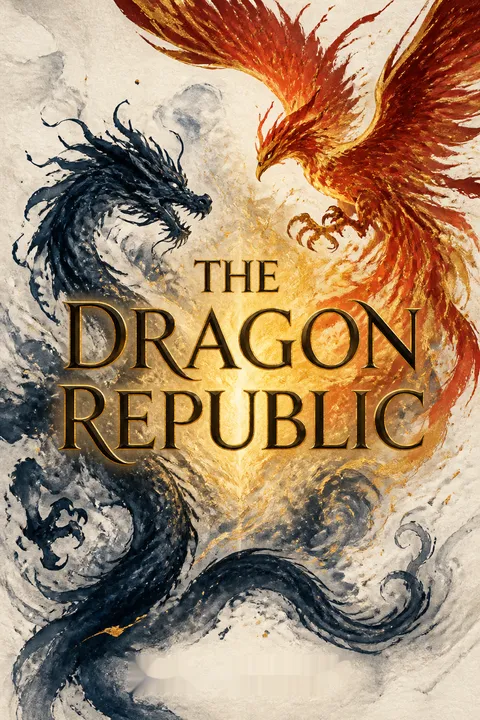


Plot Summary
Prologue
Eight years before the war, Nezha takes his little brother Mingzha to look at the forbidden caves along the Nine Curves River. Something enormous erupts from the water.
Nezha surfaces alone, surrounded by blood and one of Mingzha’s gold anklets. The dragon that took the boy greets Nezha, beginning a secret that will shape the prince’s life and haunt his family.
The childhood scene gives Nezha’s later privilege a hidden cost: the House of Yin’s beauty and authority coexist with a private wound it cannot explain away. His responsibility for Mingzha’s safety turns curiosity into guilt, while the dragon’s greeting makes that guilt inseparable from power. The anklet is an especially sharp detail. The child’s ornaments, meant to attract good fortune, become the sole remnant of a loss Nezha cannot make public. The prologue plants the book’s recurring question of whether power is a gift, a burden, or a claim laid on someone without consent.
Adlaga's Failed Assassination
After the Third Poppy War, Rin leads the Cike, a band of shamans, through a string of assassinations for Pirate Queen Moag. Their last assignment is to kill Yang Yuanfu, the official keeping Moag’s opium trade out of Adlaga. Rin arrives already suffering opium withdrawal and haunted by the destruction she unleashed on Mugen.
When Empress Su Daji unexpectedly appears at a crowded commemoration, Rin loses control of the Phoenix’s fire. She nearly burns her fellow shaman Unegen and alerts the Imperial Militia, though Suni still kills Yuanfu in the confusion. The Cike escape, but Unegen and their healer Enki leave the group, and Rin wakes to learn that her attempt at revenge has endangered the people she was meant to command.
Rin’s first crisis exposes the difference between power and agency. She can destroy a city, yet cannot reliably choose what happens when grief, withdrawal, and the Phoenix converge. Her insistence on staying in Adlaga is not merely tactical pride: finishing the job offers a temporary test of whether she can still function. The result is morally and practically the opposite. Her comrades pay for her refusal to admit incapacity, and the surviving Cike remain because their shared danger leaves them with few alternatives. Command begins here as an obligation Rin wants to claim but does not yet know how to exercise.
Moag Sells the Cike
Back in Ankhiluun, Rin finds that Moag has withheld the payment she was promised and assigned her another dangerous job. Moag’s bargain is a trap: the Cike’s skimmer is ambushed by an unmanned foreign warship, and opium gas knocks them unconscious. They awaken aboard the Seagrim, where the scarred Nezha, presumed dead since the war, frees Rin and brings her to his father, Yin Vaisra.
Vaisra asks Rin to help overthrow the Empress and establish a republic. Rin resists taking orders again, but Moag has betrayed her and six shamans cannot reach Daji alone. Kitay, meanwhile, refuses to join until he learns that his father died in the war. He then demands a place directing the campaign, turning grief into a reason to fight.
The episode replaces one unreliable patron with another, while making the difference between them deliberately uncertain. Moag treats violence as a commodity and exploits Rin’s dependence on her resources. Vaisra offers a political purpose, but he also controls the army, supplies, and information Rin lacks. Kitay’s decision adds a more intimate pressure: political allegiance becomes inseparable from mourning his father and from the need to give his intelligence practical force. Each character enters the Republic for a different reason, so their alliance is real but never simple. The book’s central problem is already visible: people who need power often mistake usefulness for trust.
Withdrawal on the Murui
As the Seagrim travels toward Lusan, Vaisra bars the physician from giving Rin opium. Her withdrawal turns into a desperate attempt to throw herself overboard, stopped by Suni, who steadies her with a story and keeps her breathing. Forced to look at refugees fleeing ruined provinces, Rin sees what victory has left behind. The ship later passes villages drowned by breached dams.
She recognizes the Cike’s role in that disaster and discovers that Chaghan and Qara helped carry it out under Altan’s orders. Rather than comfort her, the truth sharpens Rin’s guilt: she has treated the dead as numbers to avoid confronting them as people. By the seventh day, she can summon a controlled flame and begins training her power under Vaisra’s supervision.
Vaisra’s coercive detoxification is both an intervention and a rehearsal for his politics: he treats Rin’s suffering as something to discipline in service of a larger objective. Yet the recovery is not simply his achievement. Suni’s care gives Rin an immediate human tether, while the refugees and drowned villages puncture her preferred story that military victory equals peace. The dam revelation also complicates her private guilt: mass harm is not unique to her, but shared responsibility does not absolve anyone. Control arrives as a fragile practice, not a cure. Rin gains command over a flame while remaining dependent on the structures that tell her where to aim it.
The Autumn Palace Coup
Vaisra takes Rin to the Autumn Palace disguised as his drugged prisoner, hoping the Empress will let her close enough to strike. The Warlords’ meeting displays a government unable to agree on aid for starving provinces, while Daji watches and then leads Rin through hidden palace passages.
She argues that the Empire needs unity and offers help controlling the Phoenix. When Rin attacks, Daji traps her in a vision and calls on Nüwa, but Chaghan enters the spirit realm and pulls Rin free.
Ramsa’s explosives tear through the palace. Rin refuses to abandon Vaisra, returns to the council chamber, and helps Baji and Suni carry the wounded Warlord out. Their escape begins the civil war Vaisra wanted, even though the attempt to seize the capital has failed.
Daji’s argument matters because it is not a simple defense of tyranny. The council has just shown the Warlords failing to coordinate against hunger, which gives her account of political fragmentation some credibility. But her competence does not erase her betrayal of the Cike or the consequences of her rule. Rin cannot disentangle those facts under pressure. Chaghan’s intervention saves her body, while her return for Vaisra binds her more deeply to the Republic. She chooses a person and a chain of command before she has chosen an enduring political principle. The failed coup therefore succeeds in one narrower sense: it makes neutrality impossible for everyone present.
Arlong's Foreign Bargain
The Republican fleet reaches Arlong, Vaisra’s fortified water-city, where Rin discovers that Daji’s illusion has left a Seal in her mind. She cannot call the Phoenix, and Jinzha, Nezha’s elder brother, demotes her after she fails to demonstrate her fire.
The arrival of Hesperian airships brings a second threat: General Tarcquet and Sister Petra want to examine Rin in exchange for possible military support. Petra describes shamans as manifestations of Chaos and treats Rin’s body as evidence.
Rin agrees to weekly examinations because refusal would not stop the Hesperians from taking her. Meanwhile, the southern Warlords join Vaisra, and Kitay enters the command structure. The Republic now has allies, advanced weapons, and a revolution, but Rin has lost the ability that made her valuable.
Arlong converts abstract political alliance into a contest over who may define personhood. The Hesperians call their scrutiny rational inquiry, yet their willingness to seize Rin makes consent conditional on overwhelming force. Their scientific language does not neutralize the coercion; it decorates it. Rin’s loss of fire is especially destabilizing because her usefulness has become the main basis on which others recognize her. Jinzha’s demotion confirms that vulnerability changes her rank faster than her history does. Meanwhile, Vaisra’s coalition is built on the same strategic need that makes Rin exploitable. The Republic promises a different system, but its earliest arrangements already show how easily an individual can become an instrument within it.
Poison in the Murui
The Empire poisons the waters around Arlong, killing fish and other river life and fatally weakening Aratsha, the Cike’s water shaman. As the city’s troops fall ill and the southern Warlords realize that a blockade will not protect them, the Republic launches its northern campaign.
Rin’s squad tracks the poison to a former mission in Hare Province, where Niang, a former classmate, has converted Federation gas into liquid pods and released them into the river. Niang blames the Republic for threatening famine and Rin for destroying Mugen without sparing Nikara prisoners.
Kitay kills Niang when she reaches for a gas canister. Their discovery ends the immediate poisoning, but confirms that the Republic’s enemies can turn the same weapons that devastated the country against its people.
The river attack transforms a conflict of constitutions into a fight over basic survival. Water connects the military front to farms, towns, and bodies, so a single strategic act threatens populations far beyond the battlefield. Niang’s confrontation denies Rin a clean moral distinction between liberator and enemy: Niang has chosen mass poisoning, but her grievance about the dead on Mugen is not invented. Kitay’s killing of her is necessary to stop an imminent release, yet it leaves him shaken rather than triumphant. The scene shows how quickly political violence recruits personal history. Former classmates now meet as combatants, and neither intelligence nor good intentions can prevent the irreversible choice.
Radan's Coerced Republic
Jinzha’s fleet begins with easy victories in Hare Province. At Radan, Republican ships destroy the town’s improvised defenses, then Jinzha holds its men at swordpoint while officials stage a vote to join the Republic. Kitay calls the result coercion, not consent.
The campaign continues through villages that surrender or are absorbed into Vaisra’s administration, while food is requisitioned and local labor diverted to the war. A storm delays the fleet; during the pause, Rin finds villagers frozen in the snow with their belongings packed, apparently fleeing the advancing Republican army.
The sight exposes the campaign’s effect on civilians whom the Republic claims it will liberate. Jinzha presses north anyway, trusting the fleet’s strength and his own record of success.
Radan makes the Republic’s contradiction legible in a single procedure: citizens are invited to choose after the men who might resist have been defeated and the consequences of refusal made explicit. The ballots provide a picture of consent without its conditions. Rin has previously treated forced choices as the practical grammar of war; Kitay insists that calling them democratic does not change their structure. The frozen villagers extend that contradiction beyond propaganda. Even civilians who have not been massacred may flee because they cannot tell conquest from protection. Jinzha’s confidence is thus not merely military optimism. It depends on treating compliance as proof that the new order is wanted.
Boyang's Waterfall Defeat
At Boyang, Jinzha ignores Kitay’s warnings and drives the damaged fleet toward the Imperial Navy. Water mines and shallow lake conditions cripple the Republican ships. Feylen, the Wind God’s former Cike host, appears and tears the fleet apart with storms. Chaghan tries to restrain him but is hurled into the lake with Qara.
Nezha raises a wall of water to shield the ships, then collapses as a dragon god overwhelms him. Rin forces opium into his mouth to stop the possession, while the current sweeps her, Kitay, and the twins over a waterfall. Jinzha disappears in the chaos. Rin wakes on the bank with Kitay and the twins, unsure who else survived and facing a trek through enemy territory with no fleet to return to.
Boyang destroys the Republican belief that superior technology and careful planning can make war controllable. Jinzha’s impatience contributes to the defeat, but Feylen’s arrival makes the imbalance more radical than ordinary strategy can repair. Nezha’s power is revealed as a parallel to Rin’s, though his relationship to it is marked by fear and refusal rather than practiced use. Rin saves him through the very drug she has been trying to escape, a rescue that carries its own cost. The waterfall strips away rank, ships, and political shelter. Survivors must begin again as bodies in cold water, with no assurance that their comrades or cause remain intact.
The Seal's Hidden Cost
A Ketreyid patrol captures Rin, Kitay, Chaghan, and Qara while hunting Feylen. Their leader, the Sorqan Sira, reveals that the twins were placed among the Cike to monitor the shamans and prevent them from becoming uncontrollable. She also shows Rin a memory of the young Trifecta: Jiang, Daji, and Riga killed the Sorqan Sira’s daughter Tseveri while fighting for territory.
The elders recognize Daji’s Seal in Rin and put her through a near-fatal sweat ritual to draw out its venom. Rin faces an illusion of Altan and rejects the temptation to surrender to a life without loss. The ritual removes the corruption but not the barrier to her power. Kitay agrees to an anchor bond so Rin can reach the Phoenix through him.
The Ketreyids complicate the Cike’s identity: the organization that gave Rin comradeship was also an experiment watched by people who feared what shamans might become. Their intervention offers knowledge, but not uncomplicated care. The Sorqan Sira’s history of Tseveri’s murder reveals that the Trifecta’s rise was built on violence against a people who had once sheltered them. Rin’s confrontation with Altan is less a recovered romance than a reckoning with how she has used his memory to punish herself. Kitay’s decision to share her spiritual burden is an act of intimacy and risk, not a cure without consequences. Her restored power will now be relational.
A Clan Splits Apart
As Rin and Kitay prepare to leave the Ketreyids, Bekter frees the Hesperian missionaries and arms them, using their guns to overthrow the Sorqan Sira. Augus shoots her, then kills Qara when the twins shield one another. Rin’s newly accessible fire kills Augus, but Bekter escapes with the riders.
Chaghan, now severed from the twin bond that shaped his life, must return north to warn his people of the coming clan war. He leaves Rin and Kitay a horse and a way to travel. They build a raft from wreckage and spend nearly a month drifting downstream, testing how Rin’s fire works through her bond with Kitay. At Arlong, she and Kitay find the Republic’s flag still flying and reunite with Nezha, Baji, and Suni.
The coup turns the Ketreyid lesson about inherited violence into immediate loss. The Hesperians are not simply observers here: their weapons become instruments in Bekter’s internal power struggle, and Augus’s fear produces consequences he cannot undo. Qara’s death shatters the most intimate bond in the novel, leaving Chaghan to act through grief rather than the shared will he has always known. Rin’s fire returns, but it does not restore the old Cike or repair the damage of Boyang. The raft’s slow passage emphasizes how recovery depends on testing limits together. Their return to Arlong is a reunion, but the missing Jinzha and the fractured army make it a return to uncertainty.
The South Is Left Outside
Arlong is crowded with southern refugees, penned beyond the city’s barriers and given little food or shelter. Rin finds her foster brother Kesegi there, but Auntie Fang blames her for leaving Tikany and for the war’s cost. Kesegi resents that Rin never wrote and never returned to protect them. The reunion gives Rin no easy homecoming: the boy she remembers has become a hungry adolescent who sees her as a soldier who abandoned him.
When an Hesperian soldier rapes a refugee, Rin burns him to death, then hides the body. The act protects the woman but endangers the Republic’s negotiations. Kitay sees how the Hesperians and Vaisra may be using the war, and begins to suspect they allowed the Federation invasion to weaken Nikan.
The refugee camp makes political abstractions intimate. Rin cannot dismiss the southern population as a strategic map when Kesegi stands before her, but she also cannot undo her years of absence with a single visit. Auntie Fang’s cruelty does not cancel the real deprivation around them, just as Rin’s sacrifice does not erase her failure to remain connected. Her killing of the Hesperian soldier is an immediate refusal to tolerate abuse, yet secrecy turns justice into another liability in a war built on bargaining. Kitay’s suspicion reframes the alliance: the Republic may be resisting one empire while preparing to depend on another. Rin’s loyalties are no longer sheltered by certainty.
The Red Cliffs Prepare
Daji’s fleet sails south, carrying the Militia and a vast floating fortress. Tsolin defects to the Empress, explaining that he believes he can spare his people from further bloodshed. His ships strengthen the approaching enemy and leave Arlong with few options.
Rin’s delayed-march mission fails to stop the advance, and Nezha loses Shayang before returning with surviving troops. With the final defense looming, Kitay and Ramsa build Rin a leather-and-metal flying rig that uses her fire to lift her into the air.
She learns to steer it and recruits Venka, whose injured arms do not prevent her from shooting accurately. Their preparations give Rin a way to meet Feylen in the sky, while Vaisra positions the remaining fleet and fortifies the city for a battle he cannot avoid.
The preparations reveal two forms of adaptation. Tsolin chooses defection as a strategy to reduce immediate casualties, while Rin and her allies invent a riskier way to resist rather than accept his calculation. Neither choice is morally frictionless. The flying rig converts Kitay’s abstract ingenuity and Ramsa’s munitions knowledge into a physical answer to Feylen’s control of the air. Venka’s recruitment similarly treats injury as a changed condition, not a reason to exclude her. Yet the looming fleet makes innovation feel less like triumph than an improvised opening. The Republic has learned to build tools quickly; it has not solved the deeper imbalance in numbers or political trust.
Fire Over the Channel
Daji’s fleet smashes through Arlong’s chained gates while the Republic’s mines and cliff cannons inflict only limited damage. Rin’s flying rig lets her ignite the ropes binding the Imperial ships together, breaking their formation and helping Nezha drive into the fortress. When she spots ground troops threatening the refugee valley, she writes a warning in fire across the sky.
She then lands on Nezha’s ship and helps him defeat Jun and Chang En. Feylen tears the fleet apart, so Rin draws him near a cliff rigged with explosives and triggers a collapse that buries him under tons of rock. A javelin strikes Rin and sends her into the river. Nezha finds her underwater and carries her to shore, where Daji approaches through the wreckage.
Rin’s most effective acts in the battle depend on cooperation: Kitay’s design gets her airborne, Venka provides cover, and Nezha’s ship gives her a place to intervene. Even her message to the valley is an attempt to direct attention rather than simply unleash destruction. But the battle’s scale overwhelms individual heroism. The city burns, the fleet breaks, and civilians remain exposed despite the warning. Rin’s victory over Feylen is not a clean defeat of divine power; it is a trap built from explosives and terrain. Nezha’s rescue brings their closeness back at the moment when neither can afford to be alone, yet Daji’s arrival prevents that intimacy from becoming safety.
Daji Names the Enemy
Daji restrains Rin and briefly compels her to harm herself, then explains that the Trifecta grew up under occupation and abuse. In a vision, Rin sees a Hesperian soldier assault the young Daji and another Hesperian torment Jiang, while a Mugenese soldier intervenes to protect the children.
Daji argues that the Hesperians helped shape the Federation’s imperial ambitions and that her own betrayals were attempts to preserve a unified core. Her account does not undo her sale of the Cike or the deaths she caused, but it fractures Rin’s simple picture of the war.
Before Rin can decide whether to kill her, a collapsing mast pins Rin beneath the wreckage. Daji escapes, leaving Rin unsure whether she chose to spare her or was manipulated into hesitation.
Daji’s revelation does not acquit her; it changes the frame in which her crimes must be judged. The childhood vision exposes imperial violence as a system of competing powers, not a clean opposition between a cruel East and a civilized West. Daji’s use of necessity resembles the reasoning Rin has used to defend her own mass killing, which is precisely why the comparison unsettles her. Yet a shared history of injury does not make their choices equivalent or repair what each has done. Rin’s inability to say whether she released Daji or was compelled leaves agency unresolved. The scene denies her the satisfying moral clarity she hoped would make the next decision easy.
Vaisra Executes the Cike
After the battle, Vaisra’s forces capture Tsolin and execute him when he refuses to repent. Nezha stabs Rin before dawn, leaving her chained and drugged; he has chosen his father’s side despite their closeness. Lady Saikhara whips Rin and reveals that she had brought the Hesperians to seek a cure for Nezha’s condition.
Outside, Vaisra executes Baji and Suni before a crowd, presenting the shamans as threats to be removed. Rin’s fire briefly returns through her tolerance for opium, but guards suppress it. Vaisra tells her that the Hesperians will take her for study and that he no longer needs her. When Rin exposes Nezha’s secret, Vaisra denies it, protecting his son and refusing to protect her.
The Republic’s victory strips away its rhetoric of choice. Vaisra’s treatment of Rin, Baji, and Suni shows that the new regime can preserve its authority by sacrificing those who cannot be incorporated into its preferred order. Saikhara’s motive complicates her cruelty: she seeks relief for her son, but her hope is purchased through the suffering of another person. Nezha’s betrayal is especially devastating because affection has not overcome dynastic obligation. Rin’s attempt to reveal his secret is retaliation and self-defense, not a noble disclosure. By the end of the section, every relationship has been recast as a question of who will be protected when power demands a sacrifice.
Escape Into Another War
Kitay communicates with Rin through their anchor bond and breaks into her cell, but guards approach before he can free her. Ramsa draws the patrol away with bombs and dies in the resulting explosion, giving Kitay and Rin time to escape. Venka waits with a stolen uniform and a sampan.
The group finds Red Junk ships sent by Moag, and the Monkey Warlord Gurubai joins them after escaping Vaisra’s crackdown. They learn that the Hesperians have secured military bases, missionary access, trade privileges, and permission to sell opium, while Vaisra has accepted their terms.
The southern camps are in revolt, and Vaisra is moving against the Warlords. With one hand badly broken and her old allies dead or scattered, Rin chooses to lead a southern army against the Republic and its foreign backers.
The escape is a costly act of collective loyalty. Kitay risks his body to free Rin, Venka commits treason to pilot their route, and Ramsa spends his life creating the opening they need. Their rescue does not restore the Cike; it leaves Rin with a smaller, altered circle and a broken hand. The treaty explains why Vaisra can accept Hesperian dominance: he has gained the machinery to consolidate rule, even at the cost of sovereignty. Rin’s final choice is therefore neither a clean liberation nor a return to her old revenge. She selects a new war because the people excluded from the Republic have become its likely targets, and because she refuses to remain another ruler’s weapon.
Analysis
The novel’s central conflict is not a contest between a virtuous republic and a wicked empire. It is a struggle over who may define necessity, and whose lives become expendable when leaders invoke it. Daji, Vaisra, and Rin each make decisions that they frame as survival or liberation. Their motives differ, but each can reduce people to pieces on a strategic board. The story repeatedly tests political ideals against the bodies that absorb their costs: poisoned villagers, refugees behind Arlong’s barriers, soldiers used as labor, and shamans treated as weapons or specimens.
Rin’s dependence on the Phoenix gives that political problem an intimate form. Opium numbs her guilt but also weakens her ability to choose; command offers structure but can become another addiction. Kitay’s anchor bond gives her power through relationship rather than solitary mastery, yet even that intimacy risks turning him into a tool. Her eventual rejection of Vaisra is therefore not a clean moral awakening. She recognizes that she was manipulated, but she remains drawn to retaliation and to the authority her own destructive power can grant.
The novel also unsettles the language of progress. The Republic promises elections and shared government, while it compels conquered towns to vote, extracts food, and confines refugees. Hesperian technology appears advanced, but its scientific vocabulary accompanies racial hierarchy and military coercion. Modernity does not abolish domination; it supplies domination with better machinery and more persuasive explanations.
The ending refuses the reassurance of a completed revolution. Rin escapes a regime that has used and discarded her, but the southern uprising she chooses will demand bodies, discipline, and sacrifice. Her decision gives her agency while leaving open whether she can build anything beyond revenge. The final danger is not simply that Rin may lose control of the Phoenix. It is that she may control it perfectly and still choose to make the world burn.
Review Summary
The Dragon Republic receives overwhelmingly positive reviews, with readers praising its complex characters, intricate plot, and powerful themes. Many note the book's improvement over its predecessor, highlighting the author's growth as a writer. Readers appreciate the exploration of war, politics, and morality, as well as the emotional depth of the characters. The novel's intense action scenes and unexpected twists keep readers engaged throughout. Some reviewers express emotional distress at certain plot developments, indicating the story's strong impact on its audience.
People Also Read







Characters
Fang Runin
The fire-wielding survivorA war orphan from Rooster Province, Rin rises through military training by force of discipline and an appetite for recognition. Her command of the Phoenix gives her immense destructive power, but trauma, guilt, and opium dependence make that power dangerous to herself and others. She is quick to read tactical possibilities and slow to admit emotional vulnerability. Rin attaches fiercely to people who offer structure or belonging, even when their authority compromises her independence. Her relationships with Kitay, Nezha, and the Cike reveal competing needs: to be understood, to be useful, and to decide for herself. Her central psychological struggle is not simply controlling fire, but learning to distinguish chosen purpose from obedience disguised as purpose.
Chen Kitay
The strategist and anchorRin’s closest friend from Sinegard, Kitay is a prodigious reader and strategist whose mind keeps searching for coherent rules in a collapsing world. He is loyal to his family’s service to the crown, yet increasingly forced to judge institutions by what they do rather than what they claim to represent. His grief and trauma often emerge as anger at hypocrisy and bad reasoning. Kitay’s relationship with Rin combines intellectual partnership, blunt correction, and deep care; he is willing to share risks she would rather bear alone. His strength lies in converting curiosity into practical designs, but his faith that knowledge can solve a problem sometimes pushes him toward dangerous experiments.
Yin Nezha
The scarred Dragon heirThe second son of Yin Vaisra, Nezha is a polished Sinegardian cadet, gifted sailor, and politically perceptive officer. His confidence often reads as arrogance, especially to Rin, whom he once treated as an inferior. Beneath the princely composure is a young man shaped by family expectation, private pain, and fear of what his power might demand from him. He is both attracted to and unsettled by Rin’s refusal to accept the limits he has learned to live within. Their bond is charged by rivalry, affection, resentment, and incompatible ideas of duty. Nezha’s defining tension is between inherited responsibility and the possibility of choosing what kind of person that responsibility makes him.
Yin Vaisra
The republic's architectThe Dragon Warlord commands Arlong, a powerful province and its advanced fleet. Vaisra presents himself as a reformer seeking to replace hereditary provincial rule with representative government, and he is skilled at turning military weakness into political leverage. His patience, strategic intelligence, and talent for cultivating other people make him a persuasive leader. He sees individual ability in Rin and Kitay, but also evaluates that ability in terms of what it can accomplish for his project. His relationship with his sons is shaped by inheritance, expectation, and the uneven distribution of approval. Vaisra’s psychological danger lies in his ability to regard coercion as a necessary instrument while still believing that his ultimate goals justify it.
Su Daji
The calculating EmpressKnown as the Vipress, Daji rules Nikan through political instinct, martial skill, and a supernatural ability to exploit desire. She is beautiful in a way that makes people underestimate how deliberately she studies them. As a survivor of occupation and the last member of the Trifecta still openly ruling, she sees unity as a matter of national survival, even when achieving it demands betrayal and sacrifice. Her relationship with Rin combines recognition, manipulation, and a contest over who may define the future of the country. Daji’s composure is formidable, but it can conceal fear beneath certainty. She believes that rulers must make choices ordinary people cannot bear, a belief that makes her both effective and dangerous.
Chaghan
The watchful spirit-speakerA pale, sharp-tongued shaman and one of the Cike’s most enigmatic members, Chaghan is Qara’s twin and lifelong spiritual counterpart. He distrusts Rin’s leadership and recognizes how grief and anger can make her easy to steer, though his criticism often arrives as cruelty. His knowledge of the spirit world gives him insight unavailable to most of the group, but his guardedness reflects a life shaped by clan obligations and exile. He carries deep attachments he rarely discusses and often hides sorrow behind superiority.
Qara
The quiet bird-speakerQara is Chaghan’s twin, a gifted sharpshooter who communicates with birds and prefers observation to argument. Her closeness with Chaghan is so complete that she often seems to speak through his confidence, though she possesses her own judgment and tenderness. Qara is more attuned to animal life and spiritual presence than to ordinary social performance. She offers Rin a model of loyalty that is intimate without being explained in conventional terms, and her reserve should not be mistaken for passivity.
Ramsa
The explosive inventorA young former prisoner, Ramsa is the Cike’s brilliant munitions expert. He approaches danger with irreverent humor and a craftsman’s delight in mechanisms, often treating explosives as both tools and toys. His small stature and youth make others underestimate him, which he answers with technical inventiveness and a stubborn appetite for action. He values the Cike as a family, even when he masks that attachment with jokes and complaints.
Baji
The irreverent berserkerA former Sinegard student and one of the Cike’s strongest fighters, Baji hides seriousness beneath jokes, bravado, and constant teasing. He understands the pull of violence and recognizes that peaceful life may not be equally possible for every shaman. His warmth toward Rin is practical rather than sentimental: he watches for her distress, challenges her self-deception, and keeps the group’s everyday camaraderie alive.
Suni
The Cike's quiet protectorA massive, gentle fighter, Suni speaks little but offers unusual patience when others are in crisis. He helps Rin survive withdrawal by keeping her focused on breathing and telling a story that reframes her urge to die. His physical strength contrasts with a thoughtful, careful temperament. Suni’s loyalty to the Cike is grounded in shared vulnerability rather than ambition.
Sring Venka
The stubborn archerVenka is an aristocratic Sinegard graduate, a capable archer, and a survivor of the violence at Golyn Niis. Her humor is sharp, her pride fierce, and her insistence on returning to military work reflects a need to reclaim control over her body and identity. She resents being treated as too damaged to serve, while recognizing that recovery is neither quick nor simple. Her friendship with Rin is built on bluntness and mutual respect.
Chiang Moag
The pirate queenMoag rules Ankhiluun through a unified pirate fleet, commercial intelligence, and a clear understanding of what people will do for money. She is ruthless without pretending to be lawful, and her dealings with Rin make her a useful but unreliable patron. Moag values leverage above sentiment, yet she can recognize a powerful opportunity when one appears. Her independence depends on the political and economic arrangements she exploits.
Yin Saikhara
The Hesperian-connected matriarchVaisra’s wife and Nezha’s mother, Saikhara was educated in Hesperia and maintains close ties to the Gray Company. She is intensely religious and convinced that Hesperian knowledge may answer a private family crisis. Her composure can harden into contempt, particularly toward people she considers spiritually dangerous. Saikhara’s attachment to her son is powerful, but it is filtered through doctrine, fear, and the belief that institutions can repair what they do not understand.
General Josephus Tarcquet
The Hesperian envoyTarcquet leads the Hesperian military delegation and evaluates the Republic before deciding what support it merits. He is disciplined, blunt, and comfortable treating foreign policy as a test whose standards need not be disclosed. His relationship with Vaisra is defined by unequal leverage: the Republic needs weapons, while Tarcquet can delay or condition their delivery. His military pragmatism masks the imperial assumptions behind his mission.
Sister Petra
The Gray Company examinerPetra is a formidable scholar of the Gray Company, the Hesperian religious and scientific order. She studies Rin as evidence of what her theology calls Chaos, convinced that observation can both explain and correct the phenomenon. Her self-control is so complete that it can seem inhuman, and she interprets coercion as acceptable when pursuing what she considers salvation. Petra’s conflict with Rin centers on who gets to define rationality, healing, and consent.
Brother Augus
The eager young missionaryAugus is a young Gray Company missionary who approaches Nikara people with genuine curiosity and a desire to comfort them. He believes in the Maker and in his order’s civilizing mission, yet his impulses sometimes conflict with its rules. His kindness does not erase the hierarchy embedded in his worldview. Augus represents the distance between personal good intentions and the political power carried by the institution he serves.
Ang Tsolin
The cautious Snake WarlordTsolin is Vaisra’s former Strategy master and a veteran provincial ruler who has endured successive wars. He weighs political ideals against immediate civilian survival, and his reluctance to launch another conflict is grounded in the losses he has witnessed. His relationship with Vaisra blends respect, disappointment, and a teacher’s awareness of his student’s ambition. Tsolin believes that a ruler’s first responsibility is to living people, not the promise of a future system.
Chang En
The brutal warlordKnown as the Wolf Meat General, Chang En rose from military service and banditry to command the Horse Province and later the Imperial Navy. He rules through intimidation and spectacular violence, treating battle as both profession and appetite. His old connection to Jinzha makes the war personal as well as political. Chang En is dangerous not because he hides his brutality, but because he sees no reason to disguise it.
Jun Loran
The old combat masterJun is Rin’s former Combat master at Sinegard and a powerful military figure aligned with the northern provinces. He believes in discipline, hierarchy, and the value of hard experience, but his contempt for Rin reveals how easily those principles become permission to dismiss people beneath him. His history with Nezha and Jinzha gives him influence over the next generation of Dragon leaders.
The Sorqan Sira
The Ketreyid leaderThe Sorqan Sira leads the Ketreyids and regards control of shamanism as a matter of collective survival. She knows the spiritual dangers that the Nikara shamans face, but her caution also carries the authority of a clan that has its own history of loss. She tests Rin harshly, distrusts easy claims of reform, and sees alliances as instruments rather than promises. Her perspective challenges Rin’s assumption that refusing to fight is always a form of cowardice.
Bekter
The clan's restless heirBekter is a Ketreyid rider and the Sorqan Sira’s son. He is fiercely resentful of the Cike and of the Naimad clan’s long involvement with Nikara shamans. His anger is shaped by inherited grief and a belief that his people have shown too much restraint. Bekter’s political instincts are inseparable from personal vengeance, making him an unpredictable presence among the Ketreyids.
Kesegi
Rin's foster brotherKesegi is the younger boy Rin leaves behind in Tikany when she enters Sinegard. He grows up in the shadow of war, household labor, and fear of the Federation, while still remembering Rin as his sister. Their reunion exposes the cost of Rin’s long silence. Kesegi wants practical help and recognition, not the distant legend of a fire-wielding hero.
Aratsha
The river shamanAratsha is a member of the Cike who commands river water and often travels in a barrel while taking his watery form. He is quiet and dutiful, accustomed to being treated as a specialized resource by people who need his abilities. His history begins with an accidental use of power that brought danger to his village. Aratsha embodies the precarious bargain between a shaman’s usefulness and the human cost of losing control.
Feylen
The wind god's vesselOnce a member of the Cike, Feylen channels the Wind God and has become a source of dread even among shamans. His presence exposes the central danger of calling a deity: power can overwhelm the person who first opened the way. Feylen’s connection to the Cike and to Altan makes him more than a battlefield threat. He is a warning about what may happen when a shaman can no longer tell where personal will ends.
Niang
The former classmateNiang was once a fellow Sinegard student of Rin and Kitay. War turns her into a resourceful opponent who applies her education to converting Federation chemical weapons for use against the Republic. She carries a fierce grievance against the people she believes caused her family’s suffering.
Plot Devices
The Phoenix
Power fueled by angerThe Phoenix gives Rin access to devastating fire, but it also intensifies rage and presses her toward destruction. At first Rin relies on opium to mute the god’s influence, worsening her dependence and leaving her power unstable. Daji’s Seal later blocks Rin’s access, and a ritual with the Ketreyids removes the Seal’s corruption without restoring the connection. Kitay’s anchor bond eventually lets Rin reach the Phoenix through him, creating a channel that supports greater control but also makes her choices affect someone she loves. The Phoenix therefore operates as a military force, an addiction, and a test of whether Rin can claim her power without surrendering her judgment.
Daji's Seal
A barrier in Rin's mindAfter Daji traps Rin in the spirit realm, she leaves a venomous Seal that blocks Rin’s access to the Phoenix and threatens to erode her memories. The Seal makes Rin appear less useful to Vaisra and draws her into the Hesperians’ scrutiny, since their scientists want to study her powers. The Ketreyids identify the mark and use a dangerous sweat ritual to extract its corrupting influence. That process does not by itself restore Rin’s fire, so the obstacle shifts from magical injury to the far more intimate question of whether she can trust another person with her mind.
The Anchor Bond
Two minds share dangerThe Ketreyids teach Rin and Kitay a ritual that binds their souls, allowing Kitay to help Rin reach the Phoenix and keep her tethered to the material world. The bond gives them intimate access to one another’s thoughts and makes each feel the other’s pain. It provides a practical answer to Rin’s loss of fire, but it is not a harmless tool: when she pushes her power too far, Kitay suffers with her. The bond also changes their friendship from a relationship of trust and argument into a shared condition neither can ignore. Its value depends on care, restraint, and the ability to hear when the other person has reached a limit.
The Murui Fleet
Rivers become battlefrontsArlong’s paddle-wheel ships, towers, explosives, water mines, and river channels make the Murui both a transport network and a contested military artery. The Republic uses its fleet to move faster than its land opponents, while the Empire turns poisoned water, shallow lakes, and hidden explosives into weapons. Kitay’s schemes exploit these conditions, from dams and submerged obstacles to the eventual plan to collapse a cliff on Feylen. The riverine setting ensures that military choices reach civilians directly: a poisoned channel can destroy farms, and a lost fleet can strand armies far from shelter or supply.
The Gray Company
Science serves imperial powerThe Hesperian Gray Company combines religious doctrine with scientific investigation, treating shamans as manifestations of Chaos and their bodies as evidence. Sister Petra’s examinations of Rin begin as conditional observation but become increasingly coercive, while General Tarcquet makes military support depend on the Republic proving itself worthy. The Gray Company’s presence exposes the gap between Hesperian claims of rationality and the force behind its diplomacy. Its airships and firearms shape the battlefield, and its religious certainty gives colonial ambition a moral vocabulary. For Rin, the Company is both a source of potential aid and a threat to bodily autonomy and shamanic survival.
FAQ
Synopsis & Basic Details
What is The Dragon Republic about?
- A War-Torn Empire's Fate: The Dragon Republic plunges readers back into a war-ravaged Nikan, following Fang Runin (Rin) and the remnants of the Cike as they navigate a treacherous landscape of shifting alliances and brutal betrayals. Branded as war criminals after the cataclysmic Third Poppy War, Rin and her shamanic comrades become assassins for the Pirate Queen Moag, seeking vengeance against Empress Su Daji while battling their own inner demons and dwindling numbers.
- Quest for Vengeance and Identity: The narrative centers on Rin's desperate pursuit of Daji, whom she blames for Altan's death and the betrayal of the Cike. This personal vendetta intertwines with a burgeoning civil war, as the ambitious Dragon Warlord, Yin Vaisra, seeks to overthrow the Empress and establish a new republic. Rin is forced to choose sides, grappling with her identity as the last Speerly and the monstrous power of the Phoenix god within her.
- Moral Ambiguity and Shifting Loyalties: The story explores the blurred lines between good and evil, liberator and oppressor. Rin's journey is marked by intense psychological struggle, addiction, and the re-evaluation of her beliefs as she confronts the true costs of power and the complex motivations of her allies and enemies. The book sets the stage for a larger, more morally ambiguous conflict, questioning the very nature of justice and freedom.
Why should I read The Dragon Republic?
- Unflinching Exploration of Trauma: The novel delves deeply into the psychological aftermath of war, addiction, and personal betrayal, offering a raw and honest portrayal of characters grappling with immense suffering. Rin's internal battles with the Phoenix and her opium addiction provide a visceral experience of trauma's grip, making her a complex and deeply human protagonist.
- Masterful World-Building & Strategy: Kuang expands the rich, historically inspired world of Nikan, introducing new factions like the technologically advanced Hesperians and the enigmatic Ketreyid shamans. The intricate military strategies, naval battles, and political machinations are meticulously detailed, offering a compelling blend of fantasy and historical realism that will captate fans of epic fantasy and military fiction.
- Complex Moral Dilemmas: The Dragon Republic challenges readers to confront difficult questions about power, sacrifice, and the nature of leadership. No character is purely good or evil, and their choices are often driven by desperate circumstances, forcing readers to grapple with the moral compromises inherent in war and revolution. The shifting allegiances and ambiguous motivations create a truly thought-provoking narrative.
What is the background of The Dragon Republic?
- Post-War Nikara Landscape: The story unfolds in Nikan, a fictionalized version of China, immediately following the devastating Third Poppy War. The Empire is fractured, its provinces ravaged by the Federation invasion and subsequent famine. This backdrop of widespread suffering and instability creates fertile ground for civil unrest and the rise of new powers.
- Shamanism and Divine Intervention: Central to the world is shamanism, the ability to channel powerful, often chaotic, gods. The Red Emperor's historical suppression of shamans and the subsequent rise of the Trifecta (Daji, Riga, and Jiang) who wielded divine power, form the mythological and political underpinnings of the current conflict. The Hesperians, with their monotheistic "Maker" religion, introduce a new, technologically superior, and colonizing force that views shamanism as "Chaos."
- Political and Cultural Divides: The narrative highlights the deep-seated regional and cultural divides within Nikan, particularly between the privileged, northern Sinegardians (like the House of Yin and Chen) and the marginalized, "mud-skinned" southerners (like Rin and the Rooster Province refugees). This internal prejudice and power imbalance fuel the civil war, revealing that the conflict is not just about who rules, but who is deemed worthy of ruling.
What are the most memorable quotes in The Dragon Republic?
- "You will not kneel.": This powerful internal command, echoing from the Phoenix within Rin as Daji attempts to hypnotize her, symbolizes Rin's ultimate refusal to be subjugated. It marks a pivotal moment where Rin begins to reclaim her autonomy and resist external control, even from a god.
- "When you have the power that you do, your life is not your own.": Yin Vaisra's chilling declaration to Rin encapsulates a central theme of the novel: the burden and dehumanizing nature of immense power. It highlights how individuals with extraordinary abilities are often reduced to tools, their personal desires secondary to geopolitical machinations.
- "The world is our chessboard. It's not our fault if the pieces get broken.": Spoken by Daji, this quote chillingly articulates the ruthless, detached perspective of powerful leaders who view human lives as expendable pawns in their grand strategic games. It underscores the moral vacuum at the heart of the conflict and the dehumanization inherent in warfare.
What writing style, narrative choices, and literary techniques does R.F. Kuang use?
- Visceral and Unflinching Prose: Kuang employs a stark, often brutal prose style that doesn't shy away from the horrors of war, violence, and addiction. Her descriptions are vivid and sensory, immersing the reader in Rin's physical and psychological torment, making the emotional impact immediate and profound.
- Limited Third-Person Perspective: The narrative primarily follows Rin's limited third-person perspective, allowing for deep immersion into her internal struggles, biases, and evolving understanding of the world. This choice emphasizes Rin's isolation and her often-skewed perception of events, forcing the reader to question her judgments alongside her.
- Symbolism and Allusion: Kuang masterfully weaves in symbolism (e.g., fire and water, the Red Cliffs, the chessboard motif) and allusions to Chinese history and mythology (e.g., the Monkey King, Nüwa, historical figures and events). These layers enrich the narrative, providing deeper thematic resonance and inviting readers to draw parallels between the fictional world and real-world conflicts.
Hidden Details & Subtle Connections
What are some minor details that add significant meaning?
- Nezha's Childhood Trauma: The prologue, detailing young Nezha's encounter with the river dragon and Mingzha's death, is a subtle but crucial detail. It reveals the origin of Nezha's shamanic connection and his deep-seated trauma, explaining his fear of his own power and his later actions, including his ultimate betrayal of Rin, driven by a desperate desire for a "cure" for his perceived curse.
- The Red Cliffs Inscription's Ambiguity: The ancient inscription on the Red Cliffs, translated differently by Nezha ("Nothing lasts") and Kitay ("The world doesn't exist"), subtly foreshadows the novel's thematic core about the impermanence of power and the subjective nature of reality. Rin's later interpretation, that "reality was not fixed" and could be "rewritten," highlights her evolving understanding of her own agency and the fluid nature of the world of gods.
- Hesperian Clock Analogy: Sister Petra's use of a clock to explain the Divine Architect's creation of the universe is a subtle but potent symbol of the Hesperians' mechanistic, ordered worldview. This contrasts sharply with Nikara shamanism's chaotic, unpredictable Pantheon, underscoring the fundamental ideological clash that underpins the Hesperian colonization and their desire to "fix" shamanism.
What are some subtle foreshadowing and callbacks?
- Moag's Calculated Betrayal: Moag's initial reluctance to provide full support and her amusement at Rin's naivete ("People say things they don't mean all the time, little Speerly") subtly foreshadow her eventual betrayal. Her explanation that she benefits from Daji's isolationist policies ("Moag only flourishes while Daji is on the throne") explicitly lays out her self-serving motivations, making her later double-cross unsurprising to a careful reader.
- Jiang's Past as the Gatekeeper: Rin's initial encounters with Jiang in The Poppy War hinted at his past, but The Dragon Republic subtly reveals the full horror of his former identity as the Gatekeeper. The Ketreyid's memory vision of a younger, cruel Jiang, who "ripped out her still-beating heart," is a shocking callback that recontextualizes his later amnesia as a self-imposed prison, a consequence of his monstrous past.
- The Trifecta's Anchor Bond: Tseveri's prophecy to the young Trifecta ("Your bond will shatter. You will destroy one another. One will die, one will rule, and one will sleep for eternity") subtly foreshadows their eventual fates and the nature of their shamanic connection. This callback reveals that Daji, Riga, and Jiang were likely soul-bonded, explaining why Jiang is "sleeping" in the Chuluu Korikh and why Daji cannot truly die while the others live, adding a layer of tragic inevitability to their story.
What are some unexpected character connections?
- Nezha's Hidden Shamanism: The most unexpected connection is Nezha's secret shamanic ability, revealed through his childhood trauma with the river dragon and his later breakdown at Boyang. This links him directly to Rin and the Cike, creating a parallel arc of individuals burdened by divine power, and complicates his aristocratic identity. His family's desperate attempts to "cure" him, even at the expense of other shamans, highlight the hypocrisy of the Yins.
- Venka's Shared Trauma and Resilience: Venka, initially presented as a spoiled aristocrat, develops an unexpected bond with Rin rooted in shared trauma. Her casual remark about her rape ("It's happened before") and her fierce determination to fight despite her injuries reveal a hidden depth and resilience, connecting her to Rin's own experiences of violation and survival. This shared understanding transcends their social differences.
- Kitay's Hidden Rage and Vengeance: While Kitay is often portrayed as Rin's moral compass, his hidden rage and desire for vengeance are subtly revealed, particularly after his father's death and his cold-blooded killing of Niang. His intellectualization of violence and his willingness to push Rin to her limits ("show me what maximum power looks like") expose a darker, more ruthless side, connecting him to Rin's own destructive impulses and making their anchor bond more complex than simple moral guidance.
Who are the most significant supporting characters?
- Captain Eriden: The Unwavering Loyalist: Eriden, Vaisra's stoic and seemingly emotionless captain, serves as a stark example of absolute military loyalty and discipline. His unwavering adherence to orders, even when they involve morally questionable acts like executing General Hu, highlights the ruthless pragmatism required in Vaisra's Republic. He embodies the cold, efficient military machine Vaisra aims to build.
- Sister Petra Ignatius: The Colonizing Zealot: Petra, the Hesperian scholar, is more than just a foreign observer; she represents the insidious nature of religious and scientific colonialism. Her detached, "scientific" approach to studying Rin and her belief in Nikara inferiority ("lesser peoples") underscore the Hesperians' imperial ambitions to "civilize" and control Nikan, making her a chilling antagonist who embodies a different kind of destructive power.
- Ang Tsolin: The Weary Pragmatist: Tsolin, Vaisra's former mentor and the Snake Warlord, serves as a foil to Vaisra's idealism and Jinzha's recklessness. His ultimate defection, driven by a desire to protect his people from further bloodshed ("I value the lives of my people far more than I have ever valued you"), highlights the tragic choices leaders face in war and the devastating impact of civil conflict on the common populace.
Psychological, Emotional, & Relational Analysis
What are some unspoken motivations of the characters?
- Vaisra's True Ambition: While Vaisra publicly champions a "Republic" founded on freedom, his unspoken motivation is absolute power and control. His willingness to sacrifice allies, manipulate his sons, and sign away Nikan's sovereignty to the Hesperians reveals a ruthless pragmatism aimed at consolidating his own rule, rather than genuinely establishing a democratic system. He seeks to be the new Emperor, not a president.
- Nezha's Self-Loathing and Fear: Nezha's constant arrogance and disdain for shamans mask a deep-seated self-loathing and terror of his own shamanic power. His fear of the dragon god that claimed him as a child, and his desperate desire for a "cure," drive his actions, including his betrayal of Rin, as he prioritizes his own perceived normalcy and his family's approval over loyalty to his friends.
- Daji's Protective Tyranny: Daji's seemingly cruel and manipulative actions are implicitly motivated by a profound, albeit twisted, sense of protection for her people. Her childhood trauma at the hands of Hesperian soldiers and her belief that she made "calculated sacrifices" to save the Empire ("I culled. You know what rulers must sometimes do") reveal a complex figure driven by a desperate, fear-fueled desire to prevent Nikan from ever being vulnerable again.
What psychological complexities do the characters exhibit?
- Rin's Addiction as Control and Escape: Rin's opium addiction is a complex coping mechanism. Beyond numbing grief, it serves as a way to suppress the Phoenix's destructive urges and her own guilt, offering a temporary "peaceful oblivion." Her forced withdrawal under Vaisra's discipline is a brutal psychological battle, forcing her to confront her inner demons and ultimately leading to a more controlled, but still terrifying, relationship with her power.
- Kitay's Intellectualization of Trauma: Kitay copes with the horrors of war and personal loss by intellectualizing them. He seeks to understand and quantify suffering ("I was trying to see what it was like... how they felt when it ended"), using logic and strategy as a shield against overwhelming emotion. His hidden rage and willingness to inflict pain for strategic gain reveal the psychological toll of his experiences, blurring the line between his moral compass and his capacity for ruthlessness.
- Chaghan's Grief and Obsession: Chaghan's seemingly cold and detached demeanor hides a profound grief and obsession with Altan. His attempts to "catch" Altan's lingering spirit and his desperate desire to "fix" Rin's Seal are driven by an inability to let go of his lost friend. His constant needling of Rin about Altan's legacy stems from his own unresolved pain and a desperate attempt to keep Altan's memory alive, even if it means inflicting emotional wounds.
What are the major emotional turning points?
- Rin's Forced Opium Withdrawal: Vaisra's brutal decision to cut Rin off from opium is a major turning point. This agonizing process forces Rin to confront the Phoenix's rage and her own guilt head-on, leading to a period of intense suffering but ultimately enabling her to regain a semblance of control over her powers, albeit with a new, terrifying clarity.
- Kitay's Father's Death: Kitay's discovery of his father's death at the hands of the Federation is a pivotal moment that shatters his remaining innocence and fuels his personal vendetta. This loss transforms him from a reluctant participant into a fiercely committed strategist, willing to make ruthless decisions for the Republic, mirroring Rin's own journey of vengeance.
- The Anchor Bond Ritual: The ritual to forge the anchor bond between Rin and Kitay is a profound emotional turning point. It forces Rin to confront and "kill" the idealized, tormenting vision of Altan in her mind, allowing her to process her grief and move forward. The bond itself creates a new, intimate vulnerability and strength, fundamentally reshaping her relationship with Kitay and her power.
How do relationship dynamics evolve?
- Rin and Nezha: From Rivalry to Betrayal: Their relationship evolves from academic rivalry and mutual disdain at Sinegard to a complex dynamic of reluctant alliance, attraction, and ultimately, profound betrayal. Nezha's initial concern for Rin gives way to a desperate act of self-preservation, driven by his fear of his own shamanism and his family's desire for a "cure." This final betrayal shatters Rin's trust and fuels her ultimate hatred for him.
- Rin and Kitay: From Friendship to Soul-Bonded Partnership: Their relationship deepens from a childhood friendship into an unbreakable, soul-bonded partnership. Kitay becomes Rin's moral anchor and strategic mind, while Rin provides the raw power. Their shared trauma and mutual vulnerability forge an intimate connection that transcends conventional friendship, making them two halves of a single, formidable entity, capable of both immense destruction and profound empathy.
- The Cike: From Family to Fragmentation: The Cike's dynamic shifts from a tight-knit, albeit dysfunctional, family of outcasts to a fragmented, disbanded unit. The pressures of war, Rin's instability, and the individual traumas of its members lead to desertions (Unegen, Enki) and tragic deaths (Aratsha, Baji, Suni, Ramsa, Qara). Their dissolution highlights the unsustainable nature of their existence and the devastating cost of weaponizing marginalized individuals, leaving Rin increasingly isolated.
Interpretation & Debate
Which parts of the story remain ambiguous or open-ended?
- Daji's Ultimate Fate: While Rin leaves Daji severely injured and seemingly defeated, her final words ("Figure out who you're fighting for. And when you know, come find me.") and the lack of a confirmed death leave her fate ambiguous. This suggests Daji may return, potentially as an unexpected ally against the Hesperians, or as a lingering threat, keeping her role in the larger conflict open-ended.
- The Nature of the Gods and Chaos: The novel leaves the true nature of the Pantheon and the Hesperian "Chaos" open to interpretation. Are the Nikara gods truly chaotic entities, or are they manifestations of human emotions and desires? Is "Chaos" an external force, or an inherent part of human nature, as Petra suggests? This ambiguity invites readers to ponder the philosophical underpinnings of power and morality.
- The Future of Nikan and the Republic: The ending leaves the political future of Nikan highly uncertain. Vaisra's Republic, now a puppet state under Hesperian influence, faces a new civil war against the southern rebellion led by Rin. It's ambiguous whether a true "republic" can ever be achieved, or if Nikan is doomed to a perpetual cycle of foreign domination and internal conflict, with no clear path to genuine freedom.
What are some debatable, controversial scenes or moments in The Dragon Republic?
- The "Vote" in Conquered Cities: Jinzha's forced "plebiscites" in conquered cities, where civilians are compelled to "vote" for the Republic under threat of execution, are highly controversial. This scene sparks debate about the true nature of Vaisra's "democracy" and whether forced consent can ever be considered legitimate, highlighting the hypocrisy of the Republic's ideals.
- Rin's Killing of the Hesperian Soldier: Rin's brutal killing of the Hesperian soldier who was raping a refugee girl is a morally complex moment. While an act of immediate justice, it has severe geopolitical consequences, jeopardizing the Republic's alliance with the Hesperians. This scene forces readers to weigh personal morality against strategic necessity and the devastating ripple effects of individual actions in wartime.
- Nezha's Final Betrayal of Rin: Nezha's decision to stab Rin and hand her over to the Hesperians is a deeply controversial act. While motivated by his desperate desire for a cure for his shamanic curse and loyalty to his family, it is a profound betrayal of trust. This moment sparks debate about the limits of loyalty, the nature of self-preservation, and whether Nezha's actions are justifiable given
The Poppy War Series

About the Author
Other books by R.F. Kuang





Download PDF
Download EPUB
.epub digital book format is ideal for reading ebooks on phones, tablets, and e-readers.








