

Key Takeaways
Study religion as a social force, not a mistaken theory of nature
Start with observable life. Durkheim asks what religion does before deciding whether its stories are literally true. He begins with Australian totemic communities because he considers their institutions relatively simple to observe, not because he regards their beliefs as worthless. His central claim is that religious symbols express real human needs and social relations, even when believers explain them inaccurately.
Look beneath the symbol. A totem, spirit, or god can represent forces people experience through life together. This approach makes religion a subject for sociology: it helps explain how people are bound to a group, sustain shared ideas, and gain strength from belonging. Durkheim is studying recurring causes, not searching for one historical moment when religion first appeared.
The shift from asking whether a doctrine is true to asking what social reality it expresses is a powerful change of lens. It avoids treating unfamiliar beliefs as mere ignorance and makes ritual part of ordinary human life. Yet explaining what a belief does is not the same as proving what it means to its adherents, or showing that every society needs religion in the same form. Durkheim offers a compelling account of religion’s social function, but function alone cannot settle questions of theological truth or individual experience.
Define religion by sacred boundaries and shared practice, not belief in gods
Separate two domains. Durkheim defines the sacred as what is set apart and protected by restrictions; the profane is the ordinary domain from which it is separated. Sacred things need not be gods. They can include animals, objects, places, words, or teachings. Religion is a connected system of beliefs and practices about sacred things that binds adherents into a moral community, which he calls a Church.
Distinguish religion from magic. Both may use rites, spirits, and sacred objects, but Durkheim’s key distinction is social: religion unites believers in a lasting community, while a magician typically serves separate clients. His example of Buddhism also challenges definitions that require a creator god: sacred teachings and practices can form a religion without one.
This definition usefully moves the focus from supernatural belief to shared boundaries and obligations. It can include traditions that do not center on a god, while distinguishing public religious belonging from private consultation with a specialist. Its strength is also a limitation: a community is not always a clearly bounded Church, and the line between religion and magic can blur in practice. The definition works best as a sociological tool for identifying patterns, not as a final verdict on every person’s spiritual life.
Treat the totem as society's badge, not merely an animal worshipped
A name binds a clan. In the Australian societies Durkheim discusses, clan members share a totem name and regard one another as relatives, even when they are not connected by known blood ties. A totem is usually an animal or plant, but it is also the clan’s emblem, marking its identity and distinguishing it from other groups.
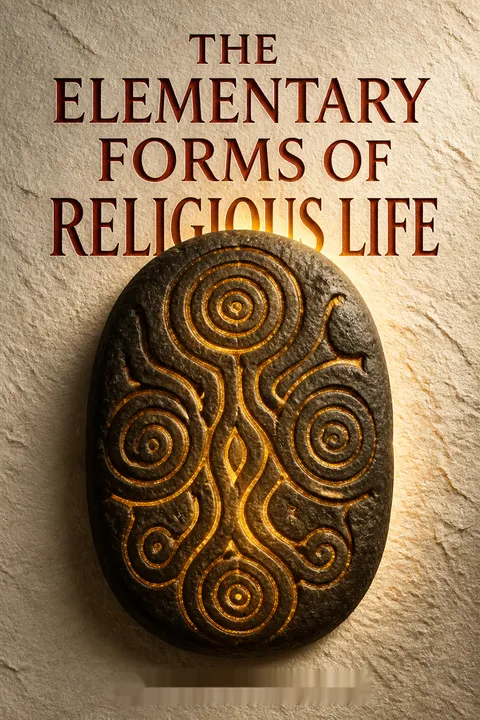
The emblem carries power. Totem images appear on bodies, objects, and ritual instruments such as the churinga, sacred pieces of wood or stone bearing totemic designs. Durkheim argues that the image can be more sacred than the animal itself: it is a visible, durable focus for the group’s shared feelings. The totem is therefore not simply an animal treated as a god; it represents the clan and the force the clan feels within itself.
The emblem matters because it gives a dispersed group a shared point of reference. A symbol can make belonging perceptible, portable, and memorable, rather than leaving it as a private feeling. Durkheim’s reading also clarifies why a plain design can carry more ritual weight than the animal it depicts. Still, a shared badge can mark exclusion as sharply as solidarity. The same symbol that gathers insiders may define outsiders, a tension that his emphasis on collective unity can leave in the background.
Gather people to make collective power tangible and emotionally real
The crowd changes the mood. Durkheim describes Australian communities alternating between dispersed daily work and gatherings for ceremonies. At a corrobbori, people sing, dance, cry out, and move together. The combined excitement can carry people beyond their ordinary emotional limits, leaving them with a sense of unusual energy and transformation.
Name the shared surge. Durkheim uses the term collective effervescence for the heightened energy produced when people assemble and affect one another. Since participants do not necessarily recognize society as the source of this force, they may attribute it to sacred beings or objects present at the ceremony. The experience is not imaginary, in his account; the mistaken part is identifying its source as something other than collective life.
This account explains why a ceremony can feel more powerful than a collection of private beliefs: coordinated attention and emotion produce an experience that no single participant creates alone. It also suggests why a group may need recurring gatherings rather than relying on old convictions to sustain themselves. The account is most persuasive when it describes shared intensity, less so when it assumes that participants experience it in similar ways. For some, collective excitement may mean belonging; for others, it may feel like pressure to conform.
Renew the group through ritual, even when its practical promise fails
The Intichiuma ceremony. Durkheim describes Central Australian rites intended to encourage the growth of a clan’s totemic animal or plant. In one version, participants visit sacred rocks associated with ancestors, scatter dust from the stones, or pour blood over them. Other ceremonies imitate an animal’s movements or recount ancestral journeys. Participants understand these actions as helping the species reproduce.
An effect beneath the stated aim. Durkheim argues that these ceremonies also renew the group’s shared beliefs and relationships. Their social effect does not prove their claimed physical effect; he treats the latter as the believers’ explanation of what happens. The rite’s emotional and moral consequences, however, are real within his account: people gather, reaffirm common traditions, and leave feeling strengthened.
The distinction between a rite’s stated purpose and its social effect is analytically useful. It allows a reader to take participants’ explanations seriously while asking what the ceremony accomplishes for the group. But it also risks explaining away those explanations by treating physical efficacy as mistaken and social cohesion as the hidden truth. A fuller account would ask how participants understand both effects, and how their own explanations shape the ceremony. Durkheim’s model is strongest as an account of additional social consequences, not as a replacement for local meaning.
See sacrifice as both shared nourishment and a gift to sacred powers
Two acts in one rite. Durkheim draws on the Australian ceremonies to explain sacrifice as more than a tribute offered to a god. The rite can combine communion, in which worshippers eat sacred food and take its power into themselves, with oblation, in which something is given to sacred beings. In some Intichiuma ceremonies, a leader and elders eat a small amount of the newly available totemic food before others may consume it freely.
Mutual dependence. The ritual expresses a relationship of exchange: people receive strength from sacred forces and also act to sustain them. Durkheim argues that the ceremony renews the worshippers and the social world those forces represent. Sacrifice is thus neither only a gift nor only a shared meal; it joins both actions.
This account avoids reducing sacrifice to a simple purchase of divine favor. It highlights how eating together can create a bond while giving something away can express dependence and obligation. The combination is recognizable in many forms of communal life, even outside explicit religious settings. Still, Durkheim’s emphasis on social renewal does not exhaust what sacrifice may mean to a participant, such as devotion, gratitude, or obedience to a deity. Those interpretations can coexist with its role in binding a community.
Notice how calendars and classifications borrow their structure from social life
Shared time and space. Durkheim argues that basic categories of thought are not merely private inventions. A calendar divides time according to recurring public activities, including ceremonies and festivals. In some communities he describes, the arrangement of clans in a camp corresponds to how people divide and orient the surrounding space.
Society supplies a framework. The book extends this argument to classes, number, cause, and other basic concepts. People can notice similarities and sequences individually, but a shared category gives those observations a stable form that others can use too. Durkheim’s claim is not that nature has no structure; it is that social organization helps people build common ways to recognize and organize that structure.
The argument makes familiar tools, such as calendars and spatial directions, look less inevitable and more like shared conventions built for coordination. It also explains how a common framework can make communication possible across individual experience. The claim should not be taken to mean that society invents time, space, or causality from nothing. Bodies and environments constrain how people experience them. Durkheim’s insight is narrower and stronger: societies give those experiences public divisions, names, and rules that individuals inherit.
Understand the soul as collective life made personal inside each person
From clan force to soul. Durkheim argues that the sacred force represented by a totem becomes individualized in each clan member. The soul is one way of imagining this shared principle as a personal presence inside a person. Ancestors and spirits develop as further versions of sacred forces, while some ancestral figures become gods associated with a whole tribe.
A social account of immortality. In the Australian beliefs he examines, souls may be understood as returning in new births. Durkheim interprets this as a way of expressing the group’s continuity despite the death of individuals. His point is not that the soul is simply a false idea, but that its sacred authority reflects the social life that individuals carry within them.
This is a striking account of the self as partly made from what it shares with others. Language, moral rules, and inherited ideas do not feel wholly private, yet they help shape personal identity. Durkheim’s explanation makes that shared dimension visible without treating individuals as mere copies of society. Its limit is the risk of reducing religious experience to social origin. Showing where an idea comes from does not determine whether it also refers to a reality beyond the group.
Use prohibitions to mark transitions into sacred roles, not just to forbid
Separation has an effect. Durkheim calls the system of religious restrictions the negative cult. It keeps sacred and profane things apart through rules about contact, food, speech, sight, work, and time. These prohibitions do more than prevent certain acts; they prepare people to enter the sacred domain.
The initiate is changed. In the Australian initiation ceremonies, a young person may be separated from ordinary life, restricted in food and speech, and subjected to demanding rites. The result is a new social and religious status: the novice becomes eligible to participate in ceremonies from which he was excluded. Durkheim treats asceticism as an intensified form of these restrictions, a discipline that trains people to endure renunciation and meet group obligations.
Restrictions can be productive as well as limiting: they signal that a role has changed and teach people how to act within it. That makes initiation more than a test of private belief; it is a public change in status. The account also invites scrutiny of who sets the rules and who bears their costs. Durkheim’s framework helps explain how boundaries sustain institutions, but it can make unequal or painful practices look socially necessary simply because they are effective.
Let public mourning turn private loss into a shared social obligation
Grief becomes collective. Durkheim describes Warramunga mourners crying, cutting their hair, injuring themselves, and gathering around the dying or dead. These acts follow social expectations rather than simply expressing each person’s private feelings. Mourning is a public duty through which the group recognizes its loss and responds together.
Ritual can repair. The shared display of sorrow intensifies emotion, but it also brings people into closer contact. Durkheim argues that this renewed solidarity helps restore the group after a death. He calls rites of sorrow or misfortune piacular rites. Their function is not limited to appeasing a dead person or reversing bad luck; the ceremony also helps a community reassemble itself around a rupture.
Durkheim’s account recognizes that grief has a social audience: rituals give loss a public form and make care and obligation visible. That can help explain why mourning practices persist even when people’s private emotions vary. Yet prescribed grief can also constrain mourners, especially when expectations differ by gender, kinship, or status. The framework is most humane when it explains the value of shared recognition without assuming that everyone must grieve in the same way or that painful customs are justified by social cohesion.
Analysis
Durkheim’s central move is to treat religion not as an intellectual mistake awaiting scientific correction, but as a durable social practice that both represents and renews collective life. The argument gains force by moving across scales: a totem links clan identity to a visible emblem; ritual gatherings turn shared feeling into an experience of external power; categories such as time and class make common thought possible. Religion becomes a bridge between social organization, emotional life, and the architecture of knowledge.
The theory is especially powerful when it distinguishes a ritual’s stated purpose from its social consequences. A ceremony intended to encourage rain or animal abundance can also reaffirm membership, transmit memory, and create confidence. These functions can coexist. Durkheim sometimes pushes the distinction too far, however, treating participants’ accounts of sacred efficacy as explanations to be replaced by sociology. A fuller interpretation would preserve local explanations as meaningful actions in their own right, rather than treating them only as symbolic coverings.
The book’s evidentiary base also demands care. Its Australian examples come through early twentieth-century ethnographic reports, framed by evolutionary assumptions about simpler and more advanced societies. Those reports support Durkheim’s analytical questions, but they do not warrant assuming that all Australian communities shared one religious system or that his account captures their full range of meanings. His model is most valuable as a theory of how collective life can become sacred, not as a universal template that makes every religion identical.
That distinction preserves the book’s lasting insight while limiting its reductionism. Social origins do not prove that religious claims are false, and social functions do not fully explain personal conviction. Durkheim shows why a community may need rituals, common symbols, and shared categories; he does not establish that these are the only sources of religious life. His strongest legacy is methodological: study what collective practices make possible, while resisting the urge to confuse a useful explanation with an exhaustive one.
Review Summary
Readers largely view The Elementary Forms of Religious Life as a foundational, though flawed, sociological work. Many praise Durkheim's insight that religion is fundamentally social, reflecting collective life rather than individual belief. His theory of the sacred versus profane and totemism as religion's elementary form is considered innovative. However, critics frequently note his Eurocentric and racist assumptions, his reliance on secondhand ethnographic data, and outdated methodology. Despite these shortcomings, most agree the book's core ideas remain applicable and influential across sociology, anthropology, and religious studies.
People Also Read

Glossary
Religion
Shared sacred beliefs and practicesDurkheim defines religion as a connected system of beliefs and practices concerning sacred things, meaning things set apart and protected by restrictions. These beliefs and practices unite adherents into a moral community, which he calls a Church. His definition does not require belief in gods or spirits.
Collective representations
Shared ideas expressing social lifeRepresentations formed through the cooperation of many minds across social life and generations. They express shared realities, including institutions and group identities, and are not reducible to any one person’s experience. Durkheim argues that they give common concepts their authority and help explain why basic categories of thought are socially shaped.
Sacred and profane
Separated domains of experienceDurkheim’s basic distinction between things set apart and protected by prohibitions, the sacred, and ordinary things, the profane. Sacredness does not depend on an object being a god or inherently powerful. The distinction organizes religious beliefs and practices by regulating contact between the two domains.
Totemic principle
Shared force represented by a totemThe impersonal sacred force Durkheim sees as central to totemism. It is represented by the totemic animal or plant, but is not identical to that species. The principle is present in the emblem, clan members, and related things, expressing the collective power that the group experiences and attributes to sacred forms.
Collective effervescence
Energy generated by group assemblyThe heightened emotional and mental energy Durkheim associates with people gathering and acting together. Shared songs, movement, and attention can make individuals feel transformed and subject to a power greater than themselves. Durkheim interprets this power as society experienced through collective life, often represented in sacred symbols.
Intichiuma
Totemic renewal ceremonyA term used in the book for Central Australian ceremonies associated with the reproduction or well-being of a totemic species. Descriptions include rites involving sacred stones, blood, imitation, and ritual consumption. Durkheim interprets these ceremonies as social as well as ritual events. The source notes that observers disputed the term’s precise meaning.
Negative cult
Rites of sacred separationDurkheim’s term for religious restrictions that keep sacred things apart from profane life. These rules may govern contact, food, speech, sight, work, or time. Though expressed as prohibitions, they can prepare people for sacred participation and help mark changes in religious or social status.
Piacular rites
Rites responding to loss or calamityDurkheim’s term for ceremonies performed in response to sorrow, misfortune, or threatening events. Mourning is a central example. Such rites may involve lament, bodily injury, or collective acts of atonement. Durkheim argues that they express shared distress and help restore social solidarity after a rupture.
About the Author
Other books by Émile Durkheim
Download PDF
Download EPUB
.epub digital book format is ideal for reading ebooks on phones, tablets, and e-readers.








