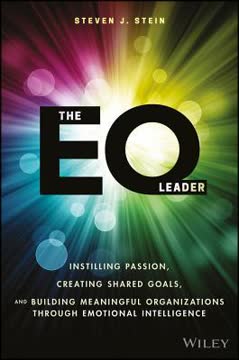
Key Takeaways
1. Emotional Intelligence is the Cornerstone of Modern Leadership
No doubt emotional intelligence is more rare than book smarts, but my experience says it is actually more important in the making of a leader.
IQ vs. EQ. For decades, cognitive intelligence (IQ) was considered the primary predictor of leadership success, influencing everything from school admissions to hiring. However, extensive research now reveals that IQ accounts for only 4-9% of job performance, leaving a vast majority unexplained. This highlights a critical gap: while book smarts are valuable, they don't fully equip individuals for the complexities of leading people.
Defining EQ. Emotional intelligence (EQ) encompasses the ability to perceive, understand, manage, and use emotions effectively, both in oneself and others. It's about "street smarts" – navigating social situations, understanding motivations, and responding appropriately. Unlike personality traits, which are relatively stable, EQ skills are dynamic and can be developed throughout one's life.
Predictive power. Studies consistently show that EQ is a stronger predictor of leadership performance than IQ. For instance, research found that emotional intelligence accounted for around 22% of job performance variance, compared to IQ's 19%. Employers increasingly recognize this, with surveys indicating that 71% value EQ over IQ, and 75% are more likely to promote high-EQ workers.
2. The Four Pillars: A Framework for High-EQ Leadership
By being authentic, supporting employees' needs, communicating with purpose, and fostering ingenuity, you can become a successful leader for the future.
Synthesizing leadership. Drawing from extensive literature and organizational surveys, a comprehensive Four-Pillar Model of successful leadership has been developed. This model distills the most critical dimensions of effective leadership into four interconnected competencies: Authenticity, Coaching, Insight, and Innovation. These pillars are not isolated traits but rather clusters of emotional intelligence skills that collectively drive leadership excellence.
Beyond traditional models. This framework moves beyond older leadership theories that often focused on command-and-control or purely transactional approaches. Instead, it emphasizes a transformative style, where leaders inspire, empower, and develop their teams. The model is designed to be applicable across diverse organizational contexts and leadership roles, from emerging leaders to seasoned executives.
EQ as foundation. Each of the four pillars is underpinned by specific emotional intelligence skills, demonstrating how EQ is not just a desirable trait but the fundamental building block for these leadership competencies. Developing these foundational EQ skills is the first step towards mastering the pillars and becoming a highly effective leader.
3. Authenticity: Be Real, Build Trust, and Inspire
An authentic leader serves as a role model for moral and fair behavior. A transparent approach commands esteem and confidence from employees.
The power of being real. In today's transparent, digitally connected world, authenticity is paramount. Leaders must be genuine, self-aware, and consistent in their public and private personas. This means acknowledging strengths and limitations, admitting mistakes, and leading with integrity, rather than projecting an infallible image.
Key EQ drivers: Authenticity is driven by several emotional intelligence skills:
- Self-Actualization: A continuous pursuit of meaning and personal growth.
- Emotional Self-Awareness: Understanding one's own feelings and their impact.
- Reality Testing: Maintaining an objective, grounded view of situations.
- Social Responsibility: Acting morally and promoting the greater good.
- Independence: Being self-directed and not swayed by popular opinion.
- Self-Regard: Possessing healthy self-confidence and self-acceptance.
Building trust. Authentic leaders foster trust and respect, inspiring employees to go the extra mile. They prioritize the organization's mission over personal ego, connect with their teams on an emotional level, and focus on long-term value. This approach contrasts sharply with leaders who are perceived as fake or self-serving, whose credibility quickly erodes.
4. Coaching: Empower and Develop Your Team
You get the best effort from others not by lighting a fire beneath them, but by building a fire within.
Shifting leadership paradigm. The traditional "tell-and-monitor" leadership style is giving way to a coaching approach. Modern workplaces thrive on collaboration and mentorship, where leaders empower employees to realize their full potential rather than merely policing tasks. This shift is crucial for fostering engagement and retaining talent, especially among younger generations.
Core coaching skills. Effective coaching leaders leverage specific emotional intelligence skills:
- Empathy: Understanding and appreciating others' feelings and perspectives.
- Interpersonal Relationships: Building strong, mutually beneficial connections.
- Assertiveness: Expressing thoughts and beliefs constructively.
- Emotional Self-Awareness: Regulating one's own emotions to maintain composure.
Impact on engagement. Organizations with strong coaching cultures report significantly higher employee engagement and revenue growth. Leaders who act as thought partners, ask open-ended questions, promote self-discovery, and provide resources create an environment where team members feel heard, valued, and motivated to achieve their best.
5. Insight: Communicate Purpose and Vision
I want to work for a company that contributes to and is part of the community. I want something not just to invest in. I want something to believe in.
Purpose-driven leadership. Insightful leaders articulate a compelling purpose, meaning, and vision for their organization, inspiring employees to exceed goals. This goes beyond a mere mission statement; it's about defining "why" the company exists and how it contributes to a greater good. This resonates deeply with employees, particularly Millennials, who seek meaning in their work.
EQ for inspiration. Key emotional intelligence skills underpin insightful leadership:
- Self-Actualization: Finding personal purpose and enjoyment in one's role.
- Optimism: Maintaining a positive, resilient outlook despite setbacks.
- Self-Regard: Projecting confidence and self-assurance.
- Social Responsibility: Demonstrating a commitment to ethical behavior and community.
- Interpersonal Relationships: Building strong connections to share the vision.
- Emotional Expression: Communicating passion and vision effectively.
Organizational benefits. A clear, inspiring purpose fosters higher engagement, motivation, and pride among employees. It also helps attract and retain top talent and makes the organization more resilient to market disruptions. Leaders like Anita Roddick of The Body Shop exemplify this, building global brands around strong social and environmental values.
6. Innovation: Embrace Risk and Foster Creativity
If you want to build a ship, don't drum up people together to collect wood and don't assign them tasks and work, but rather teach them to long for the endless immensity of the sea.
Driving future growth. Innovation is a top strategic priority for most executives, yet many lack confidence in their ability to foster it. Innovative leaders understand that success in today's fast-moving markets requires encouraging ingenuity, imagination, and autonomous thinking throughout the organization. This means defining innovation, integrating it into strategic plans, and setting clear metrics.
EQ for ingenuity. Innovative leadership is fueled by:
- Self-Actualization: A continuous drive for learning and growth.
- Independence: The ability to think and act autonomously, not swayed by popular opinion.
- Problem Solving: Tackling challenges head-on, leveraging emotions effectively.
- Assertiveness: Clearly articulating new ideas and defending them constructively.
- Flexibility: Adapting thoughts, emotions, and behaviors in response to change.
- Optimism: Believing in the potential for success despite setbacks.
Cultivating an innovative culture. Leaders must create a culture of trust where employees feel safe to propose new ideas and even to fail. This involves rewarding creativity, providing autonomy, and viewing challenges as learning opportunities. Steve Jobs, for example, drove Apple's innovation through passion, a vision for simplicity, connecting disparate ideas, and selling dreams, not just products.
7. Emotional Contagion: Leaders Set the Workplace Tone
These groups also displayed more cooperation, less interpersonal conflict and felt they'd performed better on their task than groups in which negative emotions were spread by the confederate.
Emotions are infectious. Emotions are not confined to individuals; they spread throughout a workplace, influencing mood, cooperation, and performance. This phenomenon, known as "emotional contagion," means that a leader's emotional state directly impacts the collective emotional temperature of the organization. A positive, enthusiastic leader can foster a productive and engaged environment.
Leader's impact. Leaders set the emotional tone, whether formal, friendly, anxious, or relaxed. Research shows that positive emotions are consistently linked to better performance, quality, and customer service, while negative emotions lead to poor performance and high turnover. The daily, small interactions are more influential than grand annual events.
Strategic emotional expression. Effective leaders understand the power of their emotional expression. While authenticity is key, it's also about using the right emotion at the right time. For instance, expressing sadness during a crisis can signal empathy, while anger might be perceived as a call to action (though less acceptable for female leaders). Leaders like Steve Jobs, despite his challenging personality, inspired loyalty by infusing passion and belief in the impossible.
8. Mastering Self-Perception: Know Thyself for Impact
Your visions will become clear only when you can look into your own heart. Who looks outside, dreams; who looks inside, awakes.
Beyond introspection. Self-perception in leadership goes beyond mere introspection; it's about truly "knowing thyself" in the Socratic sense – understanding your strengths, limitations, and how others perceive you. This comprehensive self-knowledge is crucial for effective leadership, as it informs decision-making and interpersonal interactions.
Key EQ components: This pillar integrates:
- Emotional Self-Awareness: Recognizing and understanding one's own feelings and their impact.
- Self-Regard: Accepting one's strengths and weaknesses, fostering healthy confidence.
- Self-Actualization: Pursuing meaningful goals and continuous self-improvement.
The 360-degree view. Leaders often have a different view of themselves than their subordinates, peers, and superiors. While some leaders underestimate their abilities (humble leaders), others overestimate them (overreporters). Leaders who accurately perceive themselves, or even underestimate their abilities, tend to be more effective. Self-aware leaders are more productive, as their clarity about their own emotions helps them regulate behavior and make better choices.
9. Leveraging Emotions for Better Decision-Making and Stress Management
We simply attempt to be fearful when others are greedy and to be greedy only when others are fearful.
Emotions are integral to decisions. The notion of making purely rational, emotionless decisions is a myth. Emotions, both incidental (unrelated mood) and direct (feelings about the decision itself), profoundly influence our choices. Neuroscientific research shows that emotions are critical for decision-making, with "somatic markers" (gut feelings) acting as shortcuts.
EQ for optimal choices. Effective decision-making and stress management rely on:
- Problem Solving: Using emotions to navigate complex issues.
- Reality Testing: Objectively assessing situations, free from emotional bias.
- Impulse Control: Resisting rash actions and delaying gratification.
- Flexibility: Adapting thoughts and actions to changing conditions.
- Stress Tolerance: Remaining calm and focused under pressure.
- Optimism: Maintaining a positive, resilient attitude.
Strategic emotional use. Leaders must learn to recognize their mood before making decisions, as happiness can lead to superficial analysis, while sadness can foster careful processing. High emotional arousal can impair memory and reasoning. The ability to "dial up" or "dial down" specific emotions, like empathy in a crisis or detachment in combat, is a hallmark of emotionally intelligent leadership.
10. Leadership Development is Measurable and Culturally Nuanced
My final conclusion is that we are in a position to make a major contribution to the organizational behavior and leadership literature. To date more than 90% of the organizational behavior literature reflects U.S.-based research and theory.
Assessing potential. Tools like the Emerging Leaders Profile (ELP) and Leadership EQ 360 provide multi-rater feedback on leadership competencies, offering crucial insights into how leaders are perceived by others. This data helps identify strengths and developmental needs, debunking the myth that most leaders universally overrate themselves; in fact, a significant portion either accurately rate or underestimate their EQ.
Global variations. Leadership effectiveness is deeply embedded in societal and organizational culture. The GLOBE study, a monumental cross-cultural research project, identified nine cultural dimensions and six leadership styles, demonstrating that what is considered effective leadership varies significantly across regions. For example, "performance-oriented" leadership is highly valued in Anglo cultures, while "self-protective" styles are more prevalent in some Middle Eastern contexts.
Adapting to diversity. Understanding these cultural nuances is vital for global leaders. Our EQ data shows variations in self-reported and observed emotional intelligence across GLOBE clusters, highlighting the need for culturally sensitive leadership development. Similarly, generational differences, such as Gen Z's lower scores in independence, problem-solving, and stress tolerance, require tailored approaches to coaching and management.
11. Entrepreneurial Success is Driven by Specific EQ Traits
The more empathic CEOs were more profitable.
Beyond business acumen. While technical skills and business savvy are essential for entrepreneurs, emotional intelligence plays a surprisingly significant role in their success, particularly in profitability. A study of entrepreneurial CEOs revealed that those with higher EQ, especially in specific areas, led more profitable companies.
Key EQ differentiators: Successful entrepreneurial CEOs often exhibit:
- Higher Self-Regard: Strong self-confidence and inner strength.
- Higher Self-Actualization: A deep sense of purpose and drive for personal growth.
- Higher Assertiveness: The ability to express ideas clearly and defend positions.
- Higher Independence: Self-direction and resilience against popular opinion.
- Higher Problem Solving: Effectively using emotions to navigate challenges.
- Higher Flexibility & Optimism: Adapting to change and maintaining a positive outlook.
- Higher Empathy: The most surprising differentiator, linking directly to higher profitability.
Challenges and opportunities. Interestingly, these CEOs often scored lower in Social Responsibility and Impulse Control, suggesting a willingness to make tough decisions or a tendency towards impatience. However, the ability to manage people-centric challenges (like hiring, training, and retention) was strongly linked to higher EQ. This highlights that while some traits might be lower, the overall EQ profile is geared towards driving business outcomes.
12. EQ Skills are Developable: Invest in Leadership Training
Improving emotional intelligence can have many benefits that go beyond the workplace. Leaders with high emotional intelligence tend to be happier, less stressed, and generally have a better quality of life.
The learnable advantage. Emotional intelligence is not an innate, fixed trait; it's a set of skills that can be learned, developed, and improved through focused effort and training. This makes EQ a powerful area for leadership development, offering tangible benefits for individuals and organizations alike.
Effective training. Organizations that invest in emotional intelligence training, especially when integrated with coaching, report significantly higher effectiveness in leadership development and positive revenue growth. A study with managers showed that EQ training led to increased EQ scores, improved morale, better quality of life, and reduced stress, even in challenging organizational climates.
Holistic benefits. Developing EQ skills not only enhances leadership performance but also contributes to personal well-being. Leaders with higher emotional intelligence tend to be happier, less stressed, and enjoy a better quality of life. This holistic improvement underscores the value of incorporating EQ development early in careers, even at college and university levels, to prepare future leaders for success.
Last updated: