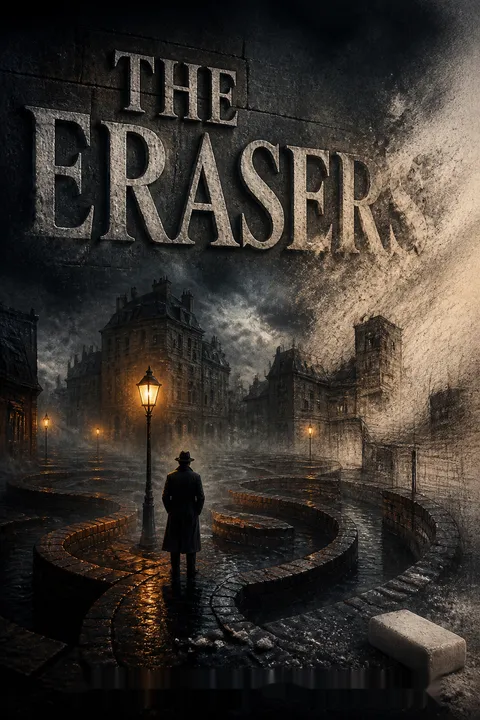


Plot Summary
Prologue
Before Wallas enters the case, the city seems to run on exact routines: a café manager sets out chairs, a canal bridge rises, and Garinati follows precise instructions into Daniel Dupont’s house. He is meant to shoot Dupont in a dark study, but the room remains lit and Dupont returns sooner than expected.
Garinati fires once and escapes, leaving the professor wounded. The café manager hears that Dupont is alive, while the newspapers report him dead. Across the canal, Garinati doubts his own failure and plans to return. The day begins with a crime that already has competing versions.
The opening establishes the book’s central instability through a practical mistake: a light left on alters the assassination, yet the public account immediately seals the event as a death. Routine appears to promise reliable order, but it cannot control what people see, remember, or report. Garinati’s careful procedure does not protect him from error; the newspaper’s certainty does not make its claim true. The prologue also teaches the reader to treat repetition as a source of doubt. The same morning, the same house, and the same wound will return in altered forms, making certainty itself part of the mystery.
Wallas Enters the Case
Wallas, a newly transferred investigator working under Fabius, reaches the provincial city after a late train journey and takes a room above the Café des Allies. His watch has stopped at 7:30, the reported time of the crime, and his first walk through the unfamiliar streets repeatedly bends him back toward the same landmarks.
At the police station, Commissioner Laurent says the local inquiry has been removed from his control and offers little confidence in a political conspiracy.
He gives Wallas the scattered evidence, including unidentified fingerprints and an account of the wounded man’s death. Laurent also notices a missing bullet in Wallas’s pistol, an unnerving detail that makes the new agent look like a suspect as well as an investigator.
Wallas’s assignment begins with an institutional problem as much as a murder: the authority that sent him has withheld information, while the local commissioner regards the case as someone else’s burden. The stopped watch makes the reported crime time physically present, but it gives Wallas no dependable measure of events. His professional confidence rests on procedures, routes, and evidence; the city immediately makes each of those unstable. Laurent’s attention to the missing bullet sharpens the irony: the investigator arrives carrying an object that could incriminate him. The case begins by weakening the ordinary distinction between observer and suspect.
Anna’s Bloodstained Carpet
At Dupont’s house, the deaf housekeeper, Anna Smite, first mistakes Wallas for a telephone repairman, then lets him enter through the back door. She insists Doctor Juard caused Dupont’s death, describing how her employer came downstairs with blood on his hand and claimed the wound was slight. She remembers carrying him to Juard’s clinic, then learning the next morning that he had died.
Anna has scrubbed the carpet and changed the bedspread, but points out where the blood had been. She also retrieves Dupont’s pistol from a drawer. One bullet has been fired, and Wallas takes the weapon as evidence. In the study, he finds Dupont’s unfinished writing, but no clear explanation of what happened.
Anna’s testimony is not simply unreliable because she is deaf or confused. She gives Wallas vivid domestic details, but her certainty about the doctor rests on suspicion, not on witnessing an attack. Her labor has erased visible evidence: she cleaned the carpet and bedspread because those tasks mattered more to her than preserving a crime scene. Wallas, meanwhile, must translate ordinary household care into forensic clues. The pistol and the missing page promise precision, yet neither explains who fired first or why. The house becomes an archive that has been tidied, rearranged, and partly destroyed by the people who lived in it.
A Witness Sees Wallas
A woman across the street, Madame Bax, initially denies seeing anything, then recalls a man in a raincoat interfering with the garden gate on the evening of the attack. She also remembers a drunk following him from the nearby café. Wallas questions the drunk, who recognizes him as the man he chased the previous night and describes a tight raincoat with a tear on the shoulder.
Wallas insists he was elsewhere, but his new face resembles the unknown visitor closely enough to unsettle the investigation. The café manager watches Wallas with growing suspicion and reports him as a lodger. The testimony gives the police a raincoat, a damaged gate, and a possible intruder, but it also makes their investigator resemble the suspect.
The witnesses do not provide a stable portrait of a criminal. Their descriptions converge on a coat and a route, while the person inside those details keeps changing. Wallas’s resemblance to the prowler turns evidence into a threat to his own identity: his alibi may be sound, yet it cannot make the witnesses’ recognition disappear. Madame Bax’s delayed memory also shows how observation is shaped by pressure. She tells more only after Wallas has supplied possible details, and she fears that suggestion could make her imagine what she did not see. The investigation begins to resemble a contest over who gets to author the evidence.
Bona Reassigns the Failure
In a bare room elsewhere in the city, Jean Bonaventure, known as Bona, waits for Garinati and reviews the planned campaign against a hidden political group. Garinati admits that Dupont returned to the study before he could turn out the light, forcing him to fire in haste. Bona dismisses the concern because his informants and the newspapers say Dupont is dead.
He refuses to let Garinati attempt the killing again, since that evening’s operation belongs to another agent. Garinati has also failed to keep track of Wallas, the special investigator sent from the capital. Bona orders him to find Wallas and report on his movements. Garinati leaves unconvinced, caught between his chief’s confidence and what he remembers seeing.
Bona’s authority depends on turning uncertain events into completed facts. He treats the newspaper report as proof and Garinati’s hesitation as weakness, because the organization cannot function if every operative reopens a settled decision. Garinati’s doubt, however, is not moral courage so much as a failure of confidence in his own senses. He remembers the shot but cannot tell whether it killed Dupont. The two men enact rival forms of certainty: Bona trusts systems and informants, while Garinati trusts a fragment of personal experience. Neither form is sufficient, and their disagreement keeps the supposed death active beneath the official story.
The Andre WS Letter
At the Rue Jonas post office, Wallas discovers that someone using the name Andre WS has received telegrams and pneumatic messages there. A clerk mistakes Wallas for that customer and hands him a message sent by J.B. It mentions a missing associate identified as G and requires Andre to complete work through the afternoon.
The text sounds like coded business, and Laurent argues that it may concern the city’s wood trade rather than murder. Post-office employees confirm that Andre resembles Wallas, wears a tight beige raincoat, and has a tear across one shoulder. Their accounts conflict about his glasses and habits. Wallas has acquired a clue, but by accepting the message he has also stepped into another man’s identity.
The letter offers the kind of clue a conventional investigation would welcome: a sender, a recipient, a deadline, and a missing associate. Yet its contents remain compatible with ordinary commerce, and the witnesses cannot agree on the recipient’s appearance. Wallas’s accidental receipt of the message is more consequential than its wording. The resemblance between him and Andre makes identity a practical vulnerability, not an abstract puzzle. The post office turns anonymity into a service that can be rented, while its clerks unwittingly help a stranger borrow another person’s place in the city. Evidence accumulates, but its meanings multiply rather than narrow.
Marchat Expects His Turn
Adolphe Marchat, a cautious businessman acquainted with Dupont, visits Laurent and says he has been asked to retrieve important files from Dupont’s house. He fears the group that attacked Dupont will kill him at the same appointed hour. Marchat claims Doctor Juard overheard the plan and alerted the conspirators, though he cannot say exactly what he heard.
Laurent dismisses the larger conspiracy and suggests that Dupont may have killed himself. Marchat interprets the commissioner’s skepticism as proof that the police are compromised. Rather than go to the house or warn Dupont, he leaves the city with his family. His flight removes the person meant to retrieve the papers and leaves Wallas to decide whether the threats are real.
Marchat’s fear is persuasive precisely because it produces practical consequences: he abandons a task, distrusts the police, and disappears. But the story gives no clean test of his claims. Laurent’s skepticism may be sound, or it may be the response of an official who has learned to protect himself by refusing the unfamiliar. Marchat’s retreat also changes the case materially. Dupont’s papers remain in the house, and the man who might have explained their importance is gone. Fear here is neither proof of danger nor mere delusion. It is an action that creates the conditions it was meant to escape.
Laurent Builds a Suicide
Laurent repeatedly tests the possibility that Dupont shot himself, while the laboratory finds that Dupont’s pistol jammed after one shot. A junior inspector’s report offers a different reconstruction: two intruders entered the study, one familiar with the house, and one stronger man who disabled the gate buzzer.
The inspector suspects Dupont recognized them and suggests the weaker visitor was an estranged illegitimate son seeking money. A paperweight bears a set of fingerprints that may indicate a struggle.
Wallas sees how the report turns small traces into a complete family drama, while Laurent treats the jammed pistol as support for suicide. Neither account can be checked against the missing body, and every new detail serves more than one story.
The report demonstrates how investigative reason can become narrative invention. Footprints, a damaged buzzer, and a moved paperweight are physical facts, but the inspector’s account converts them into motives and relationships that the evidence cannot establish. Laurent performs the same operation in the opposite direction, arranging the jammed gun around a suicide theory. Their disagreement is not simply between a good detective and a bad one. Both are trying to make fragments cohere, and both risk mistaking coherence for truth. The missing body is crucial: without it, the case has no final material authority to arbitrate between competing explanations.
Evelyne Remembers Dupont
Wallas recognizes the stationery seller as Evelyne, Dupont’s former wife, and asks what their marriage was like. She describes a man devoted to his books and work, almost entirely comfortable in a life of solitude. Dupont, she says, made decisions carefully and rarely changed them; she saw no sign that he was preparing to kill himself.
Her account weakens Wallas’s attempt to settle on suicide, but it offers no alternative culprit. Later, a shabby man in a green coat enters her shop and buys a postcard showing Dupont’s house. Wallas sees the same stranger outside but loses him in the streets. The photograph links the house to someone watching it, without revealing what that person intends.
Evelyne’s testimony complicates the psychology Laurent’s theory requires. A solitary life can resemble despair from the outside, but she remembers Dupont as purposeful rather than defeated. Her account does not prove he could not attempt suicide; it challenges the ease with which others assign him motives. The green-coated stranger introduces another kind of uncertainty. He studies a picture of the crime scene, then vanishes before Wallas can question him. The postcard makes observation portable: the house can be carried away as an image, stripped of its occupants and context. Wallas gains a witness to the mystery but not a witness he can hold.
A Postcard Sets Seven-Thirty
A postcard bearing a photograph of Dupont’s house reaches Laurent with an unsigned warning about a meeting at 7:30. Wallas has obtained the same image from Evelyne’s shop, and the overlap persuades him to take the message seriously despite its uncertain source. Doctor Juard meets Wallas at the station but repeats the account of a burglar and a fatal wound instead of explaining his evasions.
His caution leaves Wallas without a clear ally. Elsewhere, Dupont is still alive in Juard’s clinic, recovering from his wound. When Marchat fails to return with the files, Dupont disguises himself with a hat and mismatched glasses, then accepts a ride back to his house to collect them himself.
The postcard is powerful because it appears to connect separate strands, yet its origin remains unknown. Wallas treats coincidence as a reason to act, not as proof that he understands the plot. Juard’s evasive help intensifies the danger: he seems to know more than he will say, but his silence could arise from fear, complicity, or both. The reader receives a crucial fact that Wallas lacks: Dupont is alive and moving toward the house. Dramatic irony replaces the expectation of a single investigator’s discovery. Two men are now approaching the same room with incompatible assumptions about who is waiting there.
Wallas Fires First
Inside the house, Wallas waits in Dupont’s darkened study, revolver ready. A visitor enters through the back, searches the rooms, and comes upstairs carrying a weapon. When he reaches the study door, light floods the room and Wallas fires. The man falls before Wallas can establish who he is.
Wallas finds mismatched glasses and an injured arm, details that resemble the accounts of the raincoated prowler, but the dead man’s identity remains uncertain. His own watch, stopped at 7:30 throughout the day, begins ticking again. Wallas calls Laurent, who interrupts with a discovery of his own: Dupont is not dead. The two revelations do not resolve each other; they leave Wallas beside a body and a new contradiction.
The climax converts the investigation’s central errors into immediate violence. Wallas acts on a warning whose source he cannot verify, while the visitor enters a house where a supposed corpse is expected to be absent. The injured arm and unusual glasses seem to identify the man, but neither can settle the question of who fell. The watch restarting offers no moral or forensic clarity; it only makes the stalled hour move again. Laurent’s call arrives too late to prevent the shooting and too early to explain it. The case reaches a physical consequence without reaching a stable account of what happened.
Epilogue
After an exhausting night with Laurent, Wallas returns to the café and prepares to leave the city. Garinati arrives looking for him, but slips back outside without going upstairs. He believes he has confirmed Dupont’s death by finding a body in a clinic, though the reader cannot know whether that body settles the mystery.
The café manager hears of another Dupont, Albert, killed in a separate incident, and struggles to distinguish the new report from the earlier one. Wallas cannot find his return ticket, the last proof of when he arrived. The manager resumes his morning routine as the city begins another day of uncertain identities.
The epilogue refuses to let the climax become a clean solution. Garinati remains active after Wallas has shot a man, and his confidence that he saw Dupont’s corpse does not agree neatly with Laurent’s discovery. The new report about Albert Dupont extends the confusion through a name shared by separate events, while Wallas loses the ticket that could verify his own arrival. The café manager’s routine returns, but the objects and people moving through it carry unresolved histories. The ending does not merely leave a mystery unsolved; it shows how institutions and individuals keep producing confident versions of events despite their inability to distinguish one event from another.
Analysis
The Erasers treats detection as a struggle not only to discover facts but to decide which account of facts will count. Its city is built from repeated streets, standardized offices, clocks, routines, and procedures, yet those structures do not produce dependable knowledge. The same visual details recur in different contexts: a torn coat points toward a prowler, a familiar face makes Wallas look guilty, and a wound supports incompatible stories of suicide and murder. Institutions respond by making narratives. Laurent prefers explanations that fit the police files; Bona enforces the organization’s timetable; Wallas searches for a flaw that will turn fragments into proof. Each method can organize evidence, but none can guarantee that its organization is true.
The novel’s repetitions make this epistemological problem bodily. Wallas walks routes that seem to return him to their beginnings, while his watch fixes him at the very hour the case should be moving beyond. The missing corpse prevents the most basic forensic act of recognition, and the final shooting converts interpretive failure into physical consequence. Wallas believes he is defending himself, but the identity of the man he kills remains unresolved. The climax therefore refuses the reassuring shape of a detective story in which correct knowledge arrives just before action. Here, action arrives first, and knowledge follows too late to reverse it.
The title’s erasure suggests an impossible desire: to remove the mark of an event and restore a clean surface. Anna cleans the blood, officials suppress the inquiry, and the organization treats a reported death as settled. Yet traces return as fingerprints, paper messages, photographs, memories, and bodies whose identities cannot be confirmed. The book’s deepest warning is not that truth is inaccessible in principle, but that people often mistake a coherent version for a verified one. When institutions reward certainty and individuals fear ambiguity, error acquires the authority of fact. The novel leaves readers inside that interval, where every account is plausible and none is safe.
Review Summary
The Erasers receives praise for its experimental structure and maze-like narrative that blurs reality and perception. Reviewers highlight Robbe-Grillet's obsessive attention to physical details and objects, his circular plot structure, and connections to the Oedipus myth. The novel is described as a deconstructed detective story where the investigation itself matters more than solving the crime. While some find it brilliant and groundbreaking, others struggle with its dense, repetitive descriptions and lack of traditional narrative flow. Most agree it's a challenging but rewarding introduction to the nouveau roman movement.
People Also Read



Characters
Wallas
Probationary investigatorWallas is a young agent newly assigned to Fabius’s investigative service, where his first major case may determine whether he keeps his post. He is observant, methodical, and proud of his ability to move through unfamiliar places by building a continuous account of them. The city frustrates that method: streets return him to familiar corners, witnesses confuse him with another man, and his watch stops at the reported crime hour. Wallas wants evidence to lead toward a solution, yet he is also vulnerable to the pressure of making each fragment fit. His steady professional manner masks a deeper uncertainty about whether he can trust his perceptions or his place in the investigation.
Daniel Dupont
Missing political economistDupont is a former law professor and political economist who lives among the books and papers in his house. He has written about the organization of industry and has ties to influential people, though he keeps a narrow, private life. His first wife remembers him as disciplined, rational, and difficult to reach emotionally. The housekeeper knows his daily habits better than his inner life, while the investigators struggle to understand his wound and reported death. Dupont’s character is defined by control: he values planned decisions, protected privacy, and work that he believes others have not fully understood. Those qualities make him hard to interpret from the outside.
Garinati
Unsteady operativeGarinati works under Bona in a clandestine organization and is assigned to carry out an operation against Dupont. He follows detailed instructions but becomes preoccupied with the points where the plan can fail, including the light in the study and the timing of Dupont’s return. His unease is practical rather than principled: he wants to know whether the target survived and whether his own performance has endangered him. As the investigation develops, he is ordered to keep track of Wallas, placing him close to the very agent who may uncover the organization.
Jean Bonaventure
Commander of the cellKnown as Bona, Jean Bonaventure directs the local operation and treats its schedule as more reliable than the doubts of the people carrying it out. He dismisses Garinati’s uncertainty by trusting reports from his informants and shifts attention to the next planned action. Bona’s emotional discipline is a form of command: he keeps questions from spreading because a clandestine network depends on coordinated belief. His calm makes him appear formidable, but it also leaves him exposed to the possibility that the facts he accepts have been manufactured or misunderstood.
Commissioner Laurent
Skeptical local chiefLaurent leads the city police and has spent years learning the criminal networks and informal arrangements that shape local investigations. He is courteous, ironic, and reluctant to accept a conspiracy that cannot be tested against his files. The transfer of the case wounds his authority, but he also welcomes the chance to let another service carry the risk. Laurent’s skepticism is neither simple incompetence nor pure wisdom. He sees how easily investigators invent motives from fingerprints and footprints, yet his preference for ordinary explanations can make him discount evidence that does not fit the systems he knows.
Doctor Juard
Cautious surgeon and confidantJuard is a physician who treats Dupont and has known him since their student years. His hesitant manner makes almost every answer sound evasive, whether he is protecting himself, a friend, or information he believes dangerous to reveal. He is skilled enough to operate on the wounded professor, but his professional role entangles him in the official account of the injury and death. Juard’s caution is shaped by fear of being drawn deeper into a conflict he cannot control. He would like help from the authorities, yet he does not trust that they can protect him.
Adolphe Marchat
Frightened courierMarchat is a businessman connected to Dupont and asked to collect important papers from the professor’s house. He is anxious, self-protective, and uncomfortable with political danger, especially when he believes the police may be compromised. His fear makes him search for explanations in every hesitation and glance. Although he wants to be useful to Dupont, he cannot make himself trust the assignment or the people around it. Marchat’s choices expose the gap between accepting responsibility in theory and acting when the risk becomes immediate.
Evelyne Dupont
Former wife and booksellerEvelyne, once married to Dupont, now runs a stationery shop. She is perceptive about her former husband’s habits and can distinguish his solitude from the despair others project onto him. Their marriage failed because Dupont seemed content in a life organized around work and thought, leaving little room for ordinary attachment. Evelyne’s memories are not offered as a complete explanation of him; she knows his daily character but cannot claim access to every private decision. Her shop also places her among the ordinary objects that become clues in Wallas’s investigation.
Anna Smite
Deaf housekeeperAnna Smite has served Dupont for years and knows the routines of his house, from his meals to the doors he uses. She is hard of hearing, blunt, and more concerned with practical household matters than with the investigators’ theories. Her account contains important observations, but she interprets them through her own suspicions, especially her dislike of Doctor Juard. After the shooting, she cleans the blood and prepares to leave for her daughter’s home. Anna’s efforts to keep the household in order both preserve details and remove traces Wallas might have examined.
The Café Manager
Suspicious innkeeperThe manager of the Café des Allies rents Wallas a room and watches his movements with open suspicion. He takes pride in catching people out and treats a guest’s failure to fit local expectations as evidence of concealment. His memory of the neighborhood is mixed with old grievances and half-remembered stories, making him a useful observer but an unreliable interpreter. The café is his territory, and he reacts to Wallas as an intrusion into its established routines.
The Drunk
Riddle-loving witnessA regular at the Café des Allies, the drunk man drinks, tells riddles, and pursues strangers who do not want his company. His memory comes in broken, comic fragments, but he can identify the raincoat and the man he followed from the café. Alcohol makes his testimony difficult to manage, not automatically worthless. He moves between being ignored as a nuisance and becoming the investigation’s most revealing witness.
Madame Bax
Window-side witnessMadame Bax lives in the apartment building opposite Dupont’s house and often watches the street from her window. She initially withholds a memory of a man at the garden gate, then offers it after Wallas describes possible sounds and movements. She is polite and composed, but uneasy about sending someone to the police. Her testimony reflects the uncertain border between remembering an event and reconstructing it under questioning.
Fabius
Wallas’s distant chiefFabius heads the investigative service that employs Wallas and sends him to the provincial city. He is respected for persistence and a talent for noticing weaknesses in easy conclusions, though colleagues also see him as excessively skeptical. His advice favors discretion and unobtrusive observation. Fabius remains mostly outside the immediate action, but his reputation shapes Wallas’s understanding of the profession and the standards by which he fears he will be judged.
Juliette Dexter
Post-office clerkJuliette Dexter works at the Rue Jonas post office and handles the poste restante correspondence associated with Andre WS. Serious and attentive, she recognizes how closely Wallas resembles the regular customer. Her testimony provides useful details about the man’s visits, though she cannot explain what his messages mean.
Emilie Lebermann
Curious postal clerkEmilie Lebermann works beside Juliette Dexter and is more excited by the prospect of scandal than her colleague. She remembers details about Andre WS’s glasses and clothing that Juliette disputes. Her confidence illustrates how a witness’s certainty can exceed the reliability of her memory.
Madame Jean
Former temporary clerkMadame Jean once worked temporarily at the post office and is summoned because she may have handled Andre WS’s mail. She found the postal system’s procedures confusing and prefers domestic work. Suspicion makes her guarded when Wallas appears at the police station, though she has little concrete information to offer.
Antoine
Argumentative café regularAntoine is a neighborhood regular who argues with a pharmacist about words, routes, and the weather. He is eager to be right and quick to recruit the room as his audience. His small disputes echo the city’s larger confusion over how to interpret the same facts.
Plot Devices
The stopped watch
Time loses its footingWallas’s watch stops at 7:30, the reported hour of Dupont’s attack, and remains fixed through much of the day. The stopped watch makes the crime’s appointed time a physical presence, while Wallas’s unreliable sense of direction and the repeated street layouts loosen his confidence in sequence. The watch eventually starts ticking again after the shooting, but that movement does not clarify what has happened. It functions less as a clue than as a pressure on the reader’s sense of chronology, making the case feel as if it is circling an hour it cannot escape.
The eraser
A clue that cannot eraseWallas repeatedly searches stationery shops for a particular soft, crumbly eraser, while the sellers offer ordinary substitutes. The object becomes a small, concrete refrain inside a story crowded with larger mysteries. Its purpose is never reduced to a conventional clue that unlocks the crime. Instead, it gives Wallas a persistent private pursuit and reflects the book’s interest in revision: people try to rub away inconvenient evidence, but the traces remain, shift, or return in altered form. The failed search also interrupts the investigator’s forward motion, turning an ordinary purchase into another episode of delay and uncertainty.
The absent body
Death without verificationDupont is reported dead, but the local police never examine a body, and the central authorities remove it from the ordinary investigative process. This absence allows several accounts to coexist: suicide, assassination, a failed attack followed by a concealed survival, and a politically useful false report. Laurent’s theories, Anna’s testimony, Juard’s medical account, and Garinati’s confidence cannot be tested against a shared physical fact. The missing body is not merely a concealment tactic. It is the central gap that makes the investigation’s competing narratives possible and keeps the reader from treating any official conclusion as final.
Andre WS
Identity becomes evidenceThe poste restante account under the name Andre WS lets a secretive customer receive telegrams and pneumatic messages without using an ordinary home address. Wallas is mistaken for the customer because the two men resemble each other, and the clerk gives him a message intended for the other man. Clothing, glasses, a shoulder tear, and a shared face become tools for identifying someone, but each description is disputed. The device turns anonymity into an operational advantage and makes mistaken identity part of the evidence rather than a simple disguise.
The house postcard
A crime scene circulatesA photograph of Dupont’s house appears in Evelyne’s shop, is bought by a strange visitor, and later reaches Laurent as an anonymous warning about a 7:30 meeting. Wallas also obtains a copy. The image lets the house travel beyond its garden fence, turning a private location into a repeatable scene that can be studied, sold, or used to direct someone back there. Because no one can establish who sent the warning or why, the postcard both focuses Wallas’s attention and deepens his uncertainty. The picture resembles evidence, but it cannot certify its own meaning.
Download PDF
Download EPUB
.epub digital book format is ideal for reading ebooks on phones, tablets, and e-readers.








