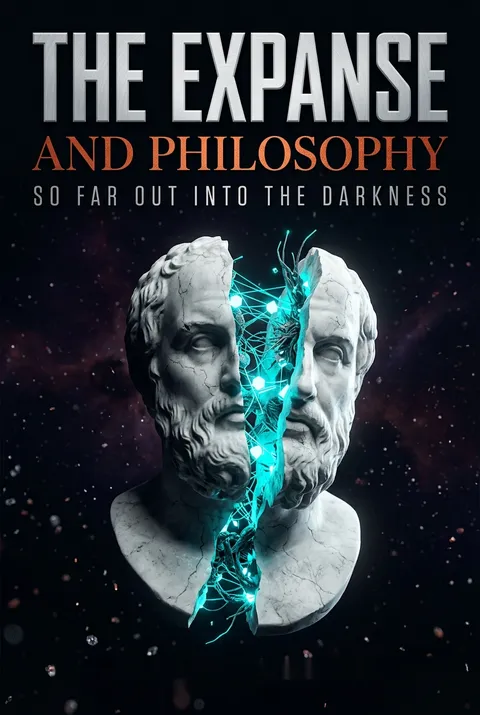


Key Takeaways
Let cosmic scale humble you, but do not mistake smallness for insignificance.
Space changes the question. The series makes the vastness of the universe feel ever-present, from dark-framed planets to characters walking outside their ships. Pascal saw such immensity as evidence of human insignificance and a reason to seek faith. Kant offered a different reading: facing something too vast to comprehend can reveal human freedom and dignity. He called the awe inspired by immense scale the mathematically sublime, and awe at overwhelming natural force the dynamically sublime.
Miller, a Belter who fears open space, nevertheless pursues Julie’s story beyond his station-bound life. Holden repeatedly acts without knowing whether the stakes or outcomes are fully understandable. Their choices suggest that uncertainty does not erase responsibility or make action pointless.
The chapter’s useful move is to turn cosmic awe into a question about conduct: what should people do when they cannot grasp the whole system? That connects the sublime to decision-making under uncertainty, where waiting for perfect knowledge can itself become a choice with consequences. The Kantian answer is more interpretive than demonstrative, however. Feeling awe does not prove that human beings possess freedom. The stronger insight is practical: a universe that offers no guarantee of significance still leaves room for humans to create meaning through their actions.
Treat extinction as the loss of humanity’s entire unfinished future.
The future dwarfs the present. Derek Parfit’s thought experiment contrasts peace, a war that kills 99 percent of humanity, and one that kills everyone. The final outcome is worse not only because more people die now, but because no future generations can exist. The chapters argue that human history could contain far more lives and achievements than the brief span already lived. In this sense, extinction destroys an unfinished possibility, not merely a population.
The Ring System offers 1,300 routes to potentially habitable worlds, making expansion far faster than a generation ship’s century-long trip to Tau Ceti. But the protomolecule’s dangers, including the apparent extinction of its creators, support Avasarala’s caution. A vast potential future does not make every risk worth taking.
Long-term thinking corrects a familiar bias: immediate casualties are easier to picture than generations who never get to exist. Yet future value cannot be counted as a blank cheque against people alive now. The Ring debate is compelling precisely because both sides identify real stakes: deprivation in the present and catastrophic loss across time. A sound decision needs more than a huge projected benefit. It also needs a credible account of risk, uncertainty, and who is asked to bear the danger.
Do not call a new frontier empty before asking who already lives there.
Expansion carries old habits. Earth’s damaged ecosystems and polluted ocean show that human ingenuity can manage environmental harm without correcting the worldview that produced it. Mars’ terraforming project and the Ring colonies then risk exporting the same assumption: land and resources are available for human use if they appear lifeless or politically unclaimed.
Ilus makes the problem concrete. Belter settlers arrive first, but an Earth-backed corporation claims the planet and treats them as trespassers. The planet also has native life, making colonization an ecological question as well as a political one. The chapters distinguish spreading Earth life to genuinely lifeless places from displacing existing life or communities. The first may protect biodiversity; the second repeats colonial extraction and dehumanization.
The frontier metaphor can make appropriation sound like discovery, while treating an ecosystem as empty simply because it lacks familiar inhabitants. This analysis usefully joins environmental ethics to political history: decisions about what counts as valuable life influence who gets protected. It also leaves room for distinctions. Preserving a native biosphere, protecting human settlers, and avoiding planetary contamination can conflict, and there is no simple rule that resolves every case. The key demand is to recognize those competing claims before naming a place available for development.
Hold decision-makers responsible, even when no single hand fires the weapon.
Atrocity can look ordinary. Hannah Arendt’s phrase banality of evil does not mean that an atrocity is trivial. It describes how grave harm can be enabled by people who stop thinking critically about their duties and accept the moral language of a system. Jules-Pierre Mao is not a cartoon monster: he loves his daughter and briefly objects to experiments on children. Still, he authorizes the protomolecule project and repeatedly returns to its promised benefits.
Scientists such as Dresden defend mass death as a small price for knowledge that might help humanity. The Milgram obedience experiments, discussed in the chapter, illustrate how authority can lead ordinary people to act against their own moral discomfort. Distance, job titles, and good intentions do not erase responsibility for foreseeable harm.
The chapter punctures the comforting idea that only sadists commit terrible acts. Institutions can divide a harmful project into tasks so that each participant sees only a narrow, respectable job. That makes reflection and accountability more important, not less. The Milgram experiments illuminate obedience, but they should not be treated as a complete explanation of genocide or as proof that every person will comply. The durable lesson is narrower and stronger: following procedure is no substitute for judging what the procedure is doing to other people.
Choose moral guides carefully, then keep asking why they are right.
Amos knows his limits. His violent instincts and emotional distance initially make him seem amoral. The chapter connects his difficulty with empathy and decision-making to a childhood shaped by abuse and danger. Neuroscientist Antonio Damasio’s work, as presented here, suggests that emotion helps people make choices by marking options as attractive or dangerous. Amos lacks some of that internal guidance.
Instead, he relies on people such as Naomi and Holden, but not blindly. He wants to understand their reasoning and changes his trust when their actions disappoint him. He can kill without pleasure or revenge, as when he shoots Strickland to stop further harm. Nietzsche’s account of master and slave morality helps explain why Amos does not fit a simple good-or-evil label, but the chapter cautions that he is not Nietzsche’s ideal of human transformation.
Amos complicates the assumption that moral behavior must spring from warm feelings. Empathy can make another person’s suffering vivid, but careful judgment, loyalty, and a willingness to check one’s reasons also matter. His reliance on trusted guides resembles distributed decision-making: people can compensate for individual blind spots by consulting others. The danger is obvious too. A trusted guide can be wrong, and loyalty can excuse harm. Amos’s habit of asking for reasons is therefore more important than simply having someone else decide.
In lawless spaces, preserve restraint before fear makes every war seem justified.
Anarchy is not a moral blank. The Canterbury crew faces a distress call, a possible pirate trap, and the loss of a bonus if they investigate. International rules exist, but no central authority guarantees enforcement. Navigator Ade Nygaard appeals both to shared obligations and to the chance that the crew may someday need help. Holden ultimately acts because ignoring the call would violate his sense of what a human being owes another.
Just war theory offers limits on force: fight only in self-defense against attack or imminent threat, after serious efforts at diplomacy; distinguish combatants from civilians; treat prisoners humanely; keep force proportionate; and do not justify atrocities by appealing only to good outcomes. The chapters use these principles to challenge leaders who turn uncertainty into a pretext for war.
The scenario shows why law and morality are related but not identical. If rules rely on voluntary enforcement, a crew can evade them while still understanding that its choices help shape future cooperation. Just war theory gives public language for judging force, rather than leaving each leader to invent a convenient excuse. Its limits deserve attention: terms such as imminent threat and proportionality can be manipulated by those in power. The framework is most useful when its application is scrutinized as closely as the decision to fight.
Oppose oppression without letting liberation become a license to rule.
Grievance does not settle means. The Belt’s anger grows from real exploitation: its people supply resources while facing poverty, discrimination, and disregard for their lives. Frantz Fanon’s account of anticolonial struggle helps explain why resistance can be experienced as a way to break the colonizer’s claim to superiority. The chapter on terrorism adds a hard question: attacks on civilians use victims as instruments to pressure a government, even when the cause is liberation.
Marco Inaros embodies the danger. He invokes Belter suffering while killing civilians and demanding power. Orwell’s distinction helps separate defensive patriotism, which can love a home without demanding domination, from nationalism, which subordinates reality and other duties to the nation. Drummer and Naomi resist the idea that one leader speaks for all Belters.
These chapters do not offer a tidy verdict on violence. One argues that anticolonial violence can shatter a political order built on dehumanization; another emphasizes the innocent people made into tools by terrorism. Holding both claims together prevents two errors: treating the status quo as peaceful simply because its violence is normalized, and treating a just grievance as proof that any tactic is legitimate. A further test is whether resistance creates shared political agency or merely installs a new authority over the people it claims to free.
Judge leadership by ability, not by a gender script centuries old.
Avasarala faces a double standard. As she campaigns against Nancy Gao, advisers urge her to appear more nurturing and less forceful. Avasarala’s experience and bluntness, traits that might signal authority in a man, are treated as liabilities in a woman. The chapter traces this expectation to influential philosophical traditions, including Aristotle’s argument that women were naturally suited to obey rather than govern, and later claims that women lacked the capacities required for leadership.
Gao’s calmer, more familiar public image fits the expected maternal role, while Avasarala is portrayed as difficult and unpredictable. Their fictional election exposes how voters can judge a woman’s style and demeanor more harshly than her record, especially when she admits an error instead of pretending to be infallible.
The historical examples make clear that political norms are not neutral descriptions of leadership. They can be inherited arguments about who is fit to rule, disguised as common sense about personality. A useful question is whether voters are evaluating a candidate’s decisions or reacting to a violation of gender expectations. The comparison should not imply that every criticism of a woman leader is sexist, or that experience guarantees good judgment. It does show why identical conduct can carry different costs depending on who performs it.
Read Naomi’s reversals as navigation across overlapping identities, not fickleness.
One person can inhabit many worlds. Kimberlé Crenshaw’s term intersectionality names how systems such as racism, gender discrimination, and class inequality can overlap in a person’s life. Naomi is a Belter, a woman, a mother, and a crewmate among Inners. Those positions place conflicting demands on her. Giving the protomolecule to Fred Johnson can serve Belter interests while damaging Holden’s trust; leaving Marco can protect her life while separating her from Filip.
The related idea of multiplicitous subjectivity describes a self shaped by several social contexts at once, rather than a single hidden identity. Naomi’s choices may look inconsistent from the outside because each choice answers a different pressure. Her new bonds aboard the Rocinante give her a way to resist without surrendering every part of herself.
Naomi’s story cautions against reading a person’s actions through a single loyalty, especially when the available choices are constrained by oppression and intimate control. The concept also changes how betrayal is interpreted: leaving a group can be self-preservation, political dissent, or both. This does not make every decision beyond criticism. It asks critics to examine the conditions that made the options possible, and whose interests are treated as the default. New solidarities can widen a person’s choices, though they cannot erase the costs of past harm.
Risk public conversation instead of trying to engineer every outcome.
Politics can begin with speech. Hannah Arendt distinguishes making politics, strategic action designed to control results, from doing politics, speaking and acting with others to build a shared world that no one can fully control. During the Ganymede evacuation, Naomi leaves a ship that could carry only a fraction of the desperate crowd. She explains the limits and proposes saving the youngest. Her decision to address people as partners, rather than as a problem to manage, makes cooperation possible.
Naomi still uses strategy and accepts some force, including sedating Amos when he tries to stop her. The point is not that calculation is always wrong. It is that treating control as the only political goal can erode the very relationships and habits needed to live together.
The scene makes communication more than a tool for getting consent: speaking publicly acknowledges other people as agents who can help shape a response. That is a valuable counterweight to expert rule and crisis management. But dialogue is not a substitute for safety or power-sharing. Naomi’s audience could have rejected her, and physical force still helps secure the plan. The example works best as a reminder to preserve spaces for participation, not as a promise that a courageous speech will dissolve conflict.
Learn the context behind words before assuming translation creates understanding.
Words carry social history. Wittgenstein’s language game model treats meaning as something shaped by the activity and context in which words are used, not just by the images they name. Calling Holden’s ship the Tachi or the Rocinante points to the same vessel, but signals different claims about ownership and legitimacy. Belter Creole likewise carries experiences that a dictionary cannot supply.
The chapters distinguish knowing what someone says from understanding the world that gives the words their force. Inners may understand a Belter’s statement that the Belt is oppressed without grasping the lived context behind it. The same gap runs in reverse when Belters treat Earth and Mars as a single, undifferentiated power.
This account explains why translation alone cannot repair political distrust. Shared vocabulary can carry incompatible assumptions about ownership, safety, and justice. Yet the argument should not turn difference into permanent incomprehensibility. The series’ relationships across the crew suggest that shared work and sustained attention can create some common context, even without full agreement. Understanding is less like finding a perfect dictionary and more like learning how another person’s words function in their life.
Analysis
The volume uses The Expanse as a laboratory for philosophical problems, not as a single argument marching toward one conclusion. Its strongest recurring question is what remains of moral responsibility when people cannot see the whole system: the universe is immense, political authority is fragmented, scientific consequences are uncertain, and identities are formed under unequal conditions. Across these scales, the contributors resist easy absolution. A person can be small in the cosmos and still responsible; a bureaucrat can be ordinary and still culpable; a good cause can still produce unjust means.
The book’s productive tensions matter. The future of humanity may be extraordinarily valuable, yet that value does not automatically excuse sacrificing present lives. Belter resistance responds to structural violence, but the Free Navy’s attack on civilians reproduces the instrumental logic it condemns. Strategic calculation can save lives, but Naomi’s public risk-taking reveals that politics also depends on treating others as participants rather than variables. These conflicts make the anthology more useful than a seamless moral handbook would be. They show that ethical judgment requires competing perspectives and attention to who bears the cost. The format also shapes its limits. Different contributors read the same characters through distinct frameworks, and their conclusions sometimes diverge. The chapter defending anticolonial violence sits uneasily beside those emphasizing terrorism’s deliberate use of civilian victims. That friction is not resolved by calling all views equally valid. Instead, it invites readers to ask what evidence would distinguish liberation from domination, and whether a movement’s practices match its promised future.
The series’ science-fiction setting sharpens questions already present in everyday politics. It makes resource scarcity, colonial entitlement, technological ambition, and moral distance visible at dramatic scale. Its most practical lesson is not that one character always knows the right answer. It is that decisions should remain open to scrutiny, especially when leaders claim certainty, necessity, or the authority to speak for everyone.
Review Summary
The Expanse and Philosophy receives positive reviews, with an average rating of 4.09 out of 5 from 43 readers on Goodreads. One reviewer gives it 4 stars, praising the interesting submissions and noting that the book is accessible even for those not well-versed in philosophy. They recommend it as a great read for devoted fans of The Expanse series, suggesting that the book offers engaging philosophical insights related to the popular science fiction franchise.
People Also Read

Glossary
The sublime
Awe before overwhelming magnitudeAn experience of something so immense or powerful that ordinary understanding cannot fully contain it. The book uses Kant’s distinction between the mathematically sublime, prompted by overwhelming scale, and the dynamically sublime, prompted by immense power observed from relative safety. In the chapter, encounters with space can provoke awe while also raising questions about human freedom and significance.
Existential risk
Threat to humanity’s futureA danger that could destroy humanity’s long-term potential, including the possibility of future generations and achievements. The term makes extinction different from a catastrophe that kills many people but leaves survivors. The book applies it to threats such as nuclear war, engineered disasters, and potentially dangerous use of the Ring System.
Banality of evil
Atrocity through thoughtlessnessHannah Arendt’s account of how immense wrongdoing can be committed by people who appear ordinary rather than monstrous. In the book’s discussion, the term highlights unreflective obedience, reliance on official language, and failure to imagine other people’s experiences. It does not mean that evil acts are minor or that perpetrators are free of responsibility.
Ressentiment
Resentment turned into valuesNietzsche’s term for a sustained, often suppressed sense of injury and hostility that can generate moral judgments and a desire for imagined revenge. The chapter contrasts this delayed, inwardly maintained resentment with Amos’s tendency to act directly and move on. The distinction helps examine whether violence is driven by revenge, protection, or another motive.
Just war theory
Moral limits on warfareA tradition of moral reasoning about when war may be justified and how it must be fought. The book presents conditions such as self-defense against attack or imminent threat, diplomacy as a last resort, protection of civilians, humane treatment of prisoners, proportional force, and limits on appeals to beneficial outcomes.
Bare life
Life excluded from protectionGiorgio Agamben’s term for human life stripped of political membership, legal protection, and recognized value. In the book’s analysis, Belters become vulnerable to exploitation and killing when powerful authorities treat them as outside the community whose rights matter. The idea links political exclusion to the unequal valuation of human lives.
Intersectionality
Overlapping systems of oppressionA term Kimberlé Crenshaw introduced to describe how forms of disadvantage, including racism, gender discrimination, and economic inequality, interact rather than operate separately. The chapter applies it to Naomi, whose position as a Belter, a woman, and a mother produces conflicting pressures and choices that cannot be understood through any single identity.
Multiplicitous subjectivity
A self across social worldsThe idea that a person’s experience of self is shaped by several social contexts at once. These contexts may give conflicting meanings to the same event, so there need not be one simple, hidden identity behind a person’s actions. The book uses Naomi to show how histories, relationships, and unequal power shape a changing, layered self.
Making and doing politics
Strategy versus shared actionHannah Arendt’s distinction, as applied in the book, between strategically trying to control political outcomes and acting or speaking with others to create a shared world. Making politics focuses on managing results; doing politics recognizes that outcomes cannot be fully controlled and that public participation has value in itself.
Language game model of language
Meaning shaped by contextWittgenstein’s later account of language as activity governed by context-specific practices and rules. Words do not merely transmit mental pictures; what they mean depends on how people use them in shared forms of life. The book uses the contrast between the names Rocinante and Tachi to show how identical referents can express different claims.
Technozoic era
Technology extending human controlA term used in the book for a response to environmental crisis that relies on increasingly powerful technology to manage nature and extend human dominion, including into space. The critique is that technical fixes can reproduce the anthropocentric assumptions that helped cause ecological damage instead of changing humanity’s relationship with the nonhuman world.
Patriotism and nationalism
Defensive loyalty versus dominationGeorge Orwell’s distinction, used in the book, between attachment to a particular home and way of life, and an obsessive identification with a nation that subordinates other duties to its power. Patriotism can defend a community while recognizing its faults. Nationalism excuses its actions, seeks greater power, and treats criticism as disloyalty.
FAQ
What's The Expanse and Philosophy: So Far Out Into the Darkness about?
- Philosophical Exploration: The book delves into philosophical questions raised by The Expanse series, such as the nature of evil, morality, and colonization.
- Interconnected Essays: It features essays from multiple contributors, each addressing different aspects of the show, including character analysis and ethical dilemmas.
- Cultural Commentary: The book serves as a commentary on contemporary issues, drawing parallels between the fictional universe and real-world challenges.
Why should I read The Expanse and Philosophy?
- Deepens Understanding: It enhances your understanding of the philosophical underpinnings of The Expanse, enriching your viewing experience.
- Engaging Discussions: The essays provoke thought and discussion about complex themes like justice, freedom, and human nature.
- Broader Context: It places the narrative within a larger philosophical and cultural context, allowing reflection on personal values and beliefs.
What are the key takeaways of The Expanse and Philosophy?
- Moral Complexity: The book emphasizes that moral decisions are rarely black and white, as seen in the characters' struggles.
- Human Nature: It explores the duality of human nature, questioning whether individuals are inherently good or evil.
- Colonialism and Power: The essays discuss themes of colonialism and power dynamics, reflecting real-world historical injustices.
What are the best quotes from The Expanse and Philosophy and what do they mean?
- “Whatever I Goddamn Like”: Reflects the theme of personal freedom and the struggle against societal norms.
- “We are Belters, nothing in the void is foreign to us”: Highlights the resilience and identity of the Belters.
- “The ends are hidden in impenetrable secrecy”: Speaks to the uncertainty of moral outcomes in a chaotic universe.
How does The Expanse and Philosophy address the concept of evil?
- Banality of Evil: Discusses Hannah Arendt's concept, illustrating how ordinary individuals can commit horrific acts.
- Moral Responsibility: Questions the nature of moral responsibility, exploring accountability within flawed systems.
- Character Analysis: Analyzes characters' moral choices, examining how backgrounds and motivations influence actions.
What philosophical theories are explored in The Expanse and Philosophy?
- Just War Theory: Discusses its application to conflicts in The Expanse, emphasizing moral obligations of combatants.
- Nietzschean Philosophy: Incorporates Nietzsche's ideas about the will to power and master versus slave morality.
- Existentialism: Touches on existential themes, questioning the meaning of life and individual agency.
How does The Expanse and Philosophy relate to contemporary issues?
- Colonialism and Exploitation: Draws parallels between the exploitation of the Belters and real-world colonial practices.
- Political Dynamics: Reflects on power, oppression, and resistance, mirroring current global conflicts.
- Ethical Dilemmas: Characters' moral dilemmas resonate with contemporary ethical issues, prompting reflection.
What role does character development play in the philosophical discussions in The Expanse and Philosophy?
- Moral Growth: Examines how characters evolve morally, shaping their understanding of right and wrong.
- Complex Motivations: Highlights the complexity of characters' motivations, influenced by personal histories and pressures.
- Interpersonal Relationships: Illustrates how relationships impact moral choices and ethical frameworks.
How does The Expanse and Philosophy define the concept of freedom?
- Existential Freedom: Explores freedom as an existential concept, navigating choices in a chaotic universe.
- Political Freedom: Discusses political freedom in the context of the Belters' struggle for self-determination.
- Moral Responsibility: Posits that true freedom comes with moral responsibility, considering actions' consequences.
What insights does The Expanse and Philosophy provide about the nature of humanity?
- Duality of Human Nature: Explores whether people are inherently good or evil and how circumstances influence behavior.
- Capacity for Change: Emphasizes potential for growth and change, suggesting transcendence of pasts.
- Collective Responsibility: Highlights societal structures' impact on individual actions and moral frameworks.
How does The Expanse and Philosophy enhance the viewing experience of The Expanse?
- Deeper Understanding: Provides a deeper understanding of themes and character motivations, enriching the experience.
- Critical Reflection: Encourages critical reflection on moral and ethical dilemmas, prompting discussions.
- Engagement with Ideas: Engages readers with complex ideas, leading to a more fulfilling viewing experience.
How does The Expanse and Philosophy explore the concept of nationalism?
- Defensive vs. Offensive: Discusses patriotism as defensive love and nationalism as aggressive power pursuit.
- Character Representations: Portrays Drummer as a patriot and Inaros as a nationalist, illustrating their actions.
- Consequences of Nationalism: Argues that nationalism leads to conflict, suggesting a cosmopolitan approach.
Download PDF
Download EPUB
.epub digital book format is ideal for reading ebooks on phones, tablets, and e-readers.








