

Key Takeaways
Build roads and schools, but do not mistake development for consent
A modernizing monarchy. Mohammad Reza Shah ruled from 1941 to 1979 and made rapid development his claim to legitimacy. His White Revolution redistributed some land, expanded women’s rights, and funded education, health care, dams, and industry. Between 1967 and 1977, universities grew from 7 to 22, while literacy rose from 17 percent to more than 50 percent. He even tracked rainfall and reservoir levels, knowing water affected crops and public welfare.
Prosperity remained uneven. The oil boom raised expectations, but wealth concentrated among elites, and many villages still lacked basic services. The Shah’s government expanded opportunity while restricting political competition, censoring criticism, and leaving much of the population outside decision-making. Material gains could improve daily life, but they could not by themselves make subjects feel represented or protect them from arbitrary rule.
The distinction between state performance and political consent is central here. Roads, schools, and clinics can make a government useful without making it accountable. Political science calls this a problem of legitimacy: people may value what a state delivers yet still reject who controls it and how decisions are made. The Shah’s modernization also complicates any simple claim that reform was merely cosmetic. Its achievements were real, but so were unequal access and political exclusion. Development can buy patience; it cannot safely substitute for a voice.
A ruler who monopolizes decisions eventually monopolizes bad news
Power narrowed the view. The Shah personally involved himself in decisions ranging from military promotions and oil contracts to factory plans. Ministers could explain their positions, but challenging him openly was risky. He believed intelligence reports already told him what ordinary people thought, so he rarely sought candid contact beyond official channels.
Warnings lost their route. Savak analyst Parviz Sabeti reported corruption and mounting unrest, but senior officials could filter or dismiss his findings. Hossein Fardust, the Shah’s trusted childhood friend and intelligence deputy, often mediated information while benefiting from the system he was meant to monitor. Queen Farah also gathered complaints, yet her warnings did not reliably reach or persuade her husband. A government built around one decision-maker made his private blind spots national vulnerabilities.
This is an information-design failure as much as a personality flaw. In organizations, subordinates learn which facts earn approval and which threaten their access, then quietly edit reality before it reaches the leader. A centralized ruler may receive more reports than anyone else while knowing less about public feeling. The corrective is not simply to hire sharper advisers. Independent institutions, protected criticism, and multiple channels for evidence make bad news harder to suppress. Even then, information matters only if leaders accept that it may require changing course.
Correct the dictator myth without turning correction into acquittal
The numbers were contested. Cooper challenges claims that the Shah’s security forces killed tens of thousands. He cites researcher Emad al-Din Baghi, who reportedly verified 3,164 deaths in the broader accounting, including 2,781 fatalities from the revolution itself. The book gives 383 as the revised figure for deaths before the revolution, while noting that it includes guerrillas killed in clashes as well as political prisoners and dissidents. Baghi’s investigation also lowered the estimated number of political prisoners from 100,000 to about 3,200.
A lower toll is not innocence. The Shah acknowledged authoritarian rule. Prisoners were tortured, censorship was real, and opponents faced surveillance and punishment. The book argues that revolutionary opponents inflated the record to delegitimize the monarchy, but its revised figures cannot erase documented abuses or the fear produced by a secret police force.
This section models an essential historical habit: challenge numbers without treating correction as exoneration. Death counts are politically powerful because they compress a complicated system of repression into a single figure. Yet a state can damage lives through censorship, intimidation, and blocked political participation without producing mass fatalities. The careful question is not whether a lower estimate makes the Shah good or bad, but what the evidence measures, who compiled it, and which forms of coercion remain outside the count.
Treat restraint as a virtue, not a crisis-management plan
Kingship carried a moral test. The Persian idea of farr meant a divine mandate linked to just rule and the people’s trust. The Shah believed a king who shed innocent blood could lose that legitimacy. His reluctance to order force shaped earlier crises: in 1953 he fled during the confrontation with Prime Minister Mossadeq, and in 1963 Prime Minister Asadollah Alam, not the Shah, took responsibility for a bloody crackdown.
Hesitation became dangerous. In 1978 the Shah again feared staining the throne with civilian deaths. He rejected Sabeti’s proposal for a larger round of arrests and repeatedly urged officers to avoid casualties. At Jaleh Square, however, troops fired on demonstrators after the situation spiraled. The result was neither the moral clarity of restraint nor the control of a decisive response, but a massacre that further damaged trust.
The Shah’s reluctance to spill blood deserves recognition, especially in a region where rulers often answered dissent with extreme force. But restraint also requires a functioning alternative: negotiation, trusted intermediaries, and institutions that can absorb conflict. Without those, refusing to decide does not prevent violence; it can leave frightened soldiers and armed opponents to decide for him. This is a hard lesson in political ethics. Nonviolence is most protective when paired with credible procedures, not when used as a substitute for governing.
A mosque network can become a revolutionary state-in-waiting
Doctrine supplied a destination. Velayat-e faqih, or guardianship of the jurist, was Khomeini’s claim that qualified Islamic jurists should govern during the Hidden Imam’s absence. In exile in Najaf, he taught that government not ruled by Islamic law was illegitimate. His position challenged the quieter clerics who opposed religious control of the state.
Organization made doctrine portable. Sermons and recorded lectures circulated on cassette tapes through mosques, seminaries, and bazaars. Couriers carried messages between cities, while merchants helped raise money and organize crowds. Khomeini’s followers used religious mourning practices to turn each round of deaths into another opportunity for protest. These networks reached people whom banned political parties and censored newspapers could not organize as easily.
The mosques functioned as more than places of worship. They were a distributed communications and organizing system with local trust, meeting space, and access to resources. Political movements often grow through institutions that already connect people, rather than through a new party built from scratch. But religious authority was not politically uniform: senior clerics such as Khoi and Shariatmadari opposed Khomeini’s program. The case warns against treating a faith community as a single bloc simply because one faction proves most effective at mobilizing it.
Opposition partners mistook a shared enemy for a shared destination
A broad alliance formed. Secular nationalists, leftists, religious liberals, and Khomeini’s supporters all opposed the Shah, but they did not want the same Iran. Exiled intellectuals such as Abolhassan Banisadr believed Khomeini could give the opposition a voice powerful enough to reach ordinary people. Mehdi Bazargan’s Liberation Movement also hoped to influence the coalition from within.
The partners misread the balance. Khomeini’s followers accepted cooperation with liberals and leftists as a way to defeat the monarchy, while maintaining a separate organization and a more radical religious goal. They built networks, gathered money, and studied their temporary allies. Once the Shah fell, Khomeini’s disciplined movement was better positioned to claim power than the more diverse opposition groups that had helped create the opening.
Coalition politics rewards unity against a common adversary, but shared opposition is not proof of shared principles. The best-organized member of an alliance can shape the transition even if it was not the largest or most representative faction at the start. The book’s account is especially vivid because it includes a revolutionary insider’s later testimony. That testimony also deserves scrutiny: former participants have reasons to portray their earlier alliances as tactical mistakes rather than shared responsibility. Both dynamics can be true.
Oil wealth can modernize a country faster than society can absorb
The boom accelerated change. After the 1973 oil-price surge, the Shah directed enormous revenues into industry, education, health care, welfare, and military expansion. But the influx of money also drove inflation, raised demand for housing and skilled labor, and encouraged rural workers to migrate to cities where jobs and services could not keep pace. Power shortages and food-price spikes made abundance feel strangely fragile.
Old alliances came under pressure. The state’s growing role in commerce threatened bazaar merchants through new taxes, regulations, and competition from large firms. The bazaar and the mosques were linked through finance and local networks, so government pressure on small businesses could strengthen the clerics’ ability to mobilize them. Economic frustration did not automatically produce revolution, but it connected groups with different grievances.
The episode resembles a resource curse, a pattern in which large natural-resource revenues strengthen the state while weakening the bargaining relationship between government and citizens. Oil let the Shah fund impressive reforms without building broad political participation. Yet the book also shows that oil was not a single-cause explanation: inflation, migration, uneven wealth, and austerity all shaped how people experienced the boom and its slowdown. Revenue creates capacity. Whether it creates stability depends on who shares in its gains and who gets a say.
Open political space without rules can make moderation look weak
Liberalization changed the risk. From 1976, the Shah relaxed censorship, released prisoners, and allowed more public discussion, hoping controlled reform would lead to elections. The change gave opponents room to organize, but the rules remained unclear and major parties had little time to prepare. Extremist cells exploited public gatherings and religious mourning periods to provoke confrontations and create new martyrs.
The state sent mixed signals. In May 1978, Sabeti proposed arresting 1,500 people he considered threats; the Shah approved only 300. He wanted both freer politics and order without bloodshed, while police and soldiers lacked consistent instructions. When violence escalated, the army fired at Jaleh Square, killing dozens. The book cites an official count of 88 dead, not the thousands claimed by opponents, but the images and rumors had already transformed public opinion.
Political opening is not automatically stabilizing. When rules are vague, opponents may test boundaries, officials may respond unevenly, and each side can interpret restraint as weakness. But the reverse claim is also too simple: repression can radicalize people and destroy the credibility needed for peaceful politics. The book is strongest when it shows both mechanisms rather than treating every protest as an engineered provocation. Distinguishing peaceful dissent, terrorism, and state violence matters, especially when competing factions use casualties to recruit support.
Do not confuse diplomatic access with understanding the society
American officials read the wrong signals. In August 1978, the CIA judged that Iran was not in a revolutionary situation and that the military supported the monarchy. Ambassador William Sullivan and his staff cultivated moderate opposition figures, but they misunderstood Khomeini’s political aims and overstated the moderates’ ability to restrain him. Some officials compared him to Gandhi without studying his writings on religious government.
Warnings were present. Israeli diplomats, American consuls, and scholars raised alarms about Islamist organization, public anger, and the Shah’s health. Yet senior U.S. leaders remained focused on other priorities, including the Camp David negotiations. Sullivan’s private proposal treated Khomeini’s return and a deal with the military as manageable, underestimating how quickly the new regime could sideline both the Shah’s allies and its liberal partners.
The intelligence failure was not simply a lack of information. It was a failure to interpret unfamiliar information through local history, religious vocabulary, and institutional power. Diplomats often trust interlocutors who speak their language and resemble their own political expectations. That can turn access into an echo chamber. The book’s portrait also suggests a bureaucratic problem: warnings existed, but no senior decision-maker integrated them into a shared picture. Intelligence is useful only when institutions are willing to challenge their preferred story.
The Shah left to avoid civil war; military neutrality cleared Khomeini’s path
The departure was not surrender alone. On January 16, 1979, the Shah and Queen Farah left Iran, presenting the trip as a temporary rest. He had refused to order a full-scale crackdown, believing the throne could not survive a mass killing of Iranians. Prime Minister Shahpur Bakhtiar remained in office, but his government could not restore order or secure a lasting compromise.
The balance collapsed quickly. Khomeini returned on February 1. On February 11, the army declared neutrality as Islamist and leftist forces overran royalist positions, and the monarchy fell. The new Islamic Republic executed many former officials and opponents. The Shah’s choice may have spared Iran an immediate civil war, but it did not protect the institutions or people that had depended on his rule.
The final choice resists an easy verdict. A forceful defense might have preserved the monarchy temporarily at the cost of mass casualties; departure avoided that immediate gamble but removed the figure around whom the army was organized. Neither outcome was guaranteed, and the Shah did not control every actor in the crisis. The book’s closing tragedy is that personal restraint could not substitute for institutions capable of transferring power peacefully. A state that depends on one ruler’s legitimacy can lose its center faster than it can build a successor.
Analysis
The book’s central argument is that the Iranian Revolution cannot be explained by a single cause, whether dictatorship, foreign interference, economic inequality, religious revival, or the Shah’s personal weakness. Its narrative instead tracks how these forces reinforced one another. Oil income expanded state capacity and funded genuine social change, while centralized rule limited political participation and weakened the institutions that might have mediated the costs of rapid transformation. The result was a modernizing state with an increasingly fragile political foundation.
The most useful analytic distinction is between capacity and legitimacy. The Pahlavi government could build infrastructure, acquire advanced weapons, and administer ambitious reforms. Yet it struggled to persuade citizens that they had meaningful ownership of those changes. Khomeini’s movement, by contrast, could not offer a comparable development program, but it possessed trusted networks, compelling symbols, and a disciplined strategy for converting grievance into collective action. The revolution therefore joined material discontent to a contest over identity, authority, and the right to define Iran.
Cooper also challenges settled narratives by revisiting human-rights figures, foreign reporting, and the Shah’s final decisions. This revision is valuable when it corrects inflated claims and distinguishes repression from revolutionary propaganda. It requires caution when its conclusions depend on interviews with former officials, royalists, and revolutionaries whose memories and interests differ. The result is not a neutral view from nowhere, but a productive argument that unsettles simple moral categories. Its deepest lesson is institutional: a leader may pursue modernization and reject mass violence, yet still fail if political channels are too weak to absorb conflict and if succession depends on one person’s uncertain authority.
Review Summary
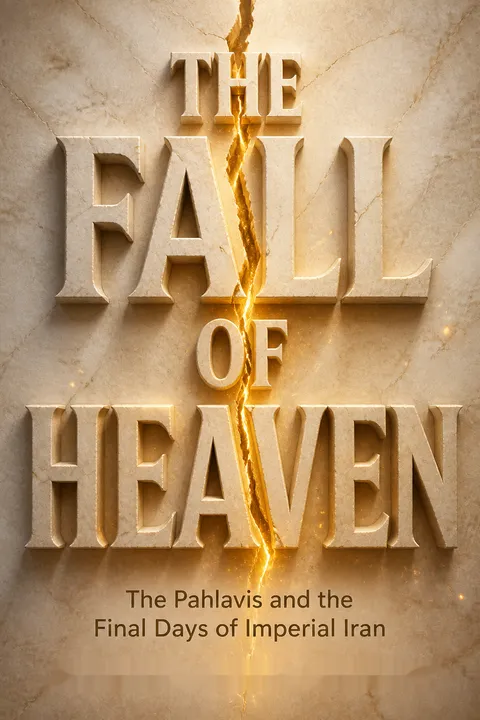
The Fall of Heaven receives mostly positive reviews for its detailed account of the final days of the Pahlavi dynasty in Iran. Readers appreciate Cooper's balanced perspective and engaging storytelling, though some criticize potential bias. The book is praised for its thorough research, including interviews with key figures like Queen Farah. Critics note the lack of opposing viewpoints and some historical inaccuracies. Overall, it's considered an valuable resource for understanding modern Iranian history, albeit from a pro-Shah perspective.
Glossary
farr
legitimacy tied to just ruleA Persian idea of divine favor or mandate associated with kingship. In the book’s account, a ruler retains the farr by governing justly and maintaining the people’s trust. It cannot be secured by force alone, and a king who sheds innocent blood risks losing this moral legitimacy.
White Revolution
the Shah’s modernization programMohammad Reza Shah’s package of social and economic reforms launched in 1963. It included land reform, women’s voting rights, profit sharing for workers, nationalization of forests, and literacy and education initiatives. The Shah used it to transform Iran rapidly, while critics objected to the authoritarian means and uneven effects.
velayat-e faqih
rule by Islamic juristsKhomeini’s doctrine that qualified Islamic jurists should govern during the Hidden Imam’s absence. It rejected the idea that clerics should remain outside political life and treated non-Islamic government as illegitimate. The doctrine became the ideological basis for the Islamic Republic’s system of clerical authority.
marja
a senior Shia authorityA senior Shia religious authority whom followers choose to emulate in matters of religious law and daily practice. A marja’s influence depends on scholarship, reputation, and a following that may support the cleric through religious dues. The book emphasizes that several marjas held differing views on political rule.
Savak
the Shah’s security serviceThe Persian acronym for the National Organization for Intelligence and Security, created under Mohammad Reza Shah. Savak gathered intelligence, monitored political opposition, and handled internal security. Its reputation for surveillance and abuse became a powerful focus of public opposition, although the book disputes claims about the scale of its killings and imprisonment.
Rastakhiz
the Shah’s single political partyThe one-party organization established by the Shah in 1975 after he abolished Iran’s two nominal political parties. It was intended to connect the monarchy with the public and prepare for political participation, but many Iranians saw it as an effort to eliminate constitutional opposition and deepen personal rule.
forty-forty strategy
repeating protests at memorialsThe revolutionary tactic of using the Shia forty-day mourning period after deaths in a protest to stage new demonstrations. Organizers sought to provoke further clashes, produce additional martyrs, and repeat the cycle. The strategy helped turn local unrest into a sequence of national confrontations during 1978.
FAQ
What's The Fall of Heaven about?
- Historical Overview: The Fall of Heaven by Andrew Scott Cooper chronicles the rise and fall of the Pahlavi dynasty in Iran, focusing on Mohammad Reza Shah's reign from 1941 to 1979.
- Key Figures: The narrative includes significant figures such as the Shah, his wife Farah Diba, and Grand Ayatollah Ruhollah Khomeini, who played pivotal roles in the events leading to the Iranian Revolution.
- Cultural Context: The book explores the cultural and religious dynamics in Iran, particularly the tension between modernity and traditionalism, and how these factors influenced the political climate.
Why should I read The Fall of Heaven?
- In-depth Analysis: Andrew Scott Cooper offers a comprehensive analysis of the Pahlavi era, providing readers with a nuanced understanding of Iranian history.
- Relevance to Current Events: Understanding the historical context of Iran's political landscape is crucial for grasping contemporary issues in the region.
- Engaging Narrative: The author combines historical facts with personal stories, making the book both informative and engaging.
What are the key takeaways of The Fall of Heaven?
- Complexity of Leadership: The book illustrates the challenges faced by leaders like the Shah, who struggled to balance modernization with traditional values.
- Role of Religion: The rise of Khomeini and the Shia clergy highlights the significant role religion played in Iranian politics.
- Impact of Foreign Influence: The narrative underscores the impact of foreign powers, particularly the United States and Britain, on Iran's political landscape.
What are the best quotes from The Fall of Heaven and what do they mean?
- “Ingratitude is the prerogative of the people.”: This quote reflects the Shah's belief that the Iranian populace failed to appreciate the progress made during his reign.
- “I want to build a government that is based on democratic practice at the bottom.”: This statement reveals the Shah's aspirations for reform and modernization.
- “I can summon a million martyrs to any cause.”: Khomeini's declaration emphasizes his ability to mobilize the masses and the power of martyrdom in Shia Islam.
How does The Fall of Heaven portray the Iranian Revolution?
- Catalyst for Change: The book depicts the Iranian Revolution as a culmination of years of discontent with the Shah's regime.
- Public Sentiment: Cooper illustrates how public sentiment shifted from support for the Shah to a desire for change, particularly among the youth and intellectuals.
- Consequences of the Revolution: The aftermath of the revolution is explored, detailing the establishment of the Islamic Republic and the challenges faced by the new regime.
What role did foreign powers play in the events of The Fall of Heaven?
- CIA Involvement: The book details the CIA's orchestration of the 1953 coup that overthrew Prime Minister Mossadeq.
- Western Interests: Cooper discusses how Western powers prioritized their interests in Iran's oil resources over the democratic aspirations of the Iranian people.
- Geopolitical Context: The narrative situates Iran within the broader context of Cold War politics, illustrating how global tensions influenced domestic affairs.
How does the author, Andrew Scott Cooper, approach the subject in The Fall of Heaven?
- Comprehensive Research: Cooper employs extensive research, including interviews with key figures and access to declassified documents.
- Personal Narratives: The author weaves personal stories and anecdotes into the historical account, making the events more relatable.
- Balanced Perspective: Cooper strives for a balanced portrayal of both the Shah and Khomeini, avoiding simplistic characterizations.
What were the social reforms introduced during the Shah's reign as discussed in The Fall of Heaven?
- White Revolution: The Shah's White Revolution aimed to modernize Iran through land reforms, women's suffrage, and educational initiatives.
- Women's Rights: The book highlights the significant strides made in women's rights during the Shah's reign.
- Economic Development: Cooper discusses the economic growth experienced during the Shah's rule, driven by oil revenues and modernization efforts.
How did the Shah's personal life influence his reign as depicted in The Fall of Heaven?
- Marital Relationships: The Shah's marriages, particularly to Soraya and Farah, are explored in relation to his political decisions and public image.
- Isolation and Loneliness: Cooper portrays the Shah as a figure often isolated from genuine connections.
- Public Persona: The Shah's carefully crafted public image is contrasted with his private vulnerabilities.
What were the consequences of the Shah's rule as outlined in The Fall of Heaven?
- Fall from Power: The book details the Shah's eventual downfall during the 1979 revolution.
- Establishment of the Islamic Republic: Cooper discusses the rise of Khomeini and the establishment of the Islamic Republic.
- Legacy of the Pahlavis: The narrative raises questions about the legacy of the Pahlavi dynasty and its impact on contemporary Iran.
How did Ayatollah Khomeini play a role in the revolution according to The Fall of Heaven?
- Mobilizing the Masses: Khomeini was instrumental in galvanizing public support against the Shah.
- Strategic Use of Media: Khomeini effectively utilized media to spread his message and counter the Shah's narrative.
- Vision for an Islamic Republic: Khomeini's vision of an Islamic republic appealed to many Iranians disillusioned with the Shah's secular policies.
How does The Fall of Heaven address the role of the United States in Iran?
- U.S. Support for the Shah: The book discusses the extensive support provided by the U.S. to the Shah, including military aid and political backing.
- Misjudgments by U.S. Officials: Cooper highlights the miscalculations made by U.S. diplomats and intelligence agencies.
- Consequences of Intervention: The narrative explores the long-term consequences of U.S. intervention in Iranian affairs.
About the Author
Other books by Andrew Scott Cooper
Download PDF
Download EPUB
.epub digital book format is ideal for reading ebooks on phones, tablets, and e-readers.








