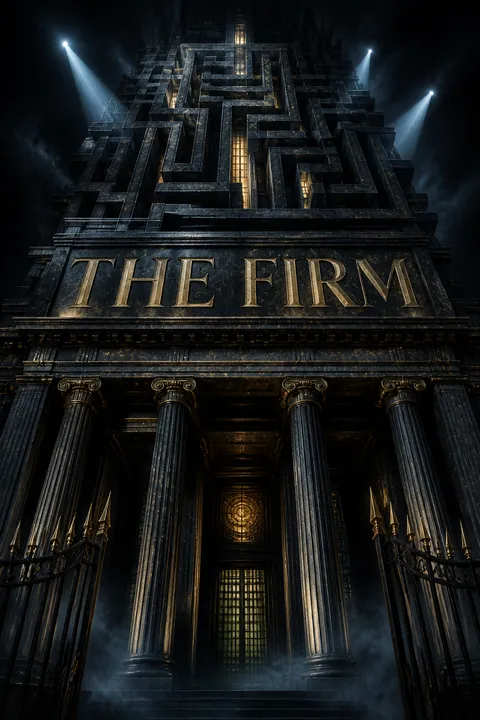


Plot Summary
The Memphis Offer
Mitchell McDeere, a brilliant Harvard law student carrying heavy debts, has offers from prestigious firms in New York and Chicago when Bendini, Lambert & Locke singles him out. The Memphis firm promises an exceptional salary, a house loan, a leased BMW, paid-off student loans, and a path to early wealth.
Its partners also ask unusually personal questions about marriage, children, drinking, and loyalty. Mitch is wary of their rules, but the money and the chance to leave poverty behind are hard to resist. His wife, Abby, is drawn to the prospect of a home and financial ease, though the firm’s interest in managing their family life unsettles her. Mitch agrees to visit Memphis.
The offer works because it speaks to Mitch’s deepest vulnerability in the language of achievement. Wealth is not merely comfort to someone raised without security; it promises a permanent escape from humiliation and dependence. The firm’s scrutiny of marriage and family initially resembles protective paternalism, making control feel like care. Abby detects the contradiction earlier than Mitch does: their private future is already being treated as an institutional resource. Their different reactions establish the marriage’s central pressure point, as Mitch equates provision with safety while Abby measures safety by the freedom to choose.
The Welcome Has a Body Count
During the McDeeres’ recruitment visit, the partners present their compact, lavishly appointed firm as a close community, and Lamar Quin’s wife, Kay, helps Abby imagine a comfortable life in Memphis. The firm’s rules reach beyond work: associates are expected to own homes, remain loyal, and build stable families.
Mitch and Abby move south, and their promised house and BMW are waiting when they arrive. But on their first evening, Kay tells them that lawyers Marty Kozinski and Joe Hodge have died in a diving accident in the Cayman Islands. Lamar sits soaked beside his pool, grieving his friend Marty. Mitch attends both funerals before beginning work, and the firm’s polished welcome acquires an unsettling shadow.
The firm’s hospitality is persuasive because it supplies what Mitch and Abby have lacked: belonging, domestic comfort, and recognition. Its generosity also makes the newcomers indebted before they understand the institution. The deaths interrupt the fantasy without yet disproving it. Mitch can grieve for the widows and still regard the tragedy as separate from his own future, while Lamar’s visible collapse makes the firm’s family rhetoric feel sincere. That ambiguity is crucial. The same community that appears to shelter its members is already marked by losses no one can explain.
A Rookie Becomes a Machine
On his first day, Mitch is assigned to partner Avery Tolar and is told to study for the Tennessee bar while learning the firm’s billing system. Avery immediately gives him a vast, complicated tax file for shipping magnate Sonny Capps, whose urgent tanker partnership requires a draft in days.
Mitch works through the night, produces hundreds of pages, and earns praise for rescuing the deadline, but his bar-study sessions fall behind. The firm’s associates treat extreme hours as proof of worth, and Mitch decides to arrive before dawn so he can become partner faster than anyone before him. Abby waits alone over carefully prepared dinners as he begins to confuse constant work with control over his future.
Mitch’s overwork is both imposed and self-authored. Avery supplies the impossible deadline, but Mitch turns it into a contest against his own history of deprivation. The firm rewards this response with praise and money, reinforcing the belief that exhaustion is evidence of agency. Abby sees the cost before Mitch does: his new home is already becoming a place he visits between shifts. The bar exam, nominally a professional hurdle, reveals how the firm can make its associates serve immediate profit even when that service threatens their own qualifications.
The FBI Names the Dead
Mitch passes the bar with the highest score, and the firm celebrates him with a bonus and a plaque bearing his name. Soon afterward, FBI agent Wayne Tarrance approaches him privately, warns that the firm’s phones and rooms may be monitored, and says Kozinski and Hodge did not die by accident. Mitch tells Lamar, who takes him to a meeting with senior partners.
They describe the FBI as hostile to the firm’s aggressive tax clients and insist that the deaths remain unexplained. Nathan Locke questions Mitch closely and orders him to avoid Tarrance. The partners’ confidence steadies Mitch, but he withholds parts of the FBI conversation, then begins to wonder why both sides seem so intent on controlling what he hears.
Mitch’s admission to the bar should mark entry into professional independence, yet the firm immediately treats his contact with the FBI as a matter of internal discipline. Each side asks him to trust its account while discouraging independent verification. His choice to conceal details from the partners is his first small act of judgment outside their supervision. The important change is not that he suddenly knows whom to believe; he does not. Rather, uncertainty itself becomes evidence. Once the firm insists that questions are dangerous, curiosity becomes a form of self-preservation.
A Private Eye Finds Patterns
Mitch visits his imprisoned brother, Ray, and learns that Ray’s former cellmate, private investigator Eddie Lomax, can work discreetly. Mitch hires Lomax to examine three earlier lawyer deaths memorialized in the firm’s library: Alice Knauss died in a collision involving a stolen truck, Robert Lamm was shot while hunting, and John Mickel’s apparent suicide involved an unregistered gun.
Lomax finds unresolved details in each case and reports that the firm has lost too many lawyers under suspicious circumstances. At Christmas, Mitch travels to Florida to locate his estranged mother, Eva, but watches her working at a diner instead of approaching her. Days later, someone shoots Lomax in his car. The investigation has shown Mitch that asking questions can get people killed.
The portraits and Lomax’s findings turn the firm’s memorial culture into a ledger of possible silencing. Mitch cannot prove murder, but the recurring irregularities replace the partners’ reassuring account with a pattern that demands explanation. His visit to Eva runs beside this inquiry: he can find his mother, yet poverty and old wounds keep him outside her life. Lomax offers the kind of loyalty Mitch rarely receives, partly because of Ray’s protection of him in prison. His murder makes trust newly costly, but also shows why Mitch’s independence cannot be reduced to ambition.
A Cayman Beach Becomes Evidence
Avery takes Mitch to Grand Cayman for client business, where the lawyers review offshore accounts and establish companies for wealthy clients. Avery drinks, pursues women, and leaves Mitch alone at a beach gathering. A local woman named Eilene draws Mitch away from the party; he gives in to the encounter despite thinking of Abby.
The next day, he notices a man watching him and begins checking the newspaper account of the earlier diving deaths. The firm’s security chief, DeVasher, later presents photographs of Mitch and Eilene, turning a private betrayal into leverage. Mitch realizes the firm is not merely secretive: it has watched his movements and collected material that could damage his marriage and career.
The seduction is engineered to expose the gap between Mitch’s self-image and his behavior, then convert that gap into control. His decision is his own, which makes the photographs more effective than a fabricated accusation; shame supplies the firm with a weapon that requires no further force. At the same time, the Cayman setting joins luxury to surveillance. The trip offers pleasure and professional prestige, but every private action becomes observable. Mitch’s guilt is real, yet the firm’s calculated exploitation of it reveals that its moral rules are not shared standards. They are instruments selectively enforced.
The Firm's Real Client
At a tax seminar in Washington, FBI Director F. Denton Voyles arranges a secret meeting with Mitch at the Vietnam Veterans Memorial, where Mitch sees his dead brother Rusty’s name on the Wall. Voyles explains that Bendini, Lambert & Locke is owned by the Chicago Morolto crime family and launders money, evades taxes, and conceals criminal proceeds through legitimate legal work.
The firm monitors Mitch at home and at work, and lawyers who tried to leave have died. The FBI wants him to copy records from inside. If he refuses, Voyles warns, the Bureau may eventually indict him with the others. Mitch returns to Memphis shaken, then tells Abby everything while they pretend to enjoy dinner in a crowded airport lounge.
The meeting forces Mitch to revise the meaning of every gift he has accepted. The house, car, and salary no longer signify success alone; they are investments in a recruit whom the firm expects to own. Voyles’s account also complicates rescue: the FBI needs Mitch to violate professional confidentiality and cannot promise perfect protection. Rusty’s name on the Wall sharpens the cost of institutional promises, since sacrifice has already entered Mitch’s family history. Telling Abby changes the danger from his private burden into a shared decision, restoring intimacy through truth even as the truth threatens their life together.
Abby Joins the Counterplot
Mitch and Abby decide not to wait for the FBI to choose another vulnerable associate. Mitch negotiates a two-million-dollar payment and insists that Ray be freed from prison; the Bureau agrees to pursue an escape, though it cannot promise a clean legal release.
Mitch also demands money before handing over evidence, wary of relying on federal assurances. After Lomax’s murder, his former secretary, Tammy Hemphill, approaches Mitch with information about the killing and agrees to help him.
Abby negotiates with Tarrance herself on a concealed bus meeting, insisting that the FBI transfer the first million before receiving Mitch’s clean files. Their plan now depends on three kinds of trust: Mitch’s skill, Tammy’s secrecy, and Abby’s willingness to share the risk.
The McDeeres’ decision is less a conversion to the FBI than a refusal to remain passive property of either institution. By negotiating payment and Ray’s escape, Mitch insists that his family’s survival count as part of the case, not as collateral damage. Abby’s role is especially consequential: she is no longer merely the person endangered by Mitch’s choices but a negotiator who tests Tarrance’s promises directly. Tammy’s involvement widens the operation beyond the law firm’s male hierarchy. Each alliance remains conditional, which is prudent, but their coordination creates a fragile form of agency.
The Locked Cayman Archive
With Avery scheduled to work in Grand Cayman, Abby leaves Memphis under the cover of visiting her seriously ill mother and secretly travels to the island. Tammy, posing as an acquaintance, gets Avery drunk and slips a sedative into his drink. While he sleeps, Abby copies keys to the locked storage room in the firm’s condominium, where twelve cabinets hold legal and banking records.
Abby and Tammy rent a fast copier, work through the night, and carry the copied papers in suitcases to a storage unit. Mitch later speaks with Barry Abanks, the dive operator whose son died with Kozinski and Hodge. Abanks rejects the drug-trade explanation and confirms that the boat’s position and the divers’ condition do not fit an ordinary accident.
The archive operation converts Mitch’s suspicion into documentary proof, but it depends on the same covert methods used against him. Abby and Tammy must deceive Avery, duplicate keys, and move evidence without leaving visible disorder. Their success is practical rather than triumphant: every copied page adds value while increasing the danger of discovery. Abanks contributes a different kind of evidence, grounded in a diver’s knowledge of the sea rather than legal inference. His account cannot identify the killers, but it removes the firm’s convenient explanation and gives Mitch a trustworthy witness to the physical facts.
The Copier Betrays Him
Back in Memphis, Mitch enters Avery’s locked office after hours and copies records from cabinets containing Cayman companies and wire transfers. He disguises the copying as routine client work by charging each batch to legitimate tax files.
DeVasher’s surveillance team notices the unusual time, volume, and borrowed access codes, then links the activity to Mitch. Meanwhile, Avery’s estranged wife and his habits leave him exposed; the firm sends him away on a supposed heart condition, but Avery later disappears from the hospital.
Abby remains away from Memphis, and Mitch keeps working while assembling a much larger case from Tammy’s copied files. The firm’s systems, built to account for every page and every hour, begin to expose the person using them against it.
The copier is a small, concrete model of the firm’s power: even reproduction is logged, priced, and assigned to an account. Mitch turns that apparatus against its owners by using its own billing discipline as camouflage, but the record of his ingenuity becomes a trail. The episode also shows how institutional knowledge differs from proof. DeVasher has anomalies, not certainty, and the partners’ wish to protect Mitch conflicts with the security chief’s suspicions. Avery’s disappearance further erodes the firm’s public image of stable mentorship, suggesting that its members are individually vulnerable even while the organization appears seamless.
A Leak Forces the Run
A senior FBI employee, Tarry Ross, sells the Moroltos information about Mitch’s cooperation and the promised payments. The firm learns that Mitch may have copied crucial records and begins preparing to destroy evidence and kill him during a flight to the Caymans.
Mitch’s security contacts alert him through a false court summons, a prearranged emergency signal. He runs from the office, spots the Nordic pursuer at the Peabody, and escapes by dropping from an upper railing into the lobby before changing clothes and leaving by another door.
He calls Tammy to get Abby moving and to collect the false identities. In Nashville, he diverts ten million dollars from a Cayman account, directing funds to Abby’s parents and his mother while sending most of the rest to Switzerland.
The leak destroys the assumption that the FBI’s secrecy is safer than the firm’s. Mitch has chosen to cooperate, but the Bureau’s internal breach nearly converts his evidence into a death sentence. His escape is enabled by improvisation and earlier habits of observation, not by institutional protection. The transfer of money is both practical and morally fraught: he takes criminal proceeds to finance flight and provide for relatives who have no part in the conspiracy. By acting without waiting for permission, Mitch stops treating the FBI as his new employer and begins treating it as another interested party.
Ray Goes Over the Wall
While Mitch disappears, prison guards escort Ray outside his cell at Brushy Mountain and guide him over the wall through a planned escape. A guard and a local contact help him reach a truck, then send him toward Knoxville with cash and civilian clothes. The arrangement gives Ray a head start but leaves him exposed as an escaped murderer.
Abby, fleeing Kentucky, sees the blonde woman who had monitored her on a plane and realizes the firm’s pursuers have found her. Ray reaches the Gulf Coast, where he intercepts the woman after she follows Abby into a hotel. He restrains her and takes her weapon, but the Mob later uses her injury to frame him for rape, putting police as well as professional killers on their trail.
Ray’s escape is a rescue shaped like a criminal act, so the brothers gain freedom by accepting the public identity that will endanger them. His prison years have made him alert to physical threats, but they have not prepared him for a pursuit involving planted accusations and official manhunts. Abby’s recognition of the blonde confirms that surveillance follows her independently of Mitch, making her own flight necessary rather than merely supportive. The false rape charge weaponizes Ray’s record: authorities are primed to believe the worst, and the fugitives must evade not only the Mob but the story being built around them.
Panama City Becomes a Decoy
Mitch, Abby, and Ray regroup at a cheap motel in Panama City Beach as federal agents, local police, and Morolto gunmen converge on the coast. Mitch uses a rented U-Haul to move the copied records, then records a detailed video deposition explaining the Cayman accounts, shell corporations, and money transfers. Motel clerk Andy Patrick recognizes Mitch from the news but accepts payment to protect the rooms and deliver a package.
Morolto men plant sightings of the trio in a green truck towing a trailer, sending police and FBI agents toward Tallahassee and Ocala. The false trail clears the immediate search area, but armed pursuers remain nearby. Mitch’s detailed testimony and documents are ready; the family still needs a route off the coast.
Panama City Beach becomes dangerous precisely because several institutions converge there with incompatible aims. Police want Ray, the FBI wants evidence, and the Moroltos want silence. Mitch’s recorded deposition turns accumulated paperwork into a coherent account a grand jury can follow, while Andy’s self-interest supplies a brief but vital shelter. The false sightings exploit the authorities’ dependence on witnesses and recognizable vehicles. Yet the plan cannot make the coast safe; it only redistributes attention. Evidence and escape now run on separate tracks, and the fugitives must keep both moving.
Midnight Under the Pier
At midnight, Abby flashes a signal from a pier while Mitch and Ray wait separately along the beach. Aaron Rimmer, the Nordic operative, rushes toward her, and Mitch tackles him before he can seize her. Rimmer strikes Mitch, but Ray arrives and overpowers the attacker. To keep him from identifying them, Ray strangles him and lowers his body into the water beneath the pier.
The three fugitives hide on a concrete crossbrace as searchers pass overhead. Barry Abanks reaches them in a small rubber raft, having dodged boats patrolling the shore. He ferries them to a schooner and a trusted sailor, George, who carries them away from Florida and toward the Caribbean.
The pier is the point at which Mitch’s carefully managed escape becomes immediate physical violence. Abby’s signal draws rescue and danger to the same place; the light that is meant to guide Abanks also exposes her to Rimmer. Ray’s decision to kill the pursuer protects the group but leaves the brothers with a burden no negotiated deal can erase. Abanks’s arrival completes a chain of assistance built from Mitch’s earlier investigation, showing how a question about a suspicious death has become a route to survival. The fugitives leave not because danger has ended, but because the people they trusted have acted.
A Firm Falls, A Boat Leaves
The fugitives sail through the Caribbean with George, who teaches Mitch and Ray how to handle the schooner. Abby mourns the home, dog, parents, and ordinary life she has lost, while Mitch gives the FBI the records and deposition that support a major investigation.
A newspaper delivered through Abanks reports indictments against fifty-one current and former firm members and thirty-one alleged Morolto associates. Mitch recognizes Lamar Quin’s name among them and feels grief as well as relief, because the people indicted were once his friends.
On Little Cayman, he and Abby begin trying to live beyond the firm’s reach. Their future remains uncertain, but Mitch admits he never wanted to be a lawyer, and Abby chooses to face the next life with him.
The indictments deliver institutional consequence, not emotional repair. Mitch has helped dismantle the organization that bought his loyalty, yet the newspaper also names people he loved and cannot rescue from their choices. Abby’s grief for ordinary domestic life prevents the escape from becoming a simple fantasy of freedom. The closing turn toward sailing reframes Mitch’s identity: his legal brilliance served survival, but it was never the self he most wanted to inhabit. Their tentative intimacy returns through honesty and shared uncertainty, not through restored wealth or a promise that danger has vanished.
Analysis
The Firm builds its thriller around a credible exchange: institutions offer protection, money, and belonging, then convert those benefits into claims on a person’s future. Mitch is not lured by greed alone. He wants to escape the precarity of his childhood and give Abby a secure home. That desire makes the firm’s package persuasive, while its demands on marriage and family signal that the price is already being negotiated. Abby sees the boundary violation sooner because she measures security by reciprocal care, not by status.
The novel’s surveillance plot makes professional ethics materially dangerous. Mitch is trained to keep client matters confidential, yet the firm’s criminal purpose turns that duty into a trap. The FBI then asks him to violate the same obligation for public justice, while offering protection it cannot guarantee. His choice is therefore not a clean contest between good and evil. It is a struggle over who gets to define responsibility when every institution has compromised its claim to trust. Documents become the story’s counterweight to coercion. Hidden accounts and shell corporations are designed to make money untraceable, but their records preserve the relationships that secrecy tries to erase. Mitch’s legal training, Tammy’s practical skill, Abby’s nerve, and Abanks’s knowledge each reveal a different piece of the system. Their evidence succeeds because no single authority owns the whole truth.
The ending refuses to equate indictment with restoration. The firm and its criminal network face exposure, but the McDeeres lose their home, family proximity, and ordinary identities. Mitch’s admission that law was never his true desire suggests that escape is also a belated act of self-definition. Yet the couple’s future remains precarious. Their renewed intimacy offers no guarantee of safety, only a relationship finally organized around shared knowledge rather than one partner’s ambition and the other’s waiting.
Review Summary
People Also Read










Characters
Mitchell McDeere
The hungry young lawyerMitch is a gifted, disciplined Harvard graduate raised in poverty, with a competitive streak sharpened by years of having to rely on himself. He wants financial security and professional distinction, but he also has a strong instinct for patterns and an appetite for work that can become self-destructive. His marriage to Abby is his deepest source of belonging, even as ambition repeatedly pulls him away from her. Mitch tends to meet fear by calculating, observing, and bargaining rather than asking for help. That practical intelligence makes him effective, but his confidence in his ability to manage every risk can blind him to the human cost of his decisions.
Abby McDeere
Mitch's clear-eyed partnerAbby is Mitch’s wife, a trained elementary-school teacher who values affection, family ties, and meaningful work more than the status the firm can provide. She is perceptive about the pressure the firm places on private life and resists the assumption that a lawyer’s spouse should organize herself around his career. Her patience is real, but not limitless; loneliness and separation expose needs Mitch has avoided hearing. Abby is emotionally direct and capable of practical courage. She does not simply follow Mitch into danger: she evaluates what he tells her, sets conditions, and contributes her own judgment to the choices they face.
Ray McDeere
Mitch's imprisoned brotherRay is Mitch’s older brother, serving a long sentence for a fatal fight. He is physically formidable, observant, and intellectually restless, with an unusual gift for languages that prison has not extinguished. His letters and visits reveal a man who can meet bleak circumstances with humor while remaining keenly aware of danger. Ray is one of the few people connected to Mitch’s childhood and understands the family’s history without requiring it to be explained. His independence can become recklessness, but his loyalty to Mitch is deep, shaped by years in which the brothers had little besides each other.
Wayne Tarrance
The persistent FBI agentTarrance is an FBI agent assigned to organized crime, forceful and resourceful, but not always as discreet as the work requires. He pursues Mitch because he believes an insider can expose a criminal operation that investigators cannot penetrate from outside. Tarrance mixes urgency with a negotiator’s bluntness, often assuming that the importance of the case should outweigh Mitch’s fear. He is neither a simple rescuer nor a neutral observer: he represents a government willing to promise protection and money while asking a young lawyer to risk his career and life.
Oliver Lambert
The firm's gracious elderLambert is the senior partner who recruits Mitch and presents the firm as a benevolent professional family. His warmth, social ease, and interest in young associates make him a convincing mentor. He values order and loyalty, and he understands how reassurance can shape a recruit’s sense of belonging. Lambert’s paternal style contrasts with the firm’s harsher machinery, making him difficult to read: care and authority arrive in the same polished manner.
Nathan Locke
The cold senior partnerLocke is a senior partner with a severe manner and a formidable presence. He questions Mitch after the FBI makes contact and reinforces the firm’s expectation of silence. Unlike Lambert’s genial style, Locke’s authority is direct and intimidating, though he remains controlled in public. His position gives him access to the firm’s most sensitive decisions, and his watchful nature makes every conversation with him feel like an examination.
Avery Tolar
Mitch's demanding mentorTolar is a brilliant tax lawyer who becomes Mitch’s supervising partner. He is ambitious, technically skilled, and intensely focused on billing, client demands, and professional achievement. His difficult personal life and appetite for risk complicate the polished image of the firm’s ideal associate. Tolar can be generous with praise, but he also expects Mitch to absorb punishing workloads without complaint. He offers a vivid example of how talent and success can coexist with a life increasingly organized around work.
Lamar Quin
Mitch's ambitious colleagueLamar is a young lawyer at the firm and Mitch’s first close colleague in Memphis. Friendly, energetic, and proud of his prospects, he helps make the firm’s culture feel welcoming to a newcomer. His friendship with Mitch is genuine, while his own ambitions keep him invested in the institution’s promises. Lamar’s family life with Kay and their children gives him a settled domestic image that Abby initially finds reassuring.
DeVasher
The firm's security chiefDeVasher runs the firm’s surveillance operation and has a background in police work. He is blunt, suspicious, and more comfortable with threats than with the partners’ careful public language. His attention to recordings, access codes, and movements makes him an immediate source of pressure for Mitch. DeVasher is practical about violence and treats security as a problem to be solved, not a moral question to be debated.
Tammy Hemphill
The resourceful investigatorTammy is Eddie Lomax’s former secretary and a private investigator’s capable, streetwise associate. She has experience with surveillance, clients, and people who underestimate her. Her appearance can be carefully altered to suit a role, but her real strengths are persistence and nerve. Tammy has her own risks and obligations, so her willingness to help Mitch depends on trust and practical judgment rather than blind idealism.
Eddie Lomax
Ray's loyal investigatorLomax is a former police officer turned private investigator, with a rough manner and a complicated reputation. Ray once protected him in prison, and Lomax repays that debt by helping Mitch investigate the firm’s history. He works through contacts, records, and patient observation rather than formal authority. Beneath his bravado is a strong sense of loyalty to the people who stood by him when he was vulnerable.
Barry Abanks
The Cayman dive operatorAbanks runs a dive lodge in the Cayman Islands and knows the surrounding waters through decades of practical experience. His son’s death has made him guarded about the lawyers who died on the same boat, but he is willing to share what he knows with someone who approaches him respectfully. Abanks trusts observation over rumor and speaks with the authority of a person who understands how boats, divers, and currents actually behave.
F. Denton Voyles
The FBI's directorVoyles is the Director of the FBI and the senior official overseeing the effort against the Morolto organization. He is direct and politically experienced, accustomed to weighing a source’s safety against the demands of a major investigation. His personal approach gives Mitch a sense of the case’s scale, but Voyles cannot make the dangers disappear. He represents government power at its most focused, as well as its limitations.
Kay Quin
Abby's Memphis confidanteKay is Lamar’s wife and one of Abby’s first friends in Memphis. She helps Abby navigate the town and explains the social customs of the firm’s families. Kind and well-intentioned, Kay believes the firm’s pressure is a normal stage of a lawyer’s career because she has lived through it herself. Her reassurance offers Abby companionship, while also revealing how easily an institution’s expectations become accepted as ordinary.
Andy Patrick
The motel clerkAndy is a motel clerk with a criminal past, a sharp eye for authority, and little faith in the people who claim to represent it. He recognizes an opportunity when Mitch asks for help, but his willingness to take risks grows from experience as much as greed. Andy understands the value of staying inconspicuous and knows that official pressure can be as dangerous as criminal attention.
Eva McDeere
Mitch's estranged motherEva is Mitch and Ray’s mother, living in Florida and supporting herself through diner work. Family tragedy and poverty have shaped the distance between her and her sons. Mitch’s decision to find her reflects a lingering need to know she is alive, even when he cannot bring himself to approach. She represents a past Mitch has tried to escape but cannot entirely leave behind.
Harold Sutherland
Abby's status-minded fatherHarold is Abby’s father, a small-town banker who values status and financial appearances. His disapproval of Mitch’s background wounded the young couple before their move to Memphis. He tends to frame personal relationships through practical questions about money and achievement, which intensifies Mitch’s resentment and Abby’s divided loyalty.
Marty Kozinski
The admired tax lawyerKozinski is a skilled negotiator and established member of the firm, respected by Lamar and other colleagues. His family life and professional standing make him a model of the success Mitch hopes to attain. The circumstances around his absence from the firm become an early source of uncertainty for Mitch.
Joe Hodge
The quiet Harvard lawyerHodge is a reserved lawyer at the firm and a Harvard graduate. He is less prominent socially than Kozinski, but his professional ties place him close to important events in the firm’s history. His quietness makes him easy to overlook, a quality that becomes part of how Mitch thinks about the people around him.
Robert Lamm
The missing hunterLamm was a lawyer at the firm and a friend of Avery Tolar. He enjoyed hunting and had an ordinary professional life that gives his unexplained death particular weight. His case becomes one of the earlier histories Mitch asks Lomax to examine.
Alice Knauss
The firm's former lawyerKnauss was a gifted lawyer who joined the firm from Harvard. She was known for confronting workplace discrimination and challenging colleagues directly. The partners remember her through a dismissive account, while her portrait and death give Mitch another reason to question the institution’s version of its past.
John Mickel
The troubled former associateMickel was a lawyer whose drinking, marital troubles, and anxiety about advancement became known around the firm. His story is presented to Mitch as a personal tragedy, but unanswered details in the case lead him to seek an independent account. He represents the psychological cost of a career built around relentless pressure.
Tarry Ross
The compromised FBI insiderRoss is a senior FBI employee with access to sensitive information and a hidden appetite for money. His position makes him valuable to people seeking intelligence about the Bureau’s investigation. He appears briefly, but his choices expose the vulnerability of an institution that Mitch has been asked to trust.
Plot Devices
The golden employment package
Comfort that creates dependenceThe salary, BMW, mortgage, retirement plan, paid debts, and exclusive vacations make Memphis attractive to a young lawyer with few resources. These benefits are not independent perks: they tie the associate’s professional identity, home, and financial future to the firm. As Mitch accepts them, the firm gains leverage over the life it appears to improve. The device makes recruitment psychologically credible because it answers genuine needs rather than relying on obvious coercion. Its meaning changes as Mitch learns that generosity can function as a form of ownership.
The surveillance fortress
Private life becomes evidenceThe firm’s guards, hidden microphones, tapped phones, recordings, and coded security systems extend its authority beyond the office. They let DeVasher monitor associates, detect unusual behavior, and collect material that can be used to threaten them. The machinery also shapes Mitch’s conduct before he knows its full reach: conversations become cautious, meetings move to public places, and ordinary routines require countermeasures. Surveillance functions as both plot engine and psychological pressure, turning the home and workplace into spaces where privacy cannot be assumed.
The Cayman paper trail
Money leaves documentary tracksNumbered bank accounts, offshore corporations, wire transfers, and legal files disguise criminal proceeds as ordinary business. The system appears impenetrable because its records are dispersed among banks and companies, but that same complexity creates a trail that can be reconstructed. Mitch and Tammy copy the records, while Mitch organizes them into a recorded explanation of how the money moves. The files change the conflict from suspicion into a prosecutable case and make physical documents as important as testimony.
False identities and signals
A moving target stays hiddenMitch and his allies use aliases, cash payments, altered appearances, emergency signals, false travel routes, and discreet meeting points to evade both FBI and Morolto surveillance. These tactics let them communicate without relying on compromised phones or predictable routines. The device also carries emotional weight: each new name and disguise loosens the fugitives’ connection to the homes and relationships they are trying to protect. Escape depends not on disappearing once, but on repeatedly making pursuit follow the wrong person or place.
The recorded deposition
Evidence survives the witnessMitch records himself explaining bank accounts, corporate structures, and laundering methods while identifying the copied documents on camera. The deposition is not a substitute for his live testimony at trial, but it gives investigators a detailed guide to the evidence and supports their effort to obtain search warrants and indictments. It converts Mitch’s legal expertise into a portable account that can travel even if he cannot safely appear in court. The camera makes his knowledge legible to prosecutors while preserving the personal cost of his absence.
About the Author
Other books by John Grisham






Download PDF
Download EPUB
.epub digital book format is ideal for reading ebooks on phones, tablets, and e-readers.








