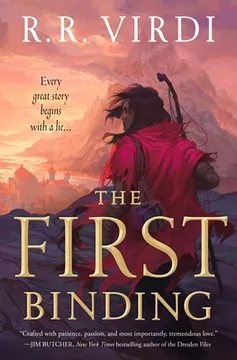


Plot Summary
The Tavern Holds Its Breath
Ari enters the Three Tales Tavern seeking the world's greatest story, then makes an audience from its silence. His red cloak moves unnaturally, his staff cracks against the floor, and his fame draws three patrons running to recruit listeners. The barkeeper, Dannil, tells him that Karchetta fears a prince's murder and the political struggle it may unleash.
Ari notices Dannil's worn cleaning rag and asks for its history. Through it, Dannil remembers Rita, the woman who helped him build their tavern and died after a long illness. Ari restores the counter with a binding, but cannot mend the broken mandolin in its case. Dannil's story earns the stranger a room and a place to perform.
Ari's craft begins with attention, not invention. He reads Dannil's attachment to a rag and lets the barkeeper's memory take precedence over his own performance. Yet his inability to mend the mandolin marks a boundary: magic can alter surfaces, but it cannot reverse loss. The opening also frames storytelling as exchange. Ari earns shelter by making another person's life matter to an audience, while his own concealed history remains the price he has not yet paid.
A Prince Made of Sunlight
As the tavern fills, Ari listens for what the people of Karchetta want: relief from the princes' quarrels and fear of war. He binds fire and air to his staff, then tells of Antoine, a farmer who promises to defend Etaynia and its namesake, Etaynia, from the Des Embras. The sun god Solus arms Antoine with strength, armor, a sword, and a shield.
Antoine defeats the shadowy armies, then sacrifices himself to destroy their leader, Umbras. The listeners weep and cheer, believing the familiar legend ends with hope. Eloine, a striking singer whose jewelry chimes as she moves, follows with songs that first lift the room and then return it to grief.
Ari does not merely tell a story; he engineers the audience's emotional route, using silence, light, rhythm, and a deliberately comforting ending. His performance is powerful because the villagers need a champion more than an accurate record. Eloine's songs expose the cost of that consolation: she can raise the crowd and then make it feel the sorrow Ari has softened. Their rivalry begins as an argument over who gets to direct attention.
The Story Beneath the Story
Eloine draws Ari aside and points out that his face betrayed the real ending of Antoine's legend. He admits that Etaynia was not the sun god's child, and that Antoine became one of the shadows after Umbras cursed him. Etaynia ultimately killed her beloved to stop the corruption, dying with him.
Eloine recognizes Ari as the man behind many contradictory legends, including the stories of the red cloak, the fire binder, and the princess-killer. He confirms she is right and admits that he has reshaped his history because people cannot always bear the truth. When armed clergos arrive to seize Eloine, Ari uses his bindings to shield her and drive them back. She asks for his full story, and he agrees.
Eloine's insight unsettles Ari because it denies him the safety of being only a performer. His fabricated version protects listeners, but it also protects him from having to state his own responsibility plainly. Eloine sees through the mask without treating him as a monster or a hero. That combination of recognition and refusal to judge too quickly makes her a rare audience, one Ari can risk telling the truth to.
Eloine Hunts a Song
While Ari recounts his past, Eloine leaves the tavern and intervenes when a man corners Marania, a sex worker he has paid for more than she agreed to provide. Eloine threatens him with her knife, then leads Marania to the Black Tap, a tavern where secrets and people are traded. Its owner, Dantonyio, directs her to Magael, who sells information from a private room.
Eloine beats Magael at Talluv, a strategy game, and pays him to search for an ancient song she has pursued for years. She also wants help escaping the clergos' attention. Her exchange secures a route toward information, not certainty, and shows she has her own dangerous business beyond Ari's story.
Eloine's intervention is practical rather than ornamental. She recognizes that Marania's vulnerability is being treated as a commodity and uses force to interrupt the transaction. At the Black Tap, she then enters a system built on the same reduction of people to leverage, but does so to pursue a song and protect herself. The contradiction matters: Eloine can navigate compromised institutions without mistaking access for justice.
Raised Beneath the Stage
Ari's story begins in Keshum, where the orphan works the theater's understage for Khalim, a caretaker who feeds and houses him but keeps him from performing. Makham, a cruel actor, mocks Ari's unknown parents; Nisha, another vulnerable child, brings him food and asks him for stories.
When the wealthy thug Koli threatens Khalim's theater, a traveling binder named Mahrab drives Koli's men away with magic and agrees to teach Ari. Mahrab starts him with mental exercises rather than spells, showing that conviction and concentration shape a binding.
Vithum, the theater's sword choreographer, trains Ari to move and fight. Between Nisha's friendship, Khalim's plays, and his teachers' lessons, Ari begins to imagine a life beyond the machinery below the stage.
The understage gives Ari a literal position beneath the stories he longs to inhabit. His early teachers offer different routes toward agency: Khalim teaches performance, Vithum bodily discipline, and Mahrab the difficult control of belief. Nisha offers something none of them can teach, the experience of being cared for without having to earn it. Ari's ambition is therefore both genuine curiosity and a child's attempt to escape a life in which others define his worth.
The Theater Becomes Ash
During rehearsals, Ari slips away to see Nisha and returns to find the theater burning and partly collapsed. Koli stands among the wreckage with seven companions whose eyes and blood have turned black. Khalim, Kauri, Talim, and Vithum lie dead, while Mahrab faces the attackers with a binding that brings down the roof.
Mahrab orders Ari to run, and Ari escapes through the understage window carrying the sealed book his teacher gave him. The theater falls behind him, burying his home, his training, and the people who raised him. He runs through the storm with no plan except survival, not yet knowing that the monsters who destroyed his first family will follow him into every later choice.
The attack transforms Ari's fantasy of becoming a storybook hero into a traumatic fact: monsters are real, and knowing their names does not make them beatable. Mahrab's final order forces Ari to survive by abandoning the people who taught him how to live. The sealed book becomes both inheritance and burden, preserving a promise of knowledge while withholding the family history Ari most wants.
Mithu's False Family
A shopkeeper tries to sell Ari to Koli, but Mithu intervenes and brings him to a household of child thieves called the sparrows. Ari earns a bed, food, and a place among them, then teaches the children to beg and steal more effectively. He keeps a small private store of coins for a future journey to the Ashram.
When he learns Mithu has been selling low-earning sparrows to Koli, Ari confronts him on the roof. Mithu admits the children were traded, not lost, and threatens to sell Ari next. Ari disarms Biloo, wounds Askar, and kills them both as they fall from the roof. Mithu jumps after them and dies too. Nika declares the sparrows belong to one another, not their former keeper.
Mithu's betrayal reveals how care can become a mechanism of control. The sparrows received food and shelter, but their safety depended on earning value for an adult who profited from their vulnerability. Ari's violence breaks that system, yet his victory is not clean: he becomes responsible for the children and must decide what kind of leader their survival requires. Nika's refusal to remain loyal to Mithu gives the group a moral center beyond revenge.
The Joy House Burns
Ari's brother Taki dies after Mithu sells him into Koli's white-joy trade, a drug that leaves users feverish, delusional, and finally unable to recover. Ari gathers the sparrows and redirects them toward selling information instead of relying only on theft. They locate Koli's drug house and prepare to burn its stock with flammable liquor.
Ari enters looking for Nisha, but Koli appears and taunts him about the theater's destruction and Nisha's disappearance. Ari sets the fire anyway and escapes as the building collapses. By morning, not a trace of Koli's house remains, and no one in Ghal admits Koli ever existed. Ari leads the sparrows into a safer business, but Nisha is still missing.
Taki's death turns revenge from an abstract promise into a response to a preventable loss. Ari's new trade in secrets gives the sparrows agency without requiring them to repeat Mithu's most brutal methods. Yet burning the drug house does not bring Nisha back or prove Koli dead. The city chooses the simpler story that the building burned and its owner left, while Ari must live with the possibility that the true threat merely changed its shape.
Gold for One Year
After a year running the sparrows, Ari has money and responsibility but no direction. At the Zanzikari, a storyteller named Maathi performs the legend of Abrahm, a binder who fought demons before turning against his own cause. Maathi recognizes Ari's talent and reminds him of the life he once wanted.
Ari decides to leave for the Ashram, but first targets Arfan, a wealthy desert merchant, to provide the sparrows with lasting security. Arfan reveals he arranged the apparent robbery to test Ari. He offers gold on the condition that Ari return to him within a year and work off the debt. Ari accepts, leaving a letter for Nika and Juggi rather than facing their pleas in person.
Maathi's story acts as a mirror: Ari hears a legend about a hero whose purpose becomes corrupted, while he is at risk of letting survival erase his own purpose. Arfan's bargain gives him a route out of Keshum but also replaces one form of dependency with another. Ari's letter is an act of care and cowardice at once. He funds the sparrows' future, yet avoids witnessing the hurt his departure will cause.
The Ashram Opens Narrowly
On the northbound journey, Ari meets Vathin, a philosopher and experienced binder who trades lessons in thought for Ari's sword training. Vathin teaches him that the bindings demand more than words: a practitioner must understand the thing being shaped and hold faith without losing himself. At the Ashram, the masters initially reject Ari because he has no sponsor and cannot perform a binding.
Vathin arrives before the decision is final, presents Mahrab's sealed book as evidence of Ari's training, and argues for his admission. The masters accept Ari as a student, though not as a practicing binder. He pays a donation and enters, carrying the book he still cannot open and the old promise that brought him north.
Vathin provides what Ari's talent alone cannot: recognition within an institution that values credentials and controlled access. Yet the Ashram's acceptance is conditional, leaving Ari both grateful and defiant. His sealed book embodies the tension between inherited knowledge and earned readiness. He has crossed a vast distance to reach a place of learning, but entry is only the beginning of a more difficult test.
The Mind's Dangerous Folds
Ari studies the principles of binding with Rishi Ibrahm, the Master Binder, who tests his concentration by hurling stones and challenging Ari to counter their paths. He also shows Ari the Crow's Nest, where students damaged by the bindings live apart from the rest of the Ashram.
Ari sees Krisham's divided identity, Reppi's fixation on destruction, and Immi's compulsive self-injury, then understands that mastery can cost a person the shape of himself. During a penance for threatening Nitham, Ari uses thiplan to dull his feet and walks across hot coals without burns. The trick earns him the name Unburned, but Rishi Ibrahm warns him that cleverness and will alone cannot make him safe.
The Crow's Nest makes the cost of magic visible in people rather than theory. Ari wants power as protection and as a route to revenge, but the damaged students show that the mind doing the binding is also what can be damaged. His fire-walking adds another layer to his emerging legend, built partly on skill and partly on concealment. He can evade pain briefly, but evasion is not the same as understanding.
The Mountain Comes Down
A wandering tinker brings word that fires, red smoke, and blood have appeared in Ampur, signs Ari connects with the Ashura. He travels there with Radi and finds a village wrecked by a gigantic serpent, the Nagh-lokh, an old god enraged after centuries of sleep. The creature's water blasts and thrashing threaten to destroy what remains.
Ari cannot reach the Ashura, but he draws on the first binding Mahrab taught him, linking a point above to one below. He calls down the mountain onto the serpent. The avalanche kills the Nagh-lokh and buries much of the village, while Ari, Radi, Laki, and her grandmother survive. Ari has used a major binding, but victory leaves him grieving the devastation it caused.
Ari's first decisive use of magic is not a clean victory over the enemy he seeks. The Nagh-lokh is dangerous, but also a suffering being awakened into destructive confusion. Ari saves lives by killing it, while his binding buries homes and may have destroyed others. The episode tests his belief that power can simply be used for justice. The mountain answers his will, but it does not distinguish between the guilty and the people beneath it.
Kites, Coins, and Consequences
Back at the Ashram, Ari uses his apprenticeship in artisanry to prepare glass-coated kite string that can withstand the force of other fliers' lines. During the Radhvahni festival, he enters the contest against Nitham, a wealthy prince's son who has made Ari a target. Ari wins, humiliating Nitham before the students and taking the prize.
Nitham retaliates with a formal complaint, claiming Ari threatened him with deadly violence. At the masters' hearing, Ari admits to anger but denies making the threat as described. The headmaster fines both students and orders Ari to choose between confinement, whipping, or walking hot coals. Ari chooses the fire, using thiplan to avoid burns, and his reputation as Unburned spreads.
The kite contest turns craft into a counterweight to inherited privilege. Ari cannot match Nitham's wealth, but he can observe the mechanics of the contest and invent an advantage. His win does not end the conflict; it shifts it from public competition to institutional power, where Nitham can exploit his status. Ari's penalty adds another layer to the legend, but the trick that saves his feet reinforces his habit of surviving through concealment rather than openly naming the cost.
A Prince's Invitation
Ari's reputation spreads through the Ashram, while he continues investigating the Ashura and planning his place among the princes. He travels to Del Soliel to seek access to the royal library, where he hopes to find older accounts of the demons. Eloine is already moving through the city under the identity of Lady Etiana, using wit and performance to approach the royal household.
At a masquerade, she and Ari reunite, and their attraction deepens even as she keeps her past and purpose guarded. Ari learns that the efantes' election is underway and that the court is full of shifting alliances. He has come for books and answers, but finds himself stepping into a political game where every invitation may carry a hidden price.
The palace replaces the street as the setting where Ari must read people, but the rules are less visible and the stakes are higher. Eloine can move through its rituals more fluently than he can, yet she is no more free of their constraints. Their reunion offers intimacy, but it also links their separate searches: Ari wants the truth behind the Ashura, while Eloine pursues a song and a history older than the court's sanctioned stories.
Eloine's Song, the Princes' Game
Away from Ari, Eloine returns to a traveling Maghani encampment and reunites with Mamman Asha, an elder who knows her by an older name. Eloine admits she is still searching for an ancient song, one she believes may be tied to the stories Ari carries. She also reports that the Shaen are moving more freely and that Amir is preparing to march.
Asha worries that Eloine's search will draw danger, but Eloine has already begun planning a game involving two princes: one with a royal library that may hold the song, and another with a lost past she hopes to recover. She asks Asha to shelter a woman she has helped free, extending her protection beyond herself.
Eloine's private history complicates the role she plays in public. Her aliases are not merely flirtation or disguise; they allow her to move through worlds that would otherwise exclude her. Asha offers both familial tenderness and warning, understanding that the song may be more than an object of research. Eloine's plans connect personal rescue, cultural memory, and political intrigue, while keeping the exact danger unresolved.
The Prison of Stillness
As Ari seeks the princes' knowledge and Eloine advances her own plans, the royal household turns more dangerous. A prince is killed, and Ari's presence, reputation, and connection to the court make him an immediate suspect. Guards seize him and place him in a dark, isolated cell.
There, stripped of his usual audience and unable to control the story being told about him, Ari faces the accusation that he killed an Etaynian prince. The book ends before he can clear his name, identify the real killer, or learn whether Koli's Ashura have entered the succession struggle. His search for the Ashura has brought him back to the kind of confinement he once escaped, but now he must find a way to act from inside it.
The ending reverses Ari's central advantage. He has survived by controlling attention, shaping rumors, and deciding which truths an audience receives. In prison, others define him before he can answer. The unresolved accusation makes his old skill, storytelling, newly inadequate: he needs evidence and allies, not merely a compelling account. The final confinement also echoes his childhood beneath the theater, suggesting that physical escape alone has never been enough to free him from the stories others impose.
Analysis
The novel treats storytelling as both Ari's vocation and his survival strategy. He first learns that a tale can earn shelter, then uses performance and rumor to build a place for himself among the sparrows. But stories also distort responsibility. Ari's public legend as an unburned hero conceals the grief, violence, and uncertainty that drive him, while his false ending for Antoine gives listeners the hope they need and hides the darker truth he cannot bear to tell. The book repeatedly contrasts what people believe with what they have actually seen.
Magic makes that contrast physical. The bindings work only when the mind can hold a chosen reality against resistance, yet conviction does not make a person invulnerable. Ari's fixation on revenge supplies power, but the Crow's Nest shows what happens when power turns inward and reshapes its user. His first great binding saves survivors from the Nagh-lokh, but the mountain's collapse also destroys the village. The act is simultaneously rescue, violence, and a new legend, none of which cancels the others.
The characters around Ari expose different forms of care and control. Mithu offers a home that becomes a business built on children's labor. Nika and Radi offer help without owning his choices. Mahrab and Vathin try to protect him by teaching patience, though Ari often mistakes caution for obstruction. Eloine, who understands both performance and concealment, recognizes that his problem is not a lack of stories but an inability to rest inside his own life. Her challenge remains unresolved when the court draws him into new dangers.
The ending returns Ari to a familiar trap: others define him before he can speak. In prison, the storyteller is no longer shaping the account. His next task is not simply to find a better story, but to discover what evidence, trust, and restraint can do when performance alone cannot free him.
Review Summary
The First Binding has received mixed reviews, with many praising its lyrical prose, intricate worldbuilding, and South Asian-inspired setting. Comparisons to The Name of the Wind are frequent, with some viewing it as homage and others as derivative. Readers appreciate the complex magic system and character development, particularly of the protagonist Ari. Critics cite slow pacing, excessive length, and similarities to other works as drawbacks. Overall, the book has garnered a dedicated fanbase while dividing others, with its ambitious storytelling and rich mythology generating significant discussion.
People Also Read






Characters
Ari
The reluctant legendAri is an orphan raised under a theater stage, where he learns to watch audiences before he is allowed to perform for them. Clever, restless, and quick to anger when someone is exploited, he finds safety in stories and later in the discipline of binding. His humor can disarm people, but it also hides fear and grief he has never fully worked through. Ari wants knowledge, a place to belong, and the power to protect others; those desires often collide with his need for control. His reputation grows faster than his understanding of himself, making him both a skilled storyteller and an unreliable judge of his own motives.
Eloine
The elusive singerEloine is a captivating singer and dancer whose sharp humor conceals a disciplined, private purpose. She recognizes when Ari is changing a story to protect himself, and she asks questions that others avoid. Her warmth is real, but so are her boundaries; she can leave a conversation, a city, or a name behind when she needs to. Eloine is drawn to old songs and histories that have been lost or distorted, and she moves through courtly and working worlds with equal fluency. She values dignity, especially for people others treat as disposable, and her kindness often arrives with a knife close at hand.
Mahrab
Ari's first binder teacherMahrab is a patient, observant binder who recognizes Ari's hunger for magic and gives it structure instead of indulging it. He teaches through stones, candlelight, repetition, and restraint, insisting that belief without understanding can become dangerous. His interest in forgotten stories reaches beyond performance, and he keeps a book whose contents Ari is not yet ready to access. Mahrab treats his student with kindness but does not confuse affection with permission. His care is most visible when he refuses to teach Ari too quickly, even when Ari interprets that caution as obstruction.
Nisha
Ari's first true friendNisha is a young street child who shares food with Ari and listens eagerly to his stories. Her generosity persists despite her own precarious life and the pressure others place on her to steal. She is perceptive enough to recognize Ari's fear of leaving the theater and offers him companionship beyond its walls. Nisha does not ask for grand promises; she wants ordinary safety, time, and a place to belong. Her kindness becomes one of Ari's clearest memories of what a life beyond survival might feel like.
Mithu
The sparrow patriarchMithu builds a household of abandoned children into a disciplined network of beggars, thieves, and information gatherers. He understands how poverty narrows a child's options, and he offers food, shelter, work, and a sense of family. His gifts are inseparable from his ambition and need for control. Mithu can speak tenderly of belonging while measuring each child by the value they bring him. He represents the uneasy overlap between protection and possession: a person may provide real care while still exploiting those who depend on him.
Nika
The sparrows' protectorNika is a capable fighter and one of the few sparrows who sees danger coming before the others do. She protects younger children without demanding that they repay her, and she understands how pride and fear shape life on the streets. Her bond with Ari is built from shared work, teasing, and the steady intimacy of surviving together. Nika can challenge him without treating him as weak, and she sees the cost of his choices even when he tries to hide it. She wants the sparrows to become a family that no longer has to live by someone else's rules.
Vathin
The philosopher sponsorVathin is an older philosopher and binder whose questions unsettle Ari's certainty without extinguishing his ambition. He teaches by asking Ari to examine what he believes, why he believes it, and what his choices do to other people. Their relationship carries the warmth of a mentor and the irreverence of an old friend. Vathin knows that power can damage the mind, and his own history with the Ashram makes his advice more than abstract caution. He supports Ari's admission while resisting the urge to decide his path for him.
Rishi Ibrahm
The reluctant masterRishi Ibrahm, the Master Binder, is brilliant, erratic, and deeply wary of teaching the bindings to someone who may not survive their costs. He provokes Ari, tests his focus, and uses humor to disguise how seriously he takes the danger. His authority does not come from composure alone; it comes from firsthand knowledge of what happens when practitioners lose control of their minds. Ibrahm sees Ari's potential but refuses to treat talent as readiness. Their relationship becomes a contest between Ari's urgency and the master's fear of repeating old harms.
Koli
The child-trading criminalKoli controls a network of child thieves and the distribution of white-joy, using fear, addiction, and money to extend his reach. He takes pleasure in making others feel powerless and understands how to turn their hopes against them. Koli's threat is not only his violence but his ability to make exploitation seem like the only available arrangement. Ari's hatred of him begins in childhood and remains a driving force, though Koli's nature and apparent resilience leave Ari unsure what justice against him would require.
Radi
The musical friendRadi is a gifted mandolin player and storyteller whose wit often arrives before his tact. He makes music into a way of reading people and changing the mood of a room. His confidence in performance contrasts with his sensitivity around rejection and the subjects he avoids discussing. Radi becomes Ari's friend at the Ashram, offering company, humor, and practical help when Ari's ambitions put him in danger. He is not fearless, but he repeatedly chooses to stay near Ari when a safer person might walk away.
Nitham
The privileged rivalNitham is a wealthy prince's son accustomed to using status and money to secure his way. He treats insult as an injury to be repaid and expects other students to make room for him. His rivalry with Ari is sharpened by the fact that Ari refuses to behave as someone beneath him. Nitham is not merely a bully; he understands institutions and social leverage, making his hostility difficult to dismiss as childish bravado. His presence tests whether Ari can resist answering every provocation with the force of his own anger.
Arfan
The merchant kingArfan is a seasoned desert merchant whose wealth has been built through patience, calculation, and a sharp understanding of people. He stages an apparent opportunity for Ari to rob him, testing the boy's nerve and judgment before offering him a different future. Arfan knows that money is only one form of influence; reputation and obligation can bind more tightly than a chain. He is neither simply generous nor cruel. He makes Ari an offer that is both a path forward and a carefully designed trap.
Dannil
The keeper of Three TalesDannil is the practical, watchful owner of the Three Tales Tavern. He built the place with Rita and values its workers and performers as part of the family they made together. His grief lives in a worn cleaning rag and in the care with which he maintains the counter. Dannil respects a good story but also knows the cost of keeping a business open. He gives Ari a chance, then must decide how far his loyalty can stretch when the storyteller's troubles threaten his home.
Maathi
The roadside storytellerMaathi is a traveling performer who recognizes Ari's talent and the buried desire that his years as a sparrow have nearly smothered. He tells the story of Abrahm, a legendary binder whose history warns that heroism can turn toward destruction. Maathi is attentive to small details and uses performance to hold an audience, but he also sees through the false stories Ari tells himself. He does not choose Ari's future for him. Instead, he makes the choice impossible to ignore.
Pathar
The traveling tinkerPathar is a practical traveling tinker who trades in goods, gossip, and the small codes his people use to share information. He enjoys a bargain but respects a promise, and he understands that stories can be worth more than objects. Pathar takes Ari toward the Ashram and later carries him to Ampur, where the tinkerer's news becomes a lead. He is cautious about danger, but not too cautious to help when a young traveler is clearly heading into trouble.
Laki
The quiet survivorLaki is a reserved student traveling north from Ampur with her grandmother. She speaks sparingly, watches carefully, and carries knowledge of the old stories surrounding Sathvan and its strange stone formations. Her quietness is not emptiness; she is attentive to what others miss and protective of what she has endured. Laki's presence on the journey gives Ari a companion whose understanding comes less from argument than from shared observation.
Estra
The inventive apprenticeEstra is a talented Artisanry student with an ambitious project of her own and a sharp sense of how materials behave. She is direct, confident, and comfortable taking the lead in a conversation. Her interest in Ari grows from curiosity about his mind and intensity, but she does not hide her expectations or soften her judgments to please him. Estra reminds him that craft, attraction, and ambition all require attention to the person standing in front of him, not merely the story he wants to tell.
Shola
Ari's wary kittenShola is a red-orange stray kitten Ari rescues from Nitham's cruelty. Skittish, hungry, and stubborn, he accepts care on his own terms and quickly makes himself at home in Ari's room. His presence gives Ari an immediate, practical responsibility that is different from revenge or study. Shola's needs are ordinary and persistent: food, warmth, safety, and room to move. He also becomes a small reminder that protecting someone can be a daily act rather than a dramatic victory.
Mamman Asha
Eloine's elderMamman Asha is an elder of the traveling Maghani, a figure Eloine trusts enough to seek out when her quest grows dangerous. She treats Eloine with a mixture of affection, humor, and concern, remembering the person beneath her current names. Asha understands the cultural and spiritual weight of the song Eloine seeks, and she knows that knowledge can carry obligations as well as answers. Her counsel is tender but never naïve about the risks ahead.
Prince Arturo
The endangered royalPrince Arturo is one of the royal figures Ari encounters as Etaynia's succession struggle intensifies. His place in the palace gives him access to political power, but that same position makes him a target of intrigue. He belongs to a family where favor, legitimacy, and survival are closely linked. Arturo's presence matters because Ari's search for stories and the Ashura draws him into a court where private danger can quickly become public accusation.
Khalim
Theater keeper and guardianKhalim runs the theater where Ari grows up, assigning him the hidden work beneath the stage while he teaches him to notice how stories move an audience. He can be strict and pragmatic, but he offers Ari shelter, work, and a route into a community. Khalim's own history of building a life with Rita shapes his belief that a home is made by the people who care for it. He gives Ari a first model of belonging, however imperfect.
Mithu's sparrows
Ari's found familyThe sparrows are the children and young people who work under Mithu in Keshum, learning to beg, steal, watch, and survive. Their skills vary, and their lives are defined by poverty as much as by loyalty to one another. Ari helps them become more capable and eventually imagines a safer life for them. They function as a family built from necessity, but their affection is genuine even when the structure around them is exploitative.
Prince Ateine
The masked royalPrince Ateine is an observant member of the royal family who prefers a mask to the public face attached to his title. He approaches Ari with curiosity and offers him a place in the palace's social game. His manner suggests that he is more interested in people than in ceremony, though his rank makes every encounter politically charged.
Rishi Saira
The guarded archivistRishi Saira, the Master Lorist, oversees the Ashram's library and its fragile collections. She is protective of the books and cautious about what students pursue, but she recognizes Ari's serious interest in stories and their origins. Her invitation to discuss a possible place in the Scriptory hints at a path for him beyond binding alone.
Plot Devices
The ten bindings
Belief shapes physical realityBindings let a practitioner alter the world by joining a focused intention to a force or object. They do not create ordinary elements from nothing; they redirect, connect, contain, or reshape what already exists. The practitioner must understand the nature of the target and hold the intended result through the folds of the mind. Ari learns that belief is not a decorative thought but the power source, and that a failed or unstable binding can damage both the world and the binder. The rules allow spectacular feats, but every use carries a psychological and physical cost.
The folds of the mind
Concentration becomes a shieldA binder divides attention into repeated, stable images, building what Mahrab calls the folds. More folds can make a binding stronger, but they demand clarity and sustained belief. The same mental structure can also resist another binder's attempt to impose a result. Ari first practices with stones and a candle flame, then learns that the folds can fail under anger, fatigue, or panic. The Crow's Nest makes the danger visible through students whose identities and perceptions have been altered by overuse.
Stories as living evidence
History changes with its tellersThe novel's legends are not stable records. Ari reshapes them for audiences, while older tales preserve clues about the Ashura, the bindings, and forgotten peoples. A story can comfort, mislead, or point toward truths that formal histories conceal. Maathi's Abrahm tale revives Ari's purpose; the signs associated with the Ashura guide him toward Ampur; and the song about the Nagh-lokh changes what the listeners believe happened. The book repeatedly asks what a story protects and what it costs to believe it.
The Ashura's warning signs
Clues connect distant attacksReports of red smoke, blood from eyes and mouths, and disturbed animals recur around supposed Ashura appearances. Ari recognizes some of these signs from the attack on his theater, then hears similar reports from the tinker. The pattern sends him toward Ampur, where he encounters the Nagh-lokh and discovers that the signs do not always explain the immediate threat. They function as leads rather than reliable answers, forcing Ari to distinguish between a story's repeated details and its actual cause.
Flowers and masks
Courtship doubles as political currencyAt the palace, flower pins mark invitations, favors, debts, and enmities within the Game of Families. Masks let nobles move through a masquerade while concealing names and rank, but they do not remove the politics beneath the ceremony. Ari receives different pins from royals and becomes entangled in the game before he understands its rules. Eloine uses the same courtly rituals to approach people who may hold the song she seeks. The system turns flirtation and access into tools that can carry real consequences.
Download PDF
Download EPUB
.epub digital book format is ideal for reading ebooks on phones, tablets, and e-readers.








