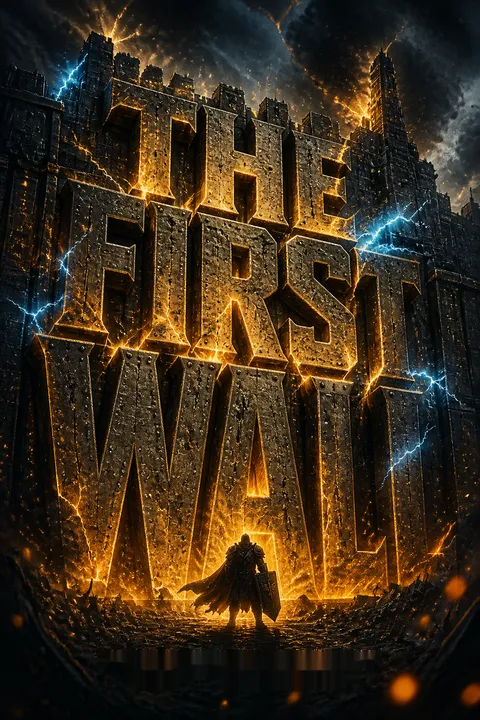


Plot Summary
Prologue
At the edge of the decisive battle, Zenobi Adedeji stands beside General-Captain Egwu as Addaba’s troops gather beneath the smoke-darkened Himalazian sky. When Egwu gives the signal, Zenobi pulls away the cover of the company standard.
Its black eye and the names of thousands of Addaba families are revealed as demolition charges erupt among the reserve tanks and guns. Zenobi declares the corps’ allegiance to Horus. The labourers who travelled across Terra to defend the Emperor have turned their weapons against his cause.
The prologue turns the standard, first entrusted to Zenobi as a sign of loyalty, into evidence of a hidden allegiance. Its embroidered family names make the reversal more than a military surprise: the people whose sacrifice gave the corps its identity have been bound to a cause they believed they opposed. Opening with the betrayal also changes how the reader hears the army’s earlier language of discipline and unity. The suspense is no longer whether the corps will reach the battle, but how a community that believes it is defending freedom can become the instrument of its opposite.
Addaba Sends Its Children
In Addaba Hive, the manufactories that once built farm equipment now produce tanks for Terra’s defence. Seventeen-year-old Zenobi Adedeji had hoped to become a shuttle pilot, but her family’s work and the Emperor’s demand for soldiers leave her marching with the newly raised Addaba 64th Defence Corps.
Captain Yennu Egwu explains that the corps will be sent toward the Imperial Palace, where Horus’s invasion is expected. Before the recruits board their transports, Egwu gives Zenobi the company standard, made by workers who stitched it between exhausting shifts.
Carrying it is both an honour and a duty: if Zenobi falls, another soldier must take it up. She leaves home believing the corps’ sacrifice can protect its people and future generations.
Zenobi’s first responsibility is not to fire a weapon but to carry an object made by people like herself. That choice makes the standard a compact image of the novel’s central problem: institutions turn labour, memory, and belonging into military resources. Egwu’s confidence gives Zenobi a form of recognition rarely available to a factory worker, yet the honour arrives inside a system that has already narrowed her choices. Her private ambition to fly does not disappear; it is displaced by a new wish to make ordinary lives matter in a war too vast for any one soldier to comprehend.
Perturabo Chooses the Port
While the corps travels toward the front, Perturabo studies Rogal Dorn’s immense defences and settles on the Lion’s Gate space port. The fortress rises beyond the Palace wall, but its landing platforms could let Horus bring major ships and reinforcements directly into Terra’s defences.
Forrix, one of Perturabo’s three senior commanders, presses the opportunity. Perturabo rejects the idea that Dorn has simply made an error; he suspects the port is bait, then decides he can turn the trap to his advantage.
Rather than lead the assault himself, he appoints the brutal, less subtle Kroeger to command it. Forrix must follow Kroeger’s orders, even if they appear disastrous, while Perturabo watches for the chance to confuse Dorn about who is directing the attack.
Perturabo’s choice of commander is a tactical maneuver shaped by wounded pride. He wants to outthink Dorn, but he also wants his brother to misread the assault as the work of someone less formidable. By putting Kroeger forward as a blunt instrument, Perturabo tries to convert unpredictability into a weapon. Forrix sees the danger in both the plan and the personality politics behind it, yet his obedience is compulsory. The Iron Warriors’ siegecraft is therefore undermined from within by a familiar pressure: loyalty to a brilliant commander whose need to prove himself can make sound judgement indistinguishable from vanity.
Rann Guards the Gateway
Dorn and Malcador anticipate that Perturabo may target the space port, but Dorn refuses to weaken other Palace defences merely to reinforce it. He gives command there to Fafnir Rann, an Imperial Fists officer with nearly eight hundred thousand army personnel and eighteen thousand legionaries under his authority.
Rann sees that the Iron Warriors will use expendable troops to draw defenders into wasting ammunition and lives. He orders the outer forces to withdraw behind the port’s shields, then prepares the Imperial Fists to strike outward instead of waiting in their trenches.
By saving the strongest guns for the armoured assault to come, Rann intends to make Perturabo spend time and men for every advance. The choice sets a mobile defence against an enemy built for attrition.
Rann’s plan recasts defence as an active choice about what not to sacrifice. He refuses the easy appearance of resolve that comes from holding every trench, because the enemy has designed those positions to consume human lives. His authority is real but bounded: Dorn decides the larger strategy, while Rann must make local decisions without knowing whether the apparent attack is the main one. Their contrast is not between courage and caution. It is between two scales of responsibility, with Rann trying to preserve the people and weapons that the larger war will need tomorrow.
The Train’s Iron Roof
At the Djibou transfer station, Zenobi and her fellow workers board a vast armoured train bound for the Himalazia. Gun towers point inward at the conscripts, while dynastic integrity officers arrive to police loyalty as well as military discipline.
When news comes that Horus’s fleet has reached the Solar System, the officers execute several company leaders judged insufficiently committed. Zenobi is then interviewed by Jawaahir Adunay Hadinet, the severe integrity high officer.
Jawaahir probes Zenobi’s pride in the Adedeji name and her fear of dying far from home; Zenobi insists that how she dies matters more than where her body is buried. The exchange confirms her resolve, but also shows how the corps’ guardians treat doubt as a danger to be punished before battle begins.
The train is both a transport and a moving institution: its closed compartments make surveillance unavoidable, while its immense scale makes each recruit feel replaceable. Jawaahir’s interrogation tests more than political allegiance. She asks Zenobi to turn fear into proof of character, a demand that leaves little room for uncertainty or grief. The executions establish the cost of hesitation before the corps has faced an enemy. Zenobi’s answer is sincere, but the reader can already see the vulnerability in a system that equates emotional complexity with disloyalty and grants its officers the power to decide what loyalty means.
A Book Above the Bunks
On the train, a trooper called Natto introduces Zenobi to the Lectitio Divinitatus, a clandestine book that presents the Emperor as divine and describes a hidden spiritual reality. Zenobi rejects his claims and reports the encounter to an integrity officer rather than keeping quiet.
The corps later gathers to witness the consequences: hundreds of soldiers accused of spreading the book are dead, and their leaders are executed in front of the troops. Zenobi understands that her report helped expose the conspiracy, yet the scale of the punishment leaves her shaken.
She wonders whether a few words from her have condemned people who might have been persuaded rather than killed. The incident deepens her faith in the corps’ cause while teaching her that its methods can resemble the coercion it claims to resist.
Zenobi’s decision to report Natto is the first point at which obedience produces consequences beyond her own safety. The corps presents the Lectitio as an enemy weapon, so reporting it feels like protection of her companions. The mass punishment then makes that simple moral equation harder to sustain. Her guilt reveals an emerging capacity to distinguish loyalty from the actions carried out in its name, even as she continues to accept the officers’ account. The episode also plants the novel’s central irony: a movement that fears religious belief uses its own quasi-religious rituals of confession, sacrifice, and absolute commitment.
Rann Strikes First
As the first assault opens, Iron Warriors artillery pounds the Lion’s Gate space port while a mass of traitor soldiers and mutants advances along Highway Four. Rann lets the enemy commit to the approach, then leads his Imperial Fists out from their prepared positions.
Shield formations push through the horde as armoured columns attack from the flanks, trapping the attackers between infantry and tanks. The manoeuvre kills hundreds of thousands in a few hours and prevents the expendable wave from simply consuming the port’s guns and ammunition.
Rann withdraws his force after the counterstroke, knowing the Iron Warriors and their allies have not yet committed their full strength. The victory buys time, but the growing heaps of dead show that even a successful defence has a price.
Rann’s counterattack is a triumph of timing, but it does not restore control of the war. His force saves its ammunition by making the enemy’s mass serve as its own obstacle, turning numbers into congestion rather than advantage. The sequence also shows how industrial logic governs the siege: soldiers, bodies, guns, and time are counted as resources to be spent or conserved. Rann’s success is therefore ethically uneasy. He refuses to waste loyal troops, yet his tactic still depends on the enemy’s willingness to feed vast numbers of coerced fighters into the killing ground.
Angron Meets the Ward
Kroeger seeks support from the World Eaters, and their captain Khârn recognizes the Iron Warrior’s appetite for direct violence. He demonstrates Khorne’s gifts by tearing through an armoured transport, then urges Kroeger to embrace a power that rewards killing rather than vows.
Kroeger agrees to seek Angron’s aid. During the assault, World Eaters crash toward the space port behind the Iron Warriors, but the defence holds long enough for Angron to enter the battle.
The daemon-primarch destroys a colossal loyalist vehicle and charges the gate, only to be struck back by the Emperor’s silver psychic barrier. With Angron unable to cross, Khârn orders his warriors to withdraw rather than let them be destroyed under the port’s guns. Horus’s commanders must find another way through.
Kroeger’s encounter with Khârn marks the beginning of a change in the Iron Warrior’s motives: violence is no longer merely a method of siege but a source of spiritual reward. Khârn, meanwhile, understands the danger of his own legion’s frenzy well enough to order a retreat when Angron is repelled. That restraint contrasts with the powers they serve, which promise certainty by narrowing a warrior’s world to slaughter. The Emperor’s ward is more than a defensive barrier. It exposes the weakness of Horus’s coalition: its most powerful champions cannot yet enter the ground they mean to conquer.
Poxville’s First Apparition
At the Palatine Arc, now a quarantine district called Poxville, the Death Guard bombard the sick with infected remains and other plague weapons. Katsuhiro, a traumatized soldier assigned to guard the perimeter, struggles to find purpose while searching for the traitor who once escaped him.
One night, he and other guards investigate a green-lit disturbance in their kitchen. Katsuhiro sees a beautiful figure in the wall’s dust and prevents a companion from firing directly at it; the others see something grotesque, and the apparition vanishes under their shots.
Rogal Dorn, Malcador, and Valdor investigate and learn that several witnesses reported different visions. Malcador identifies a daemonic incursion, linking it to the suffering concentrated inside the quarantine zone, though none of them yet knows what opened the way.
The apparition’s contradictory forms make perception itself part of the danger. Katsuhiro sees a figure that awakens longing, while the others experience disgust, suggesting that an intrusion can exploit private needs rather than simply impose a shared image. The location matters: Poxville gathers disease, fear, and forced isolation in one place, creating conditions that both human authorities and supernatural forces can use. Malcador’s explanation gives the event a political as well as psychic dimension. The defenders have contained the sick to protect the city, but containment also concentrates suffering until it becomes a source of vulnerability.
Keeler Enters the Shrine
Custodian Amon searches for the source of the kitchen apparition and discovers a hidden shrine to the Emperor, built around a copy of the Lectitio Divinitatus. The shrine’s wall bears residue from an unnatural cold, evidence that something crossed the Emperor’s ward from within.
Malcador brings Amon to Euphrati Keeler, a former remembrancer who now guides believers in the forbidden faith. Keeler takes him to gatherings where displaced people sing, exchange food, and pray for protection.
Their faith gives them purpose amid hunger and bereavement, but Amon remains wary of its links to the warp. At one gathering, a corporal’s prayer becomes a vehicle for a monstrous presence. Amon kills the possessed woman, confirming that the manifestations are not merely visions or stress-induced hallucinations.
Amon and Keeler embody competing responses to the same crisis. He seeks a source that can be identified and contained; she sees faith as a human answer to conditions that cannot be controlled. Their disagreement is not simply reason against superstition, since Amon has already encountered the supernatural. Rather, he fears that belief creates openings for manipulation, while Keeler believes belief can resist despair. The hidden shrine makes the conflict material: a prohibited faith has entered the Palace’s military spaces, and the residue at the wall suggests that neither official doctrine nor psychic protection can keep human longing neatly outside the war.
The Free Corps Breaks
The troop train carrying Zenobi’s corps is attacked by aircraft as it crosses the devastated territories. Zenobi fires from an improvised anti-aircraft turret before a strike derails several carriages and traps her behind burning ammunition.
She smothers the fire with her uniform and is pulled free, but the attack has killed Sergeant Alekzanda and many others. The survivors continue toward the Palace with little equipment and mounting suspicion. During a later raid, Kettai tackles Zenobi and Menber out of the gunship’s firing line.
When a wounded integrity officer lies unconscious nearby, Tewedros tries to kill him in revenge for Seleen’s disappearance. Zenobi points the officer’s pistol at Tewedros and shoots first, ending the threat but discovering that the first person she has killed is one of her own corps.
The train attack turns war from distant spectacle into bodily risk, while Zenobi’s survival depends on the practical knowledge she acquired in the factory. Her quick improvisation saves her from fire, but it cannot protect the people around her. The later shooting is a sharper moral threshold: she must choose between revenge against a coercive officer and preserving a unit already fracturing under suspicion. Her decision is defensible, yet its cost is immediate and intimate. The corps’ language of traitors and enemies has become a weapon that its own members can turn inward, making the line between protection and violence dangerously thin.
A Tank Named Wrath
With the train abandoned, the surviving Addaba troops march through freezing mountains toward a hidden reserve camp. Seleen is taken away after an integrity officer reads a private letter in which she admits she wishes the war did not have to be fought; Zenobi suspects she will not return.
The corps later encounters tanks from Bakk-Makkah, whose crews agree to carry some of the exhausted soldiers. Zenobi meets Nasha, commander of the tank Breath of Wrath, and the two form an immediate attachment despite the rules against fraternizing with other units.
Their closeness gives Zenobi a private life inside a journey organized around death. She still carries the standard, but her emerging bond with Nasha makes the future she once treated as an abstraction briefly feel personal.
The romance does not interrupt the march so much as reveal what the military schedule has erased. Zenobi and Nasha find tenderness in borrowed warmth, surrounded by cold, exhaustion, and a prohibition against attachment. Seleen’s removal shows the cost of expressing a wish that is not quite disloyal, while Zenobi’s relationship offers a contrasting form of risk: a connection that makes survival newly desirable. Her earlier willingness to die for a future generation is not undone, but it becomes more difficult. The war now asks her to sacrifice something she has actually touched, not merely an imagined life after victory.
Kettai’s Hidden Badge
At the reserve camp, Zenobi continues meeting Nasha in secret, convinced that she may soon be sent into battle. Kettai catches her returning after curfew and reveals that he has been working with the integrity officers as an undercover tester of the troops’ loyalty.
He has watched for signs that the corps’ soldiers would abandon their duties, but Zenobi has never given him reason to doubt her commitment. Rather than report her relationship, Kettai lets her go and warns her that once orders arrive, Addaba must come before everything else.
Soon the reserve army receives orders to attack the Lion’s Gate space port and turn the Iron Warriors’ flank. Zenobi leaves the brief shelter of the camp knowing that her remaining time with Nasha may be over.
Kettai’s revelation complicates the idea of surveillance by showing that the spy has been assessing character, not simply collecting evidence. His mercy is personal and provisional: he permits Zenobi a private attachment because he trusts that she will still answer the call. That trust depends on a hierarchy in which the collective cause can overrule intimacy at any moment. The reserve camp has offered a pause from the siege, but the orders restore the war’s demand for total availability. Zenobi is allowed a choice only because Kettai believes it will not change the choice she ultimately makes.
The Port Goes Blind
As the siege continues, Dark Mechanicum Archmagos Inar Satarael meets Volk-Sa’ra’am, an Iron Warrior fused with a daemon and forbidden technology. They connect the creature to the Lion’s Gate control network, where it can corrupt the port’s machinery and interfere with its sensors.
The disruption makes enemy movements difficult to distinguish from false signals and undermines communication between defenders. At ground level, Forrix’s warriors use Kroeger’s crude plan to enter the port hidden among waves of expendable troops.
They then move through the vast interior toward a target valuable enough to draw the Imperial Fists away from other fronts. Their infiltration succeeds, but the Iron Warriors become isolated inside the space port, cut off from the support they expected and forced to fight for every corridor.
The port’s technology becomes a second battlefield, one in which the usual distinction between infrastructure and weapon breaks down. Volk’s connection to the control systems turns the defenders’ own machinery against them, while Forrix’s concealed force exploits the confusion to move through spaces too large to monitor reliably. Both strategies depend on obscured authorship: defenders cannot tell which signals are true, and Forrix’s men are disguised by the disposable bodies around them. The siege therefore attacks not only walls but the capacity to know where the walls are failing. Information itself becomes a contested resource, as fragile as ammunition.
Abaddon Takes the Sensoria
Horus sends Zardu Layak and Ezekyle Abaddon to aid Perturabo, and Abaddon brings Sons of Horus into the Lion’s Gate fighting. He helps seize the port’s upper sensorium, while Layak uses sorcery to prepare the orbital systems for the arrival of further forces.
Rann struggles to defend several levels at once as the corrupted network feeds him unreliable reports. He refuses Dorn’s permission to destroy the connecting bridges, since loyalists may still need them, and instead calls for Sigismund and additional Imperial Fists.
In the fighting, Rann leads a counterattack into the Starspear and is nearly killed by Kroeger before Sigismund intervenes. Forrix’s infiltrators, meanwhile, are trapped and battered by the defenders. The port’s resistance holds, but its forces are stretched across too many fronts.
The battle’s momentum shifts through a series of choices that are rational in isolation and dangerous together. Dorn preserves the bridges for future use; Rann keeps fighting to prevent a permanent enemy foothold; Abaddon exploits the very systems that make the port strategically valuable. Each commander must act on incomplete information, and the corrupted sensors magnify the cost of uncertainty. Sigismund’s rescue of Rann briefly restores the defenders’ strength, but it does not reverse their strategic predicament. The scene also places Abaddon between battlefield competence and spiritual manipulation, as Layak’s ambitions use his military success for ends he does not fully accept.
The Lightbearers’ Procession
Keeler and the Lightbearers gather thousands along the western processional, hoping that shared faith can protect the Palace. Amon recognizes phrases in their worship that he has heard from daemonic manifestations and warns Keeler that their belief has been infiltrated.
As the congregation becomes possessed, the Lightbearers see themselves as defended by holy power, while Amon sees a growing daemonic swarm. Keeler turns inward to the tree from her visions and discovers a wormlike presence feeding on its roots.
She pulls against it, using the chain of faith that bears Kyril Sindermann’s name to climb from the spiritual mire. In the world outside, her struggle releases Cor’bax Utterblight. Malcador attacks the daemon with psychic fire, and Amon kills it from within its body, ending the immediate possession.
Keeler’s crisis is not resolved by abandoning faith but by testing what faith has been made to serve. The same inner landscape that once gave her comfort now shows decay hidden beneath beauty, forcing her to revise her understanding without surrendering the need for belief. Sindermann’s chain makes spiritual support concrete: another person’s faith helps her act when her own vision has been compromised. Yet the victory is not clean. Cor’bax becomes physically present, the possessed crowd has to be rescued from its delusion, and the Emperor’s ward has weakened. Faith proves capable of resistance, but never innocent of risk.
The First Wall Falls
When communication with the Lion’s Gate space port collapses, Dorn orders a retreat, judging that the defenders must survive to fight at the next line. Sigismund stays in the battle and confronts Khârn, but the World Eater’s unnatural strength overwhelms him.
Dorn arrives with reinforcements and drives Khârn away, then meets Layak, who spends his life in sorcery to open a breach through the Emperor’s ward. The first true daemon steps onto Terra. Perturabo’s flagship, the Iron Blood, descends into the port, and the Iron Warriors seize the ground they have fought to take.
Perturabo refuses Dorn’s challenge to settle their rivalry in single combat. He intends to demolish the wider Palace before claiming personal victory, while Dorn withdraws to defend the next wall.
The port’s fall is both a military defeat and a change in the nature of the siege. Layak’s sacrifice allows the immaterial enemy to cross a boundary that had previously limited its presence, while the Iron Blood’s arrival converts the captured port into a route for overwhelming reinforcements. Dorn’s withdrawal is not simple surrender; it is an attempt to preserve the capacity to resist after the first defence has failed. Perturabo, by refusing a duel, reveals the scale of his ambition. He wants his victory to include the destruction of everything Dorn has built, not merely proof that he can defeat his brother.
Titans Reach the Starspear
After the space port is lost, Perturabo establishes his siege headquarters and the first Titans of the traitor Legio Fureans emerge from the landing works. Dorn and his allies accept that the Emperor’s protective ward has contracted toward the Inner Palace, leaving the outer defences exposed to daemons as well as armies.
The Khan volunteers to reinforce the Lion’s Gate, while the Custodians withdraw to concentrate on protecting the Emperor. Malcador keeps Keeler under his protection and allows the Lectitio Divinitatus to continue for now, despite Amon’s evidence that belief can be exploited.
Amon is assigned to keep watch on the movement and receives the name Longinus. The defenders have lost the port, but the war remains active and the next wall is already under threat.
The aftermath refuses the comfort of a settled ending. The arrival of Titans expands the scale of the threat just as the defenders lose the shield that once kept daemons outside the Palace. Amon’s new duty formalizes the novel’s unresolved question: belief may shelter people, attract predators, or do both at once. By permitting the cult to continue, Malcador accepts uncertainty as a strategic condition rather than a problem that can be eliminated by decree. The siege has not taught its leaders what faith is; it has shown them that they may have to depend on it before they understand its cost.
Epilogue
In the Khertoumi Wastes, an exhausted man steps through a tear in the air as the distant hive city of Addaba burns. An elderly nomad gives him water and points him toward the Imperial Palace.
He introduces himself as John, says he belongs to neither Horus nor the Emperor, and walks into the darkness alone. His arrival offers no explanation, only a new presence moving through a war that has consumed entire worlds.
The epilogue widens the frame after the fall of the Lion’s Gate, replacing armies and primarchs with one weary stranger and one survivor in the desert. John’s refusal to identify with either side unsettles the war’s defining division without explaining what he represents. The nomad’s family has been taken and her city destroyed, so her practical offer of water carries more force than any grand claim of allegiance. The scene ends not with resolution but with movement toward the Palace, implying that even in a conflict dominated by gods, a solitary human arrival can open another line of story.
Analysis
The First Wall treats a siege as a struggle over the conditions that make loyalty possible. Its three interwoven stories measure attrition in different currencies. Rann and Perturabo spend soldiers, ammunition, and time against the Lion’s Gate. Zenobi’s corps loses companions, equipment, and confidence during its long journey. Amon and Keeler confront the erosion of the Emperor’s psychic protection and the uncertain power of belief. Each front asks what a person or institution can endure before its identity changes.
Zenobi’s story gives this question its most intimate scale. Her standard begins as a record of collective labour, and her conviction grows from the real people whose names and work it represents. Yet the corps’ language of purity and loyalty also prepares it to accept claims that cannot survive scrutiny. Its violent policing of doubt does not expose the final betrayal; it helps conceal it by teaching soldiers to treat obedience as proof. The prologue’s reversal is therefore not only a twist about allegiance. It shows how sincerely held identity can be redirected when institutions control the terms through which people understand their own sacrifice.
The faith plot makes a related argument without reducing religion to either salvation or delusion. The Lectitio gives refugees and soldiers a community, but its imagery can be appropriated by the Neverborn. Keeler’s decisive act is not to trust every vision. She recognizes that something feeding on hope has entered the vision she depends on, then uses relationships and tested belief to resist it. Amon’s scepticism protects him from one form of manipulation, but it cannot supply meaning to the desperate people he studies. Their conflict suggests that belief is neither inherently pure nor inherently corrupt; its moral force depends on what it connects people to and what they are willing to question.
Perturabo and Dorn give the same conflict a physical form. One wants a victory that proves his superiority; the other measures success by how long the Palace can remain defended. Perturabo captures the port, but the victory costs time and warriors, and Dorn preserves the ability to retreat to another wall. The book’s ending refuses a final verdict. The siege continues, the ward narrows, and faith remains both resource and risk. Survival depends not on certainty, but on recognizing what each form of loyalty is asking people to surrender.
Review Summary
The First Wall receives mixed reviews, with ratings ranging from 1 to 5 stars. Some readers praise its epic scale, character development, and unexpected twists, while others criticize its pacing, unnecessary subplots, and perceived inconsistencies. Many appreciate the book's exploration of faith and the detailed battle scenes, particularly the assault on Lion's Gate Spaceport. However, some find the narrative structure confusing and feel it doesn't advance the overall story significantly. Despite criticisms, fans of the Warhammer 40,000 universe generally find it a worthy addition to the Siege of Terra series.
Characters
Zenobi Adedeji
The standard bearerA seventeen-year-old factory worker from Addaba, Zenobi joins the defence corps after her home hive turns its production lines to war. She is mathematically gifted, practical, and used to finding order in systems where a small failure can kill workers. Captain Egwu entrusts her with the company standard, giving her a responsibility that joins family memory to public duty. Zenobi wants her life to mean something beyond the factory floor, but she is not free of fear or longing. Her bond with her cousin Menber and her growing affection for the tanker Nasha reveal how much she has to lose. She is both a devoted soldier and an ordinary young woman trying to imagine a future inside a war that has made that future uncertain.
Perturabo
The calculating siege-masterThe primarch of the Iron Warriors is a military genius who sees fortifications as puzzles and battles as proofs of intellect. He studies Dorn’s defences with obsessive precision and wants the Lion’s Gate space port to open a route into the Imperial Palace. Perturabo is acutely sensitive to being underestimated and measures achievement by whether his opponents recognize his superiority. That need coexists with genuine strategic brilliance, making it difficult for his officers to separate audacity from wounded pride. His relationship with Dorn is shaped by rivalry and a desire to demonstrate mastery, while his command of the Iron Warriors reflects his belief that victory can justify almost any cost.
Rogal Dorn
The Palace’s immovable defenderDorn, primarch of the Imperial Fists and Praetorian of Terra, has spent years transforming the Imperial Palace into a fortress. He thinks in systems, reserves, and lines of defence, and bears responsibility for decisions affecting soldiers and civilians across a vast war zone. His discipline can look like emotional distance, especially to subordinates who want recognition or to believers who challenge his certainty. He trusts military preparation more readily than spiritual claims, yet he must confront forces that his fortifications cannot fully contain. His rivalry with Perturabo is deeply personal, but Dorn’s priority remains the survival of the Palace and the Emperor it protects.
Fafnir Rann
The mobile wallRann is an Imperial Fists commander placed in charge of the Lion’s Gate space port. Unlike a static fortress, he treats his assault cadre as a wall he can move to meet the enemy. He respects the discipline of his warriors and tries to preserve army lives rather than spend them to satisfy an abstract plan. His approach requires confidence, timing, and a willingness to act without complete information. Rann’s Inwit upbringing and blunt humour make him an approachable commander, but his authority is tested by the sheer scale of the port and the limits imposed by Dorn’s wider strategy. He represents a form of defence based on adaptation rather than simply endurance.
Ezekyle Abaddon
Horus’s battle-hardened heirAbaddon, First Captain of the Sons of Horus, is most at ease when combat offers a clear enemy and an immediate objective. His military instincts remain formidable, but the growing influence of Chaos around Horus’s court troubles him. He watches former comrades and allies change under supernatural powers and questions what those powers demand in return. Abaddon is loyal to Horus and proud of his Legion, yet he does not trust every priest or commander who claims to speak for their cause. His relationship with Layak is marked by suspicion, while his concern for other warriors suggests that brotherhood still competes with ambition and obedience.
Euphrati Keeler
The faith’s reluctant guideA former remembrancer, Keeler becomes a prominent guide for people who find hope in the Lectitio Divinitatus and the worship of the Emperor. She is compassionate toward the displaced and refuses to treat their faith as merely a political inconvenience. Her experiences have convinced her that supernatural forces are real, but certainty does not protect her from being deceived by them. Keeler’s visions give her a way to perceive the conflict between the Emperor and Chaos, while her relationship with Amon forces her to confront the danger of belief as well as its power. She is neither a detached prophet nor a simple symbol; she is a person trying to interpret experiences that can save others and expose them to harm.
Amon Tauromachian
The Custodian investigatorAmon is a Custodian tasked with protecting the Emperor and investigating supernatural disturbances within the Palace. Trained to notice patterns and eliminate threats, he approaches the Lectitio Divinitatus with suspicion, especially because its rituals appear near daemonic activity. He is patient, observant, and uncompromising, but his investigation brings him into contact with suffering that cannot be reduced to evidence. Keeler challenges his assumption that religious belief is only a weakness, while Malcador asks him to distinguish the faith of ordinary people from the forces that exploit it. Amon’s struggle is not to become a believer, but to understand how an absolute duty can function in a world where certainty is unavailable.
Yennu Egwu
The scarred company commanderEgwu is Zenobi’s company commander and a veteran shaped by the demands of Addaba’s industrial life and the coming war. Her burn scars and steady manner mark her as a leader who has endured hardship rather than merely issued orders from safety. She recognizes Zenobi’s reliability and entrusts her with the company standard. Egwu understands the scale of the sacrifice expected from the corps and tries to give its soldiers a shared purpose. Her authority operates within a harsh command system that increasingly treats doubt as a threat, leaving her to balance care for her people against the demands of discipline and survival.
Sigismund
The Emperor’s relentless swordSigismund is an Imperial Fists First Captain and leader of the Templars, known for his skill and severity in battle. He is a warrior accustomed to measuring himself against formidable opponents and takes pride in serving a defined duty. Keeler’s spiritual claims disturb his relationship with Dorn, whose authority has shaped his life and military identity. Sigismund is not naturally drawn to abstract faith, but he is willing to examine what his experiences demand of him. His loyalty to his Legion and his search for a worthy purpose place him under pressure as the siege brings him into conflict with enemies who draw strength from powers beyond ordinary combat.
Kydomor Forrix
The Iron Warrior realistForrix is one of Perturabo’s senior Iron Warriors and a veteran of campaigns reaching back to Terra’s unification. He thinks strategically and understands the cost of a plan beyond its first bold move. Perturabo’s appointment of Kroeger leaves him obliged to follow a commander he considers inexperienced, while the other Iron Warriors around him become increasingly altered by Chaos. Forrix values the Legion’s survival but is not blind to its willingness to spend lives for victories that may benefit Horus more than the Fourth Legion. His pragmatism makes him an effective commander and an uneasy observer of what his Legion is becoming.
Khârn
The World Eaters’ championKhârn is a captain of the World Eaters whose combat skill is increasingly bound to the violent impulses of the Butcher’s Nails and the influence of Khorne. He understands the Legion’s appetite for battle and can sometimes direct it, even when his own thoughts are being pulled toward slaughter. His history with Sigismund gives their conflict a personal dimension beyond the larger siege. Khârn’s strength is undeniable, but his growing certainty comes at the cost of reflection and restraint. He embodies the attraction and danger of a power that promises purpose by narrowing every choice to the act of killing.
Zardu Layak
Horus’s daemon-summoning apostleLayak is a Word Bearers sorcerer and spiritual adviser to Horus, skilled in rituals that connect physical violence to the powers of the warp. He believes that sacrifice and faith can alter the boundary between worlds, and he sees the siege as part of a greater religious transformation. His masked presence and controlled speech make him difficult for Abaddon to trust. Layak treats the price of supernatural power as necessary, even when that price is his own humanity. He is a mediator between the military ambitions of Horus’s commanders and the spiritual agenda of Chaos.
Malcador
The Regent between worldsMalcador, Regent of the Imperium, advises Dorn and manages threats that military commanders cannot easily classify. He understands the psychic danger surrounding Terra, but he is willing to tolerate the Lectitio Divinitatus when suppressing it could fracture the defenders. His judgement is pragmatic rather than doctrinal: he weighs what people believe against what their belief might make possible. Malcador supports Amon’s investigation while also protecting Keeler from a premature crackdown. His confidence in uncertainty sets him apart from both Dorn’s military precision and Amon’s demand for clear rules.
Katsuhiro
The haunted quarantine guardKatsuhiro is an Imperial Army soldier assigned to guard the plague quarantine zone. Traumatized by earlier failures, he is preoccupied with survival and guilt, and he searches for a traitor who escaped him. His encounter with an apparition in the garrison kitchen unsettles his already fragile sense of reality. Katsuhiro gives the daemon strand a mortal point of view, one shaped by fear, exhaustion, and the knowledge that orders may require him to treat the sick as threats.
Menber Adedeji
Zenobi’s steadfast cousinMenber is Zenobi’s cousin and fellow Addaba recruit. He offers her practical reassurance during the journey and shares her belief that the corps serves a cause larger than its own survival. Unlike Zenobi, he is often quicker to question what the officers’ rules conceal. Their family bond gives Zenobi a point of continuity as home recedes and the corps changes around them.
Jawaahir Adunay Hadinet
The Iron WardenJawaahir is the integrity high officer assigned to the Addaba troops, formerly known for overseeing a correctional complex. She is disciplined, sharp, and convinced that wavering commitment can endanger an entire unit. Her methods turn suspicion into a daily condition of military life, and her authority reaches beyond ordinary training and discipline. She provides Zenobi’s clearest early encounter with a system that treats loyalty as something officers can test and define.
Kettai
The watchful platoon mateKettai is a soldier in the Addaba corps whose jokes and casual manner conceal close attention to those around him. He helps Zenobi survive the train attack and becomes a companion during the march and the reserve deployment. His relationship to the corps’ integrity system makes him a source of both suspicion and unexpected compassion. Kettai’s presence tests how well Zenobi can distinguish a friend from a watcher.
Nasha
The tank commanderNasha commands the Bakk-Makkah tank Breath of Wrath. He meets Zenobi when his armoured column encounters the exhausted Addaba troops in the mountains. Their attraction gives both of them a brief private refuge amid the march and the approaching battle. Nasha has no grand claim to inherited greatness; he sees himself as an ordinary man given an extraordinary vehicle and responsibility.
Barban Falk
The altered WarsmithFalk, one of the Iron Warriors’ senior commanders, insists on the title Warsmith and is no longer the person Forrix remembers. His altered nature creates unease inside the Legion even as he remains close to Perturabo’s command. Falk represents the danger that political rank and personal identity can survive after a warrior’s loyalties have changed.
Kroeger
Perturabo’s blunt weaponKroeger is the Iron Warrior appointed to lead the attack on the Lion’s Gate space port. He is a forceful, direct fighter rather than a subtle strategist, a quality Perturabo deliberately uses to complicate Dorn’s expectations. His appetite for violence makes him receptive to Khârn’s offer of Khorne’s favour. Kroeger’s command tests whether brute persistence can serve a larger plan without consuming the commander himself.
Inar Satarael
The Dark Mechanicum architectSatarael is an Archmagos of the Dark Mechanicum who pursues a new order for technology and the Legions. He builds a compact warform for the Lion’s Gate operation and works with Volk-Sa’ra’am to interfere with the port’s systems. His willingness to join machinery to warp power reflects a vision of progress without the old boundaries of human or machine.
Volk-Sa’ra’am
The daemon-machine hybridVolk-Sa’ra’am is an Iron Warrior transformed by a daemon and Dark Mechanicum experimentation. His body shifts between armour, machinery, and unnatural flesh. Satarael treats him as a partner in altering the Lion’s Gate control systems, while Volk sees himself as an instrument capable of obliterating opposition. He makes the alliance between technology and Chaos physically visible.
Olivier Muižnieks
The Lightbearers’ leaderOlivier leads the Lightbearers, a growing community of Emperor-worshippers who gather in the Basilica Ventura. He offers warmth, ritual, and a sense of welcome to people living amid hunger and bombardment. His persuasive manner makes the group grow quickly, while Keeler’s presence strengthens its influence. Olivier’s role raises the question of when shared hope becomes vulnerable to forces that imitate it.
Kyril Sindermann
Keeler’s trusted allySindermann, once an Imperial Iterator, becomes one of Keeler’s closest allies and a figure within the growing Lectitio movement. His experience with the Imperial Truth gives him a complicated perspective on the return of religious belief. He supports Keeler while remaining an independent voice, and his personal faith becomes a source of strength during her spiritual crisis.
Angron
The daemon primarch of KhorneAngron is the World Eaters’ primarch, transformed into a daemon champion of Khorne. He seeks battle wherever he can find it and embodies the physical force of the traitor assault. The Emperor’s ward limits where he can go, making him both a terrifying weapon and a sign of the barrier Horus still has to overcome.
Plot Devices
The Emperor’s telaethesic ward
The barrier that holdsThe Emperor’s psychic protection surrounds Terra and prevents daemons from freely entering the Palace. Its effects shape the siege: Angron is repelled at the Lion’s Gate, while Horus’s commanders search for ways to weaken it from within. The ward does not make the defenders invulnerable, and its gradual contraction signals that the Emperor cannot protect every part of Terra indefinitely. Its weakening connects the physical assault on the port to the spiritual conflict involving Keeler, Amon, and Layak.
The Lectitio Divinitatus
Faith under suspicionThe Lectitio Divinitatus is a religious text that presents the Emperor as divine. Its followers find community and hope through prayer, song, and shared aid, while Imperial authorities worry that worship violates the Emperor’s rejection of religion. In the siege, its spread intersects with daemonic manifestations, leaving characters unsure whether faith invites corruption, resists it, or can do both. The book links Keeler’s spiritual visions to Zenobi’s encounter with forbidden belief and Amon’s effort to distinguish human need from supernatural exploitation.
Zenobi’s company standard
A banner of divided loyaltyEgwu gives Zenobi a handmade standard stitched by Addaba workers, entrusting her with the duty of keeping it safe. For Zenobi, it carries the labour, family history, and hopes of her home hive. Its presence accompanies her through the long journey to the Palace and makes her commitment visible to the corps. The banner’s meaning shifts as the story reframes the Addaba soldiers’ loyalty, turning a symbol of communal sacrifice into a sign of how identity can be claimed by a cause its bearers misunderstand.
The corrupted port network
Confusion inside the fortressVolk-Sa’ra’am’s connection to the Lion’s Gate systems allows the traitors to interfere with sensors, communications, and other machinery. The defenders receive false and unreliable reports, making it harder to distinguish real landings from decoys or to coordinate a response across the enormous space port. The disruption helps the Iron Warriors exploit the port’s internal routes and makes ordinary military planning less dependable. It demonstrates that the siege can penetrate a fortress through its information systems as well as through its walls.
The reserve army’s journey
A delayed force of destinyThe Addaba Free Corps travels from its industrial hive toward the Himalazian front by transport planes, an enormous troop train, and finally on foot. Each stage strips away equipment and companions while bringing the soldiers closer to a battle they have imagined for years. The journey creates room for Zenobi’s relationships with Menber, Seleen, Kettai, and Nasha, while the integrity officers police what the soldiers believe and say. The corps’ arrival matters because it is meant to turn the fighting at the Lion’s Gate, but its passage also hides a deeper danger.
Download PDF
Download EPUB
.epub digital book format is ideal for reading ebooks on phones, tablets, and e-readers.








