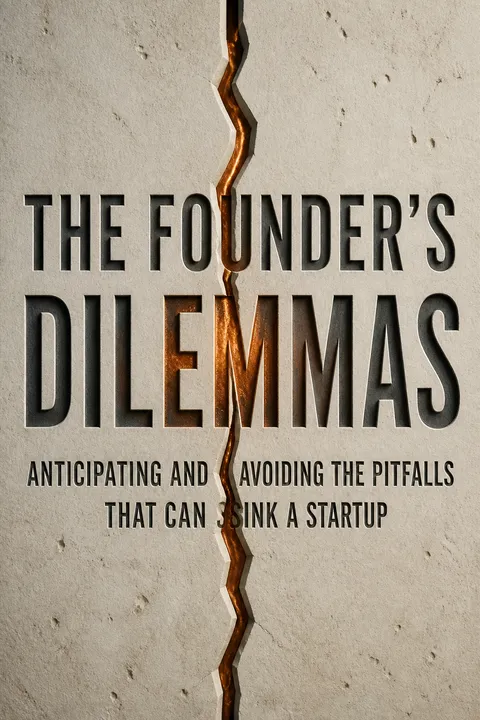


Key Takeaways
Choose whether you want the bigger company or the bigger share of control
The hidden trade-off. Founders often want both a valuable company and lasting authority over it. But growth usually requires resources from people who expect equity, decision-making power, or both. Wasserman calls the financial-payoff path a “Rich” outcome and the control-retaining path a “King” outcome. In data from 460 startups, founders who retained control of both the CEO role and the board held equity stakes worth only about 52% of those held by founders who gave up both forms of control.
Williams chose differently. At Blogger, Evan Williams resisted investors and protected his vision, but the company struggled for resources. At Odeo, he accepted venture capital and experienced executives to pursue faster growth, then chafed at the influence he had invited. The lesson is not that one goal is superior, but that choices should match the founder’s true priority.
The distinction clarifies why startup decisions can look irrational from the outside: a founder may be optimizing for autonomy rather than financial return. It also resembles a classic organizational-design problem, in which authority and incentives are distributed among owners, managers, and contributors. The useful question is not simply how much equity remains, but who can decide strategy, appoint the CEO, and approve a sale. The framework is strongest as a prompt for self-knowledge, not as a rigid binary. Founders may value wealth and control differently across life stages, and a deliberate trade-off can be revisited as circumstances change.
Found when career, personal life, and market readiness overlap enough
Readiness has three parts. A founder’s decision to leap depends on career preparation, personal circumstances, and the market opportunity. Career preparation includes relevant skills, industry knowledge, contacts, and savings. In Wasserman’s dataset, founders averaged 14 years of prior work experience, but there was no single best age: 35% had worked for at least 20 years, while others founded early.
Waiting has a price. More experience can build useful capabilities, but salary, status, family obligations, and legal restrictions can make leaving harder. Humphrey Chen rushed toward a music startup while his new family wanted stability; Barry Nalls waited until he had deep telecom experience and a financial cushion. Passion helps founders act, but can also inflate their forecasts. One cited survey found 95% of entrepreneurs thought their own startup had better than even odds of success.
This three-part readiness check improves on the familiar advice to wait until everything feels safe. It treats founding as a fit between a person, an opportunity, and a moment, rather than a personality test. Career research also suggests that experience matters most when it transfers to the task at hand, not when it merely accumulates as years on a résumé. The framework cannot eliminate uncertainty: a market window may close while a founder is preparing, and personal constraints are not always negotiable. Its practical strength is diagnostic. Identify the weakest condition, then decide whether to improve it, accept its cost, or postpone.
Add cofounders only when their missing strengths outweigh coordination costs
A team fills holes. Cofounders can contribute human capital, such as technical or managerial skill; social capital, such as customer and investor connections; and financial capital. They can also share workload and provide emotional support. In the technology and life-sciences startups studied, only 16.1% were founded by one person. Experienced managers were more likely to found solo, but that route can leave a company short of expertise or capacity.
More people are not automatically better. Every cofounder adds communication demands, potential role overlap, and a claim on equity. At UpDown, the founder added classmates with similar business backgrounds, but still needed a programmer to build the product. The test for each proposed cofounder is marginal value: do they supply a capability, network, or workload relief that the startup actually needs? Outsourcing, advisors, or later hires may sometimes fill the gap with less lasting complexity.
The chapter treats team formation as a resource-allocation choice, not a vote for collaboration in the abstract. That is useful because teams can expand information and problem-solving capacity while also increasing coordination costs. Group research often finds that diversity helps with complex tasks, but only when members can integrate their different knowledge. A small team with distinct expertise may therefore outperform a larger team with duplicate strengths. The calculus is context-dependent: a solo founder in a simple, slow-moving business faces different demands from a founder racing to build a complex medical technology. Headcount is a weak proxy for capability; complementarity is the sharper test.
Choose cofounders for complementary skills, not just familiar chemistry
Comfort can narrow the search. Founders naturally recruit people who resemble them or whom they already know. That can speed trust and communication, but homogeneous teams may share the same skill gaps and networks. Diverse functional expertise and contacts can widen a startup’s options. At Pandora, musician Tim Westergren recruited a business builder and a technical leader instead of assembling a team of fellow musicians.
Personal ties carry special risk. The “Playing-with-Fire Gap” describes the combination of high relationship damage if a partnership fails and a low willingness to discuss uncomfortable problems. In one study of nearly 400 startups, each additional preexisting friendship or family tie increased the likelihood of a cofounder leaving by 28.6%. Former coworkers were more stable on average than friends, family, or strangers. Close ties are not forbidden, but require candid expectations, conflict procedures, and practical separation between personal and work roles.
The apparent contradiction is important: teams benefit from diversity in expertise, but often benefit from similarity in commitment, values, and tolerance for risk. This resembles the distinction between task diversity and relational compatibility in team research. Diversity supplies more possible solutions; trust and shared norms make it possible to use them. The evidence about personal ties should not be treated as a universal ban on working with friends or relatives. It signals that social familiarity can create false confidence about professional fit. A trial project is a better test than friendship alone, because it reveals how people share credit, handle disagreement, and deliver under pressure.
Give founders clear authority, then redesign it as the company changes
Titles shape real power. A title may begin as a label, but it affects authority, expectations, and future status. At founding, 74% of startups in the sample had more C-level founders than lower-ranking founders, and 36% gave every founder a C-level title. Such title inflation can make later hiring or demotion painful. The idea person often becomes CEO, yet passion for the idea does not guarantee the skills needed to lead a larger company.
Decision rules should fit the stage. Consensus can bring more information into early choices, but it can stall a fast-moving company. A single decision-maker can act quickly, but may ignore useful feedback. Some teams begin collaboratively and move toward clearer authority as roles specialize. The useful compromise is to gather broad input, name who owns the decision, and set a method for resolving deadlock. Avoid co-CEO arrangements used merely to dodge a difficult conversation.
This is a problem of decision rights as much as leadership style. Organizational research distinguishes debate about the task from interpersonal conflict: disagreement over ideas can improve a decision, while unclear authority can turn that debate into recurring friction. A founder’s title also creates path dependence because employees and investors organize around it. Clear authority need not mean unchecked authority. A team can specify which decisions belong to the CEO, which require board approval, and when consultation is expected. The important limitation is that no structure remains optimal as a company grows. Good governance makes revision possible instead of treating the first org chart as destiny.
Treat founder equity as adjustable compensation, not a permanent handshake
Fairness changes with evidence. Equity discussions should weigh prior contributions, opportunity cost, expected future work, and motivation. The person with the idea may deserve a premium, but the idea’s maturity and the work still required matter. Research in the book found an average idea-person premium of 10 to 15 percentage points. Yet 33% of teams split equity equally, and teams that reached a quick equal split received lower first-round valuations than teams that negotiated longer, including teams that ultimately split equally.
Build in change. A dynamic equity agreement lets ownership adjust when commitment, roles, or circumstances change. Vesting makes founders earn shares over time or through milestones; buyback terms address a founder who leaves or reduces involvement. Robin Chase’s quick 50-50 Zipcar split became a source of frustration when her cofounder did not join full-time. By contrast, Ockham’s buyback provisions anticipated a cofounder’s possible departure. Put the agreed rules in writing.
Equity combines money, status, and a judgment about whose effort counts, which explains why negotiations feel more personal than their spreadsheets suggest. Behavioral research on anchoring helps explain why an early split can be difficult to change even after better information arrives. Dynamic terms respond to that uncertainty, but contracts cannot measure every contribution or predict every pivot. Milestones can become obsolete, and rigid formulas may reward the wrong work. The strongest agreements therefore pair clear contingencies with a process for renegotiation. They are not evidence of distrust. They are a way to protect the relationship from relying on incompatible memories of an informal promise.
Keep relationships, roles, and rewards aligned as one system
The Three Rs interact. The Three Rs System links relationships, roles, and rewards: who the founders are to one another, how authority and work are divided, and how financial gains are shared. A choice that works alone can fail when paired with conflicting choices. Evan Williams gave Meg Hourihan the CEO title at Blogger’s start, but their shared decision-making and personal relationship sat uneasily beside his larger equity stake and desire for control. Tensions grew until Meg left.
Alignment is situational. Friends may expect equality and collective decisions; former coworkers may be more comfortable with hierarchy and contribution-based rewards. Neither arrangement is universally correct. A team of former coworkers might be stable with unequal equity, while friends may be better aligned with an equal split. The system also needs review when roles, commitment, or the business change. Regular, explicit discussion can reveal misalignment before it becomes a resignation, a legal dispute, or a stalled decision.
The Three Rs are useful because they make a vague sense of team friction diagnosable. A disagreement about fairness may actually arise from a role mismatch, an unstated expectation created by a past relationship, or a reward that no longer reflects effort. This systems view resembles organizational alignment models, where strategy, structure, and incentives must reinforce one another. It also warns against importing one social logic into every decision: equality can preserve closeness, while contribution-based rewards may support a performance-oriented team. Alignment should not be confused with harmony at all costs. Productive teams need room to disagree, but their rules should make the consequences understandable.
Hire for the startup's current stage, not its imagined final form
People needs evolve. Early startups often need flexible generalists because products, strategy, and roles are still uncertain. As the business stabilizes, specialized expertise and managers become more valuable. A strong salesperson hired before the product was ready once pushed a startup to demonstrate features it could not deliver, wasting engineering time and disappointing customers. Hiring should track what the company needs now and what the next stage will demand, while recognizing that different functions mature at different speeds.
Fit includes incentives. Founders supplied 49% of executive hires in the data, but investor networks became more important as companies matured. Cash-poor firms may use equity, salary, or performance bonuses in different combinations. The book also finds a “founder discount ”: comparable founders received about $25,000 less salary than nonfounding executives, partly because attachment to the company weakens their bargaining power. This gap disappeared in companies with about 100 employees.
Hiring is not a one-time search for talent; it is a recurring fit between skills and organizational uncertainty. Generalists preserve flexibility when the work itself is changing, while specialists can raise quality when tasks become stable enough to define. This is similar to the logic of real options: flexibility has value when the future is unclear, and that value declines as uncertainty resolves. A danger is using “culture fit” to justify familiar, comfortable hires rather than useful differences. Compensation also shapes behavior, not just acceptance. A founder’s devotion can benefit the company, but should not become an excuse for underpaying the person carrying its greatest responsibility.
Take investor money for its resources, but price every control right
Capital buys time and influence. Before outside financing, the median startup in the dataset had a monthly burn rate of $75,000 and just over four months of cash remaining. Friends and family can be accessible but may lack expertise and expose close relationships to financial loss. Angels vary widely in experience and involvement. Venture capitalists can bring larger checks, industry guidance, contacts, and credibility, but expect ownership and governance rights.
The term sheet changes the company. By the third financing round, venture capitalists held more than half the equity on average in the startups studied. A liquidation preference can give investors priority in a sale, leaving founders with nothing from a modest exit. Board seats, veto rights, and staged financing also shape decisions. Founders can improve leverage by raising money before cash runs out, building a product or customer base first, and comparing competing offers. The right capital is not simply the largest check, but the package whose benefits justify its costs.
The book’s resource-dependence lens explains why financing is never just a transaction: capital changes who can influence strategy and leadership. A useful financial analogy is the difference between a loan’s stated rate and its full cost. Ownership percentage alone misses liquidation preferences, board composition, vetoes, and future dilution. Yet control costs should not obscure the value investors can provide. A capable investor may improve hiring, planning, and credibility, especially when the founders lack those resources. The evidence is mainly drawn from US technology and life-sciences companies, so its financing patterns should not be assumed to fit bootstrapped firms or other markets.
Treat founder succession as a process, not a verdict on past success
Success can trigger replacement. In Wasserman’s data, 73% of founder-CEO changes were initiated by the board or another party, not by the founder. By the third financing round, more than half of startups had replaced the original founder-CEO. The causes include poor performance, but also success: completing a product and raising capital can shift the company from technical invention toward sales, hiring, and operational management. The founder who excelled at the first stage may not be the best leader for the next.
Prepare before a crisis. A board can coach the CEO, clarify what new skills the company needs, and discuss succession expectations early. A founder who initiates the change can have more influence over the search and a continuing role. At Wily Technology, technical founder Lew Cirne was replaced as CEO as the company entered a broader commercial phase. He ultimately accepted that the next stage needed different capabilities, though the change was deeply unsettling.
Succession is easier to understand as a change in organizational demands than as a simple judgment of personal worth. The same leader can be excellent at building a prototype and poorly suited to managing a scaled sales organization. That distinction helps separate identity from role, a separation that is difficult when the founder sees the company as an extension of the self. The challenge is not merely selecting a successor; it is transferring authority in a way employees can recognize. Keeping a founder can preserve knowledge and commitment, but only if the new CEO has genuine room to lead. Ambiguous authority turns transition into shadow management.
Build skills, savings, and relationships before your startup needs them
Preparation creates bargaining power. Relevant experience, professional networks, and personal savings can help a founder attract people and investors on better terms. Barry Nalls used decades of telecom experience and a cash cushion to launch Masergy; younger founders such as Humphrey Chen had less financial protection and fewer industry connections. Preparation does not guarantee success, and waiting can strengthen salary, status, and family obligations, so the aim is not endless readiness but a deliberate resource base.
Keep the exit in view. Earlier decisions shape who can approve a sale and who receives its proceeds. In the cited venture-backed sample, acquisitions were nearly three times as common as IPOs. An earn-out may offer additional upside, but ties part of the payout to post-sale targets and gives the founder less control. Serial founders can learn from prior attempts, but each new startup still requires a fresh assessment of motives, people, and market conditions.
This closing principle reframes preparation as an investment in future choice. Savings can extend a founder’s runway; networks can reduce dependence on a single gatekeeper; relevant experience can make a smaller team viable. Together, these assets create bargaining power without guaranteeing that the founder will retain control or become wealthy. The exit examples also show why a headline offer is incomplete information: timing, payout priority, post-sale obligations, and the founder’s desire to keep building all matter. These insights are most useful when treated as questions to ask before committing, not as formulas that predict which path will succeed.
Analysis
The book’s most valuable move is to shift attention from the startup idea to the people and agreements that make the idea executable. It argues that failure often begins inside the company: unspoken expectations, mismatched roles, static equity, and resource decisions made without acknowledging their control costs. That approach is unusually practical because it connects personal choices to organizational outcomes. Founding alone, choosing a friend, naming a CEO, setting salaries, and accepting a term sheet are not isolated episodes. Together they form a path-dependent governance system.
The Rich-versus-King distinction gives that system a memorable organizing question, but its apparent simplicity needs care. Wealth and control are not always clean opposites. A founder can retain meaningful product authority while delegating operations, or accept capital while negotiating board protections. The important unit is not the founder’s equity percentage but the actual distribution of decision rights, risk, and upside. The book’s own cases demonstrate that priorities can shift with exhaustion, market urgency, or experience, so consistency should mean coherence with current aims, not stubborn loyalty to an old identity.
Its evidence is substantial for a difficult-to-study topic: nearly 10,000 founders across 3,607 US technology and life-sciences startups, combined with detailed cases. Still, most findings are associations from a selected population, much of it involving companies willing to disclose information and many with outside financing. They do not establish that a given team structure causes success, nor do they transfer automatically to small owner-operated businesses, nonprofits, or other national settings. The strongest application is therefore not mechanical imitation of percentages. It is disciplined anticipation: name the likely trade-off, write down the decision rule, and revisit it when the company or its people change. The book makes entrepreneurial judgment less romantic and more governable.
Review Summary
The Founder's Dilemmas is highly praised for its data-driven insights into startup challenges. Readers appreciate Wasserman's analysis of key decisions founders face, including co-founder selection, equity splits, and investor relationships. The book's focus on the wealth vs. control tradeoff resonates with many. While some find it dated or obvious, most consider it essential reading for aspiring entrepreneurs. Critics note its length and academic style but acknowledge its value in highlighting potential pitfalls. Overall, reviewers recommend it as a comprehensive guide to navigating the complexities of founding a startup.
People Also Read









Glossary
Rich outcome
greater financial gainAn outcome in which the founder prioritizes building the startup’s financial value, often by attracting strong cofounders, experienced hires, and investors. Those contributors may receive equity or decision-making authority. The founder can end up with less control, but a smaller share of a much larger company may be worth more than a larger share of a company kept small.
King outcome
greater founder controlAn outcome in which the founder prioritizes retaining authority over the startup, its strategy, or the CEO role. The founder may avoid investors, hire less experienced staff, or limit cofounder influence. This can preserve autonomy, but may also restrict the company’s resources and growth, leaving the founder with control of a less valuable business.
Three Rs System
relationships, roles, rewardsA framework for analyzing three interdependent founding-team choices: who the founders are to one another, how work and decision authority are divided, and how ownership or compensation is allocated. The system is well aligned when these choices fit the team’s expectations and goals. Misalignment can create conflict even when each individual choice seemed reasonable on its own.
Playing-with-Fire Gap
relationship risk imbalanceThe risk created when cofounders have a close prior social relationship, avoid difficult business conversations to protect it, and face serious personal damage if the startup relationship breaks down. Friends and relatives may assume they already understand one another, while failing to establish professional expectations. Explicit conflict procedures, separation of roles, and contingency plans can reduce this gap.
dynamic equity agreements
adjustable founder ownershipFounder equity arrangements that include provisions for changing ownership when commitment, roles, contributions, or circumstances change. Common mechanisms include time-based vesting, milestone-based vesting, and buyback terms for a founder who leaves or reduces participation. They aim to attract and motivate contributors while preventing an inactive founder from retaining an outsized share.
founder discount
lower founder compensationThe observed tendency for founders, especially founder-CEOs, to receive lower salaries than comparable nonfounding executives. The book attributes this partly to founders’ willingness to sacrifice pay for the company and partly to their strong attachment, which weakens their ability to credibly threaten to leave. In the dataset, the salary difference narrowed as startups grew.
career handcuffs
barriers to leaving employmentThe financial, psychological, and legal ties that make it harder for an employee to leave a job and found a startup. They can include high salary, status, unvested stock, noncompete restrictions, and claims over intellectual property. These ties often strengthen with career progression, even as the employee gains useful experience and connections.
paradox of entrepreneurial success
success can displace foundersThe pattern in which a founder’s successful early work, such as developing a product or raising capital, changes the company’s needs and increases the chance that the founder will be replaced as CEO. A technical founder may excel during product development but lack the skills needed for sales, hiring, and operating a larger company. Success can therefore accelerate leadership transition.
FAQ
What's The Founder's Dilemmas about?
- Focus on Founding Challenges: The Founder's Dilemmas by Noam Wasserman examines the internal challenges founders face, particularly "people problems" that can lead to startup failure.
- Founding Dilemmas Framework: It introduces a framework of "founding dilemmas," covering career decisions, team dynamics, and the balance between wealth and control.
- Real-World Case Studies: The book uses a dataset of nearly 10,000 founders and case studies, including entrepreneurs like Evan Williams, to illustrate startup complexities.
Why should I read The Founder's Dilemmas?
- Practical Insights for Founders: The book offers actionable insights and frameworks to help entrepreneurs navigate common startup pitfalls.
- Research-Backed Analysis: It combines rigorous research with real-world examples, making it a valuable resource for understanding startup dynamics.
- Avoiding Common Mistakes: By highlighting internal challenges, it aims to help founders make informed decisions for greater success.
What are the key takeaways of The Founder's Dilemmas?
- Team Dynamics Importance: Founders must carefully consider their founding teams, as relationships and roles significantly impact success.
- Wealth vs. Control Trade-offs: Founders face dilemmas between maximizing wealth and maintaining control, affecting long-term outcomes.
- Pre-Founding Considerations: Potential founders should evaluate career, personal, and market circumstances before starting a business.
What are the main dilemmas discussed in The Founder's Dilemmas?
- Career Dilemmas: Founders must decide when to launch their startup based on personal, career, and market factors.
- Founding Team Dilemmas: This includes decisions on solo versus team founding, relationship dynamics, role assignments, and equity splits.
- Hiring and Investor Dilemmas: Challenges include hiring the right team and attracting investors while balancing risks and rewards.
How does Noam Wasserman define "founding dilemmas"?
- Predictable Challenges: Founding dilemmas are common, predictable challenges that arise as startups grow, often leading to internal conflicts.
- Trade-offs: These dilemmas require founders to negotiate trade-offs, such as between wealth and control, with long-term implications.
- Focus on People Problems: Many startup failures stem from internal team issues rather than external market factors.
What is the "Three Rs" framework in The Founder's Dilemmas?
- Relationships, Roles, Rewards: The framework refers to critical areas founders must navigate: cofounder relationships, roles, and rewards (equity and compensation).
- Interconnectedness: Decisions in one area can impact others, making alignment across all three dimensions essential.
- Stability and Success: Proper alignment of the Three Rs can lead to greater team stability and increased chances of success.
How does The Founder's Dilemmas suggest managing team dynamics?
- Proactive Communication: Founders should establish open communication to address potential conflicts and ensure team members feel valued.
- Clear Role Definitions: Clearly defining roles and responsibilities can prevent overlap and reduce tensions within the team.
- Regular Check-ins: Regular discussions about team dynamics and contributions help maintain alignment and address emerging issues.
What are the risks of founding with friends or family according to The Founder's Dilemmas?
- High Emotional Stakes: Founding with friends or family can lead to emotional risks, as business conflicts may affect personal relationships.
- Avoiding Difficult Conversations: Founders may avoid critical discussions to protect personal relationships, leading to unresolved tensions.
- Statistical Instability: Teams with prior social relationships are less stable than those with professional relationships, increasing cofounder turnover.
How does The Founder's Dilemmas address equity splits?
- Equity Split Dynamics: Equity splits can lead to tension if not handled properly, with prior relationships impacting equitable splits.
- Equal vs. Unequal Splits: Teams often prefer equal splits to avoid conflict, but this can lead to dissatisfaction if contributions differ.
- Recommendations for Founders: Thoughtful negotiations considering past contributions and future expectations create a fair structure.
What strategies does The Founder's Dilemmas suggest for effective succession planning?
- Early Preparation: Founders should start thinking about succession early to mitigate resistance and ensure a smooth transition.
- Choosing the Right Successor: Selecting a successor with complementary skills and experience helps navigate growth challenges.
- Facilitating Transition: Clear roles and responsibilities during the transition reduce confusion and conflict, with the outgoing founder in a supportive role.
What role does social capital play in The Founder's Dilemmas?
- Definition of Social Capital: Social capital refers to networks and relationships that founders leverage for resources and support.
- Influence on Opportunities: Strong social capital can open doors to funding, partnerships, and talent acquisition.
- Building Social Capital: Founders are encouraged to cultivate networks and seek diverse connections to attract resources and support.
What are the best quotes from The Founder's Dilemmas and what do they mean?
- “The juice isn’t worth the squeeze.”: Reflects the idea that aggressive negotiations may not be worth the resulting tensions within the team.
- “You’re mixing friendship with business.”: Highlights risks of hiring friends, as personal relationships can complicate professional decisions.
- “Money buys time.”: Underscores the role of financial capital in allowing startups to experiment, pivot, and grow, emphasizing the need for adequate funding.
Download PDF
Download EPUB
.epub digital book format is ideal for reading ebooks on phones, tablets, and e-readers.








