Key Takeaways
1. Embrace Purushartha: India's Fourfold Path to Purpose
Indian culture is the wellspring from which many Japanese traditions emerged a long time ago.
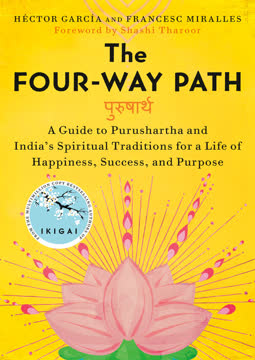
Discover your purpose. Purushartha, a Sanskrit term meaning "the objective of human beings," is India's ancient framework for a fulfilling life, akin to the Japanese concept of ikigai. It guides individuals to cultivate four essential areas, ensuring a balanced and meaningful existence. This wisdom, deeply rooted in Indian culture, offers a blueprint for living with intention and contributing positively to the world.
Four pillars of life. The four purusharthas are:
- Kama: The pleasures of the senses, desires, emotions, and love. It asks, "What do I love doing? What do I want?"
- Dharma: Moral values, duties, virtues, and the right way of living for harmony. It asks, "What does the world need from me? Why do I exist?"
- Artha: Prosperity, financial security, and what is needed to sustain oneself and one's community. It asks, "What do I need to sustain my life? What can bring wealth to me and my loved ones?"
- Moksha: Self-realization, liberation, and freedom from the cycle of death and rebirth, or simply a state of profound self-realization. It asks, "Who am I in the truest sense?"
Balanced living. While we naturally pursue kama and artha, dharma and moksha require intentional effort and discipline. Achieving balance among these four aspects is crucial for well-being and happiness. This ancient wisdom provides tools for self-discovery, helping individuals align their actions with their deepest values and contribute to a purposeful life for themselves and their communities.
2. Cultivate Self-Knowledge: The Foundation of True Happiness
“Know thyself.”
Prerequisite for purpose. Before embarking on any journey, especially the search for life's purpose, self-knowledge is paramount. Just as a pilgrim must understand their strengths and weaknesses to plan their route, we must understand ourselves to navigate life effectively. This ancient wisdom, echoed from the Temple of Apollo in Delphi to Indian mystics, emphasizes that true purpose is intimately linked to our values and priorities.
The "Who am I?" inquiry. Ramana Maharshi, a revered Indian guru, advocated atma vichara, or "self-inquiry," by repeatedly asking, "Who am I?" This seemingly simple question challenges us to look beyond superficial identifiers like name, profession, or possessions. It pushes us to uncover our essential, immutable self—that which cannot be lost in any "shipwreck" of life's circumstances.
Beyond external labels. True self-exploration means stripping away all external labels and societal roles to find the core of our being. This process helps us understand that our identity is not defined by what we have or what we do, but by a deeper, more fundamental essence. By engaging in this profound introspection, we lay the groundwork for a life aligned with our authentic self, leading to genuine happiness and fulfillment.
3. Practice Detachment: Free Yourself from Suffering
One of the insights the Buddha arrived at when he sat under the fig tree for seven days and seven nights is that seeking permanent satisfaction in impermanent things is a highway to unhappiness.
Peeling the onion of attachment. Happiness is our natural state, and to recover it, we must shed the layers of attachment that smother it. The Buddha's journey, from princely comforts to ascetic wandering, illustrates the power of detaching from material possessions. This doesn't mean embracing poverty, but rather preventing material things from dictating our emotional state or hindering our spiritual growth.
Beyond material possessions. Detachment extends to relationships and even our own knowledge. Expecting permanence in fluctuating relationships or demanding others conform to our desires is a constant source of pain. Similarly, clinging to preconceived ideas or the need to always be right creates friction and unhappiness. As the Buddha's raft simile teaches, ideas are for crossing over, not for clinging to.
The ego's fortress. The fourth and most profound detachment is from the ego—the need for recognition and the illusion of being separate from the world. Defending a large ego is exhausting and leads to constant feelings of being undervalued or attacked. Ramana Maharshi's statement, "Others do not exist," highlights the Advaita principle that we are all interconnected. Dissolving the ego through detachment opens the path to serenity and freedom.
4. Understand Non-Duality: Merge with the Universal Whole
For Advaita, material things, people, and time itself are an illusion.
Beyond separation. Advaita, meaning "non-duality," is a profound branch of Hinduism asserting that there is no separation between the individual soul (atman) and the divine (Brahman). It challenges our perception of reality, suggesting that the world we experience is often an illusion (maya) created by our intellect's ignorance (avidya), which makes us perceive ourselves as separate from the whole.
Awakening to unity. When we free ourselves from this illusion, we achieve moksha, a state of liberation where we realize we are pure being, consciousness, and love, transcending the suffering of duality. This awakening can occur through reflection, meditation, or profound connection with nature, where the lines between observer and observed blur, and we feel an integral part of something much larger than ourselves.
Flow and altruism. The experience of "flow," where the doer merges with the activity, is a practical example of non-duality, dissolving the ego and mental noise. To cultivate this:
- Focus on one task with full attention.
- Eliminate distractions.
- Engage in activities that are challenging but achievable.
Altruism also helps dissolve the ego, filling us with others and leading to peace. Realizing our insignificance within the vast universe is a powerful antidote to ego-driven problems, allowing us to merge with the grandeur of all existence.
5. Master Karma: Take Responsibility for Your Destiny
“My actions are my only true belongings. I cannot escape the consequences of my actions. They are the ground on which I stand.”
The law of cause and effect. Karma, a Sanskrit word meaning "action," is the cosmic law of cause and effect, where every action, word, and thought yields a consequence. This principle, predating Buddhism and central to many dharmic religions, emphasizes personal responsibility for our fate. Blaming bad luck or external circumstances prevents us from learning and growing, trapping us in cycles of suffering.
Beyond actions. Karma is not just about physical deeds; it encompasses our words and thoughts, as these are the seeds of future actions. To take control of our karma, we must periodically question:
- Our actions: Are they beneficial for ourselves and others?
- Our words: Are they impeccable, causing happiness or unhappiness?
- Our thoughts and desires: Are they clear and aligned with our true needs for fulfillment?
This continuous self-assessment is the light that guides us toward self-improvement and conscious living.
Breaking the cycle. The Tibetan fable of the hole in the sidewalk illustrates that what we refuse to accept will keep happening to us. Karma is a school, teaching us to recognize our mistakes and grow. By cultivating positive habits and intentionally orienting our experience, imagination, and desire toward goodness, we can reboot our life's operating system. As the Buddha's disciple Ananda learned, "Admirable friendship, admirable companionship, admirable camaraderie is actually the whole of the holy life," emphasizing the interconnectedness of our karmic journey.
6. Navigate Samsara to Nirvana: The Journey of Consciousness
“Yes, there is a Nirvanah; it is in leading your sheep to a green pasture, and in putting your child to sleep, and in writing the last line of your poem.”
The cycle of existence. Samsara, meaning "passing through different states" or "wandering," describes the continuous cycle of suffering, attachment, and confusion that the soul experiences while under the illusion (maya) of separation from the divine. This "long and winding road" of life, with its ups and downs, serves as a series of lessons to help us evolve and become our optimal selves.
The wheel of life. The samsaracakra, or wheel of life, illustrates passage through six realms (gods, demigods, humans, animals, hungry ghosts, hell-dwellers), each offering lessons to discard negative traits and embrace virtues. It's a journey from unconsciousness to consciousness, from darkness to light, which can be undertaken within a single lifetime, even within a single day, by removing obstacles like mistaken beliefs and bad habits.
Extinguish to shine. Nirvana, literally meaning "extinguishing" or "blowing out," signifies the cessation of desire, hatred, and ignorance, allowing our consciousness to ignite with divinity. It's a state of deep inner peace, freedom from the ego, and detachment from the material world. As Alan Watts explained, "if you want life, do not cling to it, let it go." This liberation is not a distant goal but a process of personal discovery, found in simple, present moments of beauty and connection.
7. Conscious Breathing (Pranayama): Expand Your Vital Energy
Breathing expands the life force of everyone and increases longevity, just as the Framingham Study demonstrated.
Ancient wisdom, modern science. While Western science, like the Framingham Heart Study, only recently linked lung capacity to longevity, India's pranayama has understood the benefits of conscious breathing for millennia. Prana means "vital energy," and ayama means "expansion" or yama "control," signifying the expansion and control of life force through breath.
Regulating the nervous system. Breathing is the only conscious gateway to influencing our unconscious parasympathetic nervous system, which regulates organ function and maintains homeostasis. By controlling our breath, we can directly impact our heart rate, reduce stress, and alleviate anxiety or lethargy. This makes pranayama a powerful tool for regaining balance and well-being.
Tailored techniques. Different breathing patterns can achieve specific states:
- Energizing (Surya Bhedana): Longer inhalation than exhalation, often through the right nostril, to activate and warm the body.
- Relaxing (Sitali Pranayama): Longer exhalation than inhalation, often a cooling breath through a rolled tongue, to calm and cleanse.
- Balancing (Box Breathing): Equal inhale, hold, exhale, hold (e.g., 4:4:4:4), used by military for anxiety, prevents hyperventilation.
These techniques offer practical ways to manage our energy and emotional state.
8. Integrate Yoga: Unite Body, Mind, and Spirit
The ultimate goal of yoga is inner balance and mental peace.
More than just poses. Originating in India over five thousand years ago, yoga's foundations are found in the Vedic texts, initially focusing on meditation, breathwork, and visualization. While modern Western yoga often emphasizes physical asanas (poses), its true purpose, derived from the Sanskrit jyog meaning "union," is to unite body, mind, and spirit, fostering inner balance and mental peace.
Evolution and pillars. The physical aspect of yoga was significantly influenced by Scandinavian gymnastics in the late 19th and early 20th centuries, leading to the diverse styles practiced today. Swami Vishnudevananda outlined five core pillars of yoga:
- Asanas (physical poses)
- Pranayama (breathwork)
- Savasana (relaxation)
- A vegetarian diet
- Positive thinking and meditation (vedanta and dhyana)
These pillars highlight yoga's holistic approach to well-being.
Accessible practice. Even a basic pose like Downward-Facing Dog (adho mukha svanasana) offers numerous benefits, from improving flexibility and circulation to reducing stress and pain in the back and shoulders. Yoga is adaptable for all levels, emphasizing that physical flexibility is a means to an end—a stable body allows for stable prana, essential for effective breathwork and meditation.
9. Balance Your Doshas: Live by Ayurvedic Wisdom
“The doshas are like an energy enneagram.”
Life knowledge. Ayurveda, India's five-thousand-year-old traditional medicine system, translates to "life knowledge" or "wisdom." It focuses on balancing the body's energies to prevent illness, recognizing that each individual has a unique constitution. This system posits that three fundamental doshas—Vata, Kapha, and Pitta—govern our physical, mental, and emotional characteristics, with one typically being dominant.
The three doshas:
- Vata (Air & Ether): Characterized by curiosity, creativity, and constant movement. Imbalance can lead to anxiety, insomnia, and digestive issues. Requires routines, warm foods, and calming activities like tai chi or light yoga.
- Kapha (Earth & Water): Known for compassion, calmness, and loyalty. Imbalance can cause insecurity, attachment, and weight gain. Benefits from dynamic exercise, stimulating intellectual activities, and light, dry, hot foods.
- Pitta (Fire & Water): Defined by passion, sharp intellect, and leadership qualities. Imbalance can result in irritability, controlling behavior, and inflammation. Needs cooling foods, stress-reducing activities like swimming or meditation, and avoidance of competitive sports.
Personalized well-being. Identifying your dominant dosha allows for personalized health and diet guidelines. For example, a Vata person needs grounding routines and warm, nourishing foods, while a Pitta person benefits from cooling practices and avoiding excessive heat or competition. Ayurveda emphasizes that understanding and balancing these energies is key to optimal health and preventing disease, offering a holistic path to well-being.
10. Experience Tantra: The Sacred Union of Sensuality and Spirit
The goal of tantra is to achieve a sensual experience, honoring the body from the place of the soul.
Beyond misconception. Tantra, originating in India between 300 and 400 AD, means "net" or "weaving" in Sanskrit. It's often misunderstood as solely uninhibited sexual experiences, but it's a profound integration of sexuality, spirituality, and mindfulness. Tantric texts, like the erotic sculptures of Khajuraho, celebrate the sacred union of masculinity and femininity, viewing sensual experience as a path to physical and spiritual transcendence.
Weaving intimacy. Tantric practice aims to "weave together" the physical and spiritual, strengthening intimacy and connection, whether practiced alone or with a partner. It emphasizes slowness, patience, and full attention, using breathing techniques, sounds, movements, and meditation to activate and channel sexual energy. The focus is on prolonging sensual awareness rather than rushing to orgasm, deepening the experience of presence and connection.
Practical exercises:
- Eye Contact: Sit face-to-face, gaze deeply into each other's eyes, and synchronize deep breathing to connect and stimulate kundalini energy.
- Conscious Sensuality: Use a timer to touch your partner with absolute concentration and amazement, focusing on every detail as if for the first time, then switch roles.
- The Art of Slowness: Engage in sexual activity with slow, rhythmic movements, enjoying the connection without external distractions or rushing, allowing you to control time rather than being controlled by it.
These practices foster a heightened state of consciousness and profound intimacy.
11. Practice Meditation: Cleanse Your Inner Lens
A mind full of prejudice and preconceived ideas that looks back with pain and resentment and forward with fear and anxiety does not allow us to enjoy the happiness of the here and now.
The mind's solvent. Happiness stems from inner clarity, not external circumstances. Meditation, practiced in India for millennia, is the ultimate tool to free the mind from noise, prejudice, and the suffering caused by past regrets and future anxieties. It acts as a "cleanser" for the inner lens through which we perceive the world, allowing us to fully experience the happiness of the present moment.
Mindfulness's roots. While mindfulness gained popularity in the West through figures like Jon Kabat-Zinn, its essence is deeply rooted in ancient Indian traditions like Zen Buddhism. Kabat-Zinn's Mindfulness-Based Stress Reduction (MBSR) program secularized these techniques, making them accessible for stress reduction and well-being, demonstrating the universal applicability of these practices.
Diverse meditative paths:
- Kirtan (Chanting Meditation): An active, communal meditation involving chanting mantras (e.g., OM NAMAH SHIVAYA), instruments, and movement. It's energizing and mood-lifting, freeing physical energy while receiving blessings.
- Visualization Meditation: Common in Tibetan Buddhism, it involves imagining benevolent beings (like Buddha emanating golden light) to cultivate compassion and goodwill, while visualizing negative energies leaving the body.
- Body Scan Meditation: A foundational mindfulness practice where attention is systematically brought to different parts of the body, observing sensations without judgment, to cultivate present-moment awareness and release tension.
These practices offer varied approaches to achieving mental peace and inner clarity.
12. Embrace Jugaad: Innovate with Resourcefulness
Success is achieved by the opposite route: by closing doors. Only if you close the door to everything inessential will you be able to focus on what is really important and be a successful human being.
Ingenious problem-solving. Jugaad, a colloquial Hindi term, refers to finding creative, low-cost solutions with minimal resources, often using whatever is immediately available. It's about overcoming obstacles with ingenuity, like putting a folded paper under a wobbly table leg. This philosophy encourages action over analysis paralysis, promoting temporary, rapid, and simple solutions that can be gradually improved.
Modern gurus and focus. India's influence extends to modern tech leadership, with CEOs like Satya Nadella (Microsoft) and Sundar Pichai (Google) embodying a focus on purpose and clarity. The story of the Mumbai entrepreneur who received an "ENOUGH" note from his mother highlights the wisdom of knowing when to stop accumulating and redirecting energy towards a more meaningful purpose, emphasizing that true success comes from focusing on what's essential.
Jugaad + Kaizen. Combining jugaad with the Japanese concept of kaizen (continual improvement) offers a powerful problem-solving framework:
- Apply Jugaad: Implement a temporary, quick solution to get started.
- Apply Kaizen: Gradually improve the temporary solution over time.
This approach prioritizes getting started and being practical, rather than striving for immediate perfection. It empowers individuals to activate their resourcefulness by asking, "What is a quick solution I can adopt today?" and then building upon it.
Last updated:
Review Summary
The Four-Way Path receives mixed reviews (3.63/5), with readers divided on its depth and approach. Critics find it superficial, overly Western-focused, and repetitive with references to Ikigai. Many note it lacks nuance, feels scattered, and inadequately explores Indian spirituality. Positive reviewers appreciate it as an accessible introduction to Hindu philosophy, particularly the four purusharthas (dharma, kama, artha, moksha), finding it peaceful and inspiring for personal growth. Most agree it's surface-level but disagree on whether that's appropriate—beginners find value while those familiar with Indian culture feel disappointed by its brevity and lack of depth.