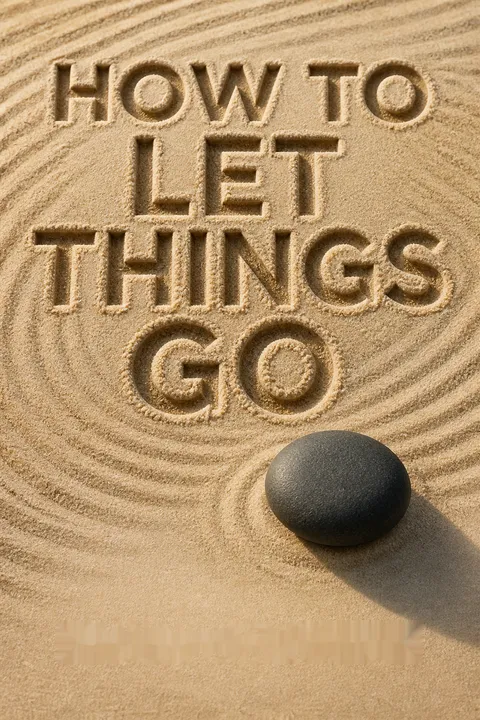


Key Takeaways
Let go selectively, so your attention returns to what you can actually shape.
Letting go is a skill. Zen priest Shunmyō Masuno argues that release is not the same as quitting carelessly. In a world of constant messages, opinions, and demands, trying to respond to everything drains attention from what matters. The Zen expression hogejaku means letting go of everything, but applying it well requires distinguishing what deserves commitment from what cannot be controlled.
Keep effort, release control. A missed opportunity, another person’s opinion, or an old disappointment may deserve acknowledgment, but not endless mental replay. The practical test is whether action is possible now. If so, act. If not, stop spending energy as if worry could force an outcome.
What's striking is the book's treatment of attention as a finite resource, not a moral test. This connects with contemporary accounts of cognitive load: each unresolved demand competes for working attention, even when it cannot be solved. The distinction between responsibility and control is especially useful. Still, letting go can become a polished excuse for avoiding difficult duties. A sound application asks two questions: Is there a concrete action within reach, and does someone depend on it? If yes, follow through. If no, release the demand to control the outcome.
Offer care without trying to manage other adults.
Respect includes restraint. Masuno recommends leaving room for other people to think, worry, and make choices without constant correction. A parent or manager who watches every move may intend to help, yet can prevent a child or employee from developing independent judgment. Advice is more useful when invited, except where someone faces real danger.
Closeness has limits. Family members remain different people, and even a strong couple may understand only part of each other. The book suggests that a few deeper shared interests can matter more than total understanding. At work, keep private matters private unless a colleague chooses to share them. And when your own workload is full, saying no is more honest than accepting a favor you cannot complete.
This guidance resembles the distinction in caregiving between support and control: help works best when it preserves the other person's agency. It also offers a useful correction to the assumption that love should mean complete access or agreement. The advice to step back, however, needs context. A silent observer can fail someone who needs protection, and unequal power can make unsolicited guidance necessary. The stronger principle is not noninterference at all costs. It is proportional involvement, with intervention guided by risk, consent, and the other person's capacity to act.
Meet uncertainty with useful action, not rehearsals of imagined disaster.
The future stays unknown. Masuno argues that prediction has limits, even when people gather more information or think through every possible outcome. If a problem is likely and something can be done about it now, take that step. If it is merely one of many possible futures, worrying cannot make it certain or prevent it.
Return to the present task. The book's Zen saying “Right here, right now, this you” points toward action in the moment available. Its example is practical rather than grand: attend to the problem actually in front of you instead of letting hypothetical troubles consume the day. Present focus does not guarantee a good outcome, but it gives effort somewhere useful to go.
The useful distinction here is between preparation and rumination. Preparation identifies a risk and changes a plan; rumination repeats the threat without adding information or action. That distinction is compatible with cognitive approaches that turn vague anxiety into a specific, manageable next step. Yet uncertainty is not always a reason to wait until a problem arrives. Some risks warrant precaution precisely because their consequences are serious. The book's strongest version is therefore not “ignore the future,” but prepare where preparation helps, then refuse to mistake worry for further preparation.
Choose your information diet before the news cycle chooses it for you.
More input is not always useful. Masuno warns that a steady stream of news, social posts, and other people's opinions can consume time without helping with work or daily life. Some information is inaccurate, irrelevant, or simply anxiety-provoking. He recommends deciding what is worth knowing and taking breaks from the rest.
Slow the response. Social media arguments can escalate when people communicate without seeing one another. Texts and emails can create a similar trap: replying while angry or disappointed may turn bad news into a larger conflict. A pause gives the first emotional surge time to settle. Silencing a phone or stepping away from a screen can protect attention for the task at hand.
This is an early, plain-language account of a problem now called attention capture: digital systems make interruption easy, while the costs of switching focus are less visible. The advice to filter input is more precise than a blanket rejection of technology. Information can protect people, expose injustice, or support good decisions, so withdrawal is not automatically wise. A practical filter asks whether a source is reliable, relevant to a decision, and needed now. The pause before replying adds a second safeguard: access to communication need not mean immediate emotional availability.
Measure growth against your own past, not a statistical average.
Averages are poor life plans. Masuno challenges the habit of judging a life by income, savings, career timing, or other population averages. A statistic can describe a group, but it cannot dictate what an individual should value or when a particular milestone should happen. Trying to stay above average merely replaces personal direction with a ranking contest.
Use a closer comparison. The book recommends comparing today's self with an earlier version of oneself. That makes progress visible without requiring another person to lose. It also warns against curating an impressive public image, especially online. Likes and approval can reward a polished persona, but they do not make that persona more truthful or help someone become more capable.
The appeal of averages is understandable: they make uncertain choices seem legible and offer a quick sense of where someone stands. But descriptive statistics cannot settle questions of meaning or fit. Masuno's self-comparison shifts the measure from rank to development, a move that can reduce envy and make goals more personally relevant. It also has a limit: people can become trapped in relentless self-monitoring. Growth should be assessed alongside rest, relationships, and changing priorities, not converted into another permanent performance score.
Learn from the past without carrying every mistake as an open wound.
Reflection beats replay. Masuno distinguishes useful memory from endless regret. After a mistake, identify what went wrong and what can be learned; repeating the thought that it should not have happened changes nothing. He uses the image of a “memory drawer” for difficult experiences: acknowledge the feelings, keep what is instructive, and set the episode aside when further rumination serves no purpose.
Let time change the story. Painful experiences may become easier to describe with humor after their emotional rawness has passed. The same practical release applies to possessions. Masuno recommends clearing out clothes left unused for years and passing usable items to someone else, rather than letting clutter or guilt keep them stored indefinitely.
The distinction between remembering and reliving matters. Reflection can extract information from a setback, while repetitive self-blame often adds punishment without improving future judgment. The “memory drawer” image is helpful because it allows an event to remain part of one's history without occupying the foreground. Still, emotional pain does not follow a tidy schedule, and humor is not a required proof of recovery. The most humane reading is permission to process at one's own pace, then choose when attention can return to present life.
Adapt each task to its conditions, and build around strengths.
Work changes with its setting. Masuno compares work to a living process: the people, conditions, and purpose differ from one project to another, so a past success should not become a rigid recipe. As a Zen garden designer, he studies a site's soil, sunlight, users, and existing qualities, then designs around what is already there rather than treating every site as interchangeable.
Use abilities together. The same principle applies to teams. Instead of forcing every person to master every weakness, let people contribute where they are strongest and rely on colleagues for other tasks. The goal is not to excuse every limitation, but to make the work fit the actual people and circumstances involved.
The garden-design example makes adaptation tangible: good work begins with observation of the conditions, not with imposing a preferred template. This resembles contingency thinking in organizational practice, where methods are judged by how they fit a task and context. Strength-based teamwork can also prevent needless duplication. Its risk is turning current strengths into permanent labels or excusing skills that a role genuinely requires. A balanced approach distinguishes a low-value weakness from a necessary capability, and leaves room for people to learn rather than assigning them fixed identities.
Protect your energy with pauses, clearer plans, and fewer unnecessary fights.
Do today's necessary work. An anecdote explains the name Konnichian, a tea hermitage whose name means “Hut of This Day.” A monk arrived late and left a note suggesting that an idle person should not assume tomorrow is guaranteed. Masuno draws a practical lesson: complete what matters today instead of routinely postponing it.
Rest is part of the work. He also recommends taking brief breaks, especially during busy stretches, and avoiding major decisions when tired at night. Not every competition deserves continued effort. When pushing harder risks exhaustion, stepping back to restore strength can be wiser than staying in the fight. Clear plans, including honest estimates of time and workload, prevent other people's requests from silently expanding into unmanageable commitments.
The chapter brings together two truths that are often wrongly treated as opposites: act promptly, and do not run yourself into the ground. The tea-room story gives urgency a human scale, while the advice on breaks recognizes that attention and judgment are not constant. This fits basic ideas about fatigue and decision quality, though the blanket preference for morning decisions is best treated as a useful default, not a law. The deeper practical rule is to make consequential choices when rested and to reserve recovery before exhaustion makes the choice for you.
Choose with the knowledge available, then make the choice useful.
Perfect certainty is unavailable. Masuno argues that many decisions have no provable best answer in advance. Once a choice is made, attention is better spent making it work than imagining that another path would certainly have succeeded. If the result disappoints, the experience can still inform the next decision.
Avoid permanent labels. The book also applies this flexibility to events themselves: success and failure, good luck and bad luck, are not fixed verdicts on a whole life. Circumstances change, and an experience can acquire different meaning over time. This does not mean that every outcome is pleasant or harmless. It means that a setback need not become a complete definition of the person who experienced it.
This is a useful antidote to hindsight bias, the tendency to see an outcome as more predictable after it has happened. Decision-makers often judge a choice by its result rather than by the information available at the time. Separating decision quality from outcome quality helps preserve learning without demanding impossible foresight. The claim that choices are all “right” can sound too reassuring if taken literally. Some options are better supported than others, and some mistakes require repair. Its most defensible meaning is that no past choice can be replaced, but its consequences can still be met intelligently.
Seek common ground before logic turns disagreement into a contest.
Being correct may not persuade. Masuno cautions that a forceful argument can make another person defensive, especially when it ignores the emotions or values behind their position. Acknowledging what is difficult for the other person can make room for a more honest discussion. In a negotiation, yielding on a nonessential point may help both sides reach a workable agreement without either side losing face.
Treat rivals as possible partners. The book describes Kyocera founder Kazuo Inamori's approach to acquired companies. Rather than simply impose the acquiring firm's culture, Kyocera held open conversations with employees and sought shared purpose. The lesson is that lasting cooperation is more likely when a victory does not humiliate the people expected to work together afterward.
The emphasis on dignity adds something important to conventional advice about argument: persuasion is not only a transfer of evidence, but also a relationship between people who need to remain in contact. Negotiation research similarly distinguishes positions from underlying interests, making room for solutions beyond a contest over who wins. Yet compromise is not always the right goal. Where a proposal is harmful or rights are at stake, yielding can entrench an injustice. The useful test is whether flexibility can preserve principle while changing the route to agreement.
Give your best to the task, then stop demanding control over its result.
A mission can emerge through practice. Masuno suggests that a person's purpose may not arrive as a fully formed answer. Asking what role matters at this stage of life, then noticing which work receives sustained effort, can help clarify it. Ambitious dreams should function as distant guides rather than burdens held so close that every step feels inadequate.
Effort has a boundary. His closing principle is to put energy into what can be done, without letting reputation or hoped-for results fracture concentration. The result is not wholly under personal control. Masuno links living freely to softheartedness, the ability to respond flexibly rather than insist that life follow one fixed script, and to humility, using one's abilities in service of others.
This ending joins ambition with nonattachment: a person can care deeply about meaningful work without treating success as proof of personal worth. That balance resembles process-oriented motivation, where attention rests on the quality of action rather than an outcome that depends on many factors. The idea of a mission is most useful as an evolving question, not a claim that every person has one destined occupation. Flexible purpose can change with responsibility, health, and circumstance. Doing one's best then becomes a standard of sincere effort, not a demand for limitless effort.
Analysis
The book is organized as ninety-nine brief instructions, but its deeper structure is a repeated exercise in sorting. Masuno asks readers to distinguish what can be changed from what cannot, what deserves attention from what merely attracts it, and what is care from what is control. This gives the collection a coherent center: freedom comes less from mastering circumstances than from choosing where effort belongs. The advice moves from relationships and anxiety to work, choice, and impermanence, so everyday examples gradually acquire a philosophical frame.
Its strongest feature is its scale. Rather than requiring retreat from ordinary life, the book applies Zen ideas to texts, office politics, clutter, career decisions, and family tension. Stories such as the horsefly repeatedly striking the same point on a screen make rigidity memorable, while the tea hermitage anecdote makes present action concrete. The short chapters also invite selective reading, fitting the book's own argument against overconsumption.
The same aphoristic style creates a limitation. Advice to accept others, avoid worry, or let sadness pass can be relieving when a person is trapped in rumination, but may be inadequate where there is abuse, structural injustice, serious grief, or a problem that requires collective action. The claim that others cannot be changed is most useful as a warning against coercive control, not as a literal denial that people influence one another. Similarly, acceptance should not erase accountability.
The book's most durable distinction is therefore not between caring and not caring, but between responsible effort and the fantasy of total control. A reader can set a boundary, apologize, intervene, or pursue a goal, then accept that the outcome is not entirely theirs to command. That combination keeps letting go from becoming passivity. It turns the practice into selective engagement: act where action matters, and stop feeding what action cannot improve.
Review Summary
How to Let Things Go received mixed reviews. Many readers appreciated the book's simple, accessible format and practical Zen-inspired advice for mindfulness and stress reduction. The bite-sized lessons were seen as easy to digest and apply to daily life. However, some found the content repetitive, overly simplistic, or lacking depth. While praised as a good introduction to mindfulness concepts, experienced readers in self-help may find it less impactful. Overall, the book was viewed as a gentle reminder to focus on what matters and let go of unnecessary burdens.
People Also Read



Glossary
hogejaku
Letting go of everythingA Zen expression meaning to let go of everything. In Masuno's use, it names the ideal of releasing attachments that consume attention, especially fixation on other people, past events, and uncertain outcomes. The practice is not simply abandoning duties. It requires judging what deserves effort and what cannot be controlled.
zengo
Zen sayingA Zen phrase or saying used to express a teaching. Masuno draws on zengo as short reminders for everyday conduct, including attention to the present moment and caution against fixed judgments. The phrases work as prompts for reflection rather than as detailed instructions or universal rules.
Middle Way
A path between extremesA Buddhist principle that Masuno applies to relationships and decisions as a search for a fair course rather than an insistence on one side's complete victory. In the book's practical examples, it means examining one's own interests, recognizing the other party's position, and considering concessions that allow people to move forward together.
softheartedness
Flexible responsivenessMasuno's term for a mind that is not rigidly attached to how things must be. A person practicing softheartedness can respond to changing people and circumstances without forcing every situation into a fixed expectation. The book pairs this flexibility with humility, so adaptability serves both authenticity and contribution to others.
Be of one essence
Fully experience the present emotionA Zen teaching Masuno applies to strong feelings, including grief and joy. It means allowing oneself to experience an emotion fully in the moment, rather than suppressing it or remaining attached to it indefinitely. The teaching does not prescribe a timetable for recovery; it points toward feeling honestly and continuing to meet life as it changes.
memory drawer
A place for processed memoriesMasuno's metaphor for storing a painful or unpleasant experience after acknowledging its feelings and considering what can be learned from it. The memory is not erased, and useful lessons remain available. The image suggests that a person can stop revisiting an event constantly without pretending it never happened.
FAQ
What's "How to Let Things Go" about?
- Author's Background: The book is written by Shunmyō Masuno, a Zen Buddhist monk and head priest of a 450-year-old temple in Japan, who is also an acclaimed garden designer and professor.
- Core Theme: It offers 99 tips on relinquishing control and focusing on what truly matters in life, drawing from Zen Buddhist principles.
- Practical Advice: The book provides practical guidance on how to let go of unnecessary worries, detach from unhelpful relationships, and live a more fulfilling life.
- Structure: It is divided into five parts, each focusing on different aspects of letting go, such as relationships, anxiety, reactions, energy, and perspectives.
Why should I read "How to Let Things Go"?
- Improve Well-being: The book offers insights into reducing stress and anxiety by letting go of things beyond your control.
- Enhance Relationships: It provides advice on maintaining healthier relationships by being more detached and less involved in others' issues.
- Practical Tips: With 99 actionable tips, the book serves as a practical guide for anyone looking to simplify their life and focus on what truly matters.
- Zen Philosophy: It introduces readers to Zen Buddhist principles, making it a valuable read for those interested in spiritual growth and mindfulness.
What are the key takeaways of "How to Let Things Go"?
- Letting Go: Learning to let go of control can lead to a more peaceful and fulfilling life.
- Focus on the Present: Emphasizes the importance of living in the moment and not dwelling on the past or future.
- Healthy Detachment: Encourages detachment from social media and unnecessary information to maintain mental clarity.
- Self-Reflection: Promotes self-reflection and understanding one's own limitations and strengths.
How does Shunmyō Masuno suggest we handle relationships in "How to Let Things Go"?
- Be Detached: Masuno advises being more detached in relationships to avoid unnecessary stress and conflict.
- Leave People Alone: He suggests that sometimes the best way to support someone is to leave them alone and let them process their emotions.
- Accept Differences: Recognize that even family members are different from you and respect their individuality.
- Avoid Meddling: Encourages observing rather than intervening in others' lives, especially in professional settings.
What are some practical tips from "How to Let Things Go" for reducing anxiety?
- Stop Worrying: If you can't be certain about something, stop worrying about it and focus on the present.
- Forget Strategically: Become skilled at forgetting trivial matters to safeguard your mental health.
- Set Realistic Expectations: Avoid setting high expectations for yourself and others to reduce disappointment.
- Focus on the Now: Immerse yourself in the task at hand to shield yourself from distractions and anxiety.
What does Shunmyō Masuno mean by "Be measured in your reactions"?
- Pause Before Reacting: He advises pausing before replying to avoid escalating situations, especially in digital communications.
- Avoid Overreacting: Encourages not taking everything at face value and being cautious of insensitive remarks.
- Limit Information Intake: Suggests blocking out unnecessary information to maintain inner calm and focus.
- Judicious Expression: Recommends expressing oneself carefully to avoid misunderstandings and conflicts.
How does "How to Let Things Go" address the concept of energy management?
- Avoid Energy Waste: The book advises against wasting energy on things that don't matter or are beyond your control.
- Streamline Tasks: Encourages identifying and eliminating unnecessary tasks to focus on what truly matters.
- Take Breaks: Highlights the importance of taking breaks, especially when busy, to maintain high performance.
- Plan Effectively: Stresses the importance of good planning to avoid overcommitting and burning out.
What are the best quotes from "How to Let Things Go" and what do they mean?
- "Let go of everything": This Zen expression, hogejaku, encapsulates the essence of living a Zen life by releasing attachments.
- "Be humble, be humble, be humble": A reminder to avoid arrogance and maintain humility in interactions with others.
- "Right here, right now, this you": Encourages living fully in the present moment, acknowledging the impermanence of life.
- "All things come from nothingness": Reflects the Zen belief in the transient nature of life and the futility of material attachments.
How does Shunmyō Masuno suggest we deal with failure in "How to Let Things Go"?
- View as a Stumble: He suggests viewing failure as a minor stumble rather than a catastrophe.
- Learn and Move On: Encourages learning from mistakes and using them as opportunities for growth.
- Avoid Regret: Advises against dwelling on past failures, as regret is seen as a delusion.
- Focus on Redemption: Emphasizes getting back on your feet and redeeming yourself after a setback.
What role does Zen Buddhism play in "How to Let Things Go"?
- Core Philosophy: Zen Buddhism forms the foundation of the book's teachings, emphasizing mindfulness and detachment.
- Practical Application: The book translates Zen principles into practical advice for modern living.
- Spiritual Growth: Encourages readers to seek spiritual growth by letting go of material and emotional attachments.
- Mindfulness Practice: Promotes mindfulness as a way to achieve clarity and focus in daily life.
How can "How to Let Things Go" help with personal growth?
- Self-Reflection: Encourages regular self-reflection to understand one's strengths and weaknesses.
- Embrace Change: Teaches the importance of embracing change and adapting to new circumstances.
- Set Personal Goals: Advises setting realistic personal goals and working steadily towards them.
- Live Authentically: Promotes living authentically by being true to oneself and one's values.
What is the significance of the book's title, "How to Let Things Go"?
- Core Message: The title encapsulates the book's central theme of relinquishing control to live a more fulfilling life.
- Practical Guide: It serves as a practical guide for those looking to simplify their lives and focus on what truly matters.
- Zen Influence: Reflects the Zen Buddhist influence of letting go of attachments and living in the present.
- Life Skill: Positions letting go as an essential life skill for achieving peace and contentment.
About the Author
Other books by Shunmyō Masuno

Download PDF
Download EPUB
.epub digital book format is ideal for reading ebooks on phones, tablets, and e-readers.








