Key Takeaways
1. Liberalism's Triumph Marks the End of Traditional Politics
Liberalism, which had always insisted on de-emphasising the importance of politics, made the decision to abolish politics completely after its triumph.
Politics abolished. In the wake of the 20th century, liberalism emerged victorious over its ideological rivals—conservatism, fascism, and communism. This triumph, however, led not to a new political era, but to the perceived end of politics itself. Liberalism ceased to be a mere political theory and permeated the very fabric of society, transforming into a naturalized lifestyle of consumerism, individualism, and postmodern fragmentation.
A new reality. This shift means that liberalism is no longer a choice but an "existential fact," an "objective order of things." Its agenda, having defeated all alternatives, has seemingly expired, leading to a "post-political" landscape. Opponents of liberalism now find themselves struggling against an invisible enemy, as the triumphant ideology has dissolved into the background noise of everyday life, making alternative political thought nearly impossible.
The status quo. The globalized world, governed by economic laws and universal "human rights," presents itself as the only reality. Political decisions are replaced by technical management, and technocrats supersede politicians. This "la gouvernance" or "micromanagement" reduces human masses to identical objects, leading to the complete abolition of politics and the suppression of any genuine dissent.
2. The Imperative for a Fourth Political Theory
Such an approach is an invitation to the development of the Fourth Political Theory — beyond Communism, fascism and liberalism.
Beyond old paradigms. The current global landscape, dominated by post-liberalism and postmodernity, necessitates a radical departure from the political theories of the 19th and 20th centuries. Neither the victorious liberalism nor the defeated communism and fascism offer viable solutions to the challenges of our time. A new, imaginative framework is required to correctly decipher postmodernity and construct an autonomous political model.
A new front. The Fourth Political Theory (4PT) is conceived as a direct challenge to the status quo:
- Postmodernity
- Post-industrial society
- Liberal thought in practice
- Globalization and its technological bases
It aims to unite all that has been discarded and humiliated by the "society of the spectacle," drawing inspiration from the "metaphysics of debris" to forge a new path.
Russia's existential choice. For Russia, the 4PT is not merely an intellectual exercise but a matter of "to be or not to be." Having rejected liberalism in the 1990s and finding communism and fascism unacceptable, Russia faces an ideological vacuum. Embracing the 4PT is seen as essential for preserving its identity and avoiding dissolution into a global order not of its making.
3. Rejecting Monotonic Progress and Linear History
The monotonic process, in biology, is incompatible with life — it is an anti-biological phenomenon.
The myth of progress. All three classical political ideologies—liberalism, communism, and fascism—shared a foundational belief in unidirectional progress, growth, and evolution. This "historical optimism" rooted in 18th and 19th-century scientific thought, posited a linear, cumulative improvement of society, from "minus to plus."
Anti-biological nature. Gregory Bateson's work on "monotonic processes" reveals the inherent destructiveness of this idea. In nature, constant, one-dimensional growth leads to the destruction of species; in mechanics, it causes breakdowns; in society, it leads to deterioration. Real societies, like natural systems, operate cyclically, not monotonically.
Racism in progress. The ideology of progress inherently contains racist elements. Asserting the superiority of the present over the past, or one culture's development over another's, is a form of "cultural, technological, and economic racism." Unipolar globalization, for instance, imposes Western values as universal, implicitly deeming other cultures "underdeveloped." The 4PT fundamentally rejects this progressivist outlook, advocating for:
- Cyclicality over linearity
- Balance, adaptability, and harmony over constant growth
- Life over mere development
4. Dasein: The Authentic Subject of the Fourth Political Theory
The historical subject is neither an individual, nor class, nor the state, nor race. This is the anthropological and the historical axiom of the Fourth Political Theory.
Beyond traditional subjects. Classical political theories each defined a historical subject: the individual for liberalism, class for communism, and the state or race for fascism. The 4PT radically rejects all these as foundational subjects, creating a "gaping void" that demands a new understanding of political agency.
Heidegger's Dasein. The most profound ontological foundation for the 4PT is Martin Heidegger's concept of Dasein ("Being-there"). Dasein, as the human experience of being-in-the-world, offers a complex, holistic model that transcends the limitations of individual, class, state, or race. It is a pre-dualistic entity, existing "between" subject and object, theory and practice.
Authentic existence. The freedom of Dasein lies in its opportunity to be authentic, to realize "Being" rather than merely "there." This involves a conscious choice to confront the "nothingness" that postmodernity embodies, rather than succumbing to inauthentic existence. The 4PT, centered on Dasein, becomes a fundamental ontological theory, seeking the truth of Being.
5. The Return of Tradition and Archaic Myths
This marks the return of theology, and becomes an essential element of the Fourth Political Theory.
Postmodern indifference. While modernity waged "theomachy" (battle against God), postmodernity is characterized by indifference to religion. This shift, however, paradoxically opens a space for the return of Tradition. The era of persecuting faith is over, even if post-liberalism seeks to create a new global pseudo-religion of chaotic ecumenism and "tolerance."
Reclaiming the sacred. The 4PT advocates for a consistent and uncompromising defense of traditional ideals and values. This means:
- Acknowledging "God's death" is no longer a mandatory imperative.
- Drawing inspiration from everything that preceded modernity.
- Readdressing ancient archaic values, cults, rites, and legends.
Eschatological vision. From this traditionalist perspective, postmodernity (globalization, post-liberalism) is easily recognized as "the kingdom of the Antichrist" or its equivalents in other religions (Dajjal, Erev Rav, Kali Yuga). This is not mere metaphor but a religious fact, signaling the Apocalypse and demanding a spiritual response.
6. Multipolarity: A World of Diverse Civilizations
The idea of a multipolar world, where the poles will be as many as there are civilisations, allows one to propose to humanity a broad choice of cultural, paradigmatic, social and spiritual alternatives.
Beyond unipolarity. The current unipolar world, dominated by the West and the United States, is deemed a global dictatorship that deprives other nations of sovereignty and imposes a singular, anti-traditional value system. The 4PT calls for the destruction of this American Empire and the establishment of a multipolar world.
Civilizational poles. This multipolar vision is based on the concept of "civilizations" as fundamental subjects of world politics, replacing outdated national, economic, or class-based analyses. These civilizations are "large spaces" united by common:
- Cultural styles
- Spiritual and moral arrangements
- Historical experiences
- Often, world religions
Examples include the European Union, a nascent Eurasian Union, Islamic, Chinese, Indian, Latin American, and potentially African civilizations.
Pluriversalism, not clash. While Huntington predicted a "clash of civilizations," the 4PT envisions a "pluriversalism" where diverse civilizations coexist, engage in dialogue, and form alliances. This allows for "regional universalism" and the autonomous development of local communities, ensuring the continuation of mankind's political history and a variety of socio-political, religious, and economic systems.
7. Deconstructing Modernity's "Civilization" Concept
In a word, even a rough deconstruction of civilisation shows that the claims to overcoming previous phases are illusions, while in practice, big and ‘developed’ collectives of people, united in a civilisation, in essence simply repeat, on a different level, the archetypes of the behaviour and moral systems of ‘savages’.
Modernity's illusion. The modern concept of "civilization" is deeply rooted in the Enlightenment's progressivism and historicism, positing a linear development from "savagery" to "barbarity" to "civilization." This diachronic (phased) interpretation, however, is a "totalitarian, false, negative episteme" that masks deeper realities.
Synchronic reality. Postmodern thought, structuralism, and the "philosophers of suspicion" (Nietzsche, Freud) reveal that "civilization" does not overcome "savagery" but coexists with it. Civilization is the numerator, and savagery-barbarism the denominator, of a fraction. The unconscious, mythic, and "savage" elements continue to powerfully shape human societies, often repressed but never truly eradicated.
Hypocrisy of universalism. The "inclusive universality" claimed by civilizations often devolves into "exclusive particularity," merely transferring tribal ethnocentrism to a higher level. The Greeks called others "barbarians," and modern Western civilization imposes its values globally, demonstrating a "cultural racism." The 4PT adopts a synchronic, pluralistic understanding of civilization, recognizing each as a unique, self-defined entity without inherent superiority or inferiority.
8. Re-evaluating the "Lost" Ideologies (Communism & Fascism)
The second and third political theories must be reconsidered, selecting in them that which must be discarded and that which has value in itself.
Beyond total rejection. While the 4PT rejects the complete ideological systems of communism and fascism, it acknowledges that certain "marginal elements" and critical insights within them hold value. Their failure against liberalism proved they did not belong to the spirit of modernity, which, paradoxically, becomes an advantage.
From Fascism: Ethnocentrism. The 4PT firmly rejects all forms of racism (biological, cultural, technological, economic) that plagued fascism. However, it can borrow a positive attitude toward the ethnos as a cultural phenomenon—a community of language, belief, and shared life, an organic entity. This "ethnocentrism" (in the plural, non-hierarchical sense) is a candidate for the 4PT's subject, contrasting with liberalism's ethnocidal individualism.
From Communism: Mythic Critique. The 4PT discards historical materialism, unidirectional progress, and materialist reductionism from communism. Yet, it embraces Marxism's "mythic, sociological" critique of capitalism, its exposure of bourgeois exploitation, and its eschatological narrative of a lost paradise and a future "common good." This "Marx through a positive view of the Right" offers a powerful tool "against liberalism."
9. The Posthuman Threat and the Post-State
The posthuman of postmodernity declares war on the political: first, based on the economy (homo oeconomicus vs. homo politicus), then against the classical subject-object economy in the name of the network dynamics of the free, creative game of disengaged ‘sets’ (Negri and Hardt).
The new man. Postmodernity is shaping a new political anthropology: the "posthuman." This entity is characterized by depoliticization, autonomization, microscopization, and "dividualization"—a fragmentation of the individual into desires, emotions, and impulses. It merges into "transindividuality," a "rhizomatic entity" or "multitude" that replaces traditional subjects and authority.
The phantom state. This posthuman condition gives rise to the "post-state," an ironic parody of traditional governance. Institutions become mobile and ephemeral, policies rapidly change, and vertical hierarchies dissolve into horizontal networks. It's a "pirate republic in cyberspace," a "Brazilian carnival" where seriousness and frivolity swap places, and amusement replaces genuine political engagement.
A deliberate war. This is not mere political entropy but a "revolutionary counter-project"—a deliberate, axiological liquidation of political structures. The "apolitical singulars and divides" form a ruling "party of postmodernity," using fashion, interactive technologies (Twitter, social networks), and celebrity culture to impose their "now" without past or future. This "dromocratic" (speed-driven) reality is exemplified by "Twitter revolutions" and "iPad presidents."
10. Fourth Political Practice: Beyond Theory and Action
We are interested in this very intermediate level not achieved by a horizontal consideration of these pairs, but only by a new, non-horizontal dimension.
Beyond dualism. The 4PT aims to transcend the fundamental dualism between subject and object, theory and practice, that has defined Western philosophy since modernity. It seeks a "pre-dualistic" root, a common origin from which these pairs emerge, rather than a compromise or combination of them.
Dasein as the "between." Heidegger's Dasein, existing "inzwischen" (in the between), serves as the pole for this approach. Fourth Political Practice is not merely the application of theory, but a realization that theory is practice, and practice is theory, at a deeper, pre-ontological level. This means:
- Contemplation becomes action.
- Principle becomes manifestation.
- Myth becomes ritual (theurgic fact).
- Mentality becomes activity (thoughts as magic).
The supranatural world. This practice leads to a "supranatural world" where the barrier between idea and realization collapses. It's a magical view where thought can change reality, a "trans-substance" where spirit transforms into body and body into spirit. This is a radical departure from evolutionary processes, appealing to roots free from linear development.
11. The Metaphysics of Chaos: A New Beginning
If logos no longer satisfies us, fascinates us, or mobilises us, then we are inclined to try something else and at last to address the problem of chaos.
The end of Logos. Modern European philosophy, based on "logos" (logical order, patriarchal, hierarchical), has exhausted itself after two millennia. This logocentric culture, which excluded "feminine chaos" from its very inception, is now in its "dusk," its structures degrading into postmodern "confusion."
Two kinds of chaos. Dugin distinguishes between:
- Postmodern "chaos": A "post-order," a mixture of contradictory fragments, a "dissipative structure of logos" in its ultimate decay. This is calculable but complex.
- Original Greek "chaos": A "pre-order," existing before ordered reality, the true metaphysical opposite of logos.
Transcending the trap. To escape the "labyrinth without an exit" of postmodernity, humanity must move beyond logocentric culture. Logos, being the cause of its own decay, cannot save itself. The solution lies in appealing to "chaos" in its original sense, as something pre-ontological and inclusive.
Chaotic Logos. This involves approaching chaos not from the position of logos, but from chaos itself—an inclusive, feminine vision. Chaos includes logos as an inner possibility, freely identifying and cherishing its exclusivity within its everlasting life. This leads to a "chaotic logos"—a fresh, spontaneous, and inclusive form of thought, eternally revived by the waters of chaos, offering "the other beginning" Heidegger spoke of.
Last updated:
Review Summary
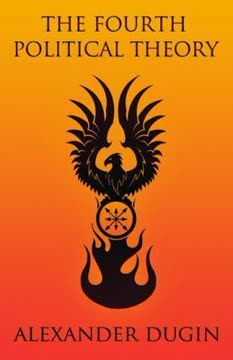
The Fourth Political Theory by Alexander Dugin receives polarized reviews averaging 3.3/5 stars. Critics praise Dugin's sophisticated critique of liberalism and Western hegemony, drawing from Heidegger's concept of Dasein. However, many find the writing repetitive, deliberately obscure, and lacking concrete solutions. Reviewers note Dugin's proximity to Putin and concern about his influence on Russian geopolitics, particularly regarding Ukraine. Common criticisms include poor understanding of Orthodox Christianity, contradictory arguments, and mixing fascist/communist elements. While some appreciate his geopolitical analysis, most conclude the "fourth political theory" remains nebulous and unconvincing despite occasional interesting insights.
Similar Books