

Key Takeaways
Treat a forecast as a warning about exposure, not just a bet on weather.
Hazards meet vulnerability. In December 1999, days of extraordinary rain triggered deadly mudslides around Caracas. The storm alone does not explain the disaster: millions lived on steep slopes, forests had been cleared, homes occupied gullies, and government oversight was weak. Estimates rose to 30,000 dead, with many more left homeless. Forecasting the rainfall would not, by itself, have predicted the scale of the loss.
Ask who is exposed. The book’s opening case argues that disaster risk also depends on where people live, how they build, and whether they can evacuate. Historical records showed severe floods in the region before, but the number of people in harm’s way had grown. A useful forecast therefore considers not only the hazard, but also the social conditions that turn it into catastrophe.
What's striking is how this account shifts forecasting from a contest of meteorological accuracy to a question of preventable harm. In risk analysis, hazard, exposure, and vulnerability are distinct: a storm can be forecast well while its human toll remains poorly anticipated. That distinction is useful for floods, heat waves, and disease outbreaks. It also guards against a common institutional mistake, treating a warning as successful only when the event is predicted precisely. Yet social vulnerability is not always easy to measure, and naming it does not automatically produce evacuation, housing, or infrastructure policy.
A model that fits yesterday can still misunderstand the system it describes.
Fit is not truth. Ancient Greek astronomers built elaborate arrangements of circles to reproduce the observed paths of planets. Ptolemy’s system could forecast their positions, yet its success did not prove that the universe was literally made of circles within circles. Kepler eventually found that elliptical orbits described the observations better, and Newton explained planetary motion through a broader law of gravity.
Models simplify on purpose. The book traces this tradition from Pythagoras, who saw mathematical order as a route to understanding nature, to modern equations that represent weather, bodies, and economies mechanically. Such simplification is powerful when a system behaves like the model, as falling objects often do. But the same confidence becomes risky when the model is merely tuned to match past observations. A convincing fit is evidence of usefulness, not proof of faithful representation.
The historical arc offers a valuable distinction between a model’s predictive performance and its account of reality. In philosophy of science, this resembles the difference between instrumental success and explanatory truth: a map can guide a traveler without being the landscape. The point is not to distrust every model, but to ask what it leaves out and where it has been tested. The caution has a limit, however. Models can represent real mechanisms even when they simplify them, and successive testing can improve them. Fallibility is a reason for calibration, not a verdict of futility.
Complexity defeats exact forecasts even when simple rules govern each part.
Simple rules, surprising outcomes. The book uses the cellular automaton Life, a grid in which each cell changes according to the states of nearby cells. A small set of rules produces moving patterns and other complex forms. For some such systems, called computationally irreducible, no shortcut can reliably calculate the later state: the system has to be run step by step. The final pattern cannot be read directly from the rules alone.
Chaos is different. Chaotic systems can be hard to forecast because small errors in the starting state grow. Complexity can defeat prediction for another reason: interactions create outcomes that cannot be derived through a simple equation. Orrell argues that weather, organisms, and economies contain both kinds of difficulty, along with influences the model has omitted. More data or faster computers may help, but cannot guarantee an exact forecast.
This distinction prevents two different limits from being blurred together. Better measurements can reduce uncertainty about starting conditions, but they cannot necessarily simplify a process whose behavior must be computed as it unfolds. That matters in biology and social systems, where interactions can generate patterns absent from any single component. Still, the argument should not be stretched into a claim that complex systems are wholly unknowable. Coarse patterns, ranges, and conditional forecasts can remain informative even when exact trajectories are inaccessible. Practical prediction is often about choosing the right level of detail, not achieving perfect foresight.
Test model error before blaming tiny errors in starting conditions.
Forecasts can fail differently. Weather models need an estimate of the atmosphere’s current state, called the initial condition, and equations that describe how it changes. The butterfly effect describes one problem: small errors in that starting estimate may grow over time. But Orrell’s research on weather forecasts argued that error in the model itself was more important during the first few days than the meteorological community generally acknowledged.
The forecast horizon matters. In the book’s account, global models showed some skill for about a week using a high-altitude pressure measure, while forecasts nearer the ground were usually useful for only two or three days. Precipitation was especially difficult beyond roughly a day. Human forecasters improved numerical results by applying local knowledge. These limits suggest checking both the model and the observations, rather than explaining every miss as unavoidable chaos.
The methodological lesson is unusually concrete: identify the source of error before investing in the wrong remedy. If initial-condition error dominates, better observations may help. If structural error dominates, additional measurements alone cannot repair the equations. This resembles engineering practice, where a component’s failure mode matters as much as its measured input. Orrell’s findings challenge the field’s preferred explanation, but one diagnostic study cannot establish a universal ranking of error sources across all models, variables, and periods. The strongest implication is procedural: forecasting centers should measure model error directly and report uncertainty transparently.
Use genes to estimate risk, not to write a person's destiny.
Inheritance is not a script. Gregor Mendel’s pea experiments showed how a few traits can pass between generations in discrete forms. In nearly 20,000 plants, about three-quarters had smooth seeds and one-quarter wrinkled seeds, matching his simple inheritance model. Human characteristics are usually less tidy. Height, heart disease, and behavior reflect many genetic influences alongside nutrition, stress, social conditions, and chance.
DNA needs context. The Human Genome Project found roughly 30,000 human genes, far fewer than many researchers expected. A gene’s effect depends on how it is expressed and interacts with other genes and the environment. Tests for some single-gene disorders can offer precise warnings, but broad claims about complex traits risk turning statistical association into destiny. Francis Galton’s belief that ability and criminality could be inherited helped inspire eugenics, showing how prediction can become a program for controlling people.
The contrast between Mendel’s peas and human traits clarifies why successful prediction in a simple case does not transfer automatically to a complex one. A genetic association may matter for population-level risk without determining an individual outcome. This distinction is central to responsible medical communication: risk estimates need a baseline, a context, and an explanation of what action they support. The historical warning about eugenics also shows that scientific claims acquire political force. Yet genetic information is not useless. Carefully validated tests can guide screening or treatment, especially when a condition has a clear genetic mechanism.
Treat markets as crowds that change the rules they are trying to predict.
Prices react to expectations. The South Sea Bubble of 1720 began with promises of enormous trade profits and a government-backed plan to absorb national debt. Shares climbed from about £175 to more than £1,000, then collapsed to £135 by September. The episode illustrates how belief in future value can inflate prices beyond the business itself. In financial markets, predictions are not just descriptions: buying and selling in response to them changes the market being predicted.
Risk is not always normal. The efficient market hypothesis treats prices as incorporating available information and makes useful tools for comparing risk. But Orrell argues that its assumptions miss investors’ social influence and feedback. The 1987 crash, when the Dow Jones fell 22.6 percent in one day, was far more extreme than a normal-distribution model suggested. Market patterns can help manage risk, but historical regularities may disappear once investors act on them.
Markets are reflexive in a way that planetary orbits are not: participants respond to forecasts, and their responses alter the object of the forecast. This makes financial prediction a problem of both measurement and behavior. The lesson also helps explain why a theory can remain useful despite limited forecasting power: portfolio diversification and option pricing can support decisions without identifying tomorrow’s price. Orrell’s critique of the efficient market hypothesis is strongest when it targets overconfidence and thin assumptions. It is weaker if interpreted to mean that market prices contain no information or that all strategies are equally sound.
Demand scrutiny when forecasts guide policy, funding, or public trust.
Models have owners. A major energy project at the International Institute for Applied Systems Analysis involved more than a hundred scientists and predicted that sharply rising demand would require over a hundred new nuclear plants each year. Will Keepin questioned the model’s assumptions and found its connection to reality too flexible. Brian Wynne studied the response and reported that the model favored nuclear and fossil-fuel interests while its weaknesses were concealed.
Expertise is social, too. Forecasters work inside institutions that shape what gets measured, funded, published, and accepted. The book describes how criticism of a model can be treated as an attack on its builders, while technical language makes public scrutiny difficult. This does not prove that every forecast is biased. It does mean that consequential predictions need independent review, clear assumptions, accessible explanations, and comparison with outcomes.
The case for scrutiny does not depend on assuming bad faith. Institutional incentives can shape research through ordinary decisions about which questions are funded, which uncertainties are emphasized, and which findings are publishable. Transparency and independent evaluation help expose these pressures without discarding technical expertise. The same principle applies to public agencies, companies, and universities. A caution is important: critique can itself become a performance of suspicion, especially when it substitutes insinuation for evidence. Accountability works best when critics disclose their own assumptions and make claims testable.
Uncertain climate projections still justify watching measurable planetary stress.
Uncertainty is not neutrality. In 1979, climate scientist Jule Charney’s group assessed the warming from doubled carbon dioxide and gave a range of roughly 1.5°C to 4.5°C. The wide range reflected uncertainty in how the climate system responds, including feedbacks involving clouds, ice, oceans, and carbon. The book argues that complex climate models cannot provide precise certainty simply by becoming larger or more detailed.
Track the physical signal. The same uncertainty does not erase the greenhouse effect or observations consistent with a warming planet, such as rising temperatures and retreating glaciers. Orrell distinguishes a general warning from an exact forecast: models can identify vulnerabilities and explore scenarios even when they cannot determine precisely what will happen in each region. The practical question is not whether every projection is right, but whether the observed changes warrant attention and preparation.
This is a useful distinction between uncertainty about magnitude and uncertainty about direction. Decision-making need not wait for a precise probability when potential harm is large and evidence is accumulating. Monitoring can also improve understanding without pretending that a model has already settled the outcome. The book’s skepticism toward climate models, however, should not be mistaken for a consensus description of climate science. Model weaknesses vary, and some predictions can be evaluated more effectively than others. The responsible stance is neither automatic trust nor blanket dismissal, but explicit attention to evidence, assumptions, and consequences.
Build resilience against plausible shocks instead of waiting for precise dates.
Preparedness beats prophecy. Easter Island and Tikopia began with similar environmental constraints but took different paths. Easter Island lost its forests and much of its population after resources were depleted. Tikopia adopted practices that limited population growth and protected its food supply. Their histories cannot predict exactly what a modern civilization will do, but they show that choices shape how societies respond to limits.
Use models as instruments. Orrell’s conclusion is not to abandon science. Models can reveal weak points, compare scenarios, and help design building codes, health systems, and financial safeguards. The 2003 SARS outbreak killed fewer than a thousand people but caused an estimated $30 billion in economic damage, demonstrating how a modest outbreak can expose vulnerabilities in connected systems. Preparation should therefore target plausible failures, even when their timing and precise form remain unknown.
Resilience is a decision strategy for situations where probabilities are unreliable or unavailable. Instead of optimizing for one predicted future, institutions can preserve options, reduce dependence on fragile systems, and prepare to adapt as evidence changes. This connects the book’s argument to robust planning: a policy can be valuable across several scenarios, not only the most likely one. Resilience is not free, however. Redundancy and precautions have costs, and indiscriminate preparation can divert resources from known needs. The challenge is to compare those costs openly with the downside of being unprepared.
Analysis
Orrell’s central contribution is a change in what counts as responsible prediction. The book asks readers to separate three things often treated as identical: a mathematical model, the real system it represents, and the decisions made using its output. The history, from Greek celestial circles to contemporary weather and economic models, shows how impressive predictive successes can encourage institutions to apply a method beyond the conditions where it works. The Caracas disaster supplies the human stakes: a forecast of rain is not a forecast of casualties unless exposure and vulnerability enter the picture.
The strongest argument is practical rather than absolute. Weather, health, and wealth forecasts depend on incomplete observations, simplifying assumptions, and systems whose feedbacks can shift. A model can be informative without being a reliable oracle. This supports a disciplined approach: measure error, distinguish uncertainty in initial conditions from uncertainty in the model, publish assumptions, and treat forecasts as inputs to decisions rather than substitutes for judgment.
The most contestable move is the broad claim that complex real-world systems are uncomputable in principle. The book draws on computational irreducibility to argue that no shortcut can capture some evolving systems. Yet limits on exact calculation do not establish limits on every useful prediction. A forecast can be accurate for a distribution, threshold, or broad trend without reproducing every detail. Climate, for example, raises distinct questions about global averages, regional outcomes, and timing, each with different evidential support. The text sometimes moves quickly from an important critique of model limitations to a sweeping conclusion about what science cannot know.
Its institutional critique is similarly valuable when treated as a prompt for better accountability, not as a reason to distrust experts wholesale. Models can expose vulnerabilities and support robust preparation even when they cannot settle the future. The durable lesson is calibrated humility: use scientific tools, inspect their boundaries, and make decisions that remain defensible when the forecast is wrong. Because the book was published in 2006, its specific claims about contemporary forecasting should be read as historically situated arguments, not a current technical review.
Review Summary
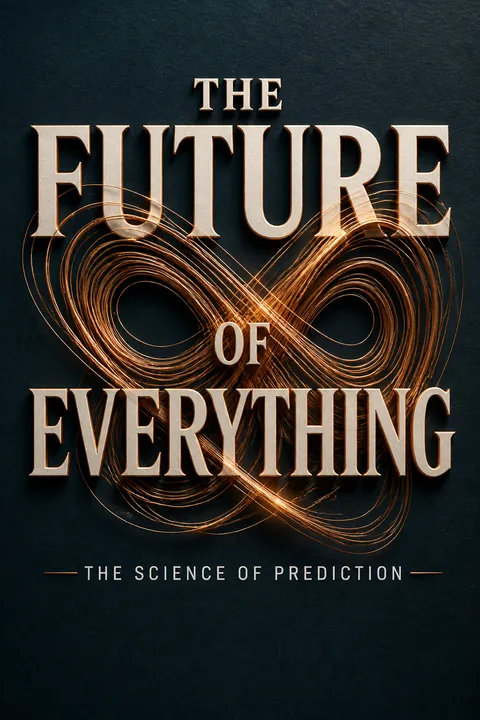
The Future of Everything explores the science of prediction across various fields. Readers found it thought-provoking, particularly its insights on weather, economics, and health forecasting. The book covers historical attempts at prediction and modern modeling techniques, highlighting their limitations and uncertainties. While some readers appreciated the author's explanations and humor, others found the content underwhelming or outdated. Overall, the book challenges readers to reconsider their expectations of predictive models and encourages a cautious approach to future planning.
People Also Read

Glossary
Uncomputable
Not accurately reducible to equationsOrrell uses this term for a real-world system that cannot be accurately represented by equations without effectively recreating the system itself. The system may follow physical rules, but interactions and emergent behavior prevent a compact model from calculating its full course. Models can still illuminate parts of such systems or support broad warnings.
Computational irreducibility
No shortcut to the outcomeA property of some rule-based systems in which the future state cannot be calculated by a shorter method than allowing the system to run through its successive steps. In the book, cellular automata such as Life illustrate the idea: simple local rules can produce behavior whose later details cannot be inferred directly from the rules.
Model error
Mismatch between model and systemThe difference between a mathematical model and the real system it is intended to represent. A model may omit processes, approximate them with simplified equations, or use inaccurate parameter values. Model error is distinct from uncertainty in the system’s starting state, and it can limit a forecast even when observations are precise.
Parameterization
Approximation of complex processesA method for representing a complicated process with a simpler equation or setting inside a model. Weather models, for example, cannot directly resolve every cloud, so they approximate cloud effects. Parameterizations make large simulations possible, but their assumptions can influence results and create uncertainty that extra computing power does not automatically remove.
Emergence
System-level behavior from interactionsA property or pattern that arises from interactions among parts of a system but cannot be explained by examining any one part alone. Clouds, organism traits, and collective market behavior are used as examples. Emergent outcomes can be consistent with underlying rules while remaining difficult to predict from those rules in advance.
Ensemble forecast
Many forecasts compared togetherA forecasting method that runs multiple predictions using altered starting conditions, different models, or variations in model assumptions. The collection is interpreted to estimate a range of possible outcomes or probabilities. Orrell cautions that an ensemble’s spread is not automatically a reliable measure of uncertainty, especially if the models share structural errors.
Efficient market hypothesis
Prices reflect available informationAn economic theory that treats competitive markets as incorporating available information into asset prices. In this view, consistently predicting price movements is difficult because prices already reflect what investors know. The book credits the theory with useful tools for assessing and managing risk, while criticizing its assumptions about rationality, investor independence, and extreme market events.
Gaia theory
Earth as self-regulating systemJames Lovelock’s theory that Earth can be usefully understood as a self-regulating system in which life and the physical environment affect one another. Organisms alter atmospheric and geological conditions, while those conditions shape life. The theory need not imply that Earth has intention or purpose; regulation can emerge from interacting processes.
Model drift
Accumulating error in forecastsA method Orrell discusses for estimating model error. A sequence of short forecasts is repeatedly compared with observations, so the starting point is reset to the observed state each time. Summing the resulting deviations helps isolate errors caused by the model from the effects of growing uncertainty in the initial condition.
FAQ
What's The Future of Everything: The Science of Prediction about?
- Exploration of Prediction Science: The book examines the science of prediction across domains like weather, health, and economics, focusing on how predictions are made and their historical context.
- Interconnected Systems: Orrell highlights the intrinsic links between weather, health, and wealth predictions, emphasizing the need to view these systems as part of a larger framework.
- Limitations of Predictive Models: The book discusses the uncertainties in predictive models, noting that while they offer insights, they often lack accuracy due to system complexities.
Why should I read The Future of Everything?
- Insightful Historical Context: It provides a comprehensive history of scientific prediction, enhancing appreciation for modern forecasting methods.
- Challenging Conventional Wisdom: Orrell encourages questioning the reliability of expert predictions, empowering readers to think critically.
- Relevance to Current Issues: The themes of uncertainty and complexity are pertinent to today's challenges like climate change and economic instability.
What are the key takeaways of The Future of Everything?
- Uncertainty in Predictions: Predictions are often uncertain, and even expert models can be wrong, highlighting the value of common sense.
- Complex Interactions: The book illustrates how interconnected systems make predictions difficult, with changes in one area affecting others.
- Historical Influence on Science: Orrell traces the evolution of predictive methods, showing their impact on contemporary practices.
What are the best quotes from The Future of Everything and what do they mean?
- “Prediction is very difficult, especially if it’s about the future.”: This underscores the inherent challenges in making accurate predictions.
- “The special and enchanted land of forecasting is inhabited by tribes of specialists...”: Reflects the esoteric nature of forecasting and the need for clearer communication.
- “In reality, human behavior transforms natural hazards into what should really be called unnatural disasters.”: Highlights the role of human actions in exacerbating natural events.
How does David Orrell define prediction in The Future of Everything?
- Broad Definition: Prediction is forecasting future events based on current knowledge and historical data, spanning fields like meteorology and economics.
- Complexity of Systems: Predictions involve understanding complex systems and their interactions, making accuracy challenging.
- Historical Context: The book traces the evolution of predictive methods, enriching the understanding of prediction as a scientific endeavor.
What are the limitations of weather forecasting discussed in The Future of Everything?
- Model Errors: Weather models often contain errors due to simplifications and assumptions, leading to inaccuracies.
- Chaos Theory: Small changes in initial conditions can lead to vastly different outcomes, complicating long-term forecasts.
- Parameterization Challenges: Difficulties in parameterizing atmospheric processes contribute to overall uncertainty in predictions.
How does The Future of Everything relate to health predictions?
- Genetic Influence: Genetic information can predict health outcomes, but environmental factors complicate this.
- Statistical Patterns: Correlations between genetic markers and diseases are discussed, but they don't imply causation.
- Emergent Properties: Health outcomes are emergent properties of complex systems, challenging reductionist views.
What role does chaos play in predictions according to The Future of Everything?
- Sensitivity to Initial Conditions: Chaos theory shows how small errors can lead to large discrepancies in predictions.
- Unpredictability: Chaos introduces unpredictability, complicating forecasting efforts even with sophisticated models.
- Implications for Science: Recognizing chaos encourages probabilistic approaches rather than deterministic ones.
How does David Orrell address the concept of free will in The Future of Everything?
- Deterministic vs. Free Will: Orrell discusses the tension between deterministic models and free will in human behavior.
- Complex Interactions: Human behavior is influenced by many factors, making it difficult to predict actions with deterministic models.
- Philosophical Implications: Raises questions about responsibility and agency in a world of uncertain predictions.
What methods does David Orrell suggest for improving predictions in The Future of Everything?
- Embrace Complexity: Shift towards accounting for complexity and interconnectedness in systems.
- Probabilistic Forecasting: Adopting probabilistic methods can improve accuracy, especially in chaotic systems.
- Interdisciplinary Collaboration: Encourages collaboration across disciplines to develop more robust models.
How does The Future of Everything address the concept of the Efficient Market Hypothesis (EMH)?
- Critique of EMH: Orrell argues that EMH oversimplifies market complexities and doesn't account for irrational behaviors.
- Randomness in Markets: Market movements often appear random, challenging the notion of consistent outperformance.
- Implications for Forecasting: EMH poses challenges for forecasters, emphasizing the need for nuanced market understanding.
How does The Future of Everything suggest we prepare for an uncertain future?
- Embrace Holistic Thinking: Adopt a perspective that considers system interconnectedness beyond mathematical models.
- Focus on Adaptability: Prioritize adaptability and resilience over predicting specific outcomes.
- Encourage Proactive Measures: Advocate for proactive measures to address challenges, emphasizing collective action.
About the Author
Download PDF
Download EPUB
.epub digital book format is ideal for reading ebooks on phones, tablets, and e-readers.








