

Key Takeaways
Put money at the center: it does more than move goods around.
The textbook omission. Economics is commonly introduced as the study of scarcity, while money is treated as a neutral tool for trading goods. Orrell argues that this misses the economy's basic activity: transactions involving money. A price does not simply reveal a value already fixed inside an object. It assigns a number to something whose worth depends on people, circumstances, and exchange.
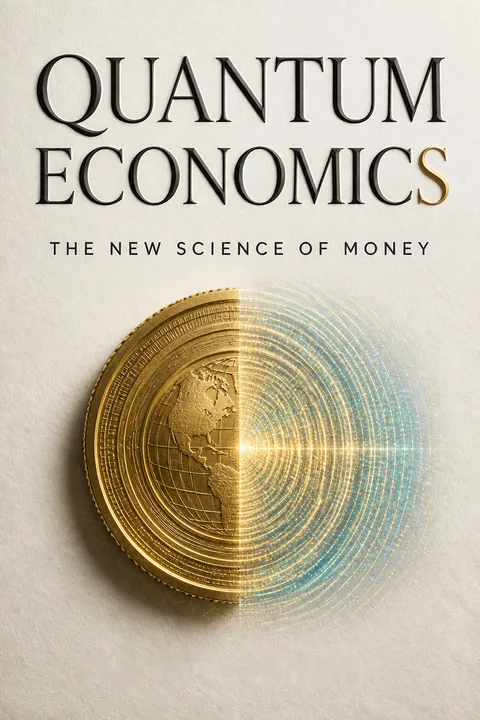
A quantum lens. The book calls money both numerical and object-like: a balance on a screen is an amount you can own, transfer, or owe. Orrell uses quantum physics to illuminate this dual character, not to claim that society is literally a collection of subatomic particles. Centering money, he argues, makes credit, finance, and the instability they can create impossible to ignore.
The reframing matters because it turns money from background infrastructure into a subject of inquiry. That move can reveal how payment systems, debt, and ownership distribute power, questions hidden by models that treat money as a convenient measuring stick. The analogy to quantum physics is most persuasive as a way to loosen rigid assumptions, not as proof that economic institutions obey physical quantum laws. The useful test is whether the lens helps explain real transactions and their consequences more clearly than the models it challenges.
Treat every price as a transaction, not a value hiding in the object.
A price is settled. A house can have an asking price, but until a buyer and seller complete a deal, its sale price remains uncertain. A stock market makes this visible: buyers may offer less than sellers are willing to accept, leaving no single agreed price. The price emerges when an order is matched and a transaction occurs.
Measurement changes markets. The deal records a price, but it also affects what other buyers and sellers expect. In the book's sample order book, buying 100 shares costs $15.90 each, while buying 10,000 shares pushes the average to $16.16 because the buyer must accept progressively higher offers. Price, in this account, is not a timeless property of the asset. It is an outcome shaped by the size and setting of the trade.
This perspective fits the practical reality of markets: posted prices, bids, and completed sales are different kinds of evidence. It also helps explain why an asset can look liquid in ordinary conditions yet become hard to price when buyers disappear. The caution is that a transaction price is not the whole story. It reflects bargaining power, rules, and market design as well as beliefs about an asset. Treating price as produced by exchange makes those conditions visible, rather than making price arbitrary.
Remember that each bank loan creates money and binds borrower to lender.
Credit creates deposits. When a bank approves a loan, it normally credits the borrower's account rather than handing over money previously saved by another customer. The newly created deposit is money; when the loan is repaid, that money is destroyed. The book cites the Bank of England's estimate that private banks created about 97 percent of UK money in the period it discusses.
Every credit has two sides. A medieval English tally stick was split between creditor and debtor, so each held one side of the same obligation. Modern accounting records the same basic pairing as credit and debt. Their totals may balance on a ledger, but their effects do not vanish: a borrower must make payments, while a lender holds a claim. Money creation therefore changes relationships as well as balances.
The distinction between lending existing savings and creating a deposit is central to understanding how credit can expand purchasing power quickly. It also redirects attention from the money supply alone to who receives new credit, what it finances, and who bears the repayment risk. The book's emphasis on entanglement usefully captures these ties, though it should not obscure the legal and institutional differences among loans. A mortgage, a government bond, and an informal debt create different obligations even when all have a creditor and a debtor.
Watch debt-fed asset booms as feedback loops, not self-correcting markets.
Credit can amplify itself. In a rising property market, banks may lend against higher house values. New borrowing gives buyers more money to bid, which can lift prices further and support still larger loans. The book describes this as a credit cycle, drawing on economist Hyman Minsky's account of how confidence and borrowing can build until a reversal exposes fragile debts.
A boom can turn. Minsky's Financial Instability Hypothesis says that periods of apparent success encourage riskier borrowing; some borrowers then depend on rising asset prices to keep up with payments. When confidence falters and prices stop climbing, those borrowers may sell, adding pressure to prices and credit. The book notes that Canadian house prices and the money supply both roughly tripled between 1999 and 2017, while general inflation remained low. It calls the point when confidence breaks a Minsky moment.
Feedback loops offer a stronger account of financial fragility than the idea that markets automatically correct every excess. They also explain why a stable consumer-price index can coexist with rapid growth in housing or other assets. Still, the Canadian comparison is evidence of parallel growth, not by itself proof that credit explains every price increase. A sound diagnosis needs to trace lending, collateral, and borrower capacity, while also checking local supply, regulation, and demand. The framework is valuable precisely because it asks what builds the boom.
Model people as context-shaped and connected, not miniature utility machines.
Choices depend on context. Quantum cognition is a mathematical approach that models judgments as sensitive to the question, its order, and the person's state of mind. In one experiment described in the book, people were offered a second chance to play a game after an uncertain first result. Sixty-nine percent played again when told they had won, and 59 percent when told they had lost. When the result was unknown, only 36 percent chose to play again, far below the 64 percent expected by a simple average.
A decision takes shape. The quantum model treats a person as holding several possible responses until a choice is required. The first question or new information can change the context for the next answer. Orrell extends this idea to money: a loan links borrower and lender, while decisions about repayment can reflect emotion, trust, and social expectations, not just a fixed calculation of personal gain.
The value of this approach is not that it makes human behavior mysterious, but that it gives context and changing preferences a formal place in the model. The game result shows why averaging over known outcomes may fail when the outcome itself is uncertain. However, a quantum description of judgment does not establish that the brain is physically a quantum computer. Its claim is strongest when it predicts patterns that simpler decision models miss, rather than when the word quantum is treated as an explanation by itself.
Do not mistake elegant equilibrium models for forecasts of living economies.
The curves are assumptions. Mainstream economics often explains prices through supply and demand curves that meet at an equilibrium. Orrell argues that actual transactions reveal a combined result, not two independently measured curves. The curves can be useful abstractions, but they should not be mistaken for direct observations of stable forces at work in every market.
Finance was missing. Many economic models described in the book treated the economy as self-correcting and gave little or no role to banks, debt, defaults, or derivatives. In 2007, a US central bank official described subprime problems as unlikely to spill over broadly, even as a crisis was developing. Orrell argues that this was more than a missed date: models that leave out credit creation and financial connections cannot fully explain a crisis driven by them. He favors using tools such as network analysis and agent-based models to study interactions and instability.
A model can be useful without being a miniature replica of the world. The crucial issue is whether its assumptions fit the question, and whether it can expose risks rather than quietly exclude them. The book's challenge is strongest when it identifies specific omissions, such as bank lending and defaults, that change the diagnosis of a crisis. But equilibrium models are not automatically useless: they can clarify conditional questions. Better practice is to compare several approaches, test them against data, and make their blind spots explicit.
Treat inequality as a system outcome, not a verdict on personal merit.
Balances hide distribution. An economy can grow in aggregate while wealth and bargaining power become more concentrated. Orrell argues that models focused on averages and market equilibrium are poorly equipped to represent that distribution. The book cites a 2017 Oxfam estimate that eight men held as much wealth as the poorest half of the world's population, illustrating the scale of concentration in the period covered.
Rank shapes experience. The book also discusses research finding that relative income rank can matter more to life satisfaction than income alone: earning more may not feel like a gain if one's peers earn much more. Debt adds another asymmetry, because a creditor's claim gives one party leverage over another. These patterns complicate the assumption that separate individuals simply trade to improve their own welfare and that the resulting outcome is fair by definition.
Distribution is not a side issue if economic outcomes affect access to housing, security, or political influence. The focus on rank also helps explain why rising average income need not translate into greater satisfaction. At the same time, a dramatic wealth comparison cannot, by itself, identify the causes of inequality or determine which policy will reduce it. The book's stronger point is methodological: models that ignore who owns assets and owes debts cannot claim to describe the full social effect of economic growth.
Keep GDP inside ecological limits instead of treating growth as the goal.
GDP records spending. Gross domestic product measures the value of final goods and services produced through market activity. It generally misses unpaid care work, resources left untraded in the ground, and pollution that has not been priced. Cleaning up pollution can add to measured output, even though the damage that required cleanup is not necessarily counted as a loss. A number built from transactions is not a complete measure of social or ecological health.
Some values need boundaries. Orrell argues that putting a price on nature does not make markets a reliable judge of ecological limits. He points to the commons: shared resources can be depleted when users act independently, but communities have also managed forests, fisheries, and other shared assets through rules and cooperation. Non-market measures, including the Genuine Progress Indicator, can offer additional information, while ecological constraints should shape what the economy is allowed to do.
The distinction between measuring economic activity and measuring well-being is essential. GDP is useful for tracking a defined kind of production, but problems begin when one indicator becomes a stand-in for every public goal. The commons example also challenges the idea that shared resources must inevitably be ruined: outcomes depend on governance, local knowledge, and incentives. Monetary valuation can still help coordinate choices, but it cannot settle questions about acceptable ecological damage. Those require explicit limits and public judgment.
Draw firm boundaries around what money and markets are allowed to decide.
Economics has a domain. The book argues that markets can describe monetary transactions, but cannot by themselves decide what makes a life worthwhile or what level of environmental harm is acceptable. Its practical proposals include giving people a basic income, allowing governments to issue money directly, shifting taxes toward land and resource use, and limiting some financial trading. It also calls for protecting shared commons and making corporations answerable to wider social consequences.
Reform the story, too. Orrell does not offer one grand model that can predict every crisis. He calls for economics to take money creation and financial risk seriously, use varied tools suited to different problems, and be more open about uncertainty and professional conflicts of interest. The central change is to stop treating efficiency, growth, or a tidy equation as sufficient proof that a policy serves the public.
A boundary-setting approach is more credible than asking one discipline to price every human and ecological concern. It keeps economic analysis useful while making room for ethics, ecology, and democratic choice to establish constraints. The proposals are directions, not a complete policy blueprint: each would involve trade-offs, institutional design, and political disagreement. Their common purpose is to prevent market prices from silently becoming society's only definition of value.
Analysis
Orrell's central move is to redefine money as an active institution rather than a passive token. This changes the unit of analysis from isolated exchanges of goods to a network of claims, obligations, and measurements. The historical tour supports that move: silver standards, tally sticks, banknotes, and digital currencies differ materially, yet each depends on rules and shared recognition that make a numerical claim transferable. The book's sharpest economic insight follows from this continuity. Bank lending creates purchasing power, so finance can shape the real economy rather than merely route its savings.
The quantum language is both the book's organizing strength and its chief epistemic risk. Concepts such as indeterminacy, entanglement, and context dependence help describe prices that emerge through trades and choices that change with framing. But resemblance is not mechanism. Social entanglement is mediated by law, institutions, and power, not by demonstrated nonlocal particle interactions. The most defensible reading is therefore methodological: quantum ideas loosen the assumption that agents and values exist independently of their relations. That is useful even if the physical analogy is not literal.
The critique of orthodox models is strongest when it identifies omissions with observable consequences, especially bank-created credit, defaults, and leverage. It is less persuasive when the failure of a particular forecast is treated as proof that a broad paradigm is intrinsically incapable of explanation. No model can represent everything, and complexity methods can also be overfit or difficult to validate. The practical standard should be comparative performance: whether a model reveals vulnerabilities, supports robust decisions, and states its limits.
The book's normative conclusion is more important than its proposed scientific metaphor. Economic measures are choices about what counts. GDP can be a consistent measure of market production without being a measure of flourishing, and prices can coordinate exchanges without settling ecological or ethical questions. The strongest legacy of the argument is therefore not a replacement orthodoxy called quantum economics, but a demand for monetary realism, empirical humility, and explicit boundaries around market authority.
Review Summary
Quantum Economics receives mixed reviews, with ratings ranging from 1 to 5 stars. Positive reviewers praise its innovative approach to economics, drawing parallels with quantum theory and critiquing mainstream economic models. They appreciate Orrell's fresh perspective on money and markets. Critical reviewers argue the book misuses quantum concepts, lacks precision, and fails to provide concrete solutions. Some find it thought-provoking despite its flaws, while others dismiss it as pseudoscience. Overall, readers agree that economics needs reform but debate the merits of Orrell's quantum-inspired approach.
People Also Read








Glossary
Quantum economics
Money-centered economic lensAn approach that places money and monetary transactions at the center of economic analysis. It treats money as both numerical information and a transferable object, and emphasizes that prices, credit, and debt emerge from relationships and context. The term draws inspiration from quantum physics without requiring the claim that society is reducible to subatomic mechanics.
Quantum theory of money and value
Money's dual natureOrrell's account of money as combining the properties of a number with those of an owned, transferable thing. A transaction assigns a numerical price to a value that is not inherently numerical or fixed. In this account, money also links credit with debt, and its creation and use shape relationships across the economy.
Money object
Transferable valued claimA transferable entity, created by an authority or organized body, with a specified monetary amount and currency unit. It may be physical, such as a coin, or digital, such as a bank deposit. The term highlights money's combined numerical and object-like aspects, and the records or rules that establish its validity.
Quantum cognition
Context-sensitive decision modelA mathematical approach to judgment and choice that uses structures from quantum theory to represent uncertainty, context, and changes caused by the order of questions. A person's response is modeled as one possibility among several until a choice is made. It offers an alternative explanation for patterns that classical probability and fixed-preference models may not capture.
Quantum logic
Logic allowing interferenceA framework in which possibilities need not behave like independent yes-or-no alternatives. In quantum models, alternatives can overlap or interfere, changing the probability of an outcome. Orrell uses the idea to explain how judgments can depend on context and question order, rather than assuming that choices simply reveal stable preferences.
Financial Instability Hypothesis
Credit-driven instability accountEconomist Hyman Minsky's account of how a long period of economic success can encourage greater borrowing and risk-taking. As confidence rises, some borrowers become dependent on asset prices continuing to increase. If prices stall and confidence falls, debt and forced selling can amplify the downturn rather than automatically restoring stability.
Minsky moment
Confidence breaks in a boomThe turning point in a credit-driven boom when confidence weakens and rising asset prices no longer support speculative borrowing. Borrowers who relied on further price gains may struggle to meet obligations or sell assets, putting additional downward pressure on prices and credit. The term names a possible shift from apparent stability to rapid financial stress.
Dynamic Stochastic General Equilibrium (DSGE) model
Equilibrium macroeconomic modelA family of macroeconomic models that represents changes over time, uncertainty, and interactions across markets, usually through assumptions about consumers, firms, and equilibrium. Orrell criticizes common versions for treating shocks as external and for giving too little attention to bank credit, debt, defaults, and financial networks. The models are used in economic analysis and policymaking.
Holon
Whole that is also partA term introduced by Arthur Koestler for an entity that has some autonomy as a whole while also functioning as part of a larger system. A person, family, organization, or society can be understood this way. The concept emphasizes that individual identity and collective organization develop through ongoing interaction rather than existing as wholly separate levels.
FAQ
1. What is Quantum Economics: The New Science of Money by David Orrell about?
- Quantum-inspired economics: The book proposes a new economic framework inspired by quantum physics, arguing that money and markets exhibit quantum-like properties such as entanglement, indeterminacy, and interference.
- Critique of classical models: Orrell critiques traditional, mechanistic economics for ignoring the active, complex role of money and for relying on unrealistic assumptions like rational economic man and equilibrium.
- Interdisciplinary approach: The book integrates insights from quantum physics, behavioral economics, complexity theory, and social sciences to create a richer, more realistic economic theory.
- Societal implications: Orrell connects his theory to issues like financial instability, inequality, environmental sustainability, and the need for ethical reform in economics.
2. Why should I read Quantum Economics: The New Science of Money by David Orrell?
- Understand economic failures: The book explains why mainstream economics failed to predict or prevent crises like the 2007–08 financial crash, highlighting the neglect of money’s quantum nature.
- Fresh perspective on behavior: Orrell introduces quantum cognition, offering a more accurate and humane model of economic decision-making that accounts for context and entanglement.
- Broader societal relevance: The book links economics to environmental and ethical concerns, challenging the dominance of GDP and advocating for new metrics and values.
- Foundation for reform: Readers gain tools to rethink economic policy, financial stability, and the role of money in society.
3. What are the key takeaways from Quantum Economics: The New Science of Money by David Orrell?
- Money as a quantum entity: Money is not just a medium of exchange but has a dual, quantum-like nature, combining numerical and owned-object properties.
- Economy as a complex system: The economy is better understood as a network of entangled agents and feedback loops, not as a self-stabilizing machine.
- Human behavior is quantum-like: Economic decisions are context-dependent, probabilistic, and influenced by entanglement with others, challenging the rational economic man model.
- Need for new metrics and ethics: Traditional measures like GDP are inadequate; economics should incorporate ethics, sustainability, and collective well-being.
4. How does David Orrell define money differently in Quantum Economics compared to traditional economics?
- Quantum duality of money: Orrell defines money as a quantum object with both real (owned thing) and virtual (numerical value) aspects, similar to wave-particle duality in physics.
- Measurement process analogy: Money acts like a quantum measurement, collapsing uncertain value into a definite price during transactions.
- Entanglement in creation: Money creation involves entangled pairs of debt and credit, linking people and institutions in complex ways.
- Beyond inert medium: This view challenges the traditional notion of money as a passive medium or mere metric.
5. What is the "quantum theory of money and value" in Quantum Economics by David Orrell?
- Dualistic nature: Money combines the properties of a number (price) and an owned thing (value), analogous to quantum wave-particle duality.
- Uncertainty and measurement: Prices are not fixed but are uncertain properties created through transactions, much like quantum measurements collapse probabilities.
- Entanglement in finance: Every act of money creation produces entangled debt and credit, influencing the dynamics and risks of the financial system.
- Rejects classical value theories: The theory moves beyond labor or utility-based value, focusing on the process of value realization.
6. How does Quantum Economics by David Orrell use concepts like entanglement and uncertainty from quantum physics to explain economics?
- Entanglement analogy: Financial contracts, such as loans, entangle debtor and creditor, so changes in one party affect the other instantly, mirroring quantum entanglement.
- Uncertainty principle: Economic values and prices are fundamentally indeterminate until measured in a transaction, similar to the uncertainty in quantum systems.
- Measurement effect: The act of transacting (measuring) changes the economic system, meaning outcomes are not predetermined but emerge through interaction.
- Complex feedback loops: These quantum concepts help explain financial instability and the emergence of crises.
7. What is the concept of "rational economic man" and how does Quantum Economics by David Orrell critique it?
- Classical definition: Rational economic man is the model of a perfectly rational, selfish individual with fixed preferences and perfect foresight.
- Behavioral critique: Orrell discusses how behavioral economics exposes cognitive biases and irrationalities, but only tweaks the classical model.
- Quantum cognition challenge: The book argues that human preferences exist in superpositions and change with context, making the rational economic man an oversimplification.
- Entangled, probabilistic agents: Economic agents are better modeled as quantum entities with entangled, context-dependent preferences.
8. How does quantum logic differ from classical logic in economic decision-making, according to Quantum Economics by David Orrell?
- Binary vs. superposition: Classical logic assumes fixed, binary choices, while quantum logic allows for superpositions—preferences can exist in multiple states until measured.
- Order matters: In quantum logic, the order of questions (measurements) affects outcomes, explaining phenomena like the order effect in surveys.
- Context-dependence: Economic decisions are influenced by context and previous measurements, which classical models cannot capture.
- Better behavioral fit: Quantum logic accounts for uncertainty, interference, and entanglement in human decision-making.
9. What is the "order effect" and how does Quantum Economics by David Orrell explain it using quantum theory?
- Order effect defined: The order in which questions are asked changes the answers, a phenomenon classical probability cannot explain.
- Quantum cognition model: Mental states are superpositions that collapse upon answering, altering the context for subsequent questions.
- Non-commutative measurement: Quantum theory naturally predicts symmetrical order effects, making them consistent rather than irrational.
- Real-world relevance: This insight helps explain survey results and decision-making anomalies in economics.
10. How does Quantum Economics by David Orrell reinterpret the "prisoner’s dilemma" using quantum game theory?
- Classical dilemma: Traditional game theory predicts rational players will always betray, leading to suboptimal outcomes.
- Experimental contradiction: In reality, people cooperate about half the time, defying classical predictions.
- Quantum game theory: Players are modeled as qubits in superposition, with entangled strategies that explain observed cooperation rates.
- Social norms and entanglement: This approach reflects the influence of shared norms and interconnectedness in real human behavior.
11. How does Quantum Economics by David Orrell explain financial crises and instability differently from mainstream economics?
- Mainstream view: Crises are seen as random shocks to a stable equilibrium, with markets assumed to be self-correcting.
- Quantum perspective: The economy is an entangled, nonlinear system where money creation and debt create complex feedback loops and endogenous instability.
- Emergence of crises: Financial crises arise from within the system due to these entanglements, not from external shocks.
- Modeling implications: Quantum economics suggests agent-based, quantum-inspired models better capture sudden, discontinuous events like defaults and bubbles.
12. What ethical and societal implications does Quantum Economics: The New Science of Money by David Orrell draw from the quantum view of the economy?
- Interconnectedness and responsibility: Individuals are entangled parts of social systems, so economic actions have collective consequences.
- Money and ethics: The quantum nature of money means economic decisions inherently involve ethical considerations like fairness and trust.
- Challenging individualism: The book calls for moving beyond atomistic, selfish models to embrace cooperation and social embeddedness.
- Policy reforms: Orrell suggests reforms such as universal basic income, financial transaction taxes, and expanding the commons to align economics with human and planetary well-being.
About the Author
Download PDF
Download EPUB
.epub digital book format is ideal for reading ebooks on phones, tablets, and e-readers.








