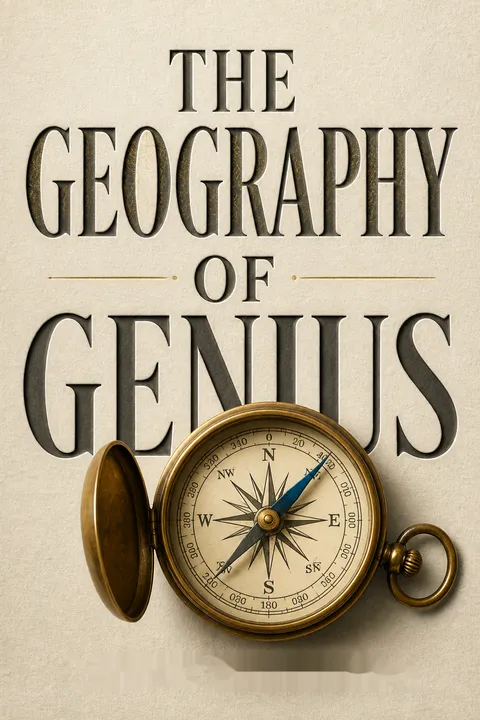


Key Takeaways
Treat genius as an achievement of a culture, not a gene.
Genius has three tests. Creative genius means producing work that is new, surprising, and valuable. High intelligence alone does not qualify, and the book estimates that genes explain only a modest share of creative achievement. Practice matters, but practice cannot explain why great thinkers repeatedly gather in particular places and periods.
Places make possibility visible. Historiometrics, the statistical study of historical patterns in achievement, finds creative peaks clustered in places such as Athens and Florence. The Fashionista Theory of Genius describes another part of the puzzle: society helps decide which creations count as genius. Culture supplies the setting, connections, and recognition that individual talent needs. The book’s central shift is from asking what genius is inside a person to asking where it can happen.
What's powerful here is the move from a heroic individual to a social process. Research on scientific recognition and artistic canons likewise shows that talent is not self-announcing: institutions, audiences, and gatekeepers shape whose work survives. That does not make achievement merely fashionable. Some works endure because they continue to reward attention. But recognition is unevenly distributed, and historical archives preserve the powerful more reliably than the excluded. A cultural account corrects genetic reductionism while inviting a harder question: which people are given the time, tools, and audience to demonstrate their ability?
Build creative conditions from friction, openness, and competing ideas.
Athens was no paradise. Its streets were cramped and filthy, its land poor, and its fortunes uncertain. Its creative peak depended on a temporary convergence of peace, public life, and competition among independent Greek city-states. Danilevsky’s law is the claim that small, independent societies can reach their creative potential more readily than people under a single cultural monopoly. Each city-state became a different kind of experiment.
Athens stayed porous. Foreign goods and ideas flowed through its port, while debate in public life made disagreement unavoidable. Athenians competed intensely, but much of that rivalry served the city’s standing, not merely private fame. Democracy contributed, though the book argues that freedom and open exchange matter more than democracy by itself. The lesson is not to recreate ancient Athens, but to resist both intellectual isolation and comfortable sameness.
The Athens story makes a strong case for productive friction: competing communities generate alternatives, while exchange lets ideas travel between them. This resembles the value of research ecosystems with multiple independent teams rather than one central authority. Yet fragmentation alone is not creative. Rival groups can become hostile, and open debate means little when some people are barred from speaking or participating. The useful model is pluralism with channels of contact: enough independence for experiments to differ, and enough shared civic life for discoveries to circulate.
Fund ambitious work, then give emerging talent room to risk.
Florence converted wealth into opportunity. Its cloth trade created money, but also brought merchants into contact with distant materials, techniques, and ideas. The Medici family used its fortune to commission art and support artists. This patronage did more than pay bills: Lorenzo de’ Medici noticed a gifted fourteen-year-old Michelangelo and brought him into a world of teachers, materials, and demanding work.
Talent grew in workshops. A bottega was an artist’s workshop where apprentices learned by working alongside experienced makers. Leonardo da Vinci began with menial tasks in Verrocchio’s workshop, then earned more substantial responsibilities. Patrons and masters sometimes let young artists take real creative risks. Florence’s wealth also made failure survivable. Money did not buy genius outright; it bought time, training, materials, and another chance.
Florence illustrates that creative funding is infrastructure, not a reward handed out after success. Apprenticeships and generous commissions let skill develop through consequential work, a principle shared by craft traditions and modern research labs. The story also complicates the romance of the solitary creator: Michelangelo and Leonardo depended on patrons, teachers, and collaborators. Patronage can, however, narrow work toward wealthy sponsors’ tastes. The strongest support systems pair resources with artistic independence and a public broad enough to value more than elite preference.
Borrow widely, observe closely, and let tradition become raw material.
Song China made continuity creative. From 969 to 1276, Hangzhou became a flourishing center of art, learning, and invention. Woodblock printing widened access to books, while merchants and travelers carried ideas into the city. Chinese innovators often judged ideas by usefulness and fit with inherited knowledge, rather than by novelty alone. The author calls the enabling role of limits the Power of Constraints: restrictions can focus invention instead of simply blocking it.
Attention turned knowledge into discovery. Shen Kuo, a scholar with interests spanning many fields, recorded observations about nature and technology in notebooks. His insight about the direction of a magnetized needle emerged from close attention to what did not quite match expectation. The Song example broadens the meaning of innovation: progress can be gradual, cumulative, and deeply connected to tradition, not just a dramatic break with the past.
This account usefully challenges the assumption that innovation must look like disruption. In many fields, advances depend on accumulated methods, shared standards, and careful refinement. The book’s contrast between Western novelty and Chinese continuity is memorable, but it risks making enormous, diverse societies sound culturally uniform. Institutions and historical circumstances vary within civilizations. A practical takeaway survives that caution: originality often comes from recombining inherited knowledge, and close observation can reveal opportunities that abstract celebration of novelty misses.
Make disagreement useful by pairing blunt debate with trust.
Edinburgh improved by arguing. The Scottish Enlightenment treated practical problems, from farming to medicine, as worthy of serious thought. Informal clubs brought people from different professions together. Some practiced flyting, a ritual form of sharp verbal attack, then returned to shared social life. The point was to challenge ideas forcefully without turning every disagreement into a lasting personal feud.
Conversation crossed disciplines. Geologist James Hutton developed a new account of the earth’s age, while his friend John Playfair helped make Hutton’s difficult writing clear enough to persuade readers. Their collaboration shows compensatory strengths at work: one person’s insight can be made more powerful by another person’s skills. Edinburgh’s clubs and universities also allowed ideas to move between teachers, students, merchants, and scholars. Intimacy and trust mattered alongside the city’s density.
The distinction between disagreement and disrespect is central. Good intellectual conflict tests assumptions, while trust gives people a reason to stay in the conversation after a bruising exchange. This echoes findings in team research: dissent can improve decisions when groups protect participation and evaluate arguments rather than status. But a club can also become a closed circle, especially when membership excludes women or outsiders. Productive debate requires more than permission to disagree. It requires fair access, active listening, and a path from criticism to joint work.
Keep moving through disorder; chance rewards the observant.
Calcutta made collisions ordinary. During the Bengal Renaissance, Indian and Western ideas met in a city shaped by colonial rule, migration, and cultural exchange. Its adda, an informal conversation without a fixed agenda, let participants wander between subjects and viewpoints. The result was not simple imitation: writers and thinkers transformed outside ideas through local traditions.
Serendipity needs preparation. The term describes a useful discovery made by accident and recognized through good judgment. Alexander Fleming noticed that mold had killed bacteria in a laboratory dish; years of scientific work helped him understand why the anomaly mattered. Calcutta’s disorder offered abundant surprises, but people still had to notice them. Tagore’s revised poems produced doodles that prompted a friend to suggest painting, opening an unexpected new direction in his work.
Chance is not a substitute for skill. It supplies unusual inputs; attention and experience determine whether those inputs become meaningful. This is a powerful corrective to innovation stories that pretend discoveries arrive fully formed. It also cautions against romanticizing Calcutta’s hardship. Disorder can expose people to unexpected combinations, but instability and deprivation can also consume the time and safety needed for creative work. A useful environment offers surprise without making basic survival the main task.
Give ideas a demanding audience, and let creative influence spread.
Vienna made listeners part of the work. Mozart wrote for patrons, critics, and the wider public. The city’s high musical expectations pushed composers to satisfy listeners without flattening their ideas. Coffeehouses supplied newspapers, company, and unplanned conversation, while musicians learned from one another across generations. Creative work was not a private performance delivered to passive spectators; it developed within an active cultural ecosystem.
Outsiders changed the conversation. In turn-of-the-century Vienna, Jewish thinkers and artists made major contributions despite widespread antisemitism and exclusion. Freud’s new approach to psychology emerged amid local debates, professional resistance, and support from colleagues. The book’s account makes recognition and access part of the creative process: an idea needs people who can hear it, challenge it, and help it travel. A city’s audience can raise standards as well as open doors.
Vienna shows why audiences are not an afterthought. In fields such as science and design, informed critique can reveal flaws and help an idea find its form. Social spaces also allow influence to spread without every encounter being a formal collaboration. Still, the same audience can punish unconventional work, and Vienna’s treatment of women and Jews makes clear that cultural energy can coexist with exclusion. A demanding public is most valuable when it is diverse enough to recognize unfamiliar work and open enough to let it be tested.
Make innovation an ecosystem, not a lone inventor's origin story.
Silicon Valley had deep roots. Before personal computers, the region fostered radio experimentation, amateur clubs, Stanford research, and defense-funded engineering. Fred Terman helped connect Stanford with industry and encouraged students such as Hewlett and Packard to build companies. The celebrated inventors worked within networks of universities, funders, mentors, and early customers.
Weak ties carried new ideas. This term means relationships with acquaintances and colleagues who connect people to different information and social circles. Such links can introduce ideas unavailable within a close-knit group. Silicon Valley also made failure less personally ruinous than it was in Renaissance Florence, which encouraged risk-taking. Its strength lay less in inventing every component than in combining, improving, financing, and distributing ideas. The lone genius story hides the network that lets an invention become useful.
The ecosystem lens helps explain why copying Silicon Valley’s visible features, such as offices or slogans, rarely recreates its outcomes. Networks, capital, technical skill, and paths to customers have to work together. Weak ties broaden information, while close relationships can provide support, so creative networks need both. The Valley’s safety net also complicates its reputation for heroic risk: risk feels different when a failed venture does not end a career. Its innovation deserves scrutiny for who benefits, who bears the costs, and which problems receive investment.
Design for disorder, diversity, and discernment, but leave outcomes open.
No city recipe guarantees genius. The book treats golden ages as complex systems: many factors interact, and small changes can produce effects no one could confidently predict. Its Three Ds are disorder, diversity, and discernment. Disorder unsettles routine; diversity brings different experiences and ideas into contact; discernment helps a community distinguish promising work from noise.
Cultivate conditions, not certainty. The author closes by bringing the search home, describing how a family can encourage curiosity, offer challenges, make space for conversation, and pay attention to a child’s ideas. These gestures do not manufacture a genius. They make room for creativity to develop. The same principle applies to schools and cities: support exploration and useful feedback, but do not mistake beanbag chairs, technology, or a fashionable district for the source of creative life.
The Three Ds work best as a diagnostic lens, not a policy formula. Disorder without stability can become chaos in the destructive sense; diversity without inclusion leaves some perspectives unheard; discernment without humility can harden into gatekeeping. The framework’s value is that it balances generation with selection. Communities need room for unexpected ideas and fair ways to test them. The book’s refusal to promise a repeatable recipe is intellectually honest: institutions can improve the odds, but no checklist can script the moment when separate ingredients become a new cultural possibility.
Analysis
The book’s most important contribution is a change in scale. Genius is neither a mysterious substance lodged inside an exceptional person nor a simple output of education and effort. It arises through relationships among a creator, a place, an audience, institutions, and historical timing. The city chapters make this claim memorable by showing that creative clusters do not share one climate or political system. Athens relied on civic argument and exchange; Florence on patronage and workshops; Edinburgh on practical inquiry and cross-disciplinary debate; Calcutta on cultural hybridity and unpredictable encounter; Vienna on audiences, migration, and intellectual circulation; Silicon Valley on networks, capital, and rapid recombination.
The travel narrative is also a useful method. Instead of offering an abstract formula, it treats streets, workshops, cafés, laboratories, and archives as evidence. Everyday settings reveal how celebrated achievements were supported by less visible labor: apprentices, patrons, colleagues, audiences, and people who made ideas legible. This is a corrective to biographies that turn success into a solitary triumph.
The argument nevertheless requires careful handling. Historical golden ages are identified retrospectively, so the cases risk survivor bias: successful clusters receive attention, while similar conditions that produced no recognized breakthrough disappear from view. The book also draws on anecdotes and social-science studies of varying strength, but correlation between environment and achievement does not establish a single cause. Its broad contrasts between Eastern and Western creativity are vivid but can flatten variation within both traditions. Finally, celebrating challenge can romanticize hardship, even though deprivation often removes the security needed to create.
Those limits do not undo the central insight. They sharpen it. A culture cannot command genius, but it can distribute access to tools, mentors, audiences, and time. It can make dissent safer, let ideas cross boundaries, and preserve room for experimentation. The most defensible lesson is not that adversity produces brilliance, but that creative work becomes more likely when people can meet uncertainty with support, resources, and others capable of recognizing value.
Review Summary
The Geography of Genius receives mixed reviews, with praise for its engaging travelogue style and exploration of creative hubs throughout history. Readers appreciate Weiner's witty prose and interesting insights into factors contributing to genius clusters. However, some criticize the book's lack of depth, Western-centric focus, and occasional factual errors. While many find the premise intriguing, opinions vary on whether Weiner successfully answers the question of why genius thrives in certain places and times. Overall, the book is seen as an entertaining, if not entirely comprehensive, examination of creativity and innovation.
People Also Read




Glossary
Fashionista Theory of Genius
Social recognition of geniusThe view that creative work cannot be separated from its recognition by a community. A person’s originality or skill alone does not secure the social status of genius. Audiences, institutions, critics, and changing standards help determine which work is noticed, valued, and preserved.
historiometrics
Statistics applied to historyA method for studying historical people and periods with tools from social science, especially statistics. In the book, it is used to examine patterns in creative achievement across time and place, including the tendency for highly accomplished people to cluster in particular cultural settings.
Danilevsky’s law
Creative potential in independent culturesThe book’s name for the claim that a people is more likely to develop its creative potential when it belongs to an independent society, even a small one. Multiple independent societies can function like separate experiments, producing different ideas rather than allowing one cultural monopoly to dominate.
Power of Constraints
Limits that focus inventionThe idea that restrictions can direct creative effort into a smaller space and sometimes produce more original solutions. A constraint may be a limited set of materials, a demanding task, or an established form. The concept does not claim that every restriction helps; excessive limits can suppress exploration.
bottega
Artist’s working workshopAn Italian workshop where artists made commissioned work and trained apprentices through practical participation. Students learned by observing masters, completing tasks, and gradually taking on more complex responsibilities. The bottega joined production, business, mentorship, and skill development rather than separating art education from everyday work.
flyting
Ritual verbal contestA Scottish practice of attacking an opponent through sharp, often humiliating language in a structured debate. In the book’s account of Enlightenment clubs, verbal combat could test ideas and expose weak reasoning. Its social value depended on participants being able to resume friendly relations afterward.
adda
Open-ended social conversationA Bengali gathering organized around conversation without a fixed agenda. Participants may move among serious and playful topics, and the exchange is valued for its own sake rather than for producing a formal decision. The book presents adda as a social setting that encourages unexpected connections.
serendipity
Useful accidental discoveryA discovery encountered unexpectedly and recognized as valuable through alertness and judgment. The book emphasizes that chance alone is insufficient: prior knowledge helps a person identify an anomaly, and a willingness to follow it can turn an accident into a discovery.
weak ties
Links to different networksRelationships with acquaintances, colleagues, and other people outside one’s closest circle. Because they often connect different social groups, weak ties can provide unfamiliar information and perspectives. They are especially useful in fast-changing environments, while close relationships remain important for trust and support.
Three Ds
Disorder, diversity, discernmentThe book’s shorthand for three conditions that can support creative places. Disorder unsettles established routines, diversity brings varied people and ideas into contact, and discernment helps communities identify valuable work. The framework describes enabling conditions, not a guaranteed recipe for producing a golden age.
FAQ
What's The Geography of Genius about?
- Exploration of Genius Locations: The book investigates cities like Athens, Florence, and Silicon Valley, known for their historical and contemporary creative output.
- Interconnectedness of Genius and Environment: Weiner argues that genius is influenced by the environment and culture, not just individual traits.
- Personal Journey: The narrative includes Weiner's travels to these locations, blending personal experiences with historical analysis.
Why should I read The Geography of Genius?
- Insightful Analysis: The book challenges the notion of genius as purely individual, exploring how environment shapes creativity.
- Cultural and Historical Context: Readers gain insights into how different societies foster creativity, inspiring personal creative endeavors.
- Engaging Writing Style: Weiner's witty and accessible writing makes complex ideas enjoyable and relatable.
What are the key takeaways of The Geography of Genius?
- Genius is Contextual: Genius is heavily influenced by cultural and social environments, not just individual talent.
- Importance of Diversity: Diverse environments are more likely to produce innovative breakthroughs.
- Value of Constraints: Constraints can enhance creativity by pushing individuals to think outside the box.
What are the best quotes from The Geography of Genius and what do they mean?
- “What is honored in a country will be cultivated there.”: Societal values shape the emergence of genius by recognizing and supporting creativity.
- “Genius is chaotic.”: Creativity often arises from disorder, suggesting that chaos can stimulate innovative thinking.
- “You can’t have genius without an audience.”: Recognition and appreciation from others are essential for genius to flourish.
How does The Geography of Genius define genius?
- Genius as a Social Construct: Genius is shaped by cultural perceptions and historical context, not just innate ability.
- Interdisciplinary Connections: True genius involves making connections between disparate fields and ideas.
- Cultural and Environmental Influences: Genius emerges from environments that support and value creativity.
What role do mentors play in fostering genius according to The Geography of Genius?
- Catalysts for Growth: Mentors nurture and develop talent, providing guidance and opportunities.
- Compensatory Genius: One brilliant mind can compensate for another's deficiencies, fostering creativity.
- Historical Examples: Mentorships, like Verrocchio and Leonardo da Vinci, illustrate mentorship's vital role in artistic breakthroughs.
How does The Geography of Genius address the relationship between money and genius?
- Wealth as a Catalyst: Money provides resources necessary for creative pursuits, allowing risk-taking and exploration.
- Patronage Systems: Patronage, especially in Renaissance Florence, enabled artists to focus on their work without financial worries.
- Cultural Investment: Societies investing in culture and the arts tend to produce more genius.
What is the significance of chaos and instability in fostering genius?
- Catalysts for Creativity: Chaos and instability can lead to bursts of creativity by disrupting the status quo.
- Opportunities for Change: Instability forces individuals to adapt, encouraging innovative thinking.
- Historical Examples: Cities like Athens and Florence experienced cultural advancements during tumultuous times.
How does The Geography of Genius compare Eastern and Western approaches to creativity?
- Cultural Differences: Eastern cultures emphasize process and tradition, while Western cultures prioritize novelty and individualism.
- Role of Community: Eastern creativity is often communal, while Western creativity is seen as individual.
- Practical vs. Abstract: Eastern approaches are practical, while Western approaches can be more abstract.
How does The Geography of Genius relate to the concept of interdisciplinary collaboration?
- Interdisciplinary Breakthroughs: Creative breakthroughs often occur at the intersection of different disciplines.
- Mutual Cerebral Stimulation: Conversations that spark new ideas are essential for fostering creativity.
- Cultural Context: Places like Edinburgh encouraged interdisciplinary collaboration, leading to significant advancements.
What insights does The Geography of Genius provide about the role of immigrants in fostering creativity?
- Immigrants as Catalysts: Immigrants bring fresh perspectives and diverse experiences, stimulating creativity.
- Cognitive Flexibility: Immigrants' openness to new ideas enhances cognitive flexibility, crucial for problem-solving.
- Historical Examples: Immigrant communities have historically contributed to cities' creative output.
How does The Geography of Genius connect creativity to the concept of place?
- Place as a Crucial Factor: The environment significantly influences creative output, with certain places more conducive to genius.
- Cultural Dynamics: Environments encouraging collaboration and diversity tend to produce more innovative ideas.
- Historical Context: Historical events and cultural shifts shape a place's creative landscape.

Download PDF
Download EPUB
.epub digital book format is ideal for reading ebooks on phones, tablets, and e-readers.








