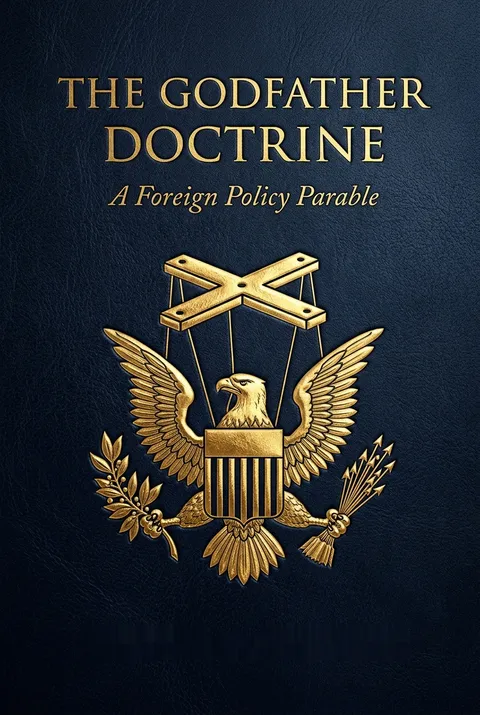


Key Takeaways
Treat decline as a strategic fact, not an insult to national identity
A changed balance of power. The book opens with Vito Corleone, the head of a powerful crime family, surviving an assassination attempt. His sons must decide how to respond as their family’s dominance fades. The authors use this crisis to represent the United States after the Cold War and September 11. Their term multipolarity describes a world where several powerful states can shape events, rather than one country setting the terms alone. Realism, as used here, is a foreign policy approach that starts by assessing power, interests, and limits before choosing goals or methods.
Adaptation beats nostalgia. The authors argue that America remains influential, but cannot assume it can dictate outcomes as it once did. The question is whether it adapts to a changing balance or clings to a vanished one.
What's valuable is the distinction between recognizing diminished freedom of action and declaring national defeat. In organizational life, a company that notices a lost advantage can change its strategy; one that denies the change may spend resources defending an obsolete position. The same logic applies to states. Yet decline is not a single measurable condition: military reach, economic influence, and diplomatic legitimacy can move in different directions. Treating the book's 2009 diagnosis as a prompt to examine specific capabilities is more useful than taking its broad language as a timeless verdict.
Match ambitions to the power and resources actually available
Good intentions have limits. The authors criticize foreign policies that seek to remake other countries, whether through military intervention or diplomacy, on the assumption that shared political systems would end conflict. They argue that this aim exceeds what even a very powerful state can reliably accomplish, and becomes especially hazardous when resources are strained. In their 2009 setting, they point to ongoing wars, financial turmoil, and a weakening capacity to sustain ambitious commitments.
Strategy begins with capacity. The book contrasts these universal goals with a practical question: what can the country protect, influence, or credibly promise? It also reaches back to George Washington and Alexander Hamilton, who accepted an agreement with former enemy Britain because securing peace mattered more than acting on resentment. The lesson is not to abandon values, but to avoid confusing them with achievable policy.
This is a useful corrective to the tendency to confuse moral purpose with practical control. Political science often distinguishes a desired outcome from the instruments capable of producing it; the gap between the two is where overreach begins. Still, capacity does not settle the ethical question. A country may be able to act and still lack a defensible reason, or may need to accept costs to uphold a commitment. The book is strongest when it asks whether goals fit resources, not when realism is taken to mean that only material power deserves consideration.
Negotiate seriously only when leverage makes compromise credible
Tom trusts the old order. In the film, Tom Hagen is the family’s legal adviser and negotiator. The authors associate him with liberal institutionalism, a view that international rules and organizations can manage disputes and encourage cooperation among states. Tom wants the crime families to settle their differences through meetings and preserve the cooperative order built under Vito. The authors call this arrangement the Pax Corleone: a period of relative stability in which the dominant family provides benefits that make its leadership acceptable.
But the balance has shifted. Tom assumes rivals still want to join the existing order and that negotiation can restore the past. The book argues that diplomacy alone cannot secure that result when a challenger sees an opportunity to gain power. In its 2009 discussion of Iran, the authors warn that offers and talks need to reflect the other side’s interests while being backed by credible pressure.
The argument makes an important distinction between diplomacy as a method and diplomacy as a substitute for strategy. Negotiation can clarify intentions, create off-ramps, and reduce miscalculation, but parties may use talks to gain time or improve their position. That possibility does not make diplomacy futile; it makes bargaining conditions matter. Tom’s error is not that he talks, but that he assumes the other families share his interest in preserving the old arrangement. Assessing a counterpart’s incentives is essential, though no outside observer can know those incentives with certainty.
Use force for defined aims, not to erase every danger
Sonny mistakes anger for strategy. Vito’s eldest son reacts to the attack by favoring immediate violence against the rival families. The authors compare him to neoconservatism, a foreign policy outlook that supports forceful action to confront threats and advance democracy abroad. In the story, Sonny treats each danger as a reason to attack, without asking whether the family can afford the conflict or what political settlement would follow.
War can deepen the problem. Sonny’s decision fractures alliances and draws other families against the Corleones. The authors liken this to the Iraq War, which they regard as a costly intervention lacking a workable political plan. Their point is not that force is never needed. It is that preemption and regime change cannot eliminate risk by themselves, and may turn a manageable challenge into a wider conflict.
The section usefully separates the emotional appeal of decisiveness from the harder test of strategic effect. A military operation can achieve its immediate target while making the political environment less secure, a distinction also central to post-conflict planning. The comparison has limits: different wars have different causes, stakes, and possible outcomes, and the film's rival families make a simplified model of international politics. Even so, the core test travels well: policymakers should specify what force is meant to change, how success will be recognized, and what follows afterward.
Build a flexible policy toolkit instead of worshipping one instrument
Michael changes the question. The youngest Corleone son is neither committed to Tom’s negotiations nor Sonny’s reflexive violence. His overriding aim is to preserve the family, so he treats diplomacy and force as tools rather than doctrines. He may bargain with one rival and use coercion against another, depending on the circumstances and the result sought.
Pair incentives with pressure. In the book’s Iran example, the authors propose combining potential benefits, such as investment and diplomatic recognition, with economic pressure if Iran pursued nuclear weapons. The mix is intended to influence choices while preparing the United States for different outcomes. Michael’s advantage is not that he always chooses the same instrument, but that each action serves a larger strategy. Force should pursue a specific objective that diplomacy can consolidate, while negotiations should not depend on goodwill alone.
This approach resembles portfolio thinking: when outcomes are uncertain, relying on one instrument creates a single point of failure. In bargaining theory, incentives can make cooperation more attractive while credible costs make defection less appealing. The combination is not automatically effective, however. Threats can harden resistance, and promised rewards may lack credibility if domestic politics make them difficult to deliver. The practical value lies in choosing a mix that can be sustained and adjusted, rather than assuming a clever combination of carrots and sticks will control another government's decisions.
Treat allies as contributors whose trust must be earned
Power depends on relationships. The authors portray Michael as more attentive than his brothers to the Corleones’ allies. The family’s smaller partners matter because their support can shift the balance in a crisis. In the film, a neighborhood baker helps protect Vito at the hospital; Michael recognizes and encourages him rather than treating him as expendable. The authors connect this to the need to value both major and minor U.S. partners.
Reciprocity sustains coalitions. Allies that accept risks but see little return may question whether continued support serves them. The book argues that Sonny’s bullying and Tom’s assumption of automatic loyalty both damage the family’s position. For the United States, the authors say, rebuilding confidence after the Iraq War requires listening to partners and taking their interests seriously, not simply expecting them to follow Washington.
The insight aligns with research on repeated cooperation: relationships endure when partners expect mutual benefit, not just commands from the strongest member. Smaller allies can contribute access, legitimacy, and political support, even when their military weight is limited. Reciprocity is not the same as granting every request, however. Alliance management also requires clear commitments and honest limits, since promises that cannot be kept may damage credibility more than a frank refusal. Trust is an asset, but it is maintained through consistent conduct rather than occasional gestures.
Rewrite institutions before rising powers write them without you
Rules follow power. Tom treats institutions as if they can govern independently of the states behind them. Michael sees them as channels shaped by the distribution of power. The authors point to rising states gaining influence in older institutions and creating new forums that exclude the United States, including the Shanghai Cooperation Organization. In their account, ignoring this shift leaves Washington defending rules that others may no longer accept.
Offer a place in the system. The proposed response is to update and expand institutions such as the Bretton Woods system to give rising powers a stake in the order. The authors describe the goal as primus inter pares, or first among equals: the United States would remain influential without assuming unmatched control. In the film, Michael adjusts the family’s business arrangements to give rivals incentives to cooperate rather than overturn the system.
Institutional design can turn raw power into predictable procedures, but only if important participants see the rules as legitimate enough to follow. Giving rising states a voice can reduce incentives to build rival arrangements, while preserving shared standards. Inclusion alone is not a guarantee of agreement: members may still disagree sharply, or use institutions to constrain one another. The book's useful question is therefore not whether institutions are powerful on their own, but whether their design reflects enough of the underlying balance to make cooperation preferable to exit.
Time coercion carefully, then convert advantage into a workable order
Michael’s violence has a stated limit. The authors address the objection that Michael’s killings at the end of the film make him resemble Sonny. They argue that Michael acts against specific rivals at a moment when the family needs room to reposition itself, rather than beginning an open-ended campaign to eliminate every competitor. He pairs coercion with a plan to shift the family’s business to Las Vegas and offer rivals a stake in its future profits.
Sequence matters. In their interpretation, force removes immediate obstacles, while accommodation and new arrangements make a more stable balance possible. Applied to American policy in 2009, the authors argue for confronting urgent threats while preparing institutions for a more multipolar order. Their distinction rests on objectives and timing: a bounded use of force is meant to establish conditions for a political settlement, not to restore unlimited dominance.
The distinction between a limited coercive move and a permanent war is strategically important, but it is also difficult to maintain in practice. Leaders may call an operation bounded while opponents, allies, or domestic audiences widen its aims. The film's clean transition from violence to order cannot establish that real campaigns will produce stable settlements. A stronger application of the argument requires explicit limits, a credible end state, and a plan for the political arrangement that follows. Without those, the language of limited force can disguise the same open-ended ambition the book criticizes.
Keep realism as a tool for protecting a moral republic
The analogy has a moral boundary. The authors insist that America is not a crime family and that strategic realism is not a complete ethical philosophy. Michael’s central concern is preserving his family’s power. A republic, by contrast, has constitutional principles, individual liberty, and a public life worth protecting. The book argues that clear-eyed assessment of power can help safeguard those goods, but should not replace them as the reason for policy.
Practicality serves a larger purpose. Realism, in this account, is a method for pursuing national security and prosperity under real constraints, not a license to treat every interest as morally equal or every means as acceptable. The authors want American statecraft to preserve its political inheritance while adjusting to a world where other states have agency and influence.
This qualification answers a common concern about realism: if states focus on power and interest, what prevents prudence from becoming mere expediency? The book's answer is that strategic judgment should serve a prior political community and its values. That is a stronger position than pretending interests and ideals never conflict. Still, a republic must debate which interests are vital and whose security counts. Realism can discipline moral ambition, but democratic accountability is needed to keep the discipline from becoming an excuse for secrecy or unchecked executive power.
Analysis
The book's central achievement is to turn a debate about international relations into a family crisis that readers can follow. Tom, Sonny, and Michael embody distinct habits of statecraft: trust rules and negotiation, rely on force, or choose instruments according to the balance of power and the objective. The film analogy makes those choices vivid and helps explain why a policy can feel morally satisfying yet fail strategically. Its strongest conceptual move is separating instruments from ends. Negotiation and force are not identities; they are tools whose value depends on circumstances, resources, and a political purpose.
That clarity comes at a cost. The Corleone family is a unitary actor with a clear survival interest, while states contain competing institutions, voters, parties, bureaucracies, and leaders with different incentives. A policy that appears strategically coherent from the outside may be impossible to sustain at home. The analogy also makes Michael's violence look more controlled than coercion usually is in international affairs. Rivals do not necessarily accept a new arrangement simply because one side has demonstrated resolve, and institutions can shape behavior as well as reflect existing power.
The book is anchored in the crises and assumptions of 2009, including the Iraq War, Iran's nuclear program, Georgia, and the financial crisis. Its specific prescriptions belong to that moment, while its analytical questions remain useful: What has changed in the distribution of power? Which commitments can be honored? What incentives might make cooperation preferable? What political settlement follows the use of force? Those questions prevent both fatalism and nostalgia. The deeper contribution is not a simple endorsement of realism, but an argument for strategically disciplined policy that recognizes limits without surrendering the values a democratic state exists to defend.
Review Summary
The Godfather Doctrine receives mixed reviews, with an average rating of 3.85/5. Readers appreciate its creative approach to foreign policy analysis using The Godfather as an analogy. Some find it insightful and entertaining, while others critique its oversimplification of complex theories. The book's short length is both praised for conciseness and criticized for lack of depth. Many readers find it thought-provoking, particularly those interested in international relations and political science. However, some question the accuracy of its theoretical representations and its continued relevance in changing political landscapes.
People Also Read

Glossary
The Godfather Doctrine
Realist statecraft parableThe authors' use of The Godfather to explain U.S. foreign policy choices. Vito's fading power represents a changing international order, while his sons represent competing responses: institutional diplomacy, forceful intervention, and flexible realism. The analogy argues that a declining dominant power should adapt its tools, alliances, and institutions rather than try to restore an earlier era.
realism
Power-aware foreign policyIn this book, realism is an approach to foreign policy that begins with the distribution and limits of power, the interests of states, and the resources available. It treats diplomacy, economic pressure, and military force as possible instruments rather than fixed doctrines. Its stated purpose is to protect the country's security and prosperity while adapting to international change.
liberal institutionalism
Cooperation through institutionsA foreign policy outlook presented in the book as emphasizing international rules, organizations, and diplomacy as ways to manage conflict and encourage cooperation. The authors associate it with the belief that institutions can help stabilize an order and that negotiation may accommodate challengers. Their criticism is that institutions cannot by themselves overcome shifts in power or divergent state interests.
neoconservatism
Forceful democratic ambitionThe book's term for a foreign policy outlook that supports robust military action and the expansion of democracy abroad. The authors associate it with Sonny's instinct to attack threats before fully considering costs, political consequences, or the limits of American power. They argue that using force to eliminate all danger can produce prolonged conflict and accelerate decline.
multipolarity
Several centers of powerAn international system in which several powerful countries can influence outcomes, rather than one dominant state controlling the main decisions or two rival blocs structuring competition. In the book's 2009 argument, the United States remains important but must share influence with rising powers, whose interests and cooperation vary by issue.
Pax Corleone
Order under Corleone leadershipThe authors' name for the period of relative stability created by the Corleone family's dominance. The family offers access to political influence and opportunities for other crime families, making its disproportionate power more acceptable. The analogy represents a U.S.-supported international order whose stability depends partly on the dominant power providing benefits and maintaining restraint.
primus inter pares
First among equalsA Latin phrase meaning first among equals. The authors use it to describe a possible future role for the United States in a multipolar system: still influential and able to help shape institutions, but no longer able to act as an uncontested hegemon. The phrase captures their goal of preserving leadership by accommodating other major powers.
Download PDF
Download EPUB
.epub digital book format is ideal for reading ebooks on phones, tablets, and e-readers.








