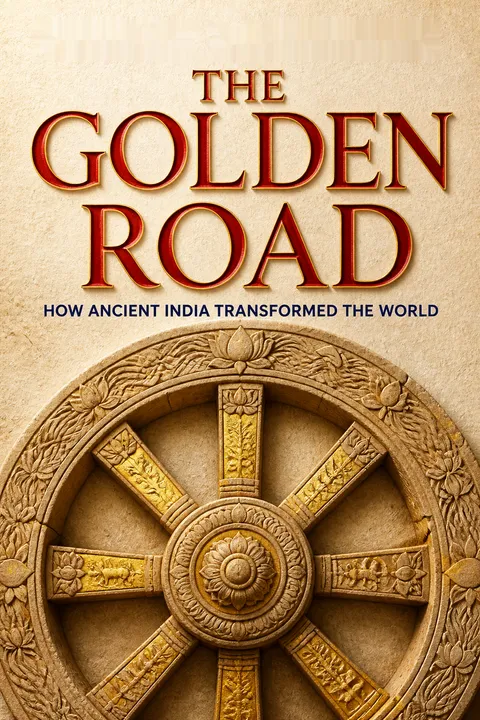


Key Takeaways
Read ancient Asia through monsoon sea lanes, not a China-centered Silk Road.
The sea connected worlds. The book calls the broad zone shaped by Indian ideas the Indosphere: a cultural network that crossed political borders from Afghanistan toward Japan and from Central Asia to Indonesia. Its Golden Road was the web of maritime routes linking India with the Red Sea, the Bay of Bengal, and the South China Sea. Monsoon winds reversed predictably each year, carrying ships outward and home again, often faster than an overland journey.
India was a trading hub. Roman sources describe as many as 120 ships sailing to India annually from one Egyptian port. Roman coins turn up in India in large numbers, while few have been found in China. Some estimates suggest taxes on Red Sea trade supplied a substantial share of Roman revenue, though the precise figures remain debated. The argument is not that land routes did not matter, but that ancient exchange was not a single highway running from China to Rome.
The maritime lens changes the map before it changes the story. In network terms, India appears not as a remote destination but as a high-traffic junction where goods, travelers, and ideas could be transferred between regions. That is a useful corrective to histories organized around modern national borders or famous land routes. It also guards against replacing one center with another: a busy hub is not the same as a sole source of influence, and surviving evidence is denser for some ports and periods than others.
The Buddha made liberation a disciplined middle path, not a priestly privilege.
A new answer to suffering. Siddhartha Gautama lived amid urban growth, social change, elaborate sacrifices, and increasing caste distinctions. He left his privileged life to investigate suffering, first trying severe self-denial. Finding that self-torture brought no freedom, he taught the Middle Path: a disciplined way between extreme asceticism and sensual indulgence. In Buddhist thought, craving and attachment bind people to samsara, the cycle of rebirth; ethical conduct and mental training offer a route toward release.
A portable teaching. The Buddha challenged the claim that salvation required priestly rituals or sacrifice. He taught in Prakrit, a common language, and presented a path open to ordinary people. At Ajanta, Buddhist paintings later placed monks and renunciation beside courts, merchants, music, and daily life. The images make the movement feel less like an isolated monastery tradition than a living faith woven into a prosperous, cosmopolitan society.
The Middle Path is more than moderation as a personality trait. It is a method for noticing how an attempted solution can reproduce the problem: punishing the body may intensify suffering rather than dissolve it. The emphasis on practice also helps explain why the teaching could travel across languages and social groups. Still, an open spiritual ideal does not guarantee equal access in every institution. The distinction between a universal message and the communities that preserve it is important to keep in view.
Ashoka turned battlefield remorse into a state-sponsored, pluralist Buddhist mission.
A ruler records regret. After a devastating campaign against Kalinga, Emperor Ashoka described mass death, deportation, and the suffering of families in inscriptions across his empire. He declared that moral conduct, rather than further territorial conquest, should guide rule. These edicts are among the earliest surviving first-person statements by an Indian ruler, and they present kingship through remorse and public responsibility rather than a catalogue of victories.
Faith travels with roads. Ashoka promoted Buddhist teaching, or dharma, meaning a path of moral duty and conduct, while also urging respect for other religious communities. He maintained roads, placed inscriptions where people gathered, and sent envoys in several directions. To Sri Lanka he sent his children and Buddhist relics; his son Mahinda is remembered for preaching to crowds there. Buddhism gained an imperial platform, though Ashoka did not simply order everyone to convert.
Ashoka makes ethical regret part of public authority, a striking contrast with rulers who advertise only conquest. His inscriptions also show how moral ideas can gain reach through ordinary state capacities: roads, communication, and repeated public messages. The record is still a ruler's self-presentation, not an unfiltered window into his motives or policies. That does not erase its significance. It invites readers to distinguish between a genuine ethical turn and the political work a public account of that turn can perform.
Follow the merchant: Buddhist monasteries grew on commerce, credit, and safe passage.
Religion had infrastructure. Early Buddhist monasteries often stood near trade routes, ports, and river crossings. Merchants and craft guilds helped finance cave halls, stupas, and images, while some monasteries managed land, workshops, mines, or loans. At sites such as Karle, inscriptions record donations by foreign traders as well as local workers and wealthy patrons. These communities could provide travelers with shelter, supplies, and access to financial services.
Trade carried devotion. Buddhist stories and sculptures often show protective figures rescuing merchants from shipwreck, pirates, or other dangers. Such images spoke directly to people whose livelihoods depended on risky journeys. The Sangha, the Buddhist monastic community, was therefore not simply a group apart from the commercial world. Its institutions connected local donors and distant travelers, helping religious ideas move along the same routes as textiles, pepper, and precious goods.
This account resists the familiar split between spiritual ideals and material interests. A monastery could pursue religious teaching while also relying on endowments, loans, and merchant networks. In institutional terms, those economic functions helped make a mobile faith durable: travelers encountered dependable places to stop, learn, and donate. The arrangement should not be romanticized. Wealth and business activity could complicate renunciant ideals, but that tension makes the evidence more illuminating, not less. It shows religion operating through practical social systems.
Treat translation as intellectual travel, not the one-way delivery of doctrine.
Pilgrims crossed borders. In 629, the Chinese monk Xuanzang left Chang'an without permission, crossed deserts and mountains, and reached Nalanda after years of dangerous travel. He studied there for five years among thousands of monks and scholars, copying texts in Sanskrit. He returned with 657 books, statues, and relics. Nalanda taught far more than Buddhism: its curriculum included logic, grammar, medicine, mathematics, astronomy, and philosophy.
Words changed in transit. The monk Kumarajiva, raised in a multilingual Central Asian setting, led a translation center in China and rendered hundreds of Buddhist works into fluent Chinese. His work helped make difficult Indian texts intelligible to new readers. Xuanzang's own translations and institutions likewise depended on Chinese patrons and collaborators. These journeys carried ideas outward, but translation also reshaped them for new intellectual and political worlds.
Translation is often described as transport, as though a text arrives unchanged in a new language. These stories show a more active process: translators choose terms, clarify arguments, and decide what a new audience can hear. Their work depends on institutions, money, and trust as much as linguistic skill. That makes cultural exchange a collaboration, though never a perfectly balanced one. The language with greater institutional support can shape which ideas survive and how later readers understand them.
Southeast Asian rulers adopted Indian prestige, then built distinct worlds from it.
Influence was not conquest. Indian traders, monks, artisans, and Brahmins brought Buddhism, Hindu traditions, Sanskrit, writing systems, and political models to Southeast Asia. Local rulers adopted these resources selectively. A Cambodian royal line, for example, retained an indigenous founding ancestor even as later generations took Sanskrit names and used Indian forms of kingship. Indian caste rules did not take root in the same way, and local customs continued to shape social life.
Adaptation reached monumental scale. Khmer artists made Indic stories their own, and Angkor Wat, built under Suryavarman II, grew into a religious complex covering more than 500 acres. Its forms and mythology drew on India, yet the temple was a Khmer creation, built within a society with its own politics, aesthetics, and engineering. Sanskrit learning and epic stories became part of local culture, not evidence that the region had become a political extension of India.
The most useful distinction here is between cultural influence and political control. Borrowed languages or sacred stories can strengthen local rulers without erasing local agency. Southeast Asian elites gained a prestigious vocabulary for kingship, while artists and communities altered it to fit their own needs. The relationship was not entirely peaceful in every period: the Chola naval raids show that military power could enter the picture. But conquest is a poor explanation for the wider, gradual adoption and transformation of Indic culture.
Wu Zetian made Buddhist cosmology a weapon against China’s male-only political orthodoxy.
A woman claims the cosmos. Wu Zetian rose from a low-ranking concubine to become the only woman in Chinese history to rule as emperor in her own right. Confucian political traditions offered little legitimacy for female rule. Buddhist advisers instead interpreted a scripture as predicting a female universal ruler, identified with Maitreya, the future Buddha. Wu used this claim to support her break from the Tang dynasty and the creation of her own Zhou dynasty.
Power took monumental form. Wu supported Buddhist monasteries, translation, and sculpture. The enormous Vairocana Buddha at Longmen, a figure associated with the cosmic Buddha, embodied the grandeur of the court. Her patronage helped make Buddhism central to Chinese state life, but her rule also involved purges and executions. The story joins intellectual exchange to political calculation without reducing the Empress either to a saint or to the hostile caricature preserved by later critics.
Wu's story shows that ideas are not politically neutral, especially when established institutions exclude a claimant. Buddhist cosmology supplied a vocabulary that Confucian orthodoxy could not easily provide, while art and ritual made that vocabulary visible across the empire. Her reliance on religious authority does not make her rule emancipatory in a modern sense: the same sovereign who challenged a gender barrier used coercion against rivals. The tension is valuable because it separates symbolic disruption from broader political freedom.
Trace zero from Indian astronomy to the arithmetic that remade Europe.
A symbol becomes a number. Indian mathematicians developed decimal place-value notation and refined the use of zero. Brahmagupta set out rules for calculating with zero and positive and negative numbers. The Sanskrit term sunya means emptiness; in mathematics, zero made it possible to express large numbers compactly and calculate with greater ease. The system drew on generations of work rather than a single sudden invention.
Knowledge crossed several hands. In the eighth century, Indian scientific texts reached Baghdad, where the Barmakid family, whose ancestors had led a Buddhist center of learning, supported translations and scholarship. The mathematician al-Khwarizmi explained Indian calculation in Arabic, and his work helped establish algebra. Centuries later, Fibonacci learned the numeral system in North Africa and promoted it in Latin Europe through the Liber Abaci, including practical methods useful to merchants.
The history of zero is a case study in how abstract ideas acquire power through notation, explanation, and use. A concept can exist without becoming widely usable; place value and written rules made calculation portable across professions and languages. The chain also complicates national claims of invention. Indian mathematical advances were foundational, but their global reach depended on Arab scholars, translators, and European teachers who adapted them for new settings.
When empires shifted, Indian ideas survived by changing languages, patrons, and routes.
A cultural sphere can contract. From the eleventh century onward, Turkish conquests altered northern India's political and religious landscape. Some Buddhist institutions suffered, but Nalanda's decline and destruction were not a simple single-event story. Persian became the language of courts across much of India, and new Indo-Persian cultures developed alongside Sanskrit traditions. Indian Muslim Sufi teachers also carried Islam across maritime routes into Southeast Asia, where it became a major religious force.
Networks reorganized. Mongol conquest reshaped Central Asian trade and made long-distance overland travel more viable under a single empire. This later network became known as the Silk Roads, a modern label for routes unlike the earlier maritime system centered on Indian Ocean exchange. Indian mathematics continued westward through Arabic and Latin texts. The irony is sharp: European merchants used mathematical tools shaped by Indian learning in the commercial expansion that eventually helped European companies dominate India.
The ending resists the idea that a civilization's influence simply vanishes when its political advantage fades. Languages, institutions, and routes can change while older knowledge remains active inside new systems. At the same time, continuity should not be mistaken for uninterrupted dominance: the book's broad account of a contracting Indosphere sits beside persistent exchange and regional reinvention. Its most durable lesson is therefore about historical movement, not an eternal hierarchy among civilizations.
Analysis
The Golden Road's central intervention is not simply to add India to a history that forgot it. It proposes a different map of how ancient influence moved: through monsoon routes, ports, merchant communities, monasteries, translators, and courts, rather than through one dominant empire or a single overland corridor. This shifts attention from borders to the institutions and people that made ideas mobile.
The argument is strongest when different kinds of evidence converge. Roman coins and Indian goods trace commercial connections; inscriptions record donors, rulers, and languages; monuments show how artists transformed imported forms; travel accounts reveal the ambitions and risks of individual pilgrims. These sources do not all support the same degree of certainty. The scale of Indo-Roman trade can be estimated but not measured exactly, while stories about rulers, missions, and origins often survive through texts written long after the events. The narrative gains credibility by showing that uncertainty rather than hiding it.
A productive tension runs through the account. India is presented as a major cultural center, yet much of its influence depended on actors beyond the subcontinent: Central Asian dynasties, Chinese translators, Southeast Asian rulers, Arab scholars, and European readers. This makes the book's strongest claim less about a permanent Indian supremacy than about the generative power of circulation. The idea of an Indosphere is useful when it names shared references and routes, but risky if treated as a unified political or cultural bloc. The history itself demonstrates uneven adoption, local resistance, and creative reinterpretation.
The final movement also matters. Knowledge can outlive the institutions that first nurtured it, but its survival changes who controls it and what it is used for. Indian mathematics, carried through Arabic scholarship into Europe, later became part of the commercial machinery that enabled European expansion into India. The story is therefore not a simple recovery of lost prestige. It is a study of how exchange produces transformation, and how intellectual gifts can return in forms their original makers could not have anticipated.
Review Summary
The Golden Road receives mostly positive reviews, praised for its engaging storytelling and extensive research on India's historical influence. Readers appreciate Dalrymple's vivid descriptions and the book's focus on India's contributions to mathematics, religion, and culture. Some criticize potential biases and overstatements, while others find it eye-opening. The book's scope and depth impress many, though some feel certain sections could be more concise. Overall, it's considered an important work highlighting India's often overlooked impact on world history.
People Also Read




Glossary
Indosphere
Indic cultural networkThe broad, connected zone in which Indian religious, artistic, linguistic, scientific, and political ideas became influential. In the book, it extends across parts of Central, South, Southeast, and East Asia. It describes cultural connections, not a single Indian empire or a territory governed from India.
Golden Road
Monsoon-linked trade networkThe book's name for the interconnected sea routes that linked India with the Red Sea, the Bay of Bengal, Southeast Asia, and China. Seasonal monsoon winds made regular voyages possible. Along these routes, merchants carried goods, while monks, artisans, texts, and religious ideas moved between ports and inland centers.
Middle Path
Moderation between extremesThe Buddha's approach to spiritual discipline, positioned between harsh self-denial and indulgence in sensual pleasure. The term describes a practical way of training the mind and conduct without treating bodily punishment as a route to freedom. In the book, it is also part of Buddhism's appeal as an alternative to costly ritual and severe asceticism.
dharma
Moral teaching and dutyA term with several meanings across Indian traditions. In the book's account of Buddhism and Ashoka, it refers especially to the Buddha's teaching and to a moral path involving conduct, restraint, compassion, and duty. Ashoka also used dharma to describe ethical principles for public life, while encouraging respect among different religious communities.
Sangha
Buddhist monastic communityThe community of Buddhist monks and nuns responsible for maintaining and teaching the Buddha's tradition. The Sangha also became an institution supported by donors and connected to trade, education, and pilgrimage. Its monasteries could shelter travelers and preserve texts, helping Buddhism develop networks beyond the places where the Buddha had taught.
Mahayana
Buddhist path open to allA major Buddhist tradition that developed in ancient India and emphasized the potential of all sentient beings to attain enlightenment. It gave special importance to compassionate Bodhisattvas, who could aid others on the path. Mahayana texts and practices became influential across Central and East Asia, where they were translated and adapted to local settings.
Sanskrit Cosmopolis
Sanskrit-based cultural sphereA transregional world of literary and political culture in which Sanskrit served as a prestigious language beyond India. Rulers and scholars in Southeast Asia adopted Sanskrit texts, scripts, titles, and models of kingship, then adapted them to local purposes. The term describes shared cultural resources, not a centralized state or uniform society.
Devaraja
Sacred Khmer kingship symbolA Khmer royal cult associated with a sacred symbol, often understood as a lingam or image connected with Shiva, that represented the ruler's divinely protected authority. In the book, the practice helped bind political power to a shared sacred landscape and local beliefs. Its exact form and meaning remain debated by scholars.
sunya
Emptiness, or zeroA Sanskrit word meaning emptiness or void, used in Indian mathematical writing for zero. Indian mathematicians developed rules for calculating with zero and incorporated it into decimal place-value notation. This made it possible to represent numbers compactly and perform calculations that were difficult with earlier systems.
FAQ
What's The Golden Road: How Ancient India Transformed the World about?
- Cultural Influence: The book explores how ancient India significantly influenced cultures, religions, and economies across Asia from 250 BCE to 1200 CE, highlighting the "Indosphere" where Indian ideas were predominant.
- Historical Figures and Events: It delves into the lives of key figures like Xuanzang and Ashoka, intertwining their journeys with broader historical contexts of trade and cultural exchange.
- Trade and Economic Power: Emphasizes India's role as a major economic hub, particularly through maritime trade routes that connected it to the Roman Empire and beyond.
Why should I read The Golden Road: How Ancient India Transformed the World?
- Rich Historical Narrative: William Dalrymple presents a compelling narrative combining history, travel, and cultural studies, making it engaging for readers interested in interconnected civilizations.
- Insight into Cultural Exchange: Provides valuable insights into how cultural exchanges shaped societies, particularly in the context of Buddhism and Hinduism's spread across Asia.
- Understanding Modern Context: Examines historical influences to help readers understand contemporary cultural and religious landscapes in Asia.
What are the key takeaways of The Golden Road: How Ancient India Transformed the World?
- India as a Cultural Exporter: Illustrates India's role as a confident exporter of its civilization, influencing regions from Afghanistan to Japan through trade and the allure of Indian ideas.
- Role of Buddhism: Highlights Buddhism's transformative power, particularly under rulers like Ashoka, in spreading Indian culture and philosophy.
- Economic Dynamics: Discusses economic relationships between India and other regions, emphasizing how trade shaped cultural exchanges.
What are the best quotes from The Golden Road: How Ancient India Transformed the World and what do they mean?
- “The day is not sufficient for asking and answering profound questions.”: Reflects the intellectual vibrancy of Nalanda, underscoring the importance of inquiry and dialogue in knowledge pursuit.
- “Buddhism was to be a teacher of the Arab world, and hence Mediterranean Europe too.”: Highlights Buddhism's far-reaching influence on global intellectual traditions and cultural interconnectedness.
- “The Golden Road linking all these diverse forms and geographies into a single cultural unit.”: Encapsulates the book's central theme of India's cultural influence creating a vast network of interconnected societies.
How did trade influence the spread of Indian culture according to The Golden Road: How Ancient India Transformed the World?
- Maritime Trade Routes: Indian merchants used monsoon winds to establish trade routes across the Indian Ocean, facilitating the exchange of goods and ideas.
- Economic Prosperity: Wealth from trade allowed Indian culture, particularly Buddhism and Hinduism, to flourish and spread.
- Cultural Exchange: Trade led to cosmopolitan centers where diverse cultures interacted, integrating Indian ideas into local traditions.
What is the Indosphere as described in The Golden Road: How Ancient India Transformed the World?
- Cultural Sphere: Refers to the vast cultural influence of India across South, Central, and Southeast Asia, creating a shared cultural heritage.
- Historical Context: From 250 BCE to 1200 CE, India was a dominant cultural force, exporting its civilization rather than merely receiving influences.
- Legacy: Emphasizes the historical interconnectedness of Asian cultures and the lasting impact of Indian civilization on neighboring regions.
How does The Golden Road: How Ancient India Transformed the World address the spread of Buddhism?
- Buddhism's Adaptation: Discusses how Buddhism adapted to local cultures as it spread, merging with indigenous beliefs in regions like China and Southeast Asia.
- Influence of Monastic Communities: Highlights the role of monastic communities in disseminating Buddhist teachings and practices.
- Cultural Artifacts: Includes discussions of art and architecture, such as stupas and sculptures, reflecting the syncretism of Buddhist and local artistic traditions.
What role did Ashoka play in the spread of Buddhism as discussed in The Golden Road: How Ancient India Transformed the World?
- Patron of Buddhism: Ashoka promoted Buddhism after his conversion, aligning his edicts with Buddhist principles of non-violence and moral governance.
- Missionary Efforts: Sent missionaries to regions like Sri Lanka and Central Asia, helping establish Buddhism as a major religion beyond India.
- Cultural Legacy: His reign marked a turning point for Buddhism, transforming it from a local tradition into a global faith.
How did ancient Indian trade influence Southeast Asia according to The Golden Road: How Ancient India Transformed the World?
- Economic Growth: Indian trade brought wealth and prosperity to Southeast Asian kingdoms, leading to urbanization and trade hubs.
- Cultural Exchange: The influx of Indian merchants and ideas led to the adoption of Hinduism and Buddhism in Southeast Asia.
- Artistic Influence: Indian artistic styles and architectural techniques were adopted in Southeast Asia, influencing temple and sculpture construction.
How does The Golden Road: How Ancient India Transformed the World explore the concept of cultural syncretism?
- Merging of Traditions: Illustrates how different cultures blended their traditions, particularly through Buddhism adapting to local customs.
- Artistic Expressions: Discusses how sculpture and painting reflect syncretism, showcasing the fusion of Indian and local styles.
- Philosophical Exchanges: Emphasizes philosophical dialogues that emerged, leading to new interpretations and practices within Buddhism and other belief systems.
What specific historical events does The Golden Road: How Ancient India Transformed the World cover?
- Pallava and Chola Dynasties: Details cultural and economic revival during their reigns, highlighting contributions to art and architecture.
- Rise of the Khmer Empire: Explores its establishment and adoption of Indian cultural elements, focusing on monumental temples like Angkor Wat.
- Mongol Invasions: Discusses the impact on the Indosphere, disrupting trade networks and leading to cultural shifts.
How does The Golden Road: How Ancient India Transformed the World connect ancient history to modern times?
- Cultural Legacy: Draws connections between ancient cultural exchanges and their lasting impacts on contemporary societies.
- Historical Narratives: Emphasizes how understanding historical interactions provides insights into current cultural dynamics.
- Global Perspective: Encourages viewing history through a global lens, recognizing the interconnectedness of cultures throughout time.
About the Author
Other books by William Dalrymple
Download PDF
Download EPUB
.epub digital book format is ideal for reading ebooks on phones, tablets, and e-readers.








