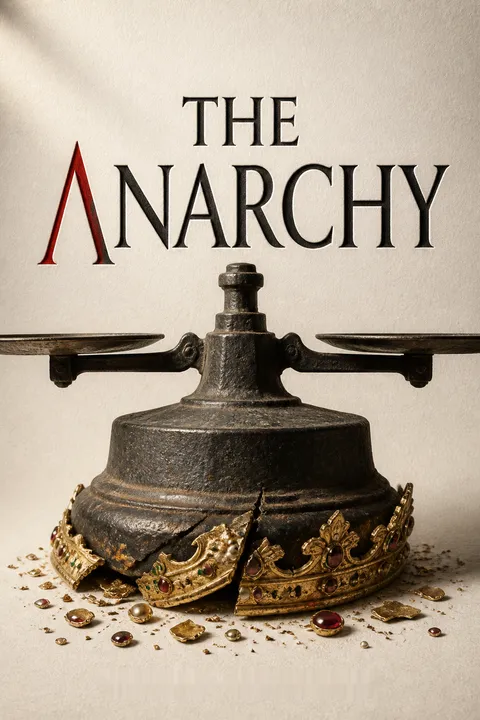


Key Takeaways
A corporation conquered India before Britain formally did.
The conqueror was a company. Founded in 1600 to trade in Asia, the East India Company began as a joint-stock venture, not an arm of the British state. Its transformation is captured by two images at Powis Castle: treasures taken from defeated Indian rulers, and a painting of Mughal emperor Shah Alam handing Robert Clive authority over Bengal’s revenues in 1765. The ceremony was neither grand nor voluntary. A small group of company officials, backed by Indian soldiers, was becoming the government of a vast population.
Trade became territorial rule. By 1803, the Company had an army of nearly 200,000 and controlled most of the subcontinent. Britain’s familiar story of national conquest obscures the unusual actor that began it: a profit-seeking corporation with its own army, diplomacy, and expanding powers.
What's striking is the gap between the Company’s modest London headquarters and its immense governing power. Modern political language often treats states and businesses as separate categories, but the Company blurred that distinction: it traded, taxed, waged war, and negotiated as a sovereign. The distinction still matters because responsibility becomes harder to locate when private institutions exercise public power. The Company was not simply a substitute for Britain, however. Parliament, the Crown, and the Royal Navy repeatedly supported it, so its corporate independence was real but never complete.
Track the capital, and the Company's conquest stops looking miraculous.
Investors built the vehicle. The Company’s founders pooled money because voyages to Asia were too expensive and risky for one merchant. Its charter granted a trade monopoly and broad privileges, while its shares let investors trade claims on future profits. The Company initially struggled to match Dutch financing, but it grew through credit, access to Indian money, and political influence in London. By 1693, it was already using payments to cultivate Parliament, where many members held Company shares.
Local finance powered expansion. In Bengal, the Company borrowed from the Jagat Seth banking family, which could move large sums across a politically fragmented region. Later, tax revenues from Bengal helped pay for goods, soldiers, and campaigns elsewhere. The Company’s rise therefore depended not only on its weapons, but on its ability to raise, borrow, and redirect money at scale.
This is a history of financial infrastructure as much as military history. In political economy, fiscal capacity means the ability to raise and reliably deploy resources. The Company’s advantage was not simply that it collected revenue, but that it connected Indian tax streams and credit networks to a durable institution in London. That arrangement made expansion self-reinforcing. It also complicates any account of conquest as a purely European achievement: Indian bankers supplied capital, while British political institutions protected the machinery that used it.
Read Mughal decline as a power vacuum, not a vanished society.
The empire weakened unevenly. Mughal authority fractured after Aurangzeb’s death in 1707, following costly wars, rebellions, and succession struggles. Nader Shah’s 1739 invasion and sack of Delhi further damaged imperial finances and prestige. Regional powers, including Bengal, Avadh, Hyderabad, and the Marathas, gained room to govern independently. Delhi and the surrounding heartlands experienced severe violence, but other regions developed prosperous courts, trade, and artistic life.
Disorder created opportunities. Armies and armed laborers moved between competing rulers, while regional states built new systems to fund soldiers and administer land. The Company entered this shifting landscape as one contender among many, not as an invader confronting a unified India. Its success depended partly on the divisions among rivals, but the book cautions against turning those divisions into a claim that all of eighteenth-century India was a dark age.
The distinction between imperial collapse and social collapse is essential. Political authority can fragment while commerce, culture, and local institutions remain vigorous, or even flourish. This resembles what historians call a polycentric order: multiple centers govern and compete instead of one capital directing everything. Such a system can be resilient, but rivalry may also make coordinated defense difficult. The Company exploited that weakness. Yet calling the period simply chaotic risks mistaking the difficulties of centralized rule for the absence of political sophistication.
European military drill mattered most when Indian allies made it count.
New tactics changed the battlefield. At the 1746 Battle of Adyar, French-trained infantry used muskets, coordinated volleys, and mobile artillery to defeat a much larger force. The lesson was not that Indian soldiers lacked skill. European companies trained locally recruited sepoys, and Indian rulers soon built disciplined infantry and modern artillery of their own.
Politics decided where force landed. Clive’s 1757 victory at Plassey depended on more than a battlefield maneuver. The Jagat Seth bankers and disaffected Bengali commanders helped arrange a change of ruler, while Mir Jafar’s forces withheld support from Siraj ud-Daula. Clive’s speed and risk-taking mattered, but so did intelligence, bribery, and a coalition inside Bengal. Plassey was a military victory built on political betrayal, not a simple triumph of a few British soldiers over an Indian army.
The book’s military story is strongest when it treats technology as an advantage that must be organized and financed, rather than as an automatic guarantee of victory. Drill and artillery can magnify a smaller force’s effectiveness, but they do not explain who supplies troops, information, or political access. Plassey illustrates that campaigns are social systems as well as contests of weapons. The limitation is that an emphasis on European tactics can still make innovation seem imported, even though Indian rulers rapidly adopted and adapted the same methods.
Control revenue, and conquest begins paying for itself.
The Diwani changed the business. In 1765, Shah Alam granted the Company the Diwani, the right to collect and administer revenue in Bengal, Bihar, and Orissa. The Company left much of the existing tax machinery in place, but placed its own officials above it. Land revenue became a source of funds for the army and for exports, reducing the need to ship silver from Britain to buy Indian goods.
A trading firm became a governing power. After Plassey, the Company had already installed rulers and received large payments. The Diwani made this influence more systematic: Bengal’s revenues could support campaigns elsewhere, helping the Company defeat rivals and enlarge its holdings. The Mughal emperor’s formal grant gave the arrangement legal cover, while the Company’s military power shaped what the grant meant in practice.
The Diwani is a vivid example of how control over revenue can matter more than possession of territory in name. In modern terms, the Company acquired a fiscal platform: predictable income that could be converted into soldiers, supplies, and political leverage. The transaction also exposes a problem of accountability. Mughal forms remained visible, but the officials extracting revenue answered to distant investors. Revenue administration was not inherently destructive, yet a system organized around transfers to shareholders had weak incentives to protect the region’s long-term productive capacity.
When tax targets survive but people do not, drought becomes disaster.
The famine was not only weather. After poor rains in 1768 and no rain in 1769, rice prices rose sharply. The 1770 Bengal famine killed an estimated 1.2 million people, about one-fifth of the population. Laborers and artisans, who had fewer reserves than landowning farmers, were among the first to starve. Some people sold possessions, livestock, and even their children; disease and hunger spread through towns and villages.
Revenue collection continued. Company officials maintained tax demands and, in some places, increased assessments, even as crops and livelihoods collapsed. Some traders hoarded grain and profited from scarcity. There were exceptions: the administrator Shitab Rai arranged regular grain shipments and relief kitchens in Patna. But relief remained uneven, while the Company protected military spending and reported that revenue had held up. The disaster showed how an extractive system could record success while the population paid the cost.
The contrast between revenue ledgers and mass death reveals a basic failure of governance: institutions measure what they are built to measure. If officials are rewarded for collections, they can interpret a stable tax intake as administrative success even while the tax base is being depleted. The drought was a natural shock; policy shaped who could withstand it. This does not make every famine fully preventable, but the evidence of relief efforts in Patna shows that choices about grain, taxation, and aid could materially affect survival.
Indian armies could match the Company; divided rulers could not.
Resistance was capable and dangerous. Mir Qasim modernized Bengal’s army and fought the Company after its traders repeatedly violated his authority. The Company eventually defeated him and his allies at Buxar in 1764, a more decisive shift than Plassey because it broke a broad coalition of Indian powers. In the south, Haidar Ali and Tipu Sultan built disciplined forces and innovative weapons. At Pollilur in 1780, Mysore inflicted a devastating defeat on Company troops.
The Company learned and exploited divisions. The Marathas also defeated a British force at Wadgaon in 1779, and their armies later acquired effective European-style infantry and artillery. The Company survived reversals by drawing on deeper revenues and credit, improving its forces, and making separate alliances with Indian rulers. Its eventual advantage was not an inability of its opponents to fight, but its greater capacity to fund war and prevent rivals from acting together.
The central comparison is organizational, not civilizational. Mysore and the Maratha powers demonstrate that Indian states could adopt military technologies and inflict serious losses. The Company’s edge came from combining trained troops with stable revenue, credit, and diplomacy. This is a classic collective-action problem: rivals may share a threat but distrust one another enough to resist coordination. Still, the outcome was not predetermined. The book’s accounts of Pollilur and Wadgaon show how close the Company could come to losing its position.
The Company captured Delhi by combining military power with Mughal legitimacy.
The emperor retained symbolic authority. Shah Alam lost battles, territory, and eventually his sight, yet his imperial status still mattered to Indian rulers. In 1765, his grant of the Diwani helped legitimize Company revenue control. In 1803, after defeating Maratha forces around Delhi, the Company again placed the emperor under its protection, presenting itself as his rescuer rather than simply his conqueror.
Wellesley made the transition concrete. Governor General Richard Wellesley used alliances, bribery, military force, and the divisions among Maratha leaders to expand Company control. By 1803, a private corporation’s army had reached the Mughal capital. The emperor remained on the throne, but the Company controlled the power behind it. The old imperial symbols were not discarded; they were absorbed into a new political order.
Shah Alam’s story shows that legitimacy is a resource distinct from coercion. An institution may lack troops yet still possess the recognized authority that helps others accept its decisions. The Company understood this and preserved Mughal ceremony when it suited its rule. That strategy resembles governance through institutional inheritance: new rulers keep familiar symbols while redirecting their authority. The arrangement also had limits. Ceremony could soften the appearance of conquest, but it could not turn a profit-driven corporation into a representative government.
Parliament rescued the Company, then slowly took its empire back.
Success created financial fragility. Plunder and expected revenue initially raised the Company’s share price, but famine, falling collections, military costs, and unsold goods helped push it toward insolvency in 1772. The Company asked the Bank of England and government for a major loan. Parliament agreed to rescue it, while the 1773 Regulating Act increased government oversight and created the office of Governor General.
Oversight did not end exploitation. Warren Hastings attempted reforms, but his impeachment became a long political spectacle shaped by faction and personal hostility. He was acquitted in 1795. Further measures increased state control, and in 1858, after the uprising of 1857, the Crown took over the Company’s Indian possessions. Regulation began well before nationalization, but it could not quickly erase the system that Company rule had created.
The rescue captures the familiar danger of institutions becoming too interconnected to fail. When the Company’s collapse threatened public credit and trade, the state had reason to save it, even as its conduct demanded oversight. The Regulating Act established a precedent, not a clean solution: the state was both disciplining the Company and benefiting from its empire. Hastings’s trial likewise warns that public accountability can be distorted by political vendettas. Scrutiny matters, but a dramatic prosecution is not the same as structural reform.
Judge an empire by who finances it, not only who flies its flag.
The Company’s empire had many makers. Indian bankers financed campaigns; Indian soldiers filled its ranks; local rulers made alliances that advanced or resisted its growth. British political support and naval power mattered too. The result was not a simple transfer of India from one nation to another, but a changing system in which corporate authority, imperial symbols, local capital, and military force reinforced one another.
Its end did not erase its warning. The Company lost its governing role after the 1857 uprising, and the Crown took over in 1858. Its brand survived, eventually becoming a London retail name. Dalrymple’s closing lesson is not that modern businesses are identical to the Company, but that corporations can gain public power through political access, financial dependence, and weak oversight. Private status alone offers no protection against public consequences.
The book’s contemporary relevance lies in the mechanism it identifies: concentrated wealth can shape government, and governments can become dependent on the institutions they are meant to supervise. That is a useful lens for examining lobbying, bailouts, and public-private partnerships. The analogy should remain bounded. Today’s corporations do not generally govern territories with private armies, and the Company operated in a distinct imperial setting. But its history makes one principle difficult to ignore: when private incentives command public power, accountability must be designed rather than assumed.
Analysis
The book’s central achievement is to change the protagonist of Indian conquest. Rather than treating the British nation as the single actor, it follows a corporation whose commercial charter, private army, financial network, and political allies allowed it to become a territorial power. The result is not simply a story of military superiority. The Company’s capacity to borrow, collect taxes, recruit Indian troops, enlist local bankers, and influence Parliament gave it advantages that could survive battlefield reverses. Its transformation into a governing institution was gradual, opportunistic, and repeatedly disguised by Mughal forms. The narrative also resists a simple decline-and-conquest sequence. Mughal authority weakened, but the subcontinent was not uniformly stagnant. Regional states accumulated wealth, courts supported artistic life, and rulers such as Tipu Sultan modernized their armies and economies. The Company faced capable opponents. Its success depended on their political divisions, its own financial reach, and its willingness to exploit internal disputes. That combination makes the book’s account more convincing than explanations based on an inherent European superiority.
Its focus on Shah Alam provides a powerful human thread through decades of political collapse, but the emperor’s symbolic journey also clarifies an institutional point: sovereignty can persist as ritual and recognition after its material foundations have disappeared. The Company did not merely replace Mughal power; it appropriated the emperor’s legitimacy when useful. That political continuity helped make a radical transfer of authority appear compatible with familiar forms. A useful qualification is that the book’s corporate frame can make a messy convergence look more unified than it was. Company officers disagreed, local allies pursued their own aims, and Parliament alternated between protecting the enterprise and trying to restrain it. The Company was neither a fully independent corporation nor a straightforward instrument of the British state. That tension is the deeper subject. The history warns that public power can migrate into institutions organized for private returns, especially when governments depend on their credit and military capacity. It also shows that regulation can arrive without immediately correcting the incentives that produced abuse.
Review Summary
The Anarchy recounts the East India Company's rise from trading firm to ruling power in India. Readers praise Dalrymple's engaging narrative and extensive research, highlighting the company's ruthless pursuit of profit and power. Some criticize the focus on military history and perceived bias. The book explores themes of corporate greed, imperialism, and cultural destruction. While many find it insightful and well-written, others feel it lacks depth in certain areas or misrepresents historical events.
People Also Read




Glossary
Diwani
Revenue administration rightsThe Mughal grant giving the East India Company authority to collect and administer revenue in Bengal, Bihar, and Orissa. Granted by Shah Alam in 1765 after the Company’s military victories, it provided a formal basis for Company control of regional finances. Revenue that had sustained Mughal rule could now support Company trade, administration, and military expansion.
sepoy
Indian infantry soldierA locally recruited soldier serving in a European-style infantry force. The French and British East India Companies trained Indian troops in coordinated musket fire and other contemporary tactics. These soldiers formed the bulk of the Company’s expanding armies, allowing a relatively small number of European officers to command forces large enough to fight across the subcontinent.
Company State
Corporation exercising state powerA political order in which the East India Company operated not merely as a trader but as a territorial ruler. It collected taxes, administered justice, maintained an army, made alliances, and waged war, while remaining a profit-seeking corporation answerable to shareholders. The term captures the unusual overlap of commercial ownership and public sovereignty.
Great Anarchy
Eighteenth-century political disorderThe book’s term for the prolonged instability across Mughal heartlands as central authority weakened and regional powers, armies, and rival claimants competed for control. The phrase describes real violence and insecurity, especially around Delhi and Agra, but does not mean all of India was uniformly impoverished or culturally stagnant. Some regional states and cities prospered during the same period.
Permanent Settlement
Fixed land-revenue arrangementA land and tax system introduced under Governor General Cornwallis in 1793. It fixed the revenue zamindar landholders owed to the Company, in return for recognizing their rights to the land so long as they paid on time. The policy stabilized and increased Company revenue, but contributed to land transfers, the ruin of established families, and greater pressure on cultivators.
dastak
Company trade passA pass used to claim Company privileges for goods moving through Bengal. Company servants and private traders increasingly used such passes to evade duties and interfere with local officials and merchants. Their abuse undermined the Nawab’s revenue and gave Company-connected traders an unfair advantage, becoming one of the disputes that helped drive Mir Qasim into open conflict with the Company.
FAQ
What's The Anarchy about?
- Historical Overview: The Anarchy by William Dalrymple examines the rise of the East India Company (EIC) from a trading entity to a colonial power in India. It covers the period from the mid-18th century to the early 19th century.
- Corporate Violence: The book delves into the violent methods employed by the EIC, including military conquests and exploitation of local rulers, to expand its influence.
- Cultural Impact: Dalrymple explores how the Company's actions reshaped Indian society, politics, and culture, leading to significant changes that resonate today.
Why should I read The Anarchy?
- Engaging Narrative: Dalrymple's storytelling combines rich historical detail with vivid character portrayals, making complex events accessible and engaging.
- Critical Perspective: The book offers a critical view of colonialism, prompting readers to reflect on the implications of corporate power and imperialism in modern contexts.
- Historical Relevance: Understanding the history of the East India Company provides valuable insights into contemporary issues of corporate influence and governance.
What are the key takeaways of The Anarchy?
- Corporate Colonialism: The book illustrates how the EIC transitioned from a commercial enterprise to a sovereign power, highlighting the dangers of unchecked corporate power.
- Impact on India: Dalrymple emphasizes the devastating effects of British colonialism on Indian society, economy, and culture, including economic exploitation and cultural disintegration.
- Lessons on Power Dynamics: The narrative serves as a cautionary tale about the interplay between commerce, politics, and military power, underscoring the importance of accountability and ethical governance.
How did the East India Company gain power in India?
- Military Conquests: The EIC used military force to defeat rival powers, such as the French and local Indian rulers, establishing control over key territories.
- Political Manipulation: The Company engaged in political intrigue, often playing local rulers against each other to weaken their authority and expand its influence.
- Economic Exploitation: By controlling trade and imposing heavy taxes, the EIC extracted wealth from India, which financed its military campaigns and administrative costs.
What role did the Mughal Empire play in the events described in The Anarchy?
- Fragmentation of Power: The decline of the Mughal Empire created a power vacuum that the EIC exploited, leading to chaos and conflict that facilitated British expansion.
- Cultural Influence: The Mughals left a rich cultural legacy that influenced the social and political landscape of India, shaping the EIC's practices and policies.
- Resistance and Collaboration: Some Mughal officials collaborated with the EIC for personal gain, while others resisted its encroachment, illustrating complex colonial relationships.
What were the consequences of the Battle of Plassey?
- Establishment of British Rule: The victory at Plassey marked the beginning of British colonial rule in India, leading to the eventual establishment of the British Raj.
- Disruption of Local Governance: The battle destabilized the existing political order, leading to chaos and conflict among local rulers.
- Economic Exploitation: Following the battle, the EIC implemented policies prioritizing profit over local welfare, contributing to economic decline and social unrest.
How did the French and British rivalry impact India?
- Military Engagements: The competition led to conflicts like the Carnatic Wars, setting the stage for British dominance as the EIC emerged victorious.
- Political Alliances: Both powers sought alliances with local rulers, leading to shifting loyalties and betrayals, contributing to regional instability.
- Economic Consequences: The rivalry disrupted trade and led to economic hardship for many Indian communities, often prioritizing military conquest over trade.
What are the best quotes from The Anarchy and what do they mean?
- "What honour is left to us?": Reflects the despair of Mughal officials witnessing their decline and the rise of the EIC, encapsulating the humiliation of a once-mighty empire.
- "The collecting of Mughal taxes was henceforth subcontracted to a powerful multinational corporation.": Highlights the absurdity of the EIC's transformation from a trading company to a governing authority.
- "The East India Company probably invented corporate lobbying.": Critiques the EIC's manipulative tactics in securing its interests through political influence.
How did William Dalrymple conduct his research for The Anarchy?
- Primary Sources: Dalrymple utilized records of the East India Company and contemporary Mughal histories, providing a nuanced understanding of events.
- Persian and Indian Histories: He incorporated Persian-language histories and accounts from Indian historians, enriching the narrative with diverse perspectives.
- Field Research: Dalrymple conducted field research in India, visiting historical sites and engaging with local scholars, deepening his insights into the cultural and historical context.
What impact did the East India Company have on Indian society?
- Economic Disruption: The Company's policies led to widespread poverty and economic instability, dismantling traditional industries to favor British imports.
- Cultural Changes: The imposition of British education and legal systems altered social structures and cultural practices, leading to a loss of indigenous traditions.
- Political Fragmentation: The Company's manipulation of local rulers contributed to the fragmentation of Indian political power, paving the way for British colonial rule.
How did the Marathas respond to the East India Company’s expansion?
- Initial Resistance: The Marathas initially fought against the Company’s encroachments, engaging in several battles to defend their territories and sovereignty.
- Internal Conflicts: The Maratha Confederacy was plagued by internal divisions and rivalries, weakening their ability to mount a unified resistance.
- Eventual Subjugation: Ultimately, the Marathas were unable to withstand the combined military might of the Company, leading to their decline and loss of power.
What lessons can be learned from The Anarchy?
- Cautionary Tale: The book warns about the dangers of corporate power and the potential for exploitation when profit motives override ethical considerations.
- Importance of Accountability: Dalrymple emphasizes the need for accountability in both corporate and governmental actions to prevent abuses of power.
- Historical Awareness: Understanding the complexities of colonial history can inform contemporary discussions about governance, corporate responsibility, and social justice.
About the Author
Other books by William Dalrymple
Download PDF
Download EPUB
.epub digital book format is ideal for reading ebooks on phones, tablets, and e-readers.








