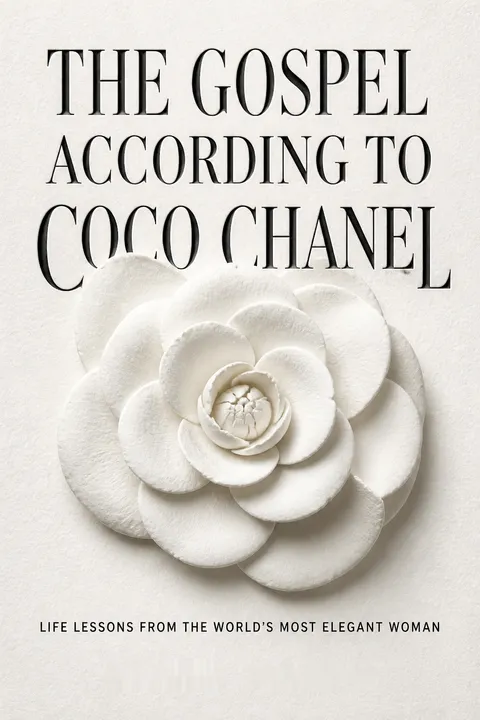


Key Takeaways
Build a signature from what works on your body and in your life
Style begins with fit. A young Gabrielle Chanel was not the prettiest woman in a photograph with her aunt, but her simple, well-proportioned clothes looked more alive than the fashionable layers swallowing her companion. Chanel trusted what suited her: streamlined jackets, practical fabrics, and clothes that let the wearer move. Her work drew on menswear, including jersey, and helped make pockets, trousers, and comfortable sportswear part of women’s wardrobes.
Copy the principle, not the label. The book distinguishes Chanel’s own designs from later interpretations by Karl Lagerfeld, then introduces “Alt Chanel”: mixing Chanel-inspired pieces with ordinary clothes rather than dressing head to toe in a luxury brand. The point is not to buy a particular jacket. It is to notice what feels and looks like you, then edit out what does not.
What's compelling is the shift from shopping as self-expression to selection as self-knowledge. Design thinking often begins by observing how a person actually uses an object, rather than imposing an idealized form; Chanel’s clothes follow the same logic. Her example also challenges the assumption that style requires novelty. A consistent preference can be more expressive than constant reinvention. There is a limit, though: what flatters one body or suits one life may not work for another. The durable lesson is not to adopt Chanel’s silhouette, but to use comfort, proportion, and movement as evidence about personal taste.
Choose the identity you are building, not the role assigned at birth
Self-invention is more than appearance. Gabrielle was born poor, lost her mother young, and was sent to an orphanage with her sisters. As an adult, Chanel repeatedly reshaped the story of her childhood, inventing more dignified origins and family memories. The book presents this as a way she refused to let deprivation define her, while acknowledging that her inventions often became outright lies.
Claim authorship without copying the deception. Chanel also drew on what she had: a sharp eye, an unusual look, horse-riding skill, and an ability to charm people who could help her. She leaned into the provincial toughness associated with her mother’s region and imagined herself as a spirited heroine rather than a helpless dependent. Her life suggests that identity can be actively made, but not that the past must be falsified to make a future possible.
The useful distinction is between revising a self-concept and revising the facts. Research on narrative identity describes how people make meaning by linking past experiences to present goals, not by erasing every painful event. Chanel’s refusal to be reduced to an orphan could be liberating; her habitual fabrication could also isolate her from trustworthy relationships. A constructive version of self-invention asks, “What capacities can this history help me build?” It does not require a glamorous ancestry. The strongest agency comes from choosing what an experience means while remaining accountable for what actually happened.
Use what you have before waiting for ideal materials or permission
Constraint can become a design tool. Chanel began with hats and expanded into clothing when her circumstances and opportunities pointed that way. Around 1914, she used jersey, a cheap fabric associated with men’s underwear, to make comfortable garments for women. One account says she bought surplus stock; another ties its use to the restrictions on what she could make in her premises. Either way, she treated an unfashionable material as an opening rather than a disqualification.
The risk was real. Chanel had little technical training in dressmaking, and her financial support came from lovers who were not obliged to keep funding her. She relied on seamstresses to turn her ideas into finished clothes. In Deauville, she opened a shop and sold modern, easy-to-wear pieces before the First World War made the old clothing conventions even less practical. She did not wait for perfect conditions or complete expertise.
This is a strong case for resourcefulness as a practical skill: a limitation narrows the field, and the remaining materials can reveal a new solution. In entrepreneurship, that resembles prototyping with available resources rather than spending months perfecting a plan. But precariousness is not automatically empowering. Chanel’s risks were buffered, at crucial moments, by wealthy men and a market of affluent customers. The insight is best applied as permission to experiment, not as an argument that people should gamble their security or that hardship reliably produces genius.
Read the moment as carefully as you read your own instincts
Timing made the clothes matter. Chanel’s Deauville shop was open as the First World War began. When wealthy customers fled Paris and then returned without their usual wardrobes, they needed clothes suitable for a changed life. Chanel’s practical skirts, sweaters, and jackets met that need. She had the sense to keep her shop open when business looked uncertain, after her lover Boy Capel advised her to wait.
Luck still needs recognition. Wartime disruption, a heat wave, Capel’s connections, and a customer base with money all shaped her opportunity. Chanel’s talent was not simply predicting what women would want. She noticed that women’s activities and circumstances were changing, and her designs answered those changes. Her later perfume launch used a related instinct: samples given to select clients created demand before Chanel No. 5 was widely available.
Chanel’s advantage resembles opportunity recognition in business: a change in the environment alters what people need, and a prepared observer sees the new fit. The example is more precise than “be in the right place at the right time,” because it shows her reading shifts in clothing, mobility, and buying behavior. Yet a good read of the moment is not the same as control over it. War created opportunity for Chanel while bringing immense harm to others. Strategic insight can explain success without turning every crisis into a personal growth story.
Build a craft by directing specialists, not pretending to do everything
Vision needs skilled hands. Chanel was not an accomplished seamstress or draftsman. She could see when a collar, sleeve, or drape was wrong, and she could explain what she wanted. Her premières, the senior workers who translated her ideas into patterns and oversaw the sewing rooms, made the work possible. Chanel shaped garments directly on mannequins, pinning and cutting until the fit met her exacting standards.
Leadership was both creative and demanding. She could have a sleeve taken apart repeatedly before approving it, while seamstresses completed the careful construction. The result was not simply an idea with a famous name attached. It was a system of judgment, communication, and skilled execution. Chanel’s limitations did not make her irrelevant; they made hiring, directing, and recognizing quality central to her contribution.
The story separates expertise from solitary mastery. Many excellent leaders do not personally perform every specialized task; their distinctive skill is setting a direction, identifying quality, and coordinating people who know more about particular techniques. Chanel’s process also shows why delegation is not the same as detachment: she stayed intensely involved in fit and finish. The caution is that a leader’s celebrated vision can eclipse the labor that realizes it. Any account of creative genius is more accurate when it names the workers, skills, and conditions behind the finished object.
Turn creative success into independence by understanding the deal behind it
Money gave Chanel choices. She repaid Boy Capel for financing her business and built a fortune through fashion, perfume, and related ventures. She preferred not to depend on a lover’s resources, and returned the Duke of Westminster’s checkbook without using it. Her financial habits included avoiding debt and resisting the urge to own more houses than she needed.
Independence is not the same as business fluency. Chanel helped create No. 5 and understood how to make the scent desirable, including giving samples to favored clients. But she accepted only a 10 percent share of the perfume profits, leaving the Wertheimer brothers to manufacture and distribute it. She spent years fighting over the agreement without improving that share. Her story makes two points at once: earning money can protect personal freedom, and creative founders need sound contracts as much as strong ideas.
Economic independence changes the range of choices available in intimate and professional life. Chanel’s refusal to rely on a partner’s money helped her preserve control over her work and relationships. The perfume agreement supplies an equally important counterpoint: confidence and commercial instinct do not substitute for careful deal-making. This is a familiar gap between creating value and capturing value. The lesson is not to distrust every partner, but to treat contracts as part of creative practice. Independence is strongest when it includes informed collaboration, not just a refusal to be beholden.
Give your best hours to work that deserves your attention
Focus was part of Chanel’s method. She centered her life on work, and treated time as too valuable to spend on every social obligation. Her collections involved hundreds of pieces, each first worked out in a basic mock-up called a toile. She concentrated on the parts she could judge best, especially how clothes sat on a body, rather than following the expected ritual of sketching designs first.
Perfection demanded repetition. Chanel could spend hours correcting a sleeve or fit before the final fabric was cut. She also depended on her staff to complete the work, which made delegation essential. Her example is not a recipe for working every waking hour. It is a case for protecting attention, skipping steps that do not serve the result, and recognizing that meaningful work can be difficult rather than continuously enjoyable.
The sharpest idea here is not hustle, but selective attention. Chanel organized her process around the stage where her judgment was most valuable, then relied on others for the rest. That resembles the distinction between busywork and high-leverage work in contemporary management. Her perfectionism also shows its cost: repeated correction can improve quality, but it can strain workers and consume disproportionate time. The sensible application is to identify the craft’s critical decision points, protect time for them, and set limits so excellence does not become an excuse for making everyone else absorb the burden.
Let love matter without making marriage the sole proof of success
Chanel’s great love did not become a marriage. Boy Capel believed in her ambitions and helped finance her early business. She loved him deeply, repaid his investment, and continued to see him after he married another woman. When Capel died in a car crash in 1919, Chanel was devastated. She never found another relationship that held the same place in her life.
Work offered direction, not a substitute for every need. Chanel continued to have lovers, including the Duke of Westminster, but refused the expectation that she abandon her fashion house to become a duchess. She later regretted not having a husband or children, while her life also showed that marriage would have required compromises she resisted. The book’s lesson is not that ambition cures heartbreak. It is that a life can be substantial without following the standard sequence of romance, marriage, and family.
Chanel’s story resists the idea that relationship status provides a reliable scorecard for fulfillment. It also resists the opposite simplification, that career achievement makes intimacy unnecessary. Attachment and purpose answer different human needs; work can organize grief without eliminating loneliness. The account is especially valuable because it leaves the tension unresolved. A reader need not choose between ambition and love as if only one can count. The more useful question is whether a particular relationship supports a chosen life, and whether work is being pursued from conviction or used to avoid every form of vulnerability.
Let rivals sharpen your identity without letting them write it
Competition clarified Chanel’s contrast. Elsa Schiaparelli gained attention with playful, surreal designs, while Chanel’s strongest identity rested on restraint, practical construction, and controlled elegance. Chanel disliked Schiaparelli and dismissed her publicly, but the rivalry exposed a real difference in what each designer thought clothes could do. One made fashion witty and conspicuous; the other insisted it should remain wearable and serve the person inside it.
A rival can reveal what matters. Chanel did not respond by becoming Schiaparelli. She continued to develop the style she trusted, even as press and customers shifted their attention. The rivalry also shows the danger of fixation: Chanel could be cruel, and the book suggests that competition consumed energy. Use an opponent’s success as information about the field, not as a command to imitate them or a reason to make them the center of your work.
Rivalry can function as a mirror: contrast makes a position legible, especially in crowded creative fields where audiences need to understand what distinguishes one offer from another. Chanel and Schiaparelli demonstrate that competing visions can coexist without one being universally superior. The productive question is what the rival clarifies about a creator’s own priorities. But rivalry easily shifts from learning to scorekeeping, which narrows attention and encourages caricature. Chanel’s sharpness made for memorable stories, yet her contempt was not necessary to preserve her design principles.
A public failure can become the first draft of a comeback
Age did not end Chanel’s career. After years in Switzerland following the war, she reopened her fashion house in 1954, at seventy. The French press disliked her first collection and described it as out of date. Chanel did not abandon the designs she believed women needed: practical suits that allowed them to sit, move, and work. Orders were sparse at first, and she kept refining the collection.
The comeback had support as well as grit. Chanel’s longtime business partner Pierre Wertheimer helped finance the return, and American customers proved more receptive to her designs than the French press had been. Her influence revived through the 1950s and 1960s. Persistence mattered, but so did capital, a recognizable reputation, and a market ready for her functional clothes. A failed first reception was evidence about timing and audience, not definitive proof that the work had no future.
The comeback is a valuable example of persistence informed by a stable point of view. Chanel did not chase every response; she kept testing a proposition about women’s mobility and comfort. That is different from stubbornly repeating a failed approach without learning. Her return also depended on resources and distribution, which makes the story more useful than a simple celebration of willpower. A setback can justify another attempt when the underlying need remains real, but persistence becomes costly when the audience, product, or conditions have fundamentally changed.
Personal freedom stops being admirable when it ignores public harm
Autonomy has an ethical boundary. During the German occupation of Paris, Chanel continued her relationship with German agent Hans Gunther von Dincklage and largely turned away from the war around her. She also tried to use Nazi rules targeting Jewish-owned businesses to reclaim control of the perfume company from the Wertheimers. They arranged for a non-Jewish proxy to protect their interests. Chanel was arrested after liberation and released, but her reputation was damaged.
Self-rule is not moral immunity. Chanel’s refusal to live by convention helped her build a remarkable career. In wartime, the same self-absorption made her appear indifferent to the danger and persecution facing others. She did not reopen her fashion house during the occupation, but that fact does not erase her choices. The book asks readers to admire her independence without treating every act of defiance as courage or every personal desire as beyond judgment.
This is the necessary limit to a story built around self-authorship. Individual freedom is meaningful, but it exists inside shared institutions and has consequences for people with less power. The wartime episode shows how decisiveness can become ethical blindness when private interests are treated as the only relevant facts. A fair assessment can acknowledge uncertainty about what a person knew while still evaluating actions and incentives. Admiration need not become exoneration. The distinction matters especially when a celebrated figure’s charisma makes the costs borne by others easier to overlook.
Analysis
This book works as both a life story and a practical argument about style, ambition, and self-definition. Its strongest claim is that Chanel’s clothes were not merely attractive objects. They expressed a changed idea of women’s daily life: bodies should move, garments should serve their wearers, and elegance need not require elaborate discomfort. The biography makes that claim concrete through jersey, pockets, menswear influences, and the carefully fitted suit.
The account also resists a tidy success myth. Chanel’s rise involved exceptional perception and nerve, but also money, timing, wartime disruption, affluent customers, influential friends, and the labor of skilled seamstresses. The book’s insistence on those conditions is important because it prevents the reader from mistaking her unusual path for a universal formula. Her resourcefulness is instructive; her safety nets and opportunities matter just as much.
Self-invention is the book’s most provocative theme. Chanel refused the social identity imposed by poverty and illegitimacy, but she also lied about her origins. That tension separates imaginative agency from denial. A person can choose a future-facing identity without making honesty seem optional. Likewise, her independence from lovers enabled creative control, yet her loneliness shows that self-sufficiency cannot supply every form of connection.
The narrative is most persuasive when admiration and criticism remain side by side. Chanel’s exacting standards, commercial instincts, and late-career comeback are impressive. Her treatment of workers, inadequate perfume contract, and wartime choices complicate any attempt to turn her into a flawless heroine. That complexity is the book’s lasting value: it asks readers to borrow her eye for usefulness, her courage to act, and her willingness to work, while refusing to romanticize cruelty, privilege, or indifference. Style becomes more than appearance when it expresses a deliberate way of living, but personal freedom earns respect only when it accounts for other people too.
Review Summary
The Gospel According to Coco Chanel received mixed reviews. Many readers enjoyed the witty writing style and insights into Chanel's life and fashion influence. However, some found the book disorganized, repetitive, and lacking depth. Criticisms included the author's frequent personal interjections and questionable life lessons. Positive aspects included the portrayal of Chanel as a strong, independent woman who revolutionized fashion. Overall, readers appreciated learning about Chanel's life and impact, but opinions varied on the book's execution and the author's approach.
People Also Read





Glossary
Chanelore
Chanel fact mixed with legendThe book’s name for the tangled body of stories about Coco Chanel, where verifiable events mingle with embellishment, contradictory accounts, and Chanel’s own inventions. The term signals that her biography cannot always be separated cleanly into fact and myth, and that the uncertainty itself shaped her public persona.
Chanel Classic
Coco-era signature designsThe book’s label for Chanel’s own early and mid-twentieth-century designs, especially tweed suits with silk linings, chain-weighted hems, quilted bags, costume jewelry, two-tone shoes, and simple black dresses. It distinguishes these historical pieces from later collections that reinterpret the house’s visual identity.
Chanel Homage
Later Chanel interpretationsThe book’s term for the House of Chanel after Karl Lagerfeld took over its creative direction in 1983. These collections drew on Coco Chanel’s established motifs, including tweed suits, chains, quilted bags, and two-tone shoes, while filtering them through Lagerfeld’s own style and the fashion culture of his time.
Alt Chanel
Chanel-inspired personal mixingA way of using Chanel’s influence without wearing a complete luxury look. It combines a Chanel or Chanel-inspired item with less formal, less expensive, or unexpected clothing. The approach reflects Chanel’s iconoclasm by treating her style as a source of ideas rather than a brand uniform.
premières
Senior garment-making leadersThe senior workers in Chanel’s fashion house who translated her directions into garments and supervised the workrooms. They coordinated seamstresses and helped turn Chanel’s visual judgments into patterns, fittings, and finished pieces. Their expertise was essential to the quality and scale of the collections.
genre pauvre
Spare, practical fashionA phrase associated with Chanel’s restrained, economical-looking style. Her clothes could appear plain beside the elaborate fashions of the period, but they were carefully designed and often made from inexpensive or unconventional materials. The book stresses that this look was not simply copied from working-class women; it drew heavily on menswear and Chanel’s own practical needs.
FAQ
What's "The Gospel According to Coco Chanel" about?
- Life Lessons from Chanel: The book explores the life and legacy of Coco Chanel, focusing on the life lessons that can be drawn from her experiences and philosophies.
- Chanel's Influence on Fashion: It delves into how Chanel revolutionized women's fashion, introducing concepts like the little black dress and costume jewelry.
- Personal and Professional Insights: The author, Karen Karbo, provides insights into Chanel's personal life, her relationships, and her business acumen.
- Cultural and Historical Context: The book places Chanel's life within the broader context of the cultural and historical events of her time.
Why should I read "The Gospel According to Coco Chanel"?
- Inspiration from a Fashion Icon: Chanel's story is one of resilience and innovation, offering inspiration for those interested in fashion and entrepreneurship.
- Understanding Chanel's Impact: The book provides a comprehensive look at how Chanel's designs and ideas have shaped modern fashion.
- Life Lessons and Wisdom: Readers can glean practical life lessons from Chanel's philosophies on style, success, and living life on one's own terms.
- Engaging Writing Style: Karen Karbo's engaging narrative style makes the book both informative and entertaining.
What are the key takeaways of "The Gospel According to Coco Chanel"?
- Style and Simplicity: Chanel believed in the power of simplicity and elegance, which she applied to both her designs and her life.
- Self-Invention: Chanel's life exemplifies the power of self-invention and the importance of creating one's own identity.
- Fearlessness and Resilience: Chanel's courage to defy norms and her resilience in the face of adversity are central themes.
- Living Authentically: The book emphasizes the importance of living life on one's own terms and staying true to oneself.
What are the best quotes from "The Gospel According to Coco Chanel" and what do they mean?
- "A girl should be two things: classy and fabulous." This quote encapsulates Chanel's belief in the importance of elegance and self-confidence.
- "Fashion fades, only style remains." Chanel emphasized the timelessness of true style over fleeting fashion trends.
- "The most courageous act is still to think for yourself. Aloud." This highlights Chanel's advocacy for individuality and self-expression.
- "Luxury must be comfortable, otherwise it is not luxury." Chanel redefined luxury as something that should enhance comfort and practicality.
How did Coco Chanel revolutionize women's fashion?
- Introduction of Jersey Fabric: Chanel popularized the use of jersey fabric, which was previously considered low-end, for elegant women's clothing.
- The Little Black Dress: She introduced the little black dress, making it a staple of women's wardrobes worldwide.
- Costume Jewelry: Chanel made costume jewelry fashionable, allowing women to accessorize without the need for expensive pieces.
- Menswear for Women: She incorporated elements of menswear into women's fashion, promoting comfort and practicality.
What life lessons can be learned from Coco Chanel's story?
- Embrace Simplicity: Chanel's designs and lifestyle emphasized the power of simplicity and elegance.
- Self-Invention is Key: Her life is a testament to the power of reinventing oneself and creating a unique identity.
- Fearlessness in Pursuit: Chanel's courage to challenge norms and pursue her vision is a lesson in resilience and determination.
- Live Authentically: Chanel's life encourages living authentically and staying true to one's values and beliefs.
How did Coco Chanel's personal life influence her work?
- Early Hardships: Chanel's difficult childhood and early life experiences shaped her drive and ambition.
- Romantic Relationships: Her relationships with influential men provided both personal and professional opportunities.
- Independence and Control: Chanel's desire for independence influenced her business decisions and her approach to fashion.
- Cultural Influences: Her interactions with artists and intellectuals of her time enriched her creative vision.
What role did Coco Chanel play during World War II?
- Controversial Relationships: Chanel's relationship with a Nazi officer during the occupation of Paris remains a controversial aspect of her life.
- Business Decisions: She closed her fashion house during the war, focusing on her perfume business instead.
- Post-War Comeback: After the war, Chanel made a successful comeback, reestablishing her brand and influence in the fashion world.
- Legacy and Criticism: Her actions during the war have been both criticized and defended, adding complexity to her legacy.
How did Coco Chanel's designs reflect her philosophy on life?
- Elegance and Simplicity: Her designs embodied her belief in the power of simplicity and elegance.
- Practicality and Comfort: Chanel prioritized comfort and practicality, challenging traditional notions of women's fashion.
- Timelessness: Her creations were designed to be timeless, reflecting her belief in enduring style over fleeting trends.
- Individuality: Chanel's designs encouraged women to express their individuality and confidence.
What impact did Coco Chanel have on modern fashion?
- Enduring Influence: Chanel's innovations, such as the little black dress and costume jewelry, continue to influence fashion today.
- Redefining Luxury: She redefined luxury as something that should be both beautiful and practical.
- Empowering Women: Chanel's designs empowered women to dress for themselves, promoting independence and self-expression.
- Cultural Icon: Chanel herself became a cultural icon, representing elegance, sophistication, and modernity.
How does Karen Karbo portray Coco Chanel in the book?
- Complex Character: Karbo presents Chanel as a complex character, highlighting both her strengths and flaws.
- Inspirational Figure: Chanel is portrayed as an inspirational figure who overcame adversity to achieve success.
- Witty and Engaging: Karbo's writing captures Chanel's wit and charisma, making her story engaging and relatable.
- Balanced Perspective: The book offers a balanced perspective, acknowledging Chanel's controversies while celebrating her achievements.
What is the significance of the title "The Gospel According to Coco Chanel"?
- Life Lessons: The title suggests that the book offers life lessons and wisdom drawn from Chanel's life and philosophies.
- Chanel as a Guide: It positions Chanel as a guide or mentor, whose experiences can provide valuable insights for readers.
- Cultural Reverence: The use of "Gospel" implies a sense of reverence for Chanel's impact on fashion and culture.
- Narrative Style: The title reflects the book's narrative style, which combines biography with personal reflection and analysis.
Download PDF
Download EPUB
.epub digital book format is ideal for reading ebooks on phones, tablets, and e-readers.








