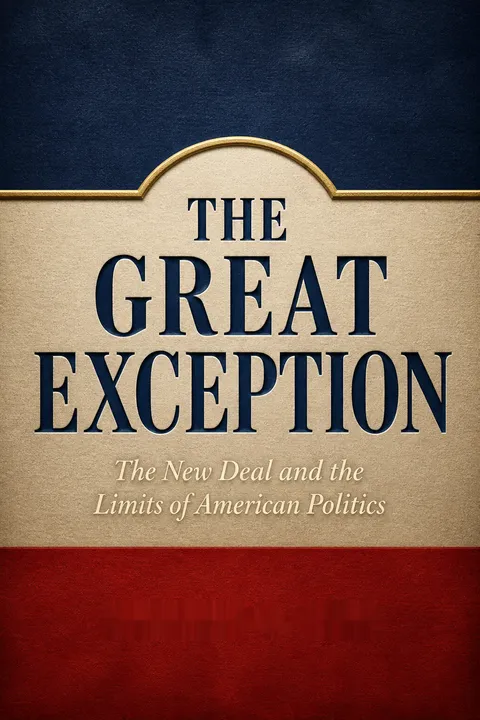


Key Takeaways
Treat the New Deal as a rare opening, not America’s natural direction.
A brief political rupture. In 1936, Franklin Roosevelt nearly fell while approaching the podium in Philadelphia. Aides helped him up, and he delivered a forceful argument that economic power could undermine democracy. The scene captures the book’s central claim: the New Deal was not the inevitable next step in American reform. It was an exceptional break, made possible by crisis and a fragile political alignment.
The opening soon narrowed. Cowie calls the period from the 1930s to the 1970s the Great Exception: an era when federal power repeatedly supported working people more than it had before or would afterward. Its sharpest policy burst came between 1935 and 1938, with labor protections, Social Security, and wage rules. By the 1970s, union strength and economic equality were retreating.
The argument shifts the question from whether the New Deal was a success to what conditions made its gains possible. That is a useful distinction: institutions that look permanent during prosperity can depend on unusually intense pressure, a favorable coalition, and political leaders willing to act. The Philadelphia episode also makes the point bodily. Roosevelt’s authority appeared commanding, but the political order behind him was precarious. The exception framing guards against nostalgia, though it risks making change seem almost impossible outside a crisis. The book’s own history shows that crises create openings, not guarantees.
Corporations won collective rights before workers were allowed to organize.
Unequal rules for solidarity. In the late nineteenth century, corporations grew into powerful national institutions. In 1886, the Supreme Court treated corporations as legal persons entitled to constitutional protection. Workers acting together, by contrast, could be accused of conspiring against the public, restrained by court injunctions, or confronted by militia. The contrast was not simply between big business and small individuals. It was between collective power protected by law and collective power treated as a threat.
The old language obscured the imbalance. Americans often described both sides in terms of individual liberty, even as corporations pooled capital and workers struggled to bargain together. In the 1894 Pullman Strike, federal intervention and troops helped break a broad railway boycott. For Cowie, this history complicates the idea that American politics rested on consensus or a natural hostility to government.
This account makes legal categories part of the machinery of economic power. A corporation can act collectively while appearing in law as an individual; workers acting collectively can be portrayed as violating individual freedom. That asymmetry resembles a broader institutional problem: formally neutral rules may favor whichever actors already possess resources, lawyers, and durable organization. The point is not that every corporate right is illegitimate or every union action democratic. It is that judging each side only as a collection of individuals misses how differently the law treats organized power.
Build coalitions with divisions in view, not under class slogans.
Solidarity had rivals. American workers differed by race, religion, birthplace, skill, and party. In the late nineteenth century, some skilled workers defended craft boundaries, while immigrants and Black workers faced exclusion from many unions and jobs. Political parties could unite voters through religious and racial loyalties while directing their attention away from shared economic interests. Employers and politicians could exploit these fractures without needing to invent them.
A temporary pause in division. Immigration restrictions beginning in 1924 reduced one source of conflict among workers, while people of Southern and Eastern European descent increasingly came to be treated as white. The New Deal period therefore saw a measure of working-class unity, but it rested partly on Black exclusion and restricted immigration. The book’s point is not that diversity prevents solidarity. It is that solidarity is built through political choices, and can be weakened when existing divisions go unaddressed.
Cowie’s account resists a romantic picture of workers discovering a common interest and naturally joining forces. Shared economic position does not erase differences in status, belonging, or perceived threat. That insight applies well beyond labor history: durable coalitions need institutions and narratives that make cooperation worthwhile across real divisions. Yet the historical pattern should not be mistaken for a prescription to seek cultural sameness. The period’s apparent cohesion came at a serious human cost. The challenge is to understand how solidarity can be constructed without relying on exclusion as its shortcut.
Use crisis to change who government serves, not just how much it spends.
Emergency made experimentation possible. When Roosevelt took office in 1933, banks had failed, unemployment was widespread, and private and local relief systems were overwhelmed. The first New Deal tried many approaches. The National Industrial Recovery Act, which let industries set codes and offered workers an unclear right to organize, disappointed workers and was struck down by the Supreme Court. Its failure did not end reform. It helped make the case for more durable legislation.
Power shifted unevenly. Between 1935 and 1938, the Wagner Act established protections for union organizing, Social Security created national insurance programs, and the Fair Labor Standards Act set wage and hour rules. This brief working-class interregnum was not a single coherent master plan. It emerged from crisis, organizing, political opportunity, and policy revision. Cowie’s emphasis is on the direction of state power, not government size alone.
The comparison between the first and second New Deals highlights a basic feature of policy design: promises do little without enforcement, administrative capacity, and a constituency able to defend them. A government can spend heavily while leaving existing power relations intact, as the first industrial codes often did. Conversely, rules that protect collective bargaining can change who has leverage. The account also cautions against treating emergencies as inherently progressive. Crisis can authorize state action, but the beneficiaries depend on political organization and choices made under pressure.
Recognize the New Deal’s gains and the racial bargain beneath them.
The coalition had a price. Southern Democrats held powerful positions in Congress and were committed to preserving racial segregation. To keep them in the Democratic coalition, New Deal laws excluded many agricultural and domestic workers, occupations in which Black Americans were concentrated. Social Security therefore offered broad protection while leaving millions of workers outside its original coverage. Federal programs could also be administered locally, where discrimination shaped access.
The story was not only exclusion. Black voters began shifting toward Roosevelt’s party, and the CIO’s industrial unions sometimes organized across racial lines, creating new opportunities for Black workers. But white prejudice among union members limited those gains. The political arrangement let Democrats attract Black voters while accommodating segregationist allies. That balance helped enact economic reform, but it placed racial justice outside the coalition’s center.
This is the book’s clearest challenge to accounts that measure reform only by the benefits delivered to the people included. Institutions distribute protection, but their exclusions also shape who counts as a political claimant. The New Deal’s economic achievements and racial compromises were not separate stories. They were linked through the coalition required to pass legislation. That does not make the gains meaningless, nor does it make exclusion an unavoidable price of reform. It does show why coalition stability must be evaluated alongside the boundaries a coalition protects.
War cemented worker power, then redirected it toward managed consumption.
Mobilization strengthened the settlement. The New Deal’s labor gains remained vulnerable until World War II expanded federal coordination and demand for workers. Wartime production helped end the Depression, drew more people into industry, and reinforced unions and federal labor protections. By the postwar period, unions represented roughly 35 percent of the labor force. Wartime taxation and postwar policies also helped compress income differences, supporting a period of rising wages and broad consumer growth.
Workers gained security, not control. Postwar bargaining delivered higher pay, benefits, pensions, and more predictable work. Yet contracts generally left major management decisions in corporate hands. The political ideal shifted toward stable employment and mass consumption, rather than a lasting worker role in directing the economy. The period brought real economic citizenship, but its main institutions did not permanently redistribute authority between workers and employers.
War shows how rapidly state capacity can expand when leaders define a shared national emergency. It also reveals the limits of that model: mobilization can create bargaining power without establishing a permanent democratic voice at work. The postwar settlement gave workers material security, and that achievement should not be minimized as mere co-option. But income and benefits are not equivalent to control over investment, technology, or workplace decisions. Separating these dimensions helps explain why a system can be broadly successful for workers and still remain vulnerable.
Treat organized labor’s midcentury peak as power with built-in limits.
A breakthrough became defensive. Industrial unions won major footholds in steel, autos, and other industries during the 1930s and 1940s. The Wagner Act made collective bargaining a federal priority, and postwar strikes showed workers could press for higher wages and benefits. But the Taft-Hartley Act of 1947 restricted labor’s political and organizing power, permitted states to pass right-to-work laws, and required union leaders to sign anti-communist affidavits.
The gains were real, the ceiling was low. Labor struggled to organize the South, failed to secure major improvements to labor law after the New Deal, and increasingly defended existing contracts rather than expanding union power. By 2010, private-sector union density had fallen to 6 percent. Cowie describes the postwar settlement as a major victory available under difficult conditions, not a failed revolution. Its weakness was that it offered no lasting protection against organized opposition.
The distinction between a constrained victory and a defeat matters. Calling the postwar settlement a sellout can obscure the immense improvement in workers’ lives; calling it a durable solution ignores how readily its legal protections could be narrowed or left unreformed. Institutionally, labor won a place at the bargaining table but not reliable power over the rules governing that table. The history also suggests that organizational strength is not self-preserving. A movement can win recognition, then lose the capacity to recruit, adapt, and make its case to people beyond its established base.
Defend individual rights without mistaking access for economic security.
Rights expanded as labor weakened. The civil rights and women’s movements opened workplaces and institutions that had excluded people by race or gender. These changes were profound. But the post-1960s political agenda increasingly emphasized equal access and individual rights, while the New Deal had focused more on collective economic protections. As unions declined, workers gained new routes into jobs without gaining the same collective power to improve wages or conditions.
The economy changed beneath the debate. Deindustrialization, inflation, and stagnating earnings weakened the institutions that had supported postwar security. By 2010, only 6 percent of private-sector workers belonged to unions. Cowie argues that individual rights and economic equality should not be treated as competing goods. The danger is assuming that fairer access to an unequal labor market can substitute for shared protection against insecurity.
The distinction between access and security helps clarify a debate often reduced to a choice between class politics and identity politics. Expanding civil and workplace rights corrects exclusions that collective institutions themselves sometimes reproduced. But access cannot guarantee fair bargaining power once people enter the market. A more complete account of equality asks both who may participate and who can shape the terms of participation. The tension is real, not a reason to retreat from rights gains. Collective protections need to become inclusive enough that they do not ask marginalized groups to choose between recognition and material security.
Look beyond New Deal nostalgia for new sources of worker leverage.
Big government is not the whole question. The Reagan era did not make the state small. It redirected public power toward different ends, while labor weakened and inequality rose. Cowie calls this a restoration of older political patterns, not a simple return to laissez-faire. The issue is whose interests state institutions serve, and whether working people have organized ways to influence them.
The old template may not fit. After the 2008 financial crisis, Obama-era reforms did not recreate the conditions that had enabled Roosevelt’s legislative breakthrough. Cowie warns against treating the New Deal as a ready-made recipe. He points instead to local living-wage campaigns, workers’ centers, immigrant-rights organizing, and other forms of collective action beyond the old labor-law system. A future project for economic security may need different institutions and broader coalitions.
Historical analogy is useful when it identifies mechanisms, not when it promises repetition. The New Deal depended on a particular crisis, electoral alignment, labor movement, and racial order. Recovering its language without rebuilding sources of organized leverage risks turning memory into political branding. The book’s turn toward local and alternative organizing is suggestive, though these efforts can struggle to scale or influence national policy. The practical question is how to connect local experimentation to durable institutions without reproducing the exclusions or political bottlenecks that limited earlier reforms.
Analysis
The book’s strongest contribution is to replace a familiar progress narrative with a conditional one. The New Deal did not simply arrive when American society became ready for social democracy. It became possible when economic collapse, labor organizing, electoral power, and wartime mobilization briefly aligned. Cowie then reads the later weakening of that order not as an inexplicable reversal, but as a return of conflicts the New Deal had never resolved: racial hierarchy, religious division, anti-statism, and a political culture that readily translates economic questions into contests over identity and individual liberty.
That argument gains force from its refusal to treat economic structure as destiny. Industrial growth and global conditions mattered, but they did not automatically produce worker power. Legal rules, coalitions, and state choices shaped who could bargain and who could claim security. The book’s most unsettling insight is that the postwar settlement was both genuinely redistributive and structurally narrow. Its solidarity was real, but its boundaries were also real.
The broad historical sweep is illuminating, though it carries a risk. By presenting the New Deal as an exceptional interval, the account can make later setbacks feel like gravity and reform like an anomaly. That may understate the persistence of organizing, civil rights victories, and public institutions that survived the period’s decline. The strongest reading is not that collective economic reform cannot recur, but that it cannot be summoned by nostalgia alone. It requires institutions that build bargaining power, political coalitions that confront racial and cultural division rather than profit from it, and a public argument that connects individual freedom to the material conditions that make choice meaningful. The book leaves readers with no simple blueprint, but a sharper question: who has the organized power to make democratic promises binding?
Review Summary
The Great Exception examines the New Deal era (1935-1970) as an anomaly in American history, arguing it was a temporary break from the nation's typical individualism and corporate dominance. Readers praised Cowie's analysis of how unique circumstances—including immigration restrictions and the Depression's severity—enabled labor's brief ascendance, though critics noted the book's dense prose and pessimistic tone. Many found it educational for understanding US political history, though some felt it lacked novel insights or practical solutions for contemporary challenges.
People Also Read




Glossary
The Great Exception
A temporary pro-worker eraCowie’s name for the period, roughly from the 1930s to the 1970s, when the federal government more systematically supported working people’s economic interests than it had before or would afterward. The era brought stronger unions, greater economic equality, and a broader role for government, but depended on specific historical conditions and contained deep racial and political fractures.
working-class interregnum
A brief window of labor gainsCowie’s description of the unusually short period of labor-oriented policymaking, especially from 1935 to 1938. The Wagner Act, Social Security, and federal wage and hour rules advanced collective economic protection. The term emphasizes that these achievements were a temporary interruption in a longer history of weak labor power, not the inevitable arrival of a permanent worker-centered order.
countervailing power
Organized power balancing businessA term associated with economist John Kenneth Galbraith, used here for the organized capacity of groups such as unions to balance the influence of business. Countervailing power can shape wages, public policy, and economic rules by giving workers leverage beyond individual negotiations. Cowie presents its weakening as a central reason economic gains became more concentrated.
welfare capitalism
Employer-provided worker benefitsA system in which employers provide selected benefits, services, or worker representation to encourage loyalty and limit unionization. In the 1920s, programs could include recreation, education, loans, and company unions. Such arrangements raised workers’ expectations of what employment might provide, but left benefits under corporate control and did not establish independent collective bargaining rights.
Lochner era
Judicial resistance to labor regulationThe period associated with the Supreme Court’s use of liberty of contract to strike down many laws regulating working hours and wages. The 1905 decision in Lochner v. New York rejected a state limit on bakers’ working hours. The Court’s broader resistance to economic regulation weakened during the 1930s, allowing key New Deal labor laws to stand.
submerged state
Government support people overlookA term Cowie uses through political scientist Suzanne Mettler’s account of government benefits that operate indirectly or are difficult for recipients to recognize as public support. Tax deductions and savings incentives, for example, can subsidize private activity without appearing like visible public programs. This obscurity can make government’s role harder to understand and defend.
New Deal order
The post-Depression political settlementThe political and economic arrangement formed around New Deal policies and alliances, becoming especially influential after World War II. It combined federal economic management, stronger labor institutions, social insurance, and a Democratic coalition that included workers and other groups. Its apparent stability concealed conflicts over race, religion, immigration, and individualism that later weakened it.
About the Author
Other books by Jefferson R. Cowie
Download PDF
Download EPUB
.epub digital book format is ideal for reading ebooks on phones, tablets, and e-readers.








