

Key Takeaways
Trace the book’s central claim: religions share a wisdom, reframed by initiates.
One truth, many forms. Schuré links Orpheus, Pythagoras, Plato, and Jesus in a story of spiritual knowledge passing from temples into public life. Orpheus represents priestly tradition, Pythagoras organizes it into a system, Plato gives it philosophical language, and Jesus presents its moral heart to ordinary people. The book treats the religions of India, Egypt, Persia, Greece, and Israel as different expressions of an underlying spiritual truth.
A theory, not a proven lineage. Schuré presents these connections as a hidden history. His narrative is valuable as a map of his ideas, but its claims about secret transmission and shared origins should not be mistaken for established historical evidence.
What is compelling here is the attempt to read religions comparatively rather than as sealed containers. Similar questions about suffering, moral conduct, and the soul recur across cultures, and comparison can reveal what each tradition makes newly visible. The risk is that a universal template can flatten real differences: traditions may share a motif without sharing its origin or meaning. Schuré’s synthesis works best as an interpretive invitation, prompting readers to compare traditions while resisting the assumption that every religion is secretly saying the same thing.
Use the triad to connect human life with nature and the divine.
Numbers as principles. In Schuré’s account, Pythagoras treats numbers not merely as quantities but as symbols of active forces. The Monad stands for unity; the Dyad, for the generative pairing of active and receptive principles; and the Ternary law, for the natural, human, and divine dimensions of existence. Their combination forms the Sacred Quaternion, a symbol of unity expressed through a threefold world. Music and mathematical proportion, in this view, make cosmic order perceptible.
A map for correspondence. Pythagoras’s system connects the structure of the universe to the structure of a person. The seven and ten also carry symbolic importance, representing stages of development and completeness, respectively.
The lasting appeal of this scheme is its demand to connect levels of explanation. A person is not only a body, and a society is not only a collection of individuals; each is shaped by interacting layers. That resembles systems thinking, which looks for relations among parts rather than treating each part in isolation. But symbolic correspondences are not empirical demonstrations. A pattern that can be mapped onto almost anything risks explaining nothing in particular. The framework is most useful as a prompt for inquiry, not as a scientific account of how the universe works.
Make insight earn its authority through disciplined character and daily practice.
Learning through formation. Schuré describes the Pythagorean school as a way of life, not simply a place for lectures. Its four stages move from preparation, through study of principles and the soul’s development, to the practical application of wisdom. Novices first face tests of patience and self-command. They then learn through silence, reflection, friendship, music, exercise, and a daily routine shaped by ethical rules. Advanced teaching, including the doctrine of numbers, is reserved for students considered ready to use it responsibly.
Knowledge must change conduct. The school’s ideal is to bring body, character, and intellect into harmony. Its students are not meant to collect impressive ideas; they are meant to become more capable of living by them.
The school’s strongest insight is that intellectual training and character formation cannot be cleanly separated. Modern professional education makes a similar demand when it pairs theory with supervised practice: competence requires judgment, not just information. The model also raises a caution. Silence and severe tests may build patience, but they can also discourage questioning or reward obedience. A sound learning community needs both sustained attention and permission to challenge its teachers. Discipline works best when it develops independent judgment rather than substituting for it.
Give reform public legitimacy before secrecy turns a school into a target.
Croton’s fragile experiment. Pythagoras, as Schuré tells it, built a community in Croton that combined education, shared living, and political influence. Its initiates formed a council of three hundred alongside the city’s existing council of a thousand. The order aimed to guide public decisions through knowledge and virtue, but its secrecy and concentrated authority made it vulnerable to suspicion.
Victory becomes backlash. After Croton defeated rival Sybaris, citizens demanded land and constitutional change. Cylon, a rejected candidate for the school, helped turn resentment into an attack. A gathering of Pythagoreans was surrounded and burned, and the order was dispersed. Schuré presents this as a political reversal; the episode also shows how easily an unelected, secretive reforming elite can lose public trust.
This episode complicates the book’s preference for rule by the wise. Expertise can improve decisions, but expertise alone does not establish a right to govern. When powerful groups operate behind closed doors, even beneficial policies can appear self-serving, and opponents can exploit that distrust. Democratic participation is not automatically wise, yet accountability gives the public a reason to accept authority. The practical lesson is not to abandon expertise, but to make its role visible, limited, and answerable to the people affected by it.
See reincarnation as the book’s answer to unequal suffering, not proven justice.
A long education of the soul. Schuré presents Pythagorean teaching as a journey through many lives. A soul develops gradually, while the choices made in one life shape its conditions and capacities in another. He calls this the repercussion of lives, linking it to the doctrine known elsewhere as karma. Death is not the end of the journey: the soul passes through an intermediate period of purification before further spiritual development or return to earthly life.
The moral promise and danger. This account is meant to make unequal fortune intelligible and to give suffering a place in a larger process. Schuré also argues that the idea should strengthen compassion, since people share one human family while developing at different rates.
A belief in continuing development can offer hope beyond the limits of a single lifetime, and it can encourage people to think of actions as having consequences beyond immediate rewards. Yet explaining disadvantage as the result of earlier choices carries a serious moral risk: it can make present suffering seem deserved and weaken the case for changing unjust conditions. A compassionate reading must keep the book’s call to aid others in view. Whatever one believes about past lives, suffering in the present is not evidence that someone has earned neglect.
Let Socratic doubt clear space for ideals that guide action.
From performance to inquiry. Schuré depicts Plato as a gifted young poet whose meeting with Socrates redirects his ambition. Socrates challenges confident speakers by asking them to explain what they mean, revealing that eloquence can disguise ignorance. His example of justice matters as much as his arguments: he tries to live by the truths he examines. Plato’s account of Socrates’s death becomes a defining lesson in fidelity to principle.
Ideals made accessible. Plato gives philosophical form to the True, the Beautiful, and the Good. Schuré interprets them as distinct paths toward a shared spiritual reality. In this reading, Plato translates truths associated with initiation into concepts that a wider audience can consider, even without undergoing a secret rite.
Socratic questioning remains useful because it tests the distance between a claim and the reasons supporting it. It does not, by itself, tell people what to value; Plato’s ideals supply a positive orientation toward truth, beauty, and goodness. The balance matters. Skepticism without standards can collapse into the idea that every opinion is equally sound, while ideals without scrutiny can become dogma. Together, inquiry and aspiration offer a more demanding form of education: question inherited claims, then ask what kind of life would make a principle real.
Use ritual to make abstract teachings felt, not merely understood.
A story enacted. Schuré presents the Eleusinian Mysteries as a ritual drama of Persephone’s descent into the underworld and her return. In the public myth, Persephone’s story belongs to the cycle of the seasons. For initiates, the drama represents the soul’s entry into material life, its suffering and forgetfulness, and its hope of returning to spiritual life. The Lesser Mysteries introduce candidates to this symbolic world; the Greater Mysteries deepen the experience through ceremonies and revelations.
From audience to participant. The initiate is meant to recognize the drama as a pattern of inner life, not just watch a myth performed. Ritual thus turns a difficult teaching about death and renewal into an experience carried by image, movement, and emotion.
Ritual can make abstract ideas memorable because it engages attention, emotion, and the body at once. That is one reason a ceremony can shape a community more deeply than a lecture alone. Schuré’s account also shows how myth can hold several meanings at once: a story can be publicly accessible while inviting more demanding interpretations. The tension is that secrecy creates belonging for insiders while drawing a boundary around outsiders. Ritual is powerful, but its value depends on whether it deepens understanding or uses mystery to shield authority from scrutiny.
Judge spiritual power by compassion, especially toward people institutions neglect.
The kingdom within. Schuré portrays Jesus as bringing teachings associated with initiation to people outside elite religious circles. The Sermon on the Mount places humility, mercy, purity of heart, and care for others at the center of spiritual life. Its promise is not merely a distant reward: the kingdom of heaven begins in the inner life and must shape conduct on earth. Jesus’s conversations and parables make that message accessible, while his healing of the sick gives compassion a practical form.
A different kind of authority. In the book’s interpretation, Jesus’s strength comes from love and insight, not status or force. His attention to women, the poor, and the sick challenges religious practice that preserves ceremonies while ignoring human need.
The measure of a moral teaching is not only its coherence but also what it asks people to notice. Directing attention toward those whom formal institutions overlook can expose the gap between stated values and everyday practice. This emphasis on care has parallels in modern ethics, where consequences for vulnerable people are treated as a test of principle. Compassion alone, however, does not settle difficult questions about resources or policy. It is a beginning: sustained care must also become organized action if it is to relieve suffering beyond individual encounters.
Understand the cross as a refusal to answer domination with force.
A chosen cost. Schuré reads Jesus’s temptation, transfiguration, and crucifixion as connected stages in a decision to pursue spiritual rather than political rule. In his account, Jesus rejects the chance to gain power through the rulers of the world and accepts the danger of public witness. At the Last Supper, bread and wine express fellowship and the sharing of spiritual life. The crucifixion then gives that commitment its most costly form.
Resurrection as testimony. Schuré treats the disciples’ experiences of the risen Jesus as real experiences, but interprets them as spiritual appearances rather than the return of a decomposed physical body. He argues that these encounters transformed the disciples’ despair into conviction and gave the emerging movement the confidence to spread.
The story joins a moral claim to a communal one: refusing violence may look like defeat, but a shared memory of sacrifice can give people courage to resist domination. That helps explain the social force of the resurrection accounts without requiring every reader to accept Schuré’s metaphysical explanation. The distinction between spiritual experience and historical proof matters. The disciples’ conviction is evidence of how powerfully they experienced the events; by itself, it cannot establish what caused those experiences. Respecting both points preserves the narrative’s force without overstating its evidence.
Turn private virtue into institutions, or politics remains governed by force.
Two temples, one unfinished. Schuré says the Christian moral ideal has taken root in people’s consciences, especially the demand for brotherly love. But he distinguishes this moral temple from a social one: the institutions and political relationships that would make justice and cooperation part of public life. In his view, societies remain organized largely by force and rivalry, even when individuals profess humane values.
A work shared by generations. The book’s conclusion calls for science and religion to become open to one another, with knowledge and moral purpose shaping public institutions. This is presented as an unfinished task, not a completed Christian achievement. The ideal of love has influenced society, Schuré argues, but it has not yet reorganized society around itself.
The distinction between personal ethics and public structure is one of the book’s most durable insights. Generosity can relieve an immediate need, but institutions determine how needs, risks, and opportunities are distributed across a population. Still, Schuré’s proposed reliance on scientific and religious authorities leaves a question unanswered: who selects them, and how are they held accountable? Moral purpose needs institutional form, but institutional design also needs public consent, transparent rules, and ways to correct mistakes. Otherwise, a project for justice can reproduce the hierarchy it hopes to overcome.
Analysis
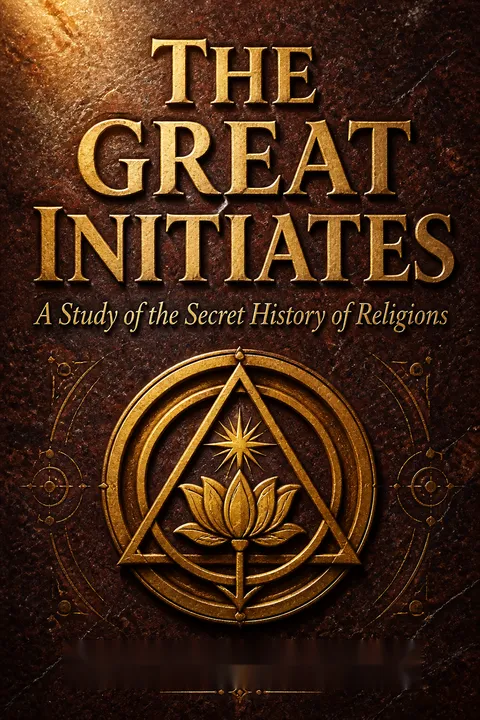
The Great Initiates is not a conventional history of religion. It is a spiritually driven narrative that interprets religious founders as successive translators of a shared wisdom. In this volume, Pythagoras organizes hidden teaching into a system, Plato makes its ideals philosophically approachable, and Jesus embodies its moral demands in a public life. The structure carries the reader from cosmic order, through education of the soul, to the political and social consequences of belief.
Its strongest contribution is the insistence that spirituality must connect thought to conduct. Number, ritual, initiation, compassion, sacrifice, and public institutions are not isolated topics in Schuré’s account. They are different settings in which a person or community tries to bring inner order into the visible world. His distinction between a moral ideal and the institutions needed to realize it remains especially useful: humane convictions do not automatically produce humane systems. The historical method is the book’s central limitation. Schuré often presents undocumented initiations, secret lineages, and private experiences as though they complete the record. His interpretations of Pythagoras’s life, Jesus’s Essene training, and the resurrection are speculative, and the text’s claim that distinct religions express a common doctrine can erase their disagreements. These features make the book unreliable as a guide to what ancient people demonstrably believed, but revealing as a record of nineteenth-century esoteric universalism.
Its political argument also contains a productive tension. Schuré condemns selfish rulers and celebrates wise spiritual guides, yet the Pythagorean experiment at Croton relies on a powerful, secretive elite. The resulting conflict raises a question the book does not resolve: how can knowledge guide public life without becoming unaccountable rule? The book’s best use is therefore neither as verified ancient biography nor as a finished political blueprint. It is a vivid argument about the aspiration to join spiritual insight, moral discipline, and social reform, alongside a reminder that good intentions do not remove the need for evidence, pluralism, and legitimate authority.
Review Summary
The Great Initiates receives mixed reviews, with ratings ranging from 1 to 5 stars. Many readers praise its spiritual insights and historical value, finding it a fascinating exploration of esoteric knowledge and religious connections. However, critics point out inaccuracies and speculative content, particularly regarding archaeological evidence. Some view it as a valuable historical document in Western esotericism, while others dismiss it as unreliable. The book's writing style is described as poetic but occasionally tedious, and its attempt to reconcile science and religion is met with skepticism by some readers.
People Also Read





Glossary
Monad
Primordial unityIn Schuré’s account of Pythagorean teaching, the Monad is the ultimate unity from which the diverse world proceeds. It represents divine essence before or beyond its many manifestations. The idea lets him describe the universe as a whole whose apparent multiplicity remains rooted in a single source.
Dyad
Generative dualityThe Dyad is the paired principle through which the Monad manifests a world. Schuré describes it as active and receptive, or masculine and feminine, aspects of divine creation. It is a symbolic account of generation and relation, not simply the number two as a quantity.
Ternary law
Threefold structure of lifeThe Ternary law is Schuré’s name for the threefold pattern he sees throughout existence. He applies it to the natural, human, and divine worlds, and to body, soul, and spirit in a person. The pattern is meant to show how distinct levels of reality correspond and interact.
Sacred Quaternion
Unity expressed in fourThe Sacred Quaternion, also described as the sacred Tetrad, is the Pythagorean symbol Schuré uses to unite the divine and human patterns of threefold existence. It represents a complete order in which differentiated parts are gathered into unity. Schuré treats it as a key to the structure of the cosmos and the diversity of religions.
astral light
Subtle universal mediumSchuré uses astral light for an invisible, pervasive medium between spirit and matter. In his account, it carries or reflects impressions, thoughts, and images, and provides a vehicle for clairvoyance and other psychic phenomena. This is an occult concept in the book, not an established scientific explanation of light or consciousness.
Epiphany
Vision of spiritual orderIn Schuré’s description of the highest Pythagorean degree, Epiphany is the initiate’s vision of reality from a spiritual vantage point. It is not meant to end in private ecstasy: the initiate returns to ordinary life expected to apply the insight through wisdom, virtue, bodily discipline, and relationships.
Essenes
Jewish religious brotherhoodThe Essenes are described by Schuré as a disciplined Jewish community that preserved prophetic traditions through shared life, study, ethical rules, and graded initiation. He presents Jesus as joining them before beginning his public mission. The account of Jesus’s membership is Schuré’s interpretation, not a fact established by the supplied text’s evidence.
Son of Man
Ideal human messengerSchuré interprets the Son of Man as more than a title for an individual. It signifies the ideal or perfected humanity, embodied in a chosen messenger who gives spiritual truth a human form. In his account of Jesus, the term also carries the sense of a representative of suffering humanity.
Greater Mysteries
Advanced Eleusinian ritesThe Greater Mysteries were the more advanced ceremonies of Eleusis in Schuré’s account. Through dramatic ritual and revelation, initiates were led to interpret Persephone’s descent and return as the soul’s movement into earthly life and its hope of spiritual renewal. The rites were restricted, and the book presents their full meaning as secret.
Download PDF
Download EPUB
.epub digital book format is ideal for reading ebooks on phones, tablets, and e-readers.








