

Key Takeaways
Connect models across disciplines to see what any single lens hides
Build a working toolkit. Shane Parrish traces his interest in better thinking to a sudden change in responsibility after September 11, 2001. His computer science education had not prepared him to make decisions affecting employees, families, and national interests. Looking beyond his own field, he encountered investor Charlie Munger’s method: use fundamental ideas from different disciplines to make sense of real problems. These mental models are simplified representations of how things work. A connected set becomes a latticework, where one idea can illuminate or correct another.
Make knowledge usable. A biologist, engineer, and businessperson may each see a different part of a forest. None is necessarily wrong, but each perspective alone can miss interactions and consequences. Models become valuable through practice: apply them, record outcomes, and update them when reality disagrees.
The strength of this approach is not simply intellectual variety. It is the habit of translating between levels of explanation: individual incentives, biological limits, physical constraints, and institutional rules can all shape the same event. That resembles systems science, which studies how interacting parts create outcomes no single part explains. The danger is collecting concepts as labels and mistaking recognition for understanding. A useful model should change what gets noticed, what gets tested, or what action is chosen. Breadth matters when it improves those judgments, not when it merely decorates them.
Use models as maps, then let reality redraw them
Simplification has a cost. A map is useful because it leaves things out. A subway diagram helps a passenger choose a route, but does not describe the experience of standing in a station. The same is true of business reports, policies, and scientific theories: each represents selected features of a more complicated world. A map can also become outdated as its territory changes.
Keep checking the terrain. Newtonian physics remains effective for many everyday calculations, though it does not explain everything that relativity addresses. In public policy, Elinor Ostrom warned that a model of shared resources can be mistaken for a universal rule, even when local communities manage those resources differently. Jane Jacobs likewise criticized city plans that treated statistical diagrams as more real than the street life they were meant to improve.
This distinction is central to responsible measurement. A model is not defective merely because it omits detail; omission is what makes it manageable. The practical question is whether the missing detail could change the decision. That is why maps need declared purposes, known boundaries, and routes for revision. In organizations, a performance metric can guide attention while also distorting it if people optimize the number rather than the underlying work. The model’s influence on behavior must be examined alongside its accuracy. Sometimes the map does not just describe the territory; it helps reshape it.
Know where expertise ends before confidence starts making decisions
Depth beats familiarity. A lifelong resident of a small town knows its relationships, history, and informal rules. A newcomer may learn the main streets in days and still mistake surface familiarity for genuine understanding. The book calls a domain of deep, tested knowledge a Circle of Competence. Within it, a person can identify what remains unknown and compare several possible responses.
Borrow expertise with care. Mount Everest illustrates the stakes: climbers have long relied on Sherpas whose experience comes from years in the region. The book reports roughly 200 bodies on the mountain, a stark reminder that a little research does not make a novice competent. To build or maintain expertise, track decisions, learn from failures, and seek candid outside feedback. When outside your circle, consult knowledgeable people and examine what their incentives may be.
The model offers a valuable antidote to overconfidence, especially when a person’s general intelligence is mistaken for domain expertise. Research on expert performance similarly emphasizes sustained practice and feedback, not just exposure to information. Yet competence is rarely a clean boundary. New tools, changing conditions, and adjacent specialties can make yesterday’s reliable judgment less reliable. The useful question is therefore not only, “Is this inside the circle?” but also, “What evidence would show that the circle has shifted?” Advice from experts also deserves scrutiny, since skill and incentives are separate questions.
Strip inherited assumptions down to facts before rebuilding the solution
Separate foundations from convention. First principles thinking means breaking a problem into its most basic, non-reducible elements in that context, then reasoning upward. It does not require discovering eternal truths. Two practical tools are disciplined Socratic questioning, which tests assumptions and evidence, and the Five Whys, which repeatedly asks why until an explanation reaches a testable cause rather than “that is just how it is.”
A medical dogma fell. Doctors long assumed that stomach acid made the stomach sterile, so bacteria were not considered a cause of ulcers. Pathologist Robin Warren noticed bacteria in stomach samples and worked with physician Barry Marshall to challenge that belief. Their work established the role of H. pylori, leading to effective antibiotic treatment. The lesson is not to reject convention reflexively, but to distinguish evidence-based constraints from assumptions that have merely gone unquestioned.
First-principles reasoning is especially useful when familiar solutions stop working, because it exposes which constraints are real and which are inherited habits. It also connects to scientific skepticism: claims gain credibility when they face tests that could prove them wrong. The method has limits. Complex systems contain relationships that cannot always be reconstructed from isolated components, and a question can be “why”ed past the level relevant to the decision. The goal is not endless reduction. It is to find a sound basis for action and retain enough context to avoid mistaking a part for the whole.
Rehearse difficult choices mentally before reality makes them costly
Simulate before acting. A thought experiment uses deliberate imagination to examine a question that is difficult, dangerous, or impossible to test directly. A useful version starts with a clear question, gathers relevant background, forms a hypothesis, varies assumptions, and examines the results. Imagining LeBron James playing basketball against Woody Allen makes a confident prediction easy; comparing James with Kevin Durant is harder because their abilities are closer.
Use the tool with discipline. Einstein imagined a person in an accelerating elevator and asked whether the experience could be distinguished from gravity. This helped develop his account of gravity. John Rawls’s veil of ignorance asks people designing social rules to imagine they do not know their future position in society. Historical counterfactuals require more caution: in a chaotic system, changing one event can alter many later events in unpredictable ways.
Mental simulation is a form of low-cost experimentation. It can reveal hidden assumptions, clarify values, and make downside scenarios vivid before they become real. Its quality depends on the quality of its inputs, however. A vivid scenario is not automatically a likely one, and imagined alternatives can be shaped by the same biases that shape ordinary judgment. Thought experiments work best when they vary one assumption at a time, include realistic constraints, and distinguish “possible” from “probable.” They are strongest as tools for sharpening questions, not as substitutes for evidence.
Ask what follows next before celebrating an immediate benefit
Look past the first result. Second-order thinking considers not only an action’s immediate effect, but the consequences of that effect. British officials once offered rewards for dead cobras in Delhi. People responded by breeding cobras, making the original problem worse. The incentive looked sensible at the first level, while its next effect undermined the goal.
Trace the chain. Farmers used antibiotics in livestock to improve weight gain and profits. A further consequence was that bacteria resistant to antibiotics gained an advantage and could spread through the food chain. The book’s practical question is simple: after this happens, what happens next? Thinking several steps ahead is not a promise to predict every outcome. It is a way to identify plausible side effects, especially in tightly connected systems, and to favor long-term gains over short-term rewards.
This model belongs beside modern systems thinking, where feedback loops and incentives often produce outcomes no participant intended. It is particularly valuable when a policy changes what people are rewarded for doing, since people adapt to rules rather than simply obeying their designers’ expectations. But consequence chains can be extended indefinitely, making every action appear dangerous. A useful analysis prioritizes effects that are both plausible and consequential, then identifies ways to monitor them. The point is neither certainty nor paralysis. It is to make hidden costs visible early enough to adjust.
Use base rates, and prepare for extremes your forecasts undercount
Update rather than guess. Probabilistic thinking means estimating how likely outcomes are instead of treating uncertain events as simply certain or impossible. Bayesian thinking updates an initial estimate when new evidence arrives. A headline that violent stabbings have doubled sounds alarming, but the book’s example compares a rise from one case per 10,000 people to two. Context changes the interpretation. By contrast, US diabetes diagnoses rose from 0.93 percent in 1958 to 7.4 percent in 2015, with a sustained increase rather than a brief spike.
Respect the tails. A bell-shaped distribution describes outcomes with limited extremes; a fat-tailed distribution allows rare events much larger than ordinary ones. Wealth and catastrophic risks can behave this way. Estimates can also be systematically overoptimistic. When prediction is unreliable, protect against ruin, preserve room to recover, and seek opportunities with limited downside.
The key contribution is to separate a new data point from the background rate against which it should be interpreted. This is essential in medicine, public policy, and news consumption, where emotionally vivid events can overwhelm a person’s sense of scale. The warning about extreme outcomes adds a different discipline: averages and recent experience may be poor guides when the distribution has a long tail. Still, calling something fat-tailed does not quantify its risk. The label should prompt stress tests and protective margins, not become a license for dramatic speculation.
Work backward from failure to find the obstacles blocking success
Reverse the question. Inversion means approaching a problem from the opposite direction: instead of asking only how to achieve a goal, ask what would guarantee failure and remove those conditions. It can also mean beginning with a proposed conclusion and examining what else would have to be true. The technique is useful when forward reasoning stalls or when avoiding a bad outcome is more manageable than producing a perfect one.
Prevention can outperform repair. Florence Nightingale collected statistics on deaths in British military hospitals during the Crimean War. The first winter’s death rate was 23 percent; the following winter it was 2.5 percent, after sanitation became a central focus. Her analysis helped reveal a preventable source of harm. The same reverse framing appears in investing: rather than promise to beat the market, an index fund can reduce losses from fees and poor manager selection.
Inversion resembles premortem analysis, a decision technique in which a team imagines that a plan has failed and identifies plausible causes in advance. This shifts attention from optimism and aspiration toward friction, hazards, and preventable mistakes. Its value is not limited to avoiding disaster; removing a binding obstacle can create more progress than adding another ambitious initiative. The caution is that a list of failure modes can become distorted toward whatever is easiest to imagine. Each obstacle should be ranked by likelihood and impact, not merely by how alarming it sounds.
Choose the simplest explanation that still accounts for the evidence
Prefer fewer moving parts. Occam’s Razor is a rule for choosing between explanations with similar explanatory power: favor the one requiring fewer assumptions. It is a guide, not a law that the simplest account must always be correct. In Los Angeles, officials faced a water-treatment problem involving sunlight and chemicals that could form a carcinogen. Rather than build a large cover over a reservoir, they used floating black balls to block sunlight, a simpler practical fix.
Simplicity must fit reality. Astronomer Vera Rubin observed that stars at the outer edges of galaxies moved faster than existing explanations predicted. Dark matter became a comparatively simple explanation for the gravitational effects, even though it had not been directly detected in the book’s account. If evidence stops fitting a simple theory, the theory or the underlying understanding must be reconsidered.
Parsimony is a useful discipline because each additional assumption creates another point where an explanation can fail. It also protects time and attention from elaborate stories built on thin evidence. But simplicity is not the same as truth, and complex phenomena can require complex explanations. A good application compares explanations with similar explanatory reach, rather than rewarding whichever story has the fewest words. The reservoir example works because the proposed fix addresses a specific mechanism. In science, an elegant theory earns trust through predictions and tests, not elegance alone.
Check for error before assigning malice, but examine incentives too
Do not personalize every failure. Hanlon’s Razor advises considering ignorance, error, or carelessness before concluding that someone acted maliciously. A driver who cuts another car off may simply have failed to see it. Assuming deliberate hostility can trigger retaliation and hide more useful explanations, such as poor communication or bad procedures.
The stakes can be enormous. During the Cuban Missile Crisis, Soviet submarine officer Vasili Arkhipov faced depth charges that the crew interpreted as evidence of attack. A nuclear torpedo could have been launched only with agreement from three senior officers. Arkhipov opposed launching and pushed to surface and contact Moscow. The incident shows the value of not escalating on an uncertain interpretation. The principle is not to excuse harmful conduct: investigate evidence, context, and incentives before deciding what caused it.
Attributing another person’s mistake to hostile intent is a form of motive overreach: an observable outcome is treated as proof of an invisible purpose. Slowing that inference can prevent conflict and leave room for correction. Yet a blanket presumption of innocence can also protect deliberate abuse or institutional misconduct. A sound approach separates intent from impact. Harm can be real even when accidental, while repeated “mistakes” may reveal incentives or negligence that require intervention. Calm interpretation is most useful when paired with fact-finding and accountability.
Analysis
The book’s strongest claim is that sound judgment depends less on having a single master theory than on having several imperfect models that can correct one another. That is a practical response to a world in which causal systems cross disciplinary boundaries. A financial choice may involve statistical uncertainty, incentives, human psychology, and institutional rules at once. A narrow specialist can reason expertly inside one slice while remaining blind to the rest. The models are most useful as habits of attention. The map metaphor asks what an abstraction omits. A circle of competence asks whether knowledge is deep enough to support a decision. First principles expose assumptions. Second-order thinking follows consequences. Probability distinguishes confidence from certainty, and inversion turns attention toward avoidable failure. Together, they form a flexible decision practice rather than a rigid checklist.
The framework also contains a tension: more models can improve perspective, but multiplying lenses can slow action and encourage post hoc explanation. Almost any outcome can be made to fit a clever analogy. To avoid that trap, a model should generate a question or prediction that can be checked, and its limits should be stated before the result is known. The book’s emphasis on feedback, falsifiability, and record-keeping supplies an important safeguard, though it is easier to practice in domains with measurable outcomes than in relationships or politics.
A second tension concerns simplicity. Parsimony helps prevent elaborate unsupported stories, but the world is not always simple. The best use of Occam’s Razor is comparative: among explanations that account for the evidence equally well, begin with fewer assumptions, then expand only when observation demands it. Likewise, Hanlon’s Razor should slow accusations, not disable accountability.
The deeper lesson is epistemic humility with practical ambition. Models do not eliminate uncertainty or guarantee good outcomes. They make uncertainty more visible, help separate what is known from what is assumed, and improve the odds that action will survive contact with reality. Their value lies in disciplined use, not in memorizing their names.
Review Summary
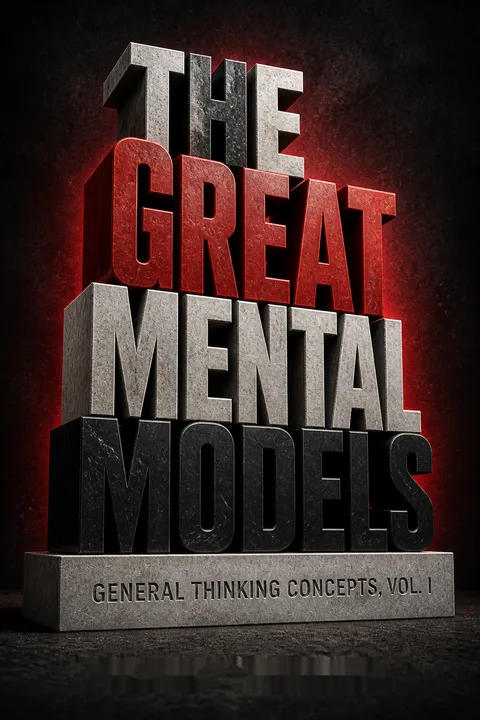
The Great Mental Models receives mixed reviews. Many praise its accessible introduction to mental models for improved thinking and decision-making, with some considering it essential reading. Critics argue the content is basic and lacking depth. Readers appreciate the book's design and examples but note repetition and narration issues in the audiobook. Some find it incomplete as the first in a series. Overall, reviewers value the concept but have varying opinions on execution, with some recommending only specific chapters or suggesting alternative resources.
People Also Read






Glossary
Mental model
Simplified representation of realityA mental model is a simplified representation of how some part of the world works. People use models, often without noticing, to decide which facts matter, infer causes, recognize patterns, and choose actions. Models are necessarily incomplete, so their usefulness depends on how well they explain or predict relevant features of a situation.
Latticework
Connected set of modelsA latticework is an interconnected collection of useful ideas drawn from different fields. Rather than storing facts in isolation, a person relates them so that one model can reveal a feature another misses. The aim is broader understanding of complex situations, not mastery of every discipline or the application of every model to every problem.
The Map is not the Territory
Representation is not realityThis principle distinguishes a description or model from the real-world system it represents. Maps simplify, select details, and reflect the purposes and limits of their creators. They remain valuable guides, but users should understand what they omit, check whether conditions have changed, and revise them when observation conflicts with the representation.
Circle of Competence
Domain of tested expertiseA Circle of Competence is an area in which a person has enough depth and experience to make relatively informed judgments and recognize the limits of their knowledge. It is not fixed or quickly acquired. It must be maintained through learning, performance tracking, reflection, and honest feedback, while expertise from others is sought outside its boundaries.
First Principles Thinking
Reasoning from basic factsFirst Principles Thinking breaks a problem into the most basic elements that cannot be reduced further for the question at hand. It separates established facts from assumptions, conventions, and inherited methods, then builds a solution from the remaining foundations. The relevant first principles depend on the problem and can change as knowledge improves.
Thought Experiment
Imagined test of a questionA Thought Experiment uses structured imagination to investigate a question that may be impossible, costly, or unsafe to test physically. It begins with a question and relevant background, proposes a hypothesis, varies conditions, and examines the implications. It can clarify values and causal assumptions, but imagined outcomes require realistic premises and careful interpretation.
Second-Order Thinking
Reasoning through consequencesSecond-Order Thinking considers not only the immediate effects of an action but also the effects those consequences create. It is especially useful when incentives or interventions change how people and systems behave. The method cannot predict every result, so it focuses on plausible downstream effects that are important enough to influence a decision.
Probabilistic Thinking
Reasoning in likelihoodsProbabilistic Thinking treats uncertain outcomes in terms of likelihood rather than certainty. It uses relevant evidence, base rates, and estimates of uncertainty to compare possible outcomes and guide decisions. It does not promise exact forecasts. Its purpose is to improve judgment about what is more or less likely and how much confidence an estimate deserves.
Bayesian thinking
Updating beliefs with evidenceBayesian thinking adjusts an initial estimate in light of new evidence while retaining relevant prior information, such as base rates or historical patterns. New information can strengthen or weaken an earlier belief rather than forcing an all-or-nothing judgment. The process is ongoing, since both prior assumptions and new evidence may be uncertain.
Fat-tailed curves
Distributions allowing extreme outcomesFat-tailed curves describe distributions in which extreme outcomes are more consequential or more common than a standard bell curve would suggest. In such settings, rare events can greatly affect the average, and past ordinary outcomes may not describe the full range of risk. The concept encourages preparation for unusually large losses or gains, not confident prediction of their timing.
Inversion
Reasoning from the opposite directionInversion approaches a problem by turning its usual direction around. Instead of asking only how to achieve a goal, it asks what would cause failure and how those conditions can be removed. It can also begin with a proposed conclusion and explore what else would have to be true. This helps expose obstacles and test assumptions.
Occam’s Razor
Prefer fewer assumptionsOccam’s Razor is a principle for comparing explanations: when competing accounts explain the evidence similarly well, prefer the one that requires fewer assumptions or moving parts. It is a rule of thumb, not proof that the simplest explanation is true. A simple account should be revised when it fails to explain important evidence.
Hanlon’s Razor
Consider error before maliceHanlon’s Razor advises considering ignorance, mistakes, or carelessness before concluding that harmful behavior was deliberately malicious. It counters the tendency to infer motives from outcomes alone and can prevent needless escalation. It does not require excusing harm or ignoring incentives; evidence and repeated behavior still matter when assigning responsibility.
Falsifiability
Capacity to be disprovedFalsifiability is the property of a claim that could, in principle, be shown false by some possible observation or test. A theory that risks failing a clear test can gain credibility when it survives serious attempts at refutation. A claim that accommodates every outcome without specifying what would count against it is difficult to evaluate empirically.
Necessity and Sufficiency
Required versus enough conditionsA necessary condition must be present for an outcome to occur, but may not produce that outcome by itself. A sufficient set of conditions is enough to produce it, though other sufficient combinations may exist. Confusing the two encourages simplistic explanations of success, which often depends on necessary ingredients plus additional circumstances, including chance.
Causation vs. Correlation
Cause versus observed associationCorrelation describes an observed relationship between two variables; causation means changes in one help produce changes in the other. An association alone does not establish causal direction or rule out a third factor. Regression to the mean can also make extreme cases improve naturally, so comparison groups and careful designs help test whether an intervention caused change.
FAQ
What's "The Great Mental Models: General Thinking Concepts, Vol. I" about?
- Purpose and Scope: The book, authored by Shane Parrish, aims to help readers develop a better understanding of how the world works by introducing them to mental models that enhance decision-making and problem-solving.
- Content Focus: It covers a range of topics including decision-making, learning, and the art of living, drawing on ideas from both science and the humanities.
- Project Ambition: This volume is part of a larger project to create a multidisciplinary education resource that is accessible to everyone, with plans for additional volumes covering various disciplines.
Why should I read "The Great Mental Models: General Thinking Concepts, Vol. I"?
- Improved Decision-Making: The book provides tools to help you make better decisions by understanding and applying mental models.
- Multidisciplinary Approach: It encourages thinking across different fields, helping you connect ideas and think in a more integrated way.
- Practical Application: The models are designed to be actionable, allowing you to apply them in real-life situations to avoid mistakes and spot opportunities.
What are the key takeaways of "The Great Mental Models: General Thinking Concepts, Vol. I"?
- Mental Models: Understanding and using mental models can significantly improve your thinking and decision-making processes.
- Latticework of Models: Building a network of interconnected models from various disciplines helps in understanding complex problems.
- Continuous Learning: The book emphasizes the importance of updating your knowledge and adapting your models as you gain new insights.
What is a mental model according to Shane Parrish?
- Definition: A mental model is a representation of how something works, simplifying complex realities into understandable chunks.
- Utility: They help in decision-making by allowing you to see problems from multiple perspectives and identify relevant information.
- Application: The book focuses on models with broad utility, which can be applied across various aspects of life and work.
How does "The Great Mental Models" suggest using first principles thinking?
- Core Idea: First principles thinking involves breaking down complex problems into their fundamental parts and building up from there.
- Techniques: The book suggests using Socratic questioning and the Five Whys method to identify and challenge assumptions.
- Innovation: By understanding the basic elements of a problem, you can create innovative solutions that are not bound by existing methods.
What is the Circle of Competence and how is it applied in the book?
- Concept: The Circle of Competence refers to understanding the boundaries of your knowledge and expertise.
- Self-awareness: It emphasizes the importance of knowing what you don't know and seeking help or learning in those areas.
- Decision-Making: Operating within your circle of competence leads to better decision-making and outcomes, while venturing outside requires caution and consultation.
How does the book explain the Map is not the Territory?
- Concept Explanation: This model highlights the difference between models or maps and the reality they represent, emphasizing that maps are simplifications.
- Limitations: It warns against mistaking the map for reality, as this can lead to errors in judgment and decision-making.
- Adaptability: The book stresses the need to update maps and models as the underlying reality changes.
What role does probabilistic thinking play in "The Great Mental Models"?
- Understanding Uncertainty: Probabilistic thinking helps in estimating the likelihood of various outcomes, improving decision accuracy.
- Bayesian Thinking: The book discusses Bayesian updating as a method to incorporate new information into existing knowledge.
- Fat-Tailed Curves: It also covers the concept of fat-tailed curves, which account for extreme events that can significantly impact outcomes.
How does "The Great Mental Models" address second-order thinking?
- Beyond Immediate Effects: Second-order thinking involves considering the long-term consequences of actions, not just the immediate effects.
- Avoiding Unintended Consequences: The book provides examples of how failing to consider second-order effects can lead to negative outcomes.
- Holistic Approach: It encourages a comprehensive view of decision-making, taking into account the broader system and potential ripple effects.
What is the significance of Occam's Razor in the book?
- Simplicity Preference: Occam's Razor suggests that simpler explanations are more likely to be correct than complex ones.
- Decision-Making Tool: The book uses this principle to guide decision-making, helping to avoid unnecessary complexity.
- Efficiency: By focusing on simpler explanations, you can save time and resources, making more efficient decisions.
How does the book use inversion as a thinking tool?
- Reverse Thinking: Inversion involves approaching problems from the opposite end, considering what you want to avoid rather than achieve.
- Problem-Solving: This method helps identify obstacles and potential pitfalls, allowing for more effective solutions.
- Practical Examples: The book provides examples of how inversion can lead to innovative solutions and better decision-making.
What are the best quotes from "The Great Mental Models" and what do they mean?
- "The quality of your thinking depends on the models that are in your head." This quote emphasizes the importance of mental models in shaping how we perceive and interact with the world.
- "Understanding only becomes useful when we adjust our behavior and actions accordingly." It highlights the need to apply knowledge in practical ways to effect positive change.
- "The map is not the territory." This quote serves as a reminder that models are simplifications and should not be confused with reality.
About the Author
Other books by Shane Parrish


Download PDF
Download EPUB
.epub digital book format is ideal for reading ebooks on phones, tablets, and e-readers.








