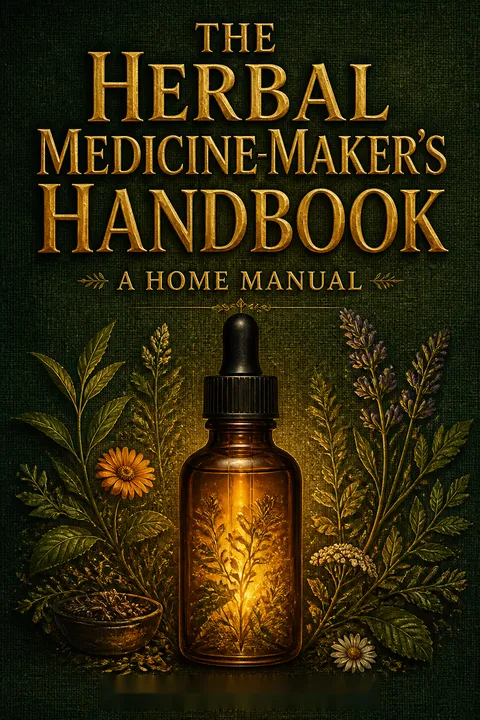


Key Takeaways
Start with one correctly identified plant, then learn by making.
Begin in the field. Green opens with a neighborhood Dandelion, a plant many people dismiss as a weed. He uses it to teach the sequence: identify the plant, avoid polluted ground, harvest thoughtfully, chop it, cover it with solvent, label the jar, and let it steep. His example tincture is shaken during a fourteen-day soak, then strained and stored in a dark bottle. The point is less the recipe than the apprenticeship: notice a plant, handle it, and learn its qualities through repeated contact.
Keep the first batch simple. Green treats making as a hands-on skill rather than a shopping project. The book is a manual, but it is also an invitation to build judgment through observation, careful work, and notes. Its medical claims should not be confused with clinical advice.
The teaching method resembles apprenticeship in cooking or field biology: a small task joins concepts to sensory memory. Chopping, smelling, labeling, and revisiting a batch make abstract ideas about extraction tangible. This can help learners notice quality and process errors that a written formula alone would miss. The limitation is important: familiarity with a plant is not proof of safe identification or medicinal benefit. Foraging requires reliable botanical identification, and a homemade preparation does not become safe simply because its maker is attentive.
Know a few local herbs deeply before collecting an encyclopedia.
Build a working repertoire. Green recommends that students concentrate on roughly thirty to thirty-five herbs instead of trying to master every plant in herbal literature. A California School of Herbal Studies group assembled a core list of thirty plants, then Green added five more and the Reishi mushroom. The selection was intended to cover a range of traditional actions, from astringent and demulcent to nervine and diuretic.
Choose for familiarity and place. Green advises starting with plants that grow nearby, are accessible in good condition, and hold personal interest. Learn to identify them, observe their growth, and understand which parts are gathered and when. The school’s list is a model, not a universal prescription: local climate, availability, and conservation needs should shape a home collection.
A bounded repertoire is a strong learning design. Expertise grows through repeated comparison: how a leaf changes as it dries, how a root tastes, or how two preparations differ. The ecological emphasis also prevents a common mismatch between herbal study and local habitat. Still, the thirty-herb target is a teaching choice, not a scientifically established threshold for competence. The California list reflects its place and era, and several listed plants are now conservation-sensitive or require particular care.
Harvest only abundance, and leave the plant community able to recover.
Treat harvesting as stewardship. Green asks the medicine-maker to gather only from healthy, abundant stands, avoid threatened species, seek permission, and stay clear of polluted or sprayed sites. He recommends taking no more than 10 percent of a native stand or 20 percent of a naturalized one, while treating those figures as ceilings rather than targets. For roots, he advises replacing soil, replanting viable crowns when possible, and scattering seeds.
Know what commerce costs. Green names Goldenseal, Black Cohosh, Echinacea, and Pipsissewa as plants harmed by demand and habitat pressure. He urges readers to favor cultivated sources or suitable substitutes. The book’s opening Dandelion harvest models a different relationship: appreciation for a common plant, paired with attention to its surroundings.
This ethic anticipates modern concerns about supply chains and ecological externalities: the price on a jar rarely reflects pressure on a wild population. Green’s numeric limits offer a memorable prompt to assess impact, but they cannot guarantee sustainability across every species, site, or season. Slow-growing plants and small, fragmented populations may not tolerate even modest removal. Local conservation guidance and cultivated sourcing are more reliable than treating a single percentage as a universal permission slip.
Protect potency through fast, shaded drying and careful storage.
Process promptly. Green argues that good medicine begins with good plant material, and that harvesting is not finished until the plant is properly handled. Fresh herbs should be moved out of bags and onto drying racks or into bundles soon after collection. He recommends shade, warmth, and moving air, generally around 85 to 100 degrees Fahrenheit, while warning that direct sun can fade color and aroma. Dry material is ready for storage when the thicker parts snap crisply.
Keep out light and moisture. Garbling means removing damaged leaves, excess stems, dirt, and other unwanted material. Green recommends airtight, light-blocking containers, clear labels, and periodic checks for moisture. He gives a rough storage guide of up to a year for leaves and flowers, and two to three years for roots, seeds, and bark.
This section has the logic of postharvest food science: time, temperature, moisture, and oxygen shape what remains in a biological material. Color and aroma are useful quality clues, though they cannot establish chemical potency or purity by themselves. Green’s practical sequence is valuable precisely because it makes quality control part of the craft rather than a last-minute concern. A further distinction matters: carefully dried herbs can still be contaminated or misidentified, so visual freshness is only one part of quality assessment.
Choose the solvent for the plant, not the product's marketing.
A solvent is a design choice. Green calls the liquid used to draw plant constituents into an extract a menstruum. He discusses water, alcohol, water-alcohol mixtures, vinegar, wine, glycerin, and fixed oils, each with different extraction and preservation properties. Water is useful for teas but spoils quickly; alcohol-water mixtures can extract a broad range of constituents and preserve a preparation; glycerin offers a sweet, alcohol-free option but does not suit every plant. Oils carry plant qualities into salves and skin preparations.
Let purpose guide the formula. The book encourages small trials and sensory checks rather than assuming one solvent is best for everything. Green also urges readers to look past glossy claims such as “full spectrum” or “superior delivery system.” A preparation’s starting herb, solvent, handling, and storage all matter.
This is a useful corrective to the idea that a more concentrated or technical-looking extract is automatically better. In pharmacognosy, solvent polarity does affect which constituents dissolve, but extraction yield is not the same as clinical effectiveness. Green’s chemistry-oriented vocabulary helps demystify commercial production, while his distrust of standardization sometimes overreaches. Standardization can support consistency, even if it cannot capture every property of a whole plant. The practical lesson is to ask what a product measures, and what that measurement does not tell the buyer.
Let plant structure decide whether you steep, simmer, or soak.
Match method to material. An infusion is made by steeping plant material in water, commonly for leaves and flowers or other relatively soft parts. A decoction simmers tougher materials such as many roots, barks, and seeds. Green says to start a decoction with cold water and heat it gradually, then simmer, usually for about ten to fifteen minutes. Covering aromatic infusions helps retain volatile components; boiling can drive them away.
Use water preparations promptly. The book treats these as fresh preparations rather than pantry staples. It suggests using infusions within roughly twelve to twenty-four hours and decoctions within a day, with a longer limit only under cool storage. Some plants call for cold infusion or should not be boiled. These distinctions are extraction guidance, not dosage instructions or a diagnosis of what a person needs.
The distinction is a practical application of material science: soft tissues release soluble contents differently from dense, woody ones, and heat changes both speed and composition. It also shows why recipes need to specify plant part and method, not merely the plant’s name. Yet traditional categories do not guarantee an optimal extraction for every constituent, and a stronger-tasting tea is not necessarily a more effective treatment. The book’s procedures are best read as craft knowledge, with medical use assessed separately.
Match each herbal preparation to its practical route of use.
Forms solve different problems. Green surveys tinctures, glycerites, hydrosols, syrups, honeys, oils, salves, lotions, poultices, compresses, baths, and suppositories. A hydrosol is aromatic water collected during steam distillation; an oil infusion can become a salve; a water-based tea can be sweetened and made into syrup. Poultices and fomentations carry moist plant material or herbal liquid to the skin. He also presents flower essences, following Edward Bach’s system, as subtle preparations.
Convenience is not proof. The author favors choosing a form that suits the plant, intended use, taste, and storage needs. He values simple kitchen equipment over elaborate machinery, while explaining that certain tasks, such as percolation or emulsifying lotion, demand more precision. These formats are not interchangeable, and the book’s therapeutic claims for them should be evaluated cautiously.
Formulation is partly a human-factors problem: a preparation that is easier to take or apply may be more acceptable than one that is unpleasant or inconvenient. This helps explain the book’s interest in syrups and herbal jello, not just tinctures. However, route of use changes exposure and risk, not merely convenience. Topical products can irritate skin, and oral products can interact with medicines or be unsuitable for some people. Flower essences also sit in a different evidentiary category from chemical extraction, despite sharing the herbal label.
Write down every batch so intuition can become reproducible craft.
Turn experiments into records. Green asks medicine-makers to log the plant’s common and botanical names, plant part, source, date, solvent, proportions, method, yield, and observations. He provides separate charts for harvest and extract records. Notes help answer practical questions: Did the herb absorb more liquid than expected? Did the dried material keep its aroma? Did a later batch behave differently?
Choose a measurement style. The “folk method” uses approximate amounts and suits personal experiments; the weight-to-volume method weighs plant material and measures solvent to create a stated ratio, such as one part herb to five parts liquid. Green presents neither as inherently superior. His advice is to work carefully, record decisions, and revise a formula based on experience rather than relying on memory.
The note-taking advice is among the book’s most transferable methods. It resembles a simple laboratory notebook: record inputs, process, and outcome so that a pleasing result can be repeated or a failure explained. This also makes a maker less dependent on advertising language. But an individual notebook is not a controlled clinical trial. Perceived benefit can reflect expectation, natural symptom changes, or other simultaneous changes. Records improve procedural consistency; they do not by themselves establish efficacy.
Treat gardening and making as part of the medicine's human value.
The garden is more than supply. Green repeatedly returns to planting, puttering, harvesting, and making as sources of pleasure and connection. His “puttering reflex” names the attentive, almost automatic sequence of noticing what a garden needs and responding to it. He sees the garden as a classroom where a learner meets living plants rather than only descriptions in books. The book’s final vision is not a laboratory full of machinery, but a kitchen linked to a garden and local landscape.
Count the experience honestly. This approach makes the activity itself part of the value: movement, sensory attention, seasonal rhythm, and care for a living place. Green also attributes broad health effects to gardening and plant connection. Those claims are best understood as his philosophy, not a substitute for evidence-based treatment.
The garden-centered approach connects herbal practice to environmental psychology and behavioral health, where contact with natural settings is often studied in relation to mood, attention, and stress. Its strongest claim is experiential: tending plants gives structure, sensory engagement, and a reason to spend time outdoors. That value can coexist with skepticism about more sweeping claims, such as gardening curing depression or boosting immunity. Nature can support wellbeing without being a universal therapy or a replacement for professional care.
Use herbal self-care alongside diagnosis, not instead of it.
Agency needs guardrails. Green presents herbalism as a household and community practice that can reduce dependence on commercial products. He also opens with a clear disclaimer: the handbook is not a substitute for medical counseling, and readers should consult a qualified practitioner about health problems. That caution matters because the text ranges from gentle culinary herbs to plants with toxicity concerns, and it discusses pregnancy, children, and chronic conditions.
Separate philosophy from clinical fact. In the closing story, a fictionalized conversation frames medicine as an ally and emphasizes personal agency. Green also suggests illness can reflect conflict between thought and spirit, and advises less focus on diagnosis. That is his worldview, not an established explanation of disease. Symptoms can signal conditions that need timely evaluation; reflective practice should never delay it.
The book’s defense of lay knowledge has real value when it encourages informed questions, practical skill, and respect for local resources. Its account of illness as a product of mental resistance, however, risks blaming people for conditions shaped by infection, genetics, environment, or chance. Patient agency is strongest when paired with accurate diagnosis and shared decision-making, not when it displaces them. Herbal products can also have meaningful risks. Self-care belongs within a broader care system, especially for serious, persistent, or worsening symptoms.
Analysis
Green’s handbook is part field guide, part kitchen manual, and part argument for cultural independence. Its narrative starts with a Dandelion harvest, then expands outward through identification, ecological gathering, drying, extraction, and a large catalogue of ways to prepare plants. That progression gives the reader a memorable route from encounter to finished preparation. The practical center is not a single proprietary formula, but a repeatable craft: choose sound material, match solvent and method to the plant, label the work, and keep records.
The book’s strongest contribution is its insistence that quality and responsibility begin before extraction. An elegant tincture cannot repair a misidentified, contaminated, poorly dried, or overharvested plant. Its conservation warnings, attention to sensory quality, and encouragement to cultivate threatened species remain more valuable than its suspicion of every commercial or scientific standard. Likewise, its celebration of gardening identifies a real human good, even where the author’s claims about immune effects or cures go beyond what the text establishes.
The central tension is epistemic. Green asks readers to question authority, yet sometimes treats intuition, plant communication, or personal experience as if they establish medical truth. They can guide attention and meaning, but cannot reliably distinguish a placebo response from a specific therapeutic effect, or a benign symptom from dangerous illness. This adaptation therefore treats preparation instructions as historical craft knowledge, not a medical protocol, and does not reproduce the book’s dosage regimens or poisoning directions.
A crucial safety correction: Appendix F recommends inducing vomiting for poisoning. That advice can cause further harm and should not be followed. For a suspected poisoning, contact local emergency services or a poison center promptly and follow their instructions. More broadly, readers should consult qualified clinicians about illness, medication interactions, pregnancy, children, and persistent or severe symptoms. The book’s best enduring lesson is not that home remedies replace medicine, but that careful observation, ecological humility, and informed participation can make people more thoughtful partners in their own care.
Review Summary
The Herbal Medicine-Maker's Handbook receives mostly positive reviews, with readers praising its detailed instructions, wealth of information, and the author's engaging writing style. Many appreciate the focus on a limited number of herbs and the practical guidance provided. Some readers find the spiritual aspects off-putting, while others embrace the holistic approach. The book is recommended for both beginners and experienced herbalists, though some suggest it's better suited for intermediate students. Overall, it's considered a valuable resource for those interested in herbal medicine-making.
People Also Read



Glossary
Menstruum
Liquid extraction solventThe solvent used to draw soluble constituents from plant material during extraction. In Green’s manual, common menstrua include water, alcohol, mixtures of water and alcohol, vinegar, wine, glycerin, and fixed oils. The choice affects what dissolves, how the preparation tastes, and how well it keeps.
Marc
Spent plant residueThe insoluble plant material left after a liquid extract has been separated from the herb. In maceration, the marc is strained and often pressed to recover liquid. Green describes composting it after extraction, rather than confusing it with the finished tincture or infusion.
Maceration
Extraction by soakingA method of extraction in which chopped or powdered plant material remains in contact with a solvent for a period of time. The liquid penetrates the plant tissue and dissolves some constituents. The mixture is then strained, and the remaining plant pulp may be pressed.
Tincture
Liquid plant extractA liquid extract made by soaking fresh or dried botanical material in a solvent, usually alcohol or a water-alcohol mixture, then separating the liquid from the plant residue. Green also uses the term for some vinegar, wine, and glycerin extracts. Ratios and strengths vary by method.
Infusion
Water-based steeped extractA liquid preparation made by steeping plant material in hot or cold water rather than boiling it. Green associates infusions especially with flowers, leaves, soft stems, and some roots. Covering a hot infusion is recommended when aromatic components might otherwise escape.
Decoction
Simmered plant preparationA water-based extraction made by gradually heating and simmering plant material, commonly tougher roots, bark, or seeds. Green advises beginning with cold water and simmering the material to soften its dense tissues. Delicate aromatic plants are generally better suited to infusion.
Percolation
Solvent flowing through herbAn extraction method in which solvent passes slowly through a packed column of powdered, dried herb. The liquid collects dissolved constituents as it flows through. Green contrasts this more equipment-sensitive method with maceration, which relies on soaking and takes longer.
Weight to volume (w/v) method
Measured herb-to-solvent ratioA way of preparing extracts by weighing the plant material and measuring the volume of solvent. A stated ratio, such as 1:5, describes the amount of herb relative to the solvent volume. Green contrasts this method with an approximate folk method and stresses recording the actual formula.
Circulatory displacement
Movement through steeping liquidGreen’s explanation for how an infusion can extract plant material without stirring when the herb is held near the top of the liquid. As liquid near the herb becomes concentrated, it sinks and is replaced by less-saturated liquid. He demonstrates the idea with a suspended tea bag in a clear jar.
Hydrosol
Aromatic distilled waterThe water-based distillate produced when steam carries volatile plant components into a condenser and the vapor returns to liquid. After some essential oil separates, the remaining water retains a mild aroma and water-soluble constituents. Green distinguishes a true hydrosol from water scented by adding essential oil.
Glycerite
Glycerin-based herbal extractA plant extract made with glycerin, alone or blended with water or other solvents. Green presents glycerites as sweet-tasting alternatives for people avoiding alcohol and as preparations suitable for some children. Their solvent range and preservation properties differ from alcohol tinctures.
Puttering reflex
Attentive garden tendingGreen’s playful name for the way entering a garden can prompt a person to notice and respond to small needs in sequence, such as pruning, watering, or clearing a path. He describes this attentive activity as a sensory, calming form of engagement, not a formal medical technique.
FAQ
What's The Herbal Medicine-Maker's Handbook about?
- Comprehensive Guide: The Herbal Medicine-Maker's Handbook by James Green is a detailed manual for making herbal medicines at home, covering everything from basic concepts to advanced techniques.
- Practical Applications: It includes practical advice on creating various herbal preparations like tinctures, infusions, and poultices, making it accessible for both beginners and experienced herbalists.
- Holistic Approach: The book emphasizes a holistic view of health, integrating physical, mental, and emotional aspects of well-being through the use of herbs.
Why should I read The Herbal Medicine-Maker's Handbook?
- Empowerment Through Knowledge: Reading this book empowers individuals to take charge of their health by learning how to create their own herbal remedies.
- Connection to Nature: It fosters a deeper connection with nature and the healing properties of plants, encouraging readers to appreciate the environment around them.
- Practical Skills: The book provides practical skills that can be applied in everyday life, promoting self-sufficiency and a natural approach to health.
What are the key takeaways of The Herbal Medicine-Maker's Handbook?
- Herbalism is Accessible: The book emphasizes that anyone can learn to make herbal medicine, regardless of prior experience, encouraging experimentation with local plants.
- Quality Matters: James Green stresses the importance of sourcing high-quality, organic, or ethically wildcrafted herbs for effective medicine-making.
- Holistic Health Perspective: It emphasizes the importance of viewing health holistically, considering the interplay between body, mind, and spirit in the healing process.
What are the best quotes from The Herbal Medicine-Maker's Handbook and what do they mean?
- “The day you decide to appreciate yourself is the day you begin to dance.”: This quote reflects the joy and empowerment that comes from engaging in herbal medicine-making.
- “Herbal medicine-making is much like dancing; it’s easy, it’s natural, and it’s undeniably delightful.”: This analogy emphasizes the creativity and enjoyment involved in the process of making herbal remedies.
- “Healing is inspired, not ordained.”: This highlights the idea that healing comes from within and is a natural process facilitated by individual actions and beliefs.
What are the different methods of herbal extraction discussed in The Herbal Medicine-Maker's Handbook?
- Infusions: Involve steeping herbs in hot water, suitable for delicate plant parts like flowers and leaves, allowing for quick and effective extraction.
- Decoctions: Made by boiling harder plant materials, such as roots and barks, necessary for extracting active constituents from tougher tissues.
- Tinctures: Concentrated extracts made by soaking herbs in alcohol or a mixture of alcohol and water, preserving the extracted properties for longer periods.
How do I identify and harvest herbs for making medicine according to The Herbal Medicine-Maker's Handbook?
- Learn Local Plants: Familiarize yourself with the herbs that grow in your local area, understanding their characteristics and uses for effective harvesting.
- Respectful Harvesting: Emphasizes the importance of offering gratitude for the plant's life, fostering a connection and ensuring sustainable practices.
- Safety First: Avoid harvesting plants that may be contaminated or sprayed with chemicals, choosing clean, organic sources for safety and efficacy.
What equipment do I need to start making herbal medicine as per The Herbal Medicine-Maker's Handbook?
- Basic Tools: Essential equipment includes jars for storage, a mortar and pestle for grinding, and a strainer for separating liquid extracts from plant material.
- Measuring Devices: Accurate measuring tools, such as scales and graduated cylinders, ensure proper dosages and consistency in herbal preparations.
- Preparation Equipment: Additional items like a blender for making tinctures, a dehydrator for drying herbs, and a double boiler for gentle heating are recommended.
What is the process for making tinctures as described in The Herbal Medicine-Maker's Handbook?
- Maceration Method: Dried herbs are soaked in alcohol or vinegar to extract their medicinal properties over a period of time.
- Weight to Volume Ratio: Emphasizes measuring the herb to menstruum ratio, typically using a 1:5 or 1:10 ratio for dried herbs, ensuring effective extraction.
- Storage and Usage: Tinctures should be stored in dark glass bottles to protect them from light, with dosage varying based on the herb's potency and individual needs.
How do I prepare herbal syrups according to The Herbal Medicine-Maker's Handbook?
- Basic Ingredients: Use a simple syrup made from sugar and water, flavored with herbal infusions or tinctures to enhance taste and medicinal properties.
- Preservation Techniques: High sugar concentration, typically around 64% sugar by weight, is used to preserve the syrup and prevent fermentation.
- Dosage Recommendations: Standard dosage is about 1 teaspoonful, making syrups easy to administer, especially to children or those averse to bitter tastes.
How does The Herbal Medicine-Maker's Handbook address the use of essential oils?
- Integration in Preparations: Essential oils can be incorporated into various herbal preparations, enhancing therapeutic effects and providing pleasant aromas.
- Caution with Concentration: Essential oils are highly concentrated and should be used sparingly, with guidelines on blending them into syrups, salves, and lotions.
- Preservative Qualities: They can serve as natural preservatives in herbal preparations, extending shelf life while adding health benefits.
How can I create my own herbal salves using The Herbal Medicine-Maker's Handbook?
- Base Ingredients: Use a combination of fixed oils and beeswax as the base for salves, allowing for smooth application and effective delivery of herbal properties.
- Infusion Process: Infuse herbs into the oil before mixing with beeswax, ensuring the salve retains the medicinal qualities of the herbs used.
- Customization: Experiment with different herbs and essential oils to create personalized salves tailored to specific skin conditions or therapeutic needs.
How does The Herbal Medicine-Maker's Handbook address the relationship between herbalism and modern medicine?
- Complementary Practices: Discusses how herbalism and modern medicine can coexist, each offering unique benefits and perspectives on health.
- Empirical Knowledge: Emphasizes the importance of empirical knowledge from traditional herbal practices, which can inform and enhance modern medical approaches.
- Holistic Health: Advocates for a holistic view of health that incorporates both herbal and pharmaceutical interventions, focusing on overall well-being.
Download PDF
Download EPUB
.epub digital book format is ideal for reading ebooks on phones, tablets, and e-readers.








