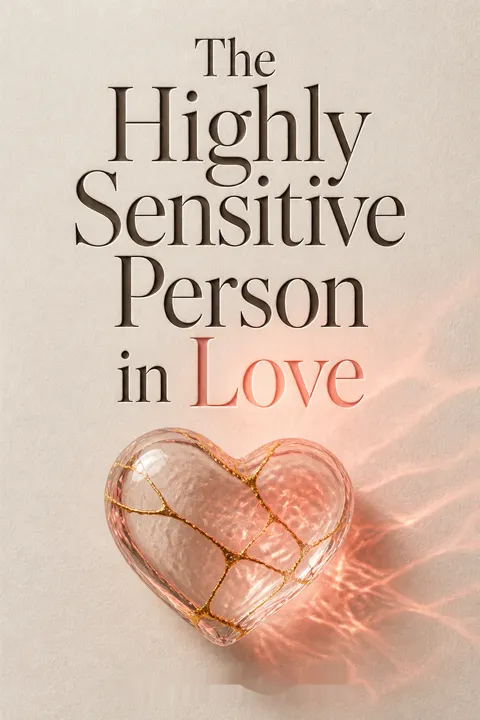


Key Takeaways
Treat sensitivity as temperament, not a defect to cure
A different processing style. Elaine Aron describes a highly sensitive person, or HSP, as someone whose nervous system notices subtleties, reflects deeply on experience, and becomes overwhelmed sooner by intense or prolonged stimulation. She estimates that 15 to 20 percent of people are highly sensitive. The trait can support attentiveness, conscientiousness, intuition, and appreciation of art, while making busy environments, criticism, and change harder to manage.
A useful clue, not a verdict. Aron's 22-question self-test suggests that 12 or more true answers may indicate high sensitivity, but she cautions against treating a score as a diagnosis. Her central relationship lesson is that temperament influences how partners experience one another, but it does not decide whether a relationship succeeds. Understanding the difference can replace self-blame with more accurate choices about work, rest, and partnership.
What's useful here is the shift from moral judgment to person-environment fit. A person who needs quiet after a crowded day is not necessarily avoidant or uncaring; the same setting may simply demand more regulation from that nervous system. This resembles approaches in occupational psychology that redesign tasks around human variation rather than treating every mismatch as an individual failure. The caution is equally important: a temperament label can become a shortcut that excuses behavior or explains every conflict. It works best as a hypothesis to test against experience, not as a complete account of anyone.
Build love around your arousal threshold, not someone else's pace
Find the workable middle. Aron uses optimal level of arousal to describe the range of stimulation in which a person feels alert and comfortable. Everyone adjusts stimulation throughout the day, by seeking company, rest, novelty, or quiet. HSPs, she argues, reach overload sooner. A full day of sightseeing may leave one partner eager to go out again and the other needing a quiet evening. Neither response proves anything about how much the partners care.
Novelty can be a separate trait. High sensation seeking, or HSS, means wanting varied, unfamiliar, and intense experiences. Aron treats it as independent of sensitivity: someone can be high or low on either trait. An HSP who is also an HSS may crave adventure and still become overstimulated by it, making the search for balance especially delicate.
The arousal model makes everyday disputes easier to describe without turning them into character trials. It also connects with stress-regulation research: once physiological activation rises, attention narrows and self-control becomes harder. Couples can use that knowledge to plan breaks before irritability takes over. The model should not imply that people have one fixed threshold or that every preference is biologically predetermined. Sleep, health, workload, safety, and culture all shift what feels manageable. A good plan asks what each person needs in this situation, rather than assuming a permanent rule from a trait label.
Separate inborn sensitivity from learned fear, shyness, and gender scripts
Sensitivity is not shyness. Aron distinguishes an inborn tendency to pause and observe from fear of social judgment, which can develop through experience. An attentive child may watch a new person before approaching; a frightened child may be anxious and remain wary even after the situation seems safe. Sensitivity is also not the same as social introversion: Aron reports that about 30 percent of HSPs are socially extroverted.
Culture adds another layer. The book describes how boys are often taught to hide emotion and girls are often expected to be caring, sociable, and endlessly available. Sensitive men may feel they fail a narrow model of manhood; sensitive women may feel they must outperform their limits to appear capable. The practical response is to build self-respect and flexible boundaries, rather than confusing social expectations with personal defects.
This distinction is valuable because it separates temperament from adaptations that may be changeable. Contemporary psychology likewise treats personality, learned fear, and social roles as interacting influences, not interchangeable labels. That makes room for both self-acceptance and growth: someone can honor a need for quiet while still practicing a feared conversation. The book's historical gender analysis gives useful context, though its broad categories of men and women do not capture every identity or relationship. Its strongest general lesson is to ask whether a supposed personal failing is actually a response to a social rule that deserves questioning.
Name intimacy's risks before they quietly run your relationship
Fear can wear many disguises. Aron describes eight common concerns: exposure and rejection, angry attacks, abandonment, loss of control, one's own destructive impulses, being engulfed, commitment, and irritation with a partner's small habits. An HSP may withdraw not because love is unwanted, but because closeness brings intense stimulation and the possibility of loss or criticism. Max, a client in the book, shared vivid dreams in therapy while avoiding spontaneous connection, partly because he feared being trapped by another person's needs.
Early bonds shape expectations. Attachment style is a learned pattern of expecting care and safety in close relationships. Aron presents four broad styles: secure, preoccupied, dismissive avoidant, and fearful avoidant. She argues that HSPs are not more likely than others to have insecure attachment, but difficult early relationships may affect them strongly. Security can grow through dependable relationships, reflection, grief, and professional help.
Naming distinct fears gives a couple something more workable than the vague instruction to become more intimate. Attachment research supports the idea that early expectations can shape adult bids for comfort, although those patterns are not destiny. The book's account is especially helpful when it treats withdrawal as protection rather than proof of indifference. Still, fear should not automatically be interpreted as a childhood echo: a partner may be behaving unsafely now. Reflection can clarify the source, but present-day coercion, contempt, or abuse calls for protection and support, not just more vulnerability.
Let love deepen through attention, shared intensity, and honest disclosure
Love has a setting. Aron and her husband define love in research terms as feelings and actions linked to wanting an intimate relationship with a particular person. Their work also suggests that context matters. In their bridge study, men who met a woman on a high, swaying suspension bridge showed more attraction than men who met her on a low, sturdy bridge. Arousal may be mistaken for attraction, while emotionally vivid settings can make a meeting memorable.
Reflection intensifies feeling. HSPs may dwell longer on a person's qualities, giving admiration more room to grow. But deep feeling does not guarantee compatibility. Aron recommends expressing genuine interest, spending time together in meaningful situations, and letting trust and disclosure develop in stages. In her account, only a minority of people report falling in love at first sight; affection often grows as people become familiar.
The bridge experiment illustrates a broader psychological point: feelings are partly interpreted through the circumstances in which they arise. Shared novelty can make partners feel more alive together, a pattern also consistent with research on self-expansion, the idea that close relationships broaden a person's sense of identity and possibility. But attraction under arousal is not a reliable compatibility test. Strong chemistry may reflect the event, not the partner's character. The practical value is to create occasions for genuine discovery while still judging trust, reciprocity, and everyday conduct over time.
Translate temperament differences into agreements, not accusations
Difference is not a diagnosis. An HSP who dislikes noise and a non-HSP who seeks activity may each bring useful capacities: one notices problems early, the other may act readily. Aron calls this a potential strength of dissimilar couples, but warns that initial admiration can turn into contempt when partners expect each other to change basic temperamental preferences. She cites John Gottman's finding that about 69 percent of couples' conflicts remain unresolved, including in happy relationships. The difference lies partly in how couples understand and discuss them.
Similarity has its own friction. Two HSPs may feel readily understood and share a comfortable pace, but both may avoid confrontation, delay decisions, or hesitate over tasks neither enjoys. The author reports a slight tendency for HSP-HSP couples to be more satisfied than HSP-non-HSP couples, not a guarantee. The goal is to identify recurring differences and negotiate practical arrangements without treating either partner as defective.
This perspective challenges the fantasy that a good relationship eliminates disagreement. Research on couples often distinguishes solvable disputes from enduring differences, and the useful question is not whether conflict disappears but whether it can be handled without contempt or coercion. Temperament language can reduce blame by making a pattern visible. It can also flatten a more complicated issue: a partner's repeated disregard is not simply a difference in stimulation needs. Agreements should be revisited when circumstances change, and they should distribute inconvenience fairly rather than making one person's sensitivity the permanent household rule.
Schedule novelty together, then pause before conflict becomes overwhelm
Rest alone is not enough. In a study described by Aron, couples who spent an hour and a half each week on self-chosen exciting activities for ten weeks reported greater relationship satisfaction. Couples assigned pleasant activities or no special activity did not show the same increase. For HSPs, exciting need not mean exhausting: the point is shared engagement at a level both can enjoy.
Make hard talks safer. Aron adapts relationship advice into dialogue: listen without interrupting, then state one's own view plainly rather than surrendering it. When either partner is overaroused, take a break and agree when to return. She notes that a pause of at least 20 minutes may help the body settle. Avoid difficult discussions when tired, and repair hurtful remarks with a direct apology. Avoiding every disagreement may feel peaceful, but unresolved issues can quietly become distance.
The activity study usefully distinguishes shared time from shared engagement. Couples do not strengthen a bond simply by occupying the same room; doing something involving novelty or challenge can create fresh information about each other. Conflict research also supports pauses when emotional activation is high, since intense stress interferes with listening and flexible thinking. A timeout only helps if it is not a disguised exit. Naming a return time protects both regulation and accountability. Excitement should also be jointly chosen: one partner's thrilling outing can be the other's prolonged endurance test.
Make sexual pleasure fit your sensory wiring, not a cultural script
Sensitivity changes the experience. Aron reports a questionnaire study involving 443 people. HSP respondents were more likely to describe sex as mysterious or powerful, to be distracted by small sounds or smells, and to need a pause when overwhelmed. They more often preferred familiar sexual routines. Yet the groups did not differ on several measures, including orgasm frequency, and the author emphasizes that sensitivity is not itself a sexual disorder.
Desire needs room. In the survey, highly sensitive women reported fewer partners on average and placed more weight on love, the other person's welfare, and concerns such as pregnancy or sexually transmitted infections. Aron advises partners to discuss what feels good, allow either person to stop or change course, and avoid having sex merely to relieve pressure. A person's preferences are information for mutual negotiation, not a test of whether they are normal.
The chapter's strongest contribution is treating sensory comfort as relevant to sexual communication, rather than assuming that distraction or a need for predictability signals rejection. That fits broader understandings of sexuality as shaped by attention, safety, context, and bodily response. The survey is exploratory, however, and its sample should not be taken as a population-wide estimate or as proof that sensitivity caused each reported difference. The practical standard is simpler and more robust: consent must remain active, pain deserves attention, and partners should not infer desire or satisfaction from stereotypes.
Let spiritual longing deepen intimacy without turning partners into gods
Love can prompt inner work. Aron uses Jungian language to describe the ego-Self axis, a symbolic connection between the conscious self and a larger source of psychological wholeness. She also draws on the terms essential spirit and prevailing spirit: respectively, instinctive vitality and the practical rules of culture. In this view, dreams, recurring attractions, and relationship conflicts can reveal disowned needs or hopes. They are prompts for reflection, not automatic instructions.
A partner is not a savior. Linda's intense attraction to a spiritual teacher helped expose a longing that her marriage alone could not satisfy. Her teacher encouraged her to treat the attraction as part of her inner development, rather than a command to abandon her husband. Aron suggests that love can support self-knowledge when partners remain distinct people, speak honestly, and make choices consciously. Spiritual interpretation should enrich ordinary responsibility, not replace it.
The symbolic framework offers a language for experiences that purely practical relationship advice can leave untouched: recurring dreams, idealization, and the sense that love reorganizes a life. Its value is interpretive rather than demonstrably causal. A dream or attraction may reveal a neglected wish, but it cannot establish what action is right or what another person represents. Psychological insight becomes safer when paired with reality testing, ethical judgment, and attention to consequences. The book's most grounded spiritual idea is that intimacy can foster self-knowledge without making a partner responsible for completing or rescuing someone.
Analysis
Aron's central move is to make temperament visible in a field that often explains relationship trouble through communication skills or individual pathology alone. The HSP lens makes familiar disputes newly legible: one person experiences a crowded evening as connection, another as overload; one interprets a pause as caution, another as rejection. The book's recurring cases give these abstractions stakes, from Diane's marriage entered for safety to Max's indirect handling of an invitation. They show how self-misunderstanding can harm both partners, even when neither is malicious.
The argument is strongest when it treats sensitivity as a context-dependent difference with benefits and costs. Attunement can support caregiving and early detection of tension, while overstimulation can narrow attention and make conflict harder. This resembles modern models of person-environment fit and stress regulation. Its practical advice follows logically: protect recovery time, communicate needs explicitly, and design shared experiences rather than demanding that one partner adopt the other's pace.
Some claims need careful boundaries. The book's 15 to 20 percent estimate and self-test offer a useful self-description, not a clinical classification. Sensitivity is better understood dimensionally than as a sharp division between two kinds of people, and the author's survey findings cannot by themselves establish causation or represent all populations. The biological language can also tempt readers to label a partner instead of examining behavior. A temperament difference does not excuse dishonesty, intimidation, or chronic disregard.
The book's Jungian account of dreams, spirit, and the Self speaks to readers seeking meaning, but it is a different kind of claim from its reported relationship studies. Treating symbols as hypotheses preserves their reflective value without mistaking them for evidence. The most durable synthesis is neither genetic fatalism nor limitless self-improvement: temperament sets conditions, history shapes expectations, culture assigns status, and deliberate relationships can still change how those forces play out.
Review Summary
The Highly Sensitive Person in Love receives mixed reviews. Many readers find it insightful and life-changing, helping them understand their sensitivity and improve relationships. The book explores HSP traits, relationships, and spirituality. Some appreciate the author's writing style and personal anecdotes, while others find it too clinical or dated. Critics note the book's heavy focus on Jungian psychology and spirituality, which may not resonate with all readers. Despite its flaws, many HSPs find the book validating and helpful in navigating their personal and romantic lives.
People Also Read





Glossary
Highly Sensitive Person
deep sensory processingAron's term for a person with an inherited tendency to notice subtleties, process experience deeply, and become overstimulated sooner than many others. The book presents high sensitivity as a normal temperament variation, not an illness. It can support conscientiousness and attunement while making intense environments, criticism, and prolonged demands more taxing.
High Sensation Seeking
novelty and intensity seekingA temperament trait describing a strong appetite for unfamiliar, varied, complex, or intense experiences. Aron treats it as separate from high sensitivity: a person may be high or low on either trait. Someone high in both may seek adventure yet also become overstimulated, creating a narrow balance between boredom and overload.
Pause-to-Check System
checks before actingAron's accessible name for the nervous-system process she associates with high sensitivity. It describes taking in a situation, comparing it with prior experience, and considering details before acting. The term emphasizes that pausing can be a useful information-gathering strategy, not necessarily fear or indecision.
Four Attachment Styles
patterns of relational securityA framework describing four broad ways adults may approach closeness: secure, preoccupied, dismissive avoidant, and fearful avoidant. The patterns reflect expectations about whether others will be available and whether the self is worthy of care. Aron presents them as rooted partly in early relationships, while noting that greater security can be developed.
Self-Expansion Model
love broadens identityA relationship model associated with Elaine and Arthur Aron. It proposes that close relationships can broaden a person's sense of self by bringing a partner's perspectives, activities, and resources into one's life. The book connects this idea to shared novelty: engaging experiences together may renew interest and increase relationship satisfaction.
complex
emotionally charged patternIn Jungian psychology, a complex is a cluster of memories, feelings, and assumptions that can strongly shape perception and behavior around a particular subject. Aron describes complexes as having opposing poles, such as idealizing or resenting a parent. When activated, a complex can make a person think in absolutes or project disowned qualities onto a partner.
ego-Self axis
link to inner wholenessA Jungian concept used by Aron for the continuing relationship between the conscious ego and the broader, organizing Self of the psyche. The connection may feel secure or alienated, and the book relates it to early caregiving and adult intimacy. It is a symbolic psychological framework, not a measurable anatomical structure.
essential spirit
instinctive vitalityA term Aron adopts from John Desteian for the instinctive, embodied energy that can feel vivid in love, creativity, and contact with nature. The book contrasts it with prevailing spirit, the shared practical and cultural rules that help organize everyday life. Both are presented as necessary, though excessive conformity may suppress personal desire.
prevailing spirit
shared cultural expectationsA term Aron adopts from John Desteian for the practical norms and collective values that guide ordinary social life. It includes ideas about what is sensible, respectable, or expected in relationships. Aron contrasts it with essential spirit, arguing that healthy choices can respect convention without silencing a person's authentic needs.
FAQ
What's The Highly Sensitive Person in Love about?
- Understanding HSPs in Relationships: The book delves into how high sensitivity affects romantic relationships, highlighting both challenges and strengths.
- Personal Experience and Research: Elaine N. Aron combines her experiences as an HSP with research to offer insights into navigating love.
- Practical Advice: It provides actionable advice for HSPs and their partners on communication, understanding differences, and fostering intimacy.
Why should I read The Highly Sensitive Person in Love?
- Insightful for HSPs: Offers valuable insights into the emotional experiences of HSPs and their impact on relationships.
- Guidance for Partners: Helps non-HSP partners understand the unique needs of their sensitive loved ones, promoting empathy.
- Research-Based Strategies: Provides evidence-based strategies to improve relationship dynamics and enhance emotional intimacy.
What are the key takeaways of The Highly Sensitive Person in Love?
- Understanding Sensitivity: Recognizes high sensitivity as a normal, inherited trait affecting perception and relationships.
- Navigating Differences: Teaches how to manage differences between HSPs and non-HSPs for a harmonious partnership.
- Embracing Vulnerability: Stresses the importance of openness and vulnerability in fostering deeper connections.
What are the best quotes from The Highly Sensitive Person in Love and what do they mean?
- “We HSPs and our partners...”: Highlights the need for understanding emotional experiences and differences in relationships.
- “Without this help, love...”: Warns of potential struggles HSPs face without adequate understanding and support.
- “The main point to understand...”: Emphasizes recognizing high sensitivity as a fundamental personality aspect, not a flaw.
How can I determine if I am a highly sensitive person (HSP)?
- Self-Test: Includes a self-test with statements like “I seem to be aware of subtleties in my environment.”
- Scoring: Answering true to twelve or more questions suggests high sensitivity, though fewer true answers can still indicate sensitivity.
- Understanding Sensitivity: Being an HSP means having a nervous system that processes information more deeply.
What are the common challenges HSPs face in relationships?
- Fear of Intimacy: HSPs may fear intimacy due to heightened sensitivity, leading to anxiety about vulnerability.
- Overwhelm from Stimulation: Easily overwhelmed by stimuli, making social situations and emotional balance challenging.
- Misunderstandings with Partners: Differences in temperament can lead to misunderstandings with non-HSP partners.
How can HSPs create satisfying partnerships?
- Open Communication: Practice honest communication about needs and feelings to foster understanding.
- Setting Boundaries: Establish clear boundaries to manage emotional and sensory overload.
- Finding Balance: Balance solitude needs with partner’s needs to ensure both feel valued.
How does sensitivity affect love and intimacy in HSPs?
- Deeper Emotional Connections: HSPs often form deeper connections due to heightened sensitivity.
- Fear of Overarousal: May fear overarousal during intimacy, leading to avoidance or difficulty expressing needs.
- Need for Understanding: Partners must understand the HSP’s need for downtime and emotional processing.
What challenges do HSPs face in relationships with non-HSPs?
- Different Arousal Levels: Different optimal arousal levels can lead to misunderstandings and conflicts.
- Intimacy Needs: Non-HSPs may desire more intimacy than HSPs are comfortable with, creating tension.
- Communication Gaps: HSPs may struggle to communicate needs effectively, causing frustration.
What strategies does The Highly Sensitive Person in Love suggest for HSPs?
- Establish Boundaries: Learn to set boundaries to protect emotional well-being.
- Practice Self-Care: Engage in self-care routines to recharge and maintain emotional health.
- Seek Support: Encourage seeking support from understanding friends, family, or therapists.
How can non-HSP partners support their HSP loved ones?
- Be Patient and Understanding: Practice patience and strive to understand HSP needs.
- Encourage Open Communication: Create a safe space for dialogue about feelings and needs.
- Participate in HSP Activities: Engage in comfortable activities to strengthen bonds and create shared experiences.
How does The Highly Sensitive Person in Love address sexual intimacy for HSPs?
- Unique Sensitivity: HSPs may feel overwhelmed by physical sensations during sexual intimacy.
- Communication About Needs: Emphasizes discussing sexual preferences and boundaries for mutual satisfaction.
- Emotional Connection: Highlights the need for a strong emotional bond as a prerequisite for sexual intimacy.
About the Author
Other books by Elaine N. Aron

Download PDF
Download EPUB
.epub digital book format is ideal for reading ebooks on phones, tablets, and e-readers.








