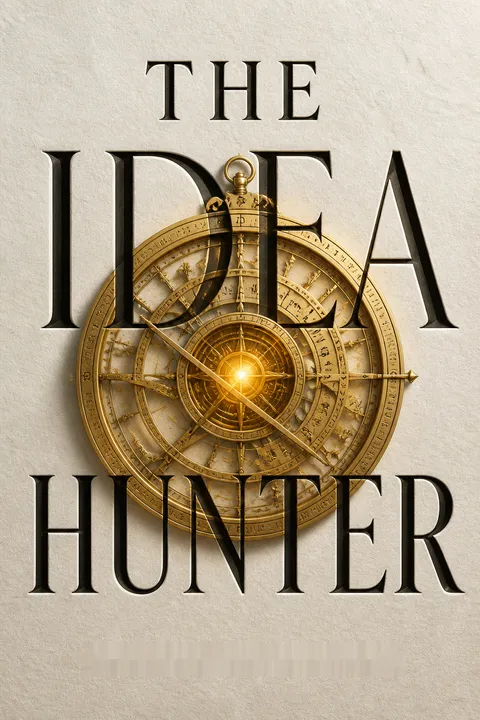


Key Takeaways
Hunt for ideas already in use, then adapt them to your problem.
Innovation often starts elsewhere. Clarence Birdseye saw people in northern Canada preserve food by freezing it quickly, then adapted the practice into a commercial method for frozen foods. Apple executive Phil Schiller drew on an old electronic scroll wheel when the company needed a better music-player interface. In both cases, the valuable act was not inventing from nothing, but recognizing a useful pattern and moving it into a new setting.
Reuse still takes judgment. A one-size coffee lid can be copied with little change; Birdseye’s insight required a much larger shift in purpose. The Idea Hunt is the ongoing search for useful ideas outside one’s own head, followed by the work of selecting, adapting, and applying them. The idea is a starting point, not a finished solution.
This view usefully replaces the romance of the lone flash of genius with a practical account of recombination. It also resembles how scientific fields advance: researchers borrow methods, instruments, and models across disciplines. But transfer is not automatic. A technique that works in one setting may fail in another because the users, incentives, or constraints differ. The real skill is not merely spotting a precedent, but identifying which part of it can travel and testing whether it works in its new home.
Let your professional purpose decide which ideas deserve your attention.
Purpose is a search filter. The book calls a person’s distinctive professional direction their gig. It is broader than a job title: a teacher might be known for developing other teachers, while a salesperson might bring unusual empathy to understanding customers. A clear gig helps determine what to notice and what to ignore when information is everywhere.
Check the fit. The authors adapt vocation questions into three practical tests: Does the work engage you? Are you capable, or willing to become capable, of doing it well? Is there a real need for it? Warren Buffett illustrates the value of knowing one’s limits. He avoids investments he cannot understand, while learning deeply before entering unfamiliar sectors. A gig is not fixed forever; it should be reconsidered as abilities, interests, and opportunities change.
A purpose filter offers a useful defense against distraction, and it connects with goal-setting research: attention becomes more selective when people know what they are trying to accomplish. The three tests also balance personal motivation with external demand, preventing purpose from becoming pure self-expression. Still, a gig should guide exploration without becoming a cage. People can mistake current competence for permanent limits, or overlook emerging work because it does not yet fit their identity. Treating purpose as revisable keeps the filter useful rather than rigid.
Curiosity turns ordinary scenes into clues that expertise alone misses.
Interest beats posturing. At a 1905 car race, Henry Ford examined a wrecked vehicle and noticed a strong, lightweight valve component. His search led to vanadium steel, which helped solve a key problem in building a durable, affordable car. Ford’s attention came from caring about the problem, not from trying to impress anyone with what he already knew.
Stay ready to learn. The book contrasts curiosity with relying on intelligence or a familiar success formula. Sam Walton traveled to stores and questioned people about pricing, inventory, and operations. His interest in what others knew helped him learn beyond his own experience. Curiosity makes surprising details easier to notice, but it becomes useful only when connected to a question, a project, or a genuine effort to understand.
Curiosity is more than a pleasant personality trait here; it is a method for directing attention toward anomalies. In scientific work, unexpected observations often matter because they challenge what a researcher assumed was normal. Ford’s example captures that shift from passive looking to investigative looking. Yet curiosity without a purpose can become indiscriminate browsing. The productive form combines openness to surprise with enough domain knowledge to recognize why a detail matters and enough discipline to follow it up.
Cross boundaries; your freshest lead may come from a stranger's world.
Different networks reveal different facts. Sociologist Mark Granovetter’s research on job seekers found that people often received useful leads from acquaintances rather than close friends, whose contacts tended to overlap with their own. The book calls these less-connected relationships weak ties. They can provide information that a person’s familiar circle does not have.
Jim Koch found a market clue in a bar. While considering a craft brewery, he asked a stranger why he drank imported beer. The customer liked the image but described the taste as spoiled. Koch recognized an opening for a fresher premium beer. Similar cross-pollination shaped TopCoder: its founder borrowed tournament ideas from college basketball and ranking methods from chess to organize software contests. In each case, insight came from looking beyond the standard sources in the field.
Weak ties matter because information travels through networks, and redundant connections tend to circulate familiar knowledge. The examples also show that outsiders can reveal how a product is actually experienced, not merely how its makers intend it to work. Diverse input is not a substitute for expertise, however. A stranger’s observation may be vivid but unrepresentative, so it should generate a question or hypothesis rather than settle one. The strongest search pairs outside perspectives with careful validation.
Make observation a routine: notice, record, and give ideas a rough form.
Seeing needs a structure. Ritz-Carlton staff are trained to notice guest preferences and service problems, record them, and share relevant details so they can improve a future stay. The book’s example is a guest whose preferred drink was noted after a conversation and made available on a later visit. Observation becomes more useful when employees know what matters to their work and have a way to preserve what they learn.
Capture fragments before they fade. Thomas Edison filled thousands of notebooks with notes and sketches, allowing ideas to accumulate and connect over time. A rough sketch, outline, or mock-up is a prototype: a tangible early version that makes an idea easier to assess and discuss. It need not be polished. Recording and prototyping turn fleeting impressions into material that can be revisited, challenged, and improved.
This process links individual attention with organizational memory. Cognitive science has long emphasized the limits of unaided recall; external notes let people revisit details without relying on memory to preserve them perfectly. Prototypes add a social benefit: colleagues can react to an object or sketch more concretely than to an idea described in the abstract. The system can still become burdensome if every observation is saved. A useful practice includes a filter: keep what connects to a live need, and periodically review what has stopped being relevant.
Reserve time for learning, and maintain a changing portfolio of idea sources.
Learning needs calendar space. Charlie Munger protected a daily stretch of his most alert time for reading and thinking before selling that time to clients. The book also describes companies that set aside employee time for self-directed projects, including 3M and Google. The point is not that every workplace can copy the same policy, but that learning rarely happens reliably if it is left to whatever time remains.
Track where ideas come from. An idea portfolio is a deliberate collection of sources and saved material: people, publications, websites, customer encounters, and project notes. Choreographer Twyla Tharp stored material for each production in a dedicated box; IDEO kept a shared collection of objects and components for designers to inspect and reuse. Review the collection, add fresh sources, and discard those that no longer serve current work.
The combination of protected time and a curated source collection treats learning as infrastructure rather than a mood. It also addresses two different bottlenecks: time scarcity and source homogeneity. A portfolio can make exploration more intentional, much as a diversified financial portfolio limits dependence on one asset. But diversification is not valuable for its own sake. Too many feeds and saved notes can create an archive that feels productive while consuming attention. The test is whether sources yield insight that improves a real project.
Keep ideas moving through experiments, then prune even promising branches.
Ideas improve in combination. The early concept for West Side Story centered on conflict between Catholics and Jews. Years later, composer Leonard Bernstein and writer Arthur Laurents saw a newspaper story about gang conflict in Los Angeles, and the project shifted toward the story that became the musical. The original idea had stayed available long enough to meet a better direction.
Experiment before committing. At W. L. Gore, engineer Dave Myers tested a coating while developing artificial arteries, then applied it to bicycle cables and, eventually, guitar strings. Feedback from musicians revealed that the coated strings held their tone longer. Prototypes helped the idea develop, but organizations cannot support every promising branch. Selecting and shelving ideas is necessary so the strongest ones receive the resources and attention required to become useful products.
The emphasis on flow is a strong antidote to treating brainstorming as a one-time event. Iteration gives ideas contact with evidence, users, and neighboring concepts. It also supports psychological safety: rough versions are easier to revise than polished proposals tied to a person’s reputation. The harder balance is between patience and focus. Early pruning can eliminate unusual possibilities before they have a fair test, while endless incubation can waste resources. Clear criteria, small experiments, and explicit decisions to pause or proceed help manage that tension.
Use conversations to develop ideas, not to display certainty.
A response can open or close a door. The book distinguishes conversational moves that invite further explanation from those that shut discussion down. A manager who immediately declares an idea unworkable may never learn what problem it was trying to solve. Listening, asking open questions, and inviting a person to elaborate make it more likely that useful details will surface.
Ask the basic question. A new marketing executive at a pen company challenged the assumption that the business was simply selling writing instruments. By asking why customers bought the products, he found that many wanted gifts. That reframing changed how the company could think about pricing, promotion, and distribution. The book also advises finding organizational connectors: people who know where information lives and can link someone to sources beyond their immediate group.
Conversation is not just a channel for transferring finished knowledge; it can change what participants think they know. This aligns with research on psychological safety, where people are more willing to raise uncertainties when disagreement does not invite humiliation. The pen example shows why basic questions can be powerful: they expose assumptions that specialists have stopped noticing. But openness is not the same as accepting every suggestion. Good conversation protects the possibility of an idea while still asking for evidence, constraints, and a clear account of whose needs it serves.
Launch ideas by solving a live problem with minimal disruption.
A good idea still needs a route in. W. L. Gore struggled to persuade guitar retailers to stock Elixir Strings, partly because the brand was unfamiliar and the strings cost more. Partnering with Taylor Guitars helped establish credibility: the strings were fitted to guitars sent to retailers, giving buyers a chance to encounter them. The product also addressed a practical concern for stores, which otherwise had to replace worn strings frequently.
Make adoption easier. The book advises connecting a proposal to a problem stakeholders already care about, explaining its benefits plainly, and offering a low-risk way to try it. It also warns against demanding unnecessary change. Thomas Edison’s early electric-lighting system worked with existing gas fixtures and infrastructure rather than requiring customers to replace everything at once. An idea is more likely to spread when its value is visible and the first step feels manageable.
This account connects innovation to diffusion: people adopt new practices more readily when they can see an advantage, try them, and fit them into existing routines. The launch is therefore part of the idea, not a marketing afterthought. The advice to minimize disruption is practical, but it has a boundary. Some genuinely valuable changes require replacing old systems, and compatibility can preserve harmful arrangements. The useful question is whether existing infrastructure is merely convenient or whether it prevents the outcome the innovation is meant to achieve.
Analysis
The book’s central contribution is to recast innovation as a practiced search rather than a rare gift. Its cases make the argument tangible: a retail observation, a customer’s offhand complaint, or an old component from another product can become valuable when someone notices a connection and works it through. The sequence is broadly consistent across the examples: orient attention around a meaningful professional aim, seek information beyond familiar circles, record what appears, test ideas in provisional form, and build enough social support for an idea to be adopted.
The framework is strongest where it joins individual habits to organizational conditions. A curious employee cannot easily learn from customers if the role offers no time or access. A rough prototype cannot invite useful feedback if colleagues punish uncertainty. Pixar’s shared spaces and Ritz-Carlton’s service records illustrate that idea work depends on structures that make observation and exchange possible, not simply on personal motivation.
A useful tension sits at the heart of the approach. The book encourages broad exploration, but also insists on focus through a clear professional purpose. These aims are not opposites if purpose acts as a compass rather than a fence. An accountant can search across industries while still pursuing better ways to serve clients. Yet a narrow interpretation of one’s current role may prevent discovery of a more valuable direction. The gig therefore needs regular reconsideration.
The account also gives less attention to power. Employees may notice useful changes but lack authority to test them; external ideas may be borrowed without recognizing their origins; and customers’ expressed preferences may conflict with what they actually need. The practical answer is not to abandon the Hunt, but to pair openness with attribution, evidence, and decision rights. The book’s most durable lesson is that ideas are neither private possessions nor self-executing miracles. They become valuable through attentive observation, thoughtful recombination, collaboration, and disciplined implementation.
Review Summary
The Idea Hunter receives mixed reviews, with an average rating of 3.77 out of 5. Many readers find it inspiring and practical, praising its framework for idea generation and diverse examples. Some appreciate its insights on curiosity, observation, and diverse thinking. However, critics argue it's lightweight, lacking originality, and resembles a magazine article. The book's emphasis on famous successful figures is questioned for its relevance to average readers. Overall, it's seen as a quick, motivating read that may not offer substantial new information for experienced professionals.
People Also Read


Glossary
The Idea Hunt
Ongoing search for useful ideasThe authors’ term for deliberately looking beyond one’s own thoughts for ideas that can improve work. The Hunt is personal and continuous: it is guided by professional goals, draws on varied sources, and involves capturing, testing, combining, and applying what is found. It treats innovation less as invention from nothing and more as discovery followed by useful adaptation.
gig
Distinctive professional directionA person’s evolving sense of how they add distinctive value and where they want their professional life to go. A gig is broader than a job title or formal specialty. It helps focus learning and idea seeking, while remaining open to revision as interests, strengths, and the needs of employers, clients, or society change.
I-D-E-A principles
Four habits for idea huntingThe book’s organizing framework for the behaviors of an effective Idea Hunter. It groups the work into four dimensions: sustained curiosity, variety in idea sources, regular practice in observing and recording, and flexibility in developing ideas. Together, the principles describe a repeatable approach to finding and applying ideas rather than a talent that depends on occasional inspiration.
circle of competence
Known area of sound judgmentA way to distinguish areas in which a person can make informed judgments from areas where their understanding is weak. The book uses Warren Buffett’s investing discipline to show how knowing the boundary can prevent poorly grounded decisions. The circle is not necessarily permanent: learning can expand it, but new work should be understood before confidence outruns competence.
weak ties
Connections beyond familiar circlesRelationships with people whose networks and information sources differ from one’s own. The book draws on Mark Granovetter’s research on job seekers, which found that useful leads often came through acquaintances rather than close contacts. In idea work, weak ties can offer unfamiliar information or perspectives that close colleagues are less likely to provide.
structural holes
Gaps between social groupsGaps between groups that have limited contact, such as sales and engineering teams. The book uses sociologist Ronald Burt’s work to explain why people who connect across such gaps may encounter varied information and identify opportunities others miss. Bridging a structural hole can help an idea travel between specialties, but it also requires making the connections understandable to each group.
T-shaped professional
Deep expertise plus broad connectionsA professional with depth in a particular specialty and enough breadth to connect that expertise with other fields, people, or ways of thinking. The vertical stroke represents specialized knowledge; the horizontal stroke represents wider learning and relationships. The book does not argue that every specialist should become a generalist, but that specialists benefit from reaching beyond their immediate professional world.
Tech Box
Accessible collection of idea promptsIDEO’s shared collection of objects, components, and technologies from past or potential projects. Designers can inspect and experiment with the items to find useful forms, functions, or materials for current work. The term also suggests a general practice: keep ideas and examples visible and retrievable so they can prompt new combinations instead of disappearing into memory or inaccessible files.
connectors
People who link others to knowledgePeople who are unusually well placed in an organization’s informal communication network. They keep up with relevant information, know who has particular expertise, and connect people who need knowledge with people who possess it. The authors emphasize that connectors are not necessarily senior executives; their value comes from their relationships and their ability to help ideas move.
Download PDF
Download EPUB
.epub digital book format is ideal for reading ebooks on phones, tablets, and e-readers.








